
Disclosure: VPNFin is reader-supported. If you buy a VPN through links on this page, we may earn a commission at no extra cost to you. This never affects our ratings — here’s how we research.
Almost every comparison of these two asks which is safer. That question has no answer until you define what you’re protecting against, because Tor and a VPN solve genuinely different problems.
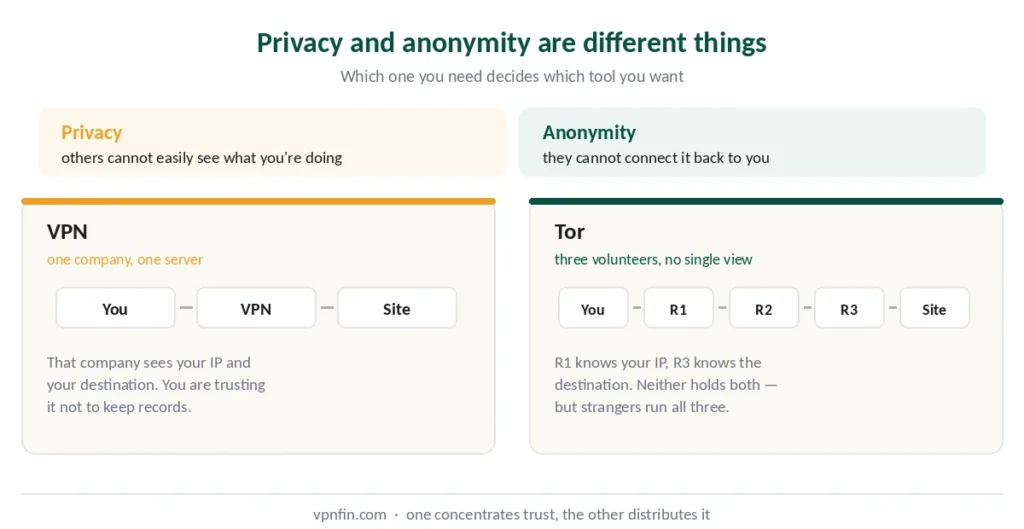
Privacy means others cannot easily see what you’re doing. Anonymity means they cannot connect what you’re doing back to you.
A VPN is built for the first. Tor is built for the second. Most people asking this question want the first and don’t know it.
The Short Answer
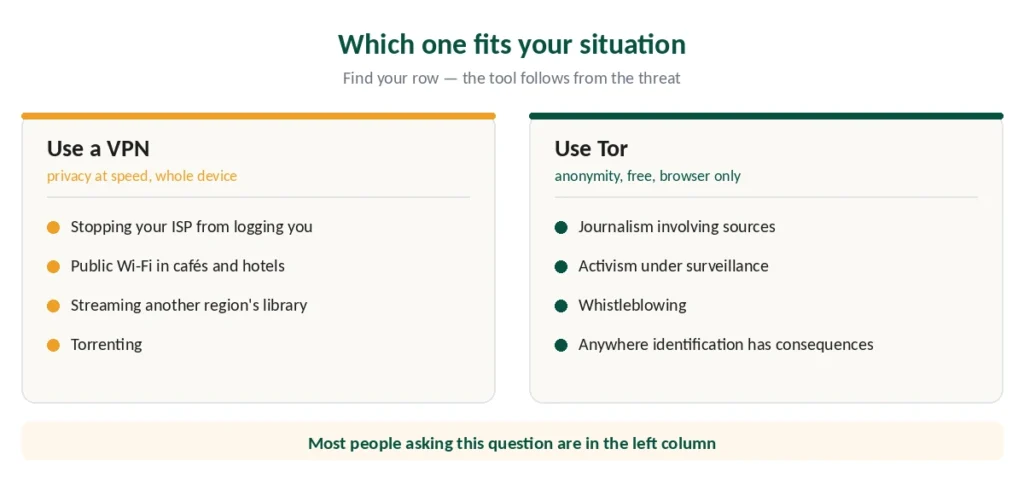
A VPN if you want your ISP to stop logging your browsing, safety on public Wi-Fi, streaming from another region, or torrenting. Fast enough that you forget it’s on.
Tor if being identified would carry serious consequences — journalism involving sources, activism under surveillance, whistleblowing. Free, and dramatically slower.
Neither if you think one of them makes you untraceable. Both have specific limits, covered below.
The Difference That Explains Everything Else
A VPN routes everything through one server belonging to one company. That company sees your real IP and your destination. Your privacy depends entirely on it not keeping records — which is why audited no-logs policies matter, and why we examine audit records in every review we publish.
Tor routes through three volunteer-operated relays, each in a different location, with a layer of encryption stripped at each hop. The first relay knows your IP but not your destination. The last knows your destination but not your IP. No single operator holds both halves.
That is the whole difference. Tor eliminates the single point of trust. A VPN concentrates it in one company you have to choose carefully.
⚠️ It cuts both ways. Tor’s relays are run by strangers you cannot vet. A VPN provider is at least a company with a reputation, a jurisdiction and — sometimes — published audits.
Speed: Not a Close Contest
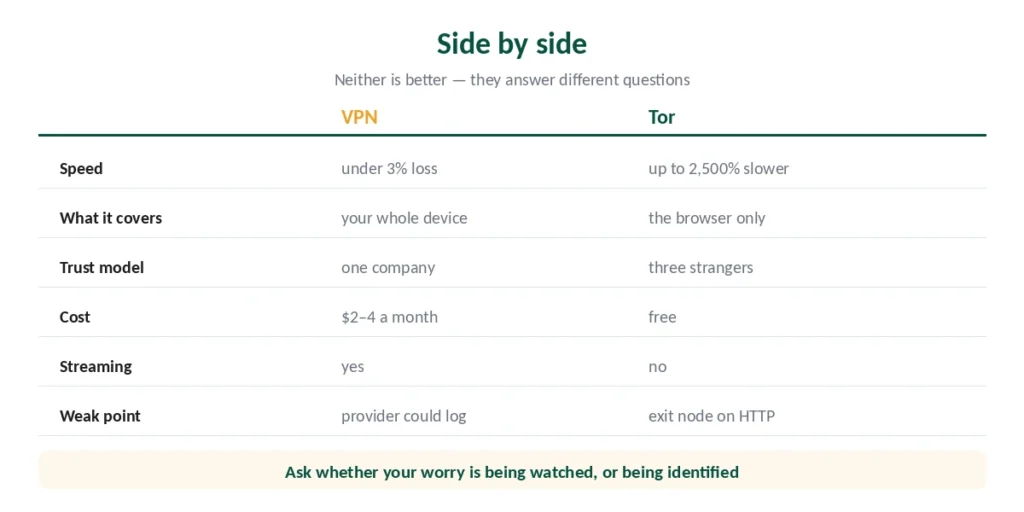
Top10VPN measured a difference of up to 2,500% between the two in April 2026.
Why Tor is slow by design. Your traffic takes three hops through volunteer hardware, each adding latency based on location, load and available bandwidth. Exit relays are the bottleneck: far fewer volunteers run them than entry or middle relays, so the whole network queues through a narrow opening.
Why VPNs aren’t. Commercial providers run purpose-built server clusters with high-capacity uplinks. The fastest provider we rank loses under 3% of baseline speed in independent testing.
What this rules out. Tor cannot stream video, handle video calls, or move large files. Trying makes it frustrating enough that people abandon it — which is worse than never starting, because they abandon it mid-task.
What Each One Actually Covers
Tor Browser protects the browser. Anything else on your device — email client, messaging apps, background services, system updates — travels normally and unprotected.
A VPN covers the whole device. Every application, every connection, whether or not you thought about it.
This trips people up constantly. Someone runs Tor Browser for sensitive research while their email client checks mail over the ordinary connection, and assumes both are covered.
The Weak Points
Tor: the exit node. Traffic leaves the network unencrypted at the final relay. On an HTTPS site that doesn’t matter, since the site’s own encryption still applies. On plain HTTP, whoever runs that exit relay can read everything passing through.
Tor: visibility. Your ISP can see you’re using Tor even without seeing what you do. In some places that alone attracts attention, and in a few countries circumvention tools carry legal risk regardless of use — our legality guide covers where.
VPN: you’re trusting one company. If the provider keeps logs despite claiming otherwise, everything routes through a party that knows exactly who you are. The 2017 PureVPN case is the standard example, covered in our PureVPN review.
Both: neither makes you anonymous by itself. Cookies, browser fingerprints and any account you log into identify you regardless of how the traffic travels. What a VPN does and doesn’t conceal is more specific than either camp usually admits.
Using Both Together
Two arrangements exist, and the order matters.
Tor over VPN — the recommended one. Connect to your VPN first, then open Tor Browser. Your ISP sees a VPN connection rather than Tor use, and the entry relay sees the VPN’s address rather than yours. This is what NordVPN’s Onion Over VPN does automatically, though your provider may hide the option behind a protocol setting, and Proton VPN builds the same route into its app as a one-click option.
VPN over Tor — connecting to a VPN through the Tor network — is considered less secure and much harder to configure. Not recommended without a specific reason.
Is it worth it? For most people, no. You inherit Tor’s speed with extra overhead on top. It makes sense when the ISP knowing you use Tor is itself a problem.
Which Should You Use?
A VPN covers what most people actually want: stopping ISP logging, safety on public networks, regional content, torrenting, and consistent speed. It is the right answer for everyday privacy, and it is the reason we rank providers at all.
Tor covers what a few people genuinely need: protection where being identified has consequences beyond embarrassment. Journalists, activists, whistleblowers, people under surveillance. It is free, and for that threat model nothing commercial matches it.
A useful test: ask whether your concern is someone watching you, or someone identifying you. Watching is a privacy problem — a VPN solves it. Identifying is an anonymity problem — that’s Tor’s territory. And sometimes neither tool is the answer — encrypted DNS covers more than people expect, for free.
⚠️ And be honest about the threat model. Using Tor for ordinary browsing means accepting severe slowness for protection against something that isn’t happening to you. Our guide on whether you need a VPN makes the same argument in the other direction.
How We Research
This guide draws on published technical analysis from named sources including Top10VPN, Shattered.io and TrustMyIP, documentation from the Tor Project, and our own full reviews of the providers we rank — cross-checked and verified at publication. Where sources came from VPN companies with an interest in the comparison, we used them only for claims confirmed independently. Our full approach lives on the About Us page.
Tor vs VPN FAQ
It depends what you mean by safe. Tor provides stronger anonymity because no single relay operator knows both your identity and your destination. A VPN provides better protection against everyday threats — public Wi-Fi interception, ISP logging, commercial tracking — because it covers your entire device at usable speed. Different tools for different threats.
Dramatically. Top10VPN measured a difference of up to 2,500% in April 2026. Tor routes through three volunteer relays, and exit relays are a bandwidth bottleneck because far fewer volunteers run them. Streaming, video calls and large downloads are effectively impossible on Tor.
No — Tor Browser protects only what happens inside that browser. Your email client, messaging apps and background services use your normal connection. A VPN covers every application on the device, which is a common source of confusion for people who assume Tor protects everything.
Yes, and the order matters. Tor over VPN — connecting to the VPN first, then opening Tor Browser — is the recommended arrangement: your ISP sees a VPN connection rather than Tor use, and the entry relay sees the VPN’s address. NordVPN automates this with its Onion Over VPN servers. The reverse arrangement is less secure and harder to set up.
Traffic leaves the Tor network unencrypted at the final relay. On HTTPS sites this doesn’t matter because the site’s own encryption still applies. On plain HTTP sites, whoever operates that exit relay can read everything passing through it. Since anyone can run an exit relay, this is a genuine risk.
In most countries, yes — the Tor Project is a US-registered non-profit, funded partly by government agencies specifically to help activists and journalists. In some countries with heavy censorship, circumvention tools including both Tor and VPNs may carry legal risk under broadly written laws.
The Short Version
They’re not competitors. A VPN gives you privacy at usable speed across your whole device, trusting one company to keep its word. Tor gives you anonymity by splitting trust across three strangers, at a speed that rules out most of what you do online.
For everyday concerns — your ISP, public Wi-Fi, regional content, torrenting — a VPN is the answer and Tor is overkill that you’ll stop using within a week.
For situations where identification carries real consequences, Tor is the tool, and no VPN substitutes for it.