
Disclosure: VPNFin is reader-supported. If you buy a VPN through links on this page, we may earn a commission at no extra cost to you. This never affects our ratings — here’s how we research.
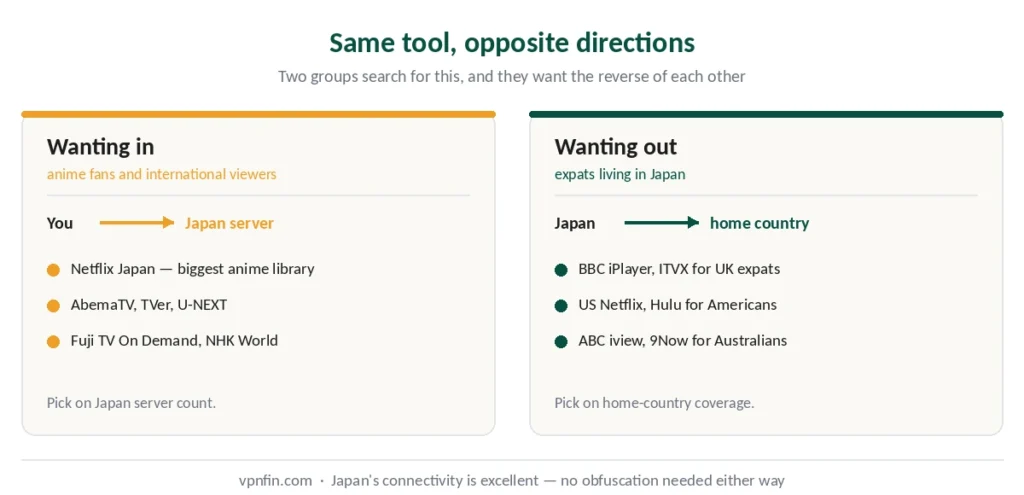
Searches for a Japan VPN come from two groups who want opposite things.
Anime fans and international viewers want a Japanese IP address, because Netflix Japan holds the largest anime catalogue of any regional library, plus J-dramas and originals that never appear elsewhere.
Expats living in Japan want the reverse — a server in their home country, so BBC iPlayer, US Netflix or ARD stop refusing to load.
Both need a provider with strong Japanese infrastructure, but for different reasons. This guide covers each.
The Short Answer
For a Japanese IP: you need a provider with plenty of Japan servers and a habit of rotating addresses, because Japanese platforms filter IPs identified as proxies rather than blocking VPNs outright.
For expats: server count in your home country matters more than anything Japan-specific. Japan’s internet is fast and largely unthrottled, so almost any decent provider performs well from there.
Free VPNs fail at both. Their small address ranges are flagged fastest, and they’re the first thing streaming platforms block.
What a Japanese IP Actually Unlocks
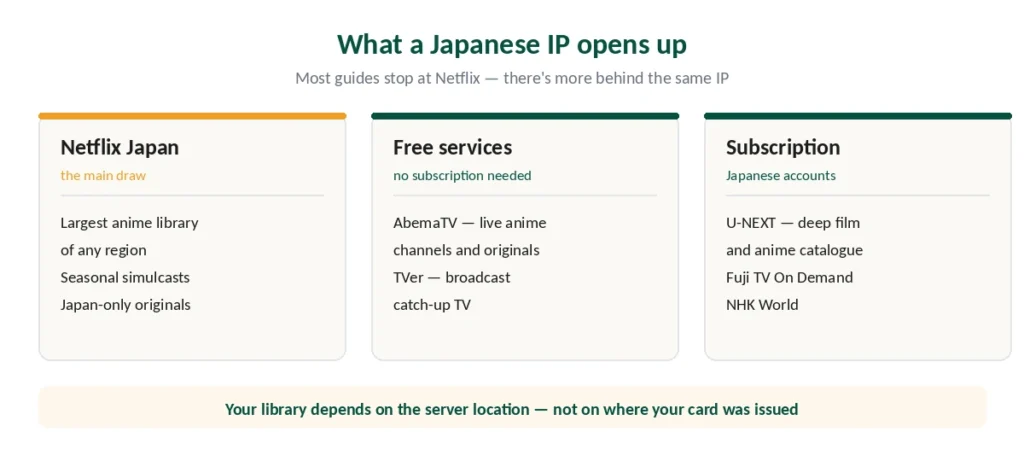
Netflix Japan is the main draw. It carries the largest anime library of any Netflix region — seasonal simulcasts, certain Studio Ghibli titles, and Japan-exclusive originals absent from US and European catalogues.
Beyond Netflix, and this is where most guides stop too early:
AbemaTV — free streaming with live anime channels and originals.
TVer — catch-up service for Japanese broadcast television.
U-NEXT — subscription service with a deep film and anime catalogue.
Fuji TV On Demand and NHK World for Japanese broadcast content.
⚠️ Your library depends on the server location, not on where your payment card was issued. People assume a foreign card blocks access — it doesn’t. Connect to a Japanese server and Netflix serves the Japanese catalogue. For purchases the reverse is true — the card tells the platform what the IP doesn’t.
Why Some Servers Work and Others Don’t
Here is the mechanism, and it explains the frustration.
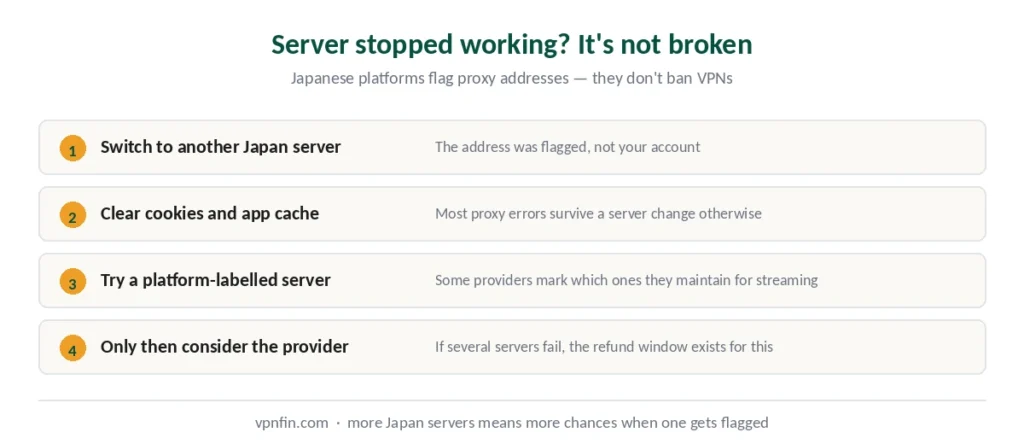
Japanese platforms don’t block VPNs as a category. They restrict IP addresses identified as proxies or data-centre ranges. When a VPN server has too many concurrent users, its address gets flagged and added to a known-proxy list. Hulu works the same way, with two extra layers on top.
The practical consequence: a server that worked last week may fail today, and switching to another Japanese server usually fixes it. Providers with more Japan servers give you more chances — NordVPN operates over 130 there.
What actually helps:
Switch servers before assuming anything is broken. Clear browser cookies and app cache — most proxy errors come from a flagged address rather than a broken account. And check whether your provider labels servers for streaming, as CyberGhost does.
For Expats in Japan
The direction reverses, and the requirements change with it.
You need servers in your home country, not in Japan. UK expats need UK servers for iPlayer and ITVX. Americans need US servers. Australians need Australian ones for ABC iview and 9Now.
Japan’s infrastructure works in your favour. The country has excellent connectivity and minimal ISP throttling of VPN traffic — the problem that plagues users in some other countries barely exists here. Standard protocols perform well without obfuscation. The contrast with Turkey is stark — there, deep packet inspection drops standard protocols outright.
What to prioritise: breadth of country coverage rather than Japanese server count. ExpressVPN covers 113 countries, the widest of the providers we rank.
Is It Legal?
Yes. Japan has no laws restricting VPN use, strong internet freedom protections, and no general content censorship. VPNs are widely used by Japanese nationals and expats alike, and by businesses for ordinary security reasons. India is the contrasting case — legal for users, but hostile enough to providers that they left. ⚠️ Indonesia sits at the other end of the region, where a registration rule can pull a service offline without any law changing.
The nuance is contractual rather than legal. Accessing another region’s Netflix library breaches the platform’s terms of service — not any law. The realistic consequence is the platform blocking that server, not action against you. Our legality guide covers where VPN use genuinely carries legal risk, and Japan is not on that list.
⚠️ One warning worth repeating. Sites offering “free Netflix accounts” or cracked streaming tools are malware distribution, aimed at harvesting logins and card details. A VPN subscription is the legitimate route.
Why Free VPNs Don’t Work Here
The failure is structural rather than incidental.
Free tiers have tiny address ranges shared by enormous numbers of users. That concentration is exactly what triggers the proxy-detection Japanese platforms use — flagged almost immediately and permanently.
Data caps make anime impractical. A single season at reasonable quality consumes several gigabytes; free tiers typically allow 10 GB a month total.
Most free tiers exclude Japan entirely. Proton VPN’s free tier, the most reputable, offers three locations — the US, Netherlands and Japan — but caps you at one device with no streaming support. Our free VPN guide covers what the free options genuinely do and don’t do.
Which Provider to Choose
For Japanese content: server count in Japan matters most, because more addresses mean more chances when one gets flagged. NordVPN runs over 130 Japanese servers and includes SmartPlay, which handles geo-restrictions without manual configuration.
For reliability without fiddling: providers that label servers by platform save you the guesswork. CyberGhost does this, and it also carries the longest refund window at 45 days.
For expats: country breadth beats Japan-specific strength. ExpressVPN’s 113 countries covers essentially any home region.
For households: Surfshark’s unlimited connections matter if the whole family streams — our streaming guide covers library counts across all five.
⚠️ Whichever you pick, use the refund window to test your specific case. Access shifts month to month, and any guarantee about a particular platform — including in this article — is a snapshot.
How We Research
This guide draws on published testing from named sources including Comparitech, SpeedTestHQ and WizCase, provider documentation on Japanese server counts, and our own full reviews of the providers we rank — cross-checked and verified at publication. Where a source shared ownership with a provider it recommended, we noted that and weighted it accordingly. Streaming access changes month to month, so treat any unblocking claim as a snapshot rather than a guarantee. Our full approach lives on the About Us page.
Japan VPN FAQ
Yes. Japan has no laws restricting VPN use, strong internet freedom protections and no general content censorship. VPNs are widely used by Japanese nationals, expats and businesses. Accessing another region’s streaming library breaches that platform’s terms of service, which is a contractual matter rather than a legal one.
Among the providers we rank, NordVPN operates over 130 Japanese servers. Server count matters here specifically because Japanese platforms flag individual IP addresses as proxies — more servers means more alternatives when one stops working.
Its IP address was probably flagged as a proxy. Japanese platforms maintain lists of known proxy and data-centre addresses, and servers with many concurrent users get identified fastest. Switch to a different Japanese server and clear your browser cookies or app cache — most proxy errors come from a flagged address rather than a broken account.
No. Your library depends on the location of the server you’re connected to, not on where your card was issued. Connect to a Japanese server and Netflix serves the Japanese catalogue regardless of your billing details.
Realistically no. Free tiers share small address ranges among many users, which is exactly what triggers proxy detection, and data caps of around 10 GB a month make anime impractical. Most free tiers exclude Japan entirely — Proton VPN’s free plan includes it but permits one device and no streaming.
Servers in your home country rather than in Japan. UK expats need UK servers, Americans need US servers, Australians need Australian ones. Japan’s connectivity is excellent with minimal ISP throttling, so standard protocols work well and obfuscation isn’t necessary.
The Short Version
Wanting in: pick a provider with many Japan servers, expect to switch between them occasionally, and don’t assume a flagged address means the VPN is broken.
Wanting out: pick on home-country coverage instead. Japan’s connectivity is excellent and won’t fight you.
Either way, skip the free options. Their address ranges are flagged fastest, their data caps make anime impractical, and most exclude Japan entirely.