
Disclosure: VPNFin is reader-supported. If you buy a VPN through links on this page, we may earn a commission at no extra cost to you. This never affects our ratings — here’s how we research.
Two things bring people to this search, and they’re very different.
Argentine content from abroad — Telefe, El Trece, TyC Sports, local football coverage. Legitimate, straightforward, and partly unnecessary: several of those channels stream from anywhere without a VPN at all.
Regional pricing — Argentina’s weak peso makes subscriptions to HBO Max, Steam, YouTube Premium and others substantially cheaper there than elsewhere. This is the reason most people are actually reading, and it comes with consequences nobody advertises.
We’ll cover both honestly, starting with the part that saves you money on us.
The Short Answer
VPNs are fully legal in Argentina. Freedom House rates the country 71 out of 100 on internet freedom — one of the more open environments in Latin America.
Check before you buy. Published testing indicates several Argentine channels and streaming services work from abroad without an Argentine IP address.
On regional pricing: the savings are real, and so is the risk to your account. We explain rather than instruct.
What Actually Needs a VPN
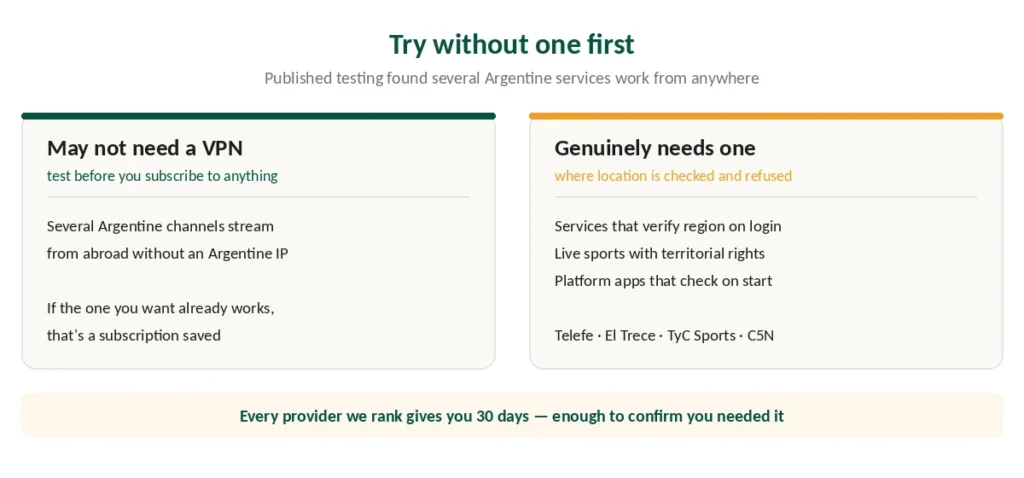
Some Argentine services geo-restrict, and some don’t. Published testing found that several channels and streaming platforms work from anywhere without an Argentine IP — so the first step is simply trying without one.
Where a VPN is genuinely needed: services that check your location and refuse, live sports coverage with territorial rights, and platform apps that verify region on login.
Argentine channels worth knowing about: Telefe, El Trece, C5N and TyC Sports for general programming; ESPN Argentina and DIRECTV Sports for football, rugby, basketball and tennis.
⚠️ Test first, subscribe second. If the channel you want already works, you’ve saved yourself a subscription — and if it doesn’t, every provider we rank gives you at least 30 days to confirm the VPN fixes it.
Regional Pricing: The Honest Version
This is the elephant in the room, so let’s address it directly.
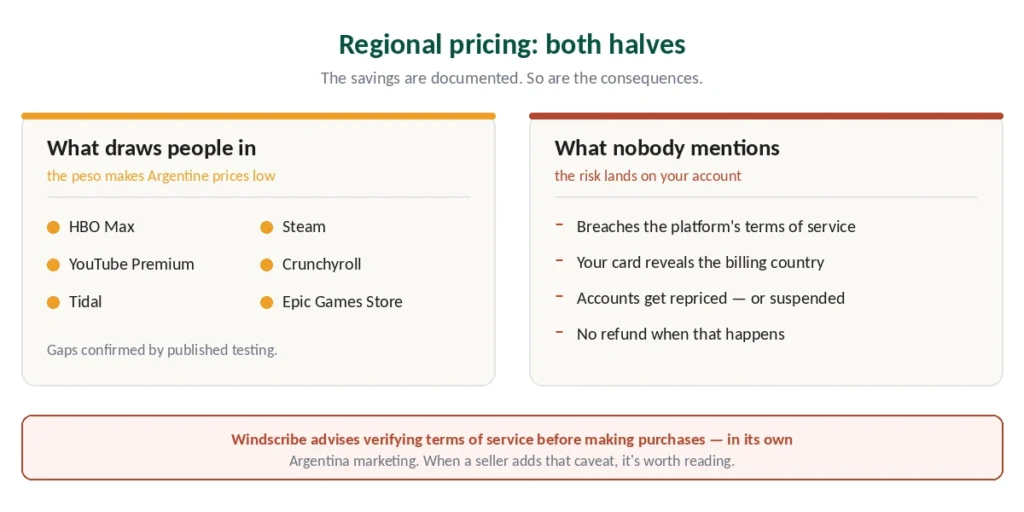
The savings are documented. Argentina’s currency situation means services including HBO Max, Steam, YouTube Premium, Crunchyroll, Tidal and the Epic Games Store price considerably lower there than in North America or Europe. Testing by published sources confirms the gaps are substantial.
What nobody mentions in the same breath:
It breaches the terms of service of essentially every platform involved. These agreements specify that you subscribe in your country of residence, and paying through a different region violates that.
Payment method usually gives you away. Most platforms verify billing country against your card. A VPN changes your IP; it doesn’t change what your bank issued.
Accounts get corrected or closed. Platforms detect mismatches and respond — sometimes by repricing you to your actual region, sometimes by suspending the account. The subscription you saved on can disappear along with whatever’s attached to it.
Even Windscribe, in its own Argentina marketing, advises verifying that VPN use doesn’t violate a site’s terms before making purchases. When a provider selling you the tool includes that caveat, it’s worth reading.
Our position: we’re not going to write the instructions. The savings are real, the mechanism is widely known, and the risk lands on your account rather than ours. Make the decision with both halves of the picture.
Virtual Servers vs Physical Ones
A distinction that matters here more than in most countries.
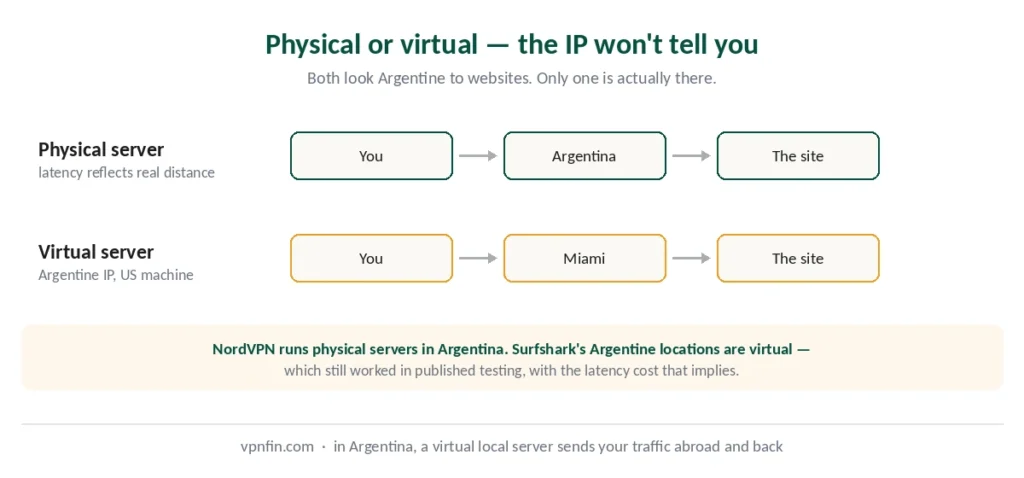
A physical server sits in Argentina. Latency reflects the real distance, and the IP is registered locally.
A virtual server assigns an Argentine IP while the machine sits elsewhere — often Brazil, Chile or the United States. The same applies to Brazilian servers, where Miami and Amsterdam are the common substitutes.
Both give you an Argentine address as far as websites are concerned. The difference is speed: a virtual Argentine server routed through Miami adds real distance to every request.
Among providers we rank: NordVPN operates physical servers in Argentina. Surfshark’s Argentine locations are virtual, which published testing found still worked for accessing local sites — with the latency trade-off that implies.
⚠️ If you’re in Argentina connecting to a virtual Argentine server, your traffic leaves the country and returns. Our speed guide covers why distance is the second-largest factor in VPN performance.
For Argentines: Privacy at Home
The other direction, which local sources emphasise.
Argentine ISPs — including Personal and Claro — can log browsing habits and share that data with third parties. Local privacy protections are weaker than in the EU, and a VPN removes the ISP’s view of where you go. Mexican ISPs go further, with reported throttling of streaming traffic on top of the logging.
Public Wi-Fi in Buenos Aires and elsewhere carries the same risks as anywhere — our guide on whether you need a VPN covers what those actually are in 2026.
And international libraries are larger. Netflix US carries considerably more than the Argentine catalogue, which is the mirror image of the inbound use case — our streaming guide covers which providers open the most regions.
What a VPN Doesn’t Change
Argentine law still applies, including Ley 11.723 on copyright. Encryption doesn’t alter what’s lawful to download or share.
Terms of service still bind you. Accessing a platform from a region you don’t live in breaches its agreement regardless of how the traffic travelled — our legality guide covers the distinction between breaking a contract and breaking a law. ⚠️ There is a third category, and the region has produced the clearest example: a Brazilian court order once made VPN use itself finable for thirty-nine days, without any statute changing.
Your payment method still identifies you. For anything involving a purchase, the card tells the platform what your IP doesn’t.
Which Provider to Choose
For an Argentine IP: physical servers beat virtual ones on speed. NordVPN runs physical infrastructure there and posted the best speed result in independent benchmark testing.
For Argentines wanting international content: breadth matters more than local presence. ExpressVPN covers 113 countries, the widest of the five.
For households: Surfshark’s unlimited connections, accepting that its Argentine locations are virtual.
Free options: the usual problems apply, and Argentine servers are uncommon on free tiers — our free VPN guide covers which three are genuinely safe.
How We Research
This guide draws on published testing from named sources including Top10VPN, Cybernews and VPNOverview, Freedom House’s internet freedom scoring, and our own full reviews of the providers we rank — cross-checked and verified at publication. Where a source selling VPNs included a caveat against its own commercial interest, as Windscribe did on terms-of-service compliance, we’ve quoted that position. This is not legal advice. Our full approach lives on the About Us page.
Argentina VPN FAQ
Yes, entirely. The government doesn’t restrict VPN services, and Freedom House rates Argentina 71 out of 100 on internet freedom — among the more open environments in Latin America. Using a VPN for unlawful activity remains unlawful, and Argentine copyright law under Ley 11.723 applies regardless.
Not always. Published testing found several Argentine channels and streaming services accessible from anywhere without an Argentine IP address. Try the service you want first — if it works, you’ve saved a subscription. If it doesn’t, a VPN with Argentine servers is the standard fix.
The price differences are real, driven by the peso’s weakness — services including HBO Max, Steam and YouTube Premium cost considerably less there. But it breaches those platforms’ terms of service, your payment method usually reveals the mismatch, and accounts get repriced or suspended when detected. The savings and the risk both belong in the decision.
A physical server sits in Argentina; a virtual one assigns an Argentine IP while the machine sits elsewhere, often Brazil or the US. Both look Argentine to websites, but a virtual server routed through Miami adds real latency. NordVPN runs physical servers in Argentina; Surfshark’s Argentine locations are virtual.
Yes. Providers including Personal and Claro can log which sites you visit and when, and share that data with third parties. Local privacy protections are weaker than in the EU, which is one of the more concrete reasons for Argentines to use a VPN domestically.
Telefe, El Trece and C5N for general programming; TyC Sports, ESPN Argentina and DIRECTV Sports for football, rugby, basketball and tennis. Note again that several of these may work without a VPN — test before assuming you need one.
The Short Version
Try without one first. Published testing indicates several Argentine channels work from abroad with no VPN at all — that’s a subscription saved.
Legal, and the environment is open. Freedom House rates Argentina 71 out of 100 on internet freedom.
On regional pricing: the discounts are real, the terms-of-service breach is real, and your payment method usually reveals the mismatch anyway. We’ve given you both sides rather than a walkthrough.
And check whether your provider’s Argentine servers are physical, because a virtual one routed through Miami costs you latency the IP address doesn’t reveal.