
Disclosure: VPNFin is reader-supported. If you buy a VPN through links on this page, we may earn a commission at no extra cost to you. This never affects our ratings — here’s how we research.
VPNs are entirely legal in Mexico. No law restricts personal use, and the government has not enacted censorship comparable to China or Russia.
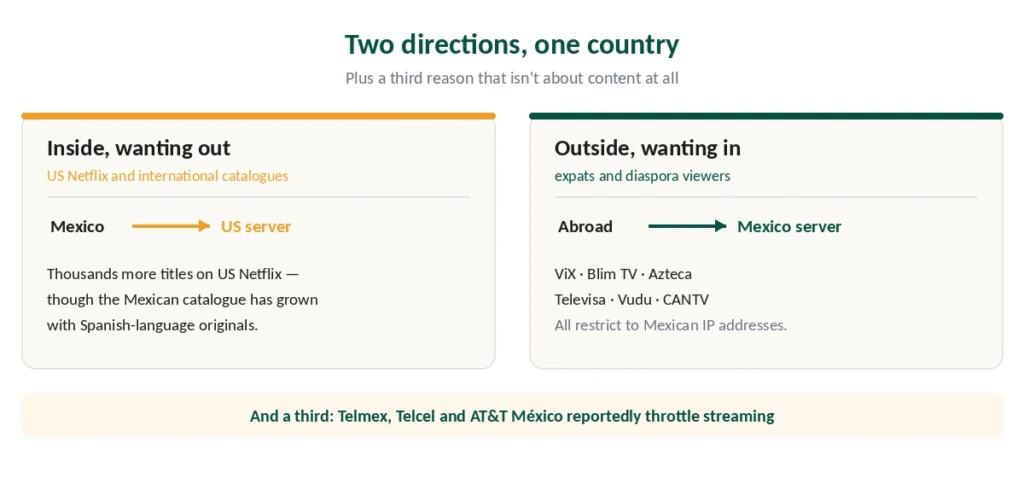
The reasons people actually want one here are more specific than the usual privacy pitch, and one of them is well documented: Telmex, Telcel and AT&T México have been reported to throttle streaming traffic.
That’s a concrete problem with a concrete fix, unlike most of what gets advertised.
The Short Answer
Legal, with no national restrictions. Use remains a personal choice.
Two directions, as with most countries. Mexicans wanting US Netflix, which carries thousands more titles; expats wanting ViX, Blim TV and Mexican broadcast from abroad.
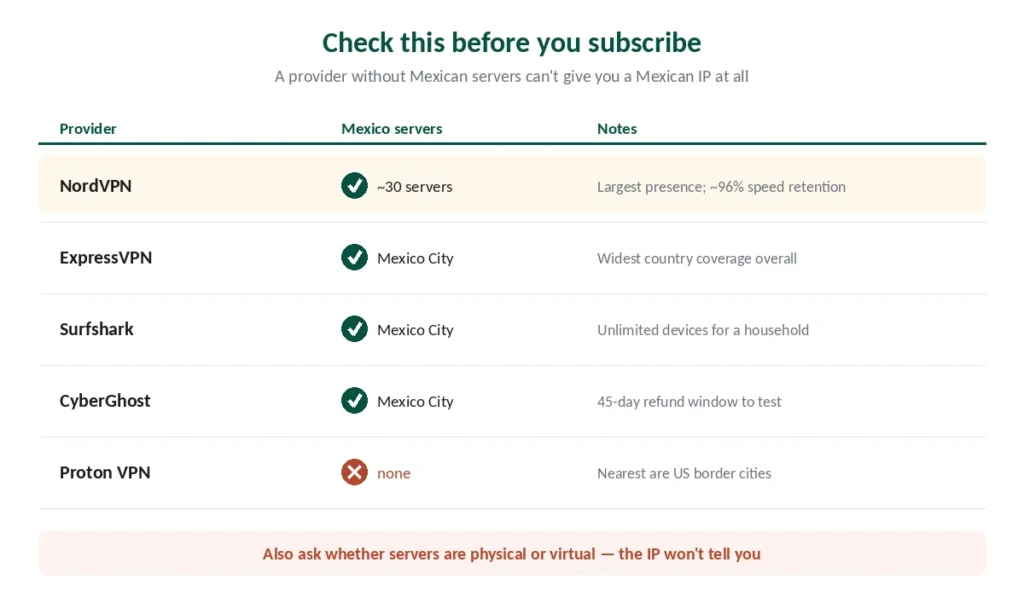
One thing to check before subscribing: not every provider has Mexican servers. Proton VPN doesn’t — its nearest options sit in US border cities.
Throttling: The Documented Case
Reported throttling by Telmex, Telcel and AT&T México on streaming traffic is the most specific reason for a VPN in Mexico, and it’s the one most guides mention last.
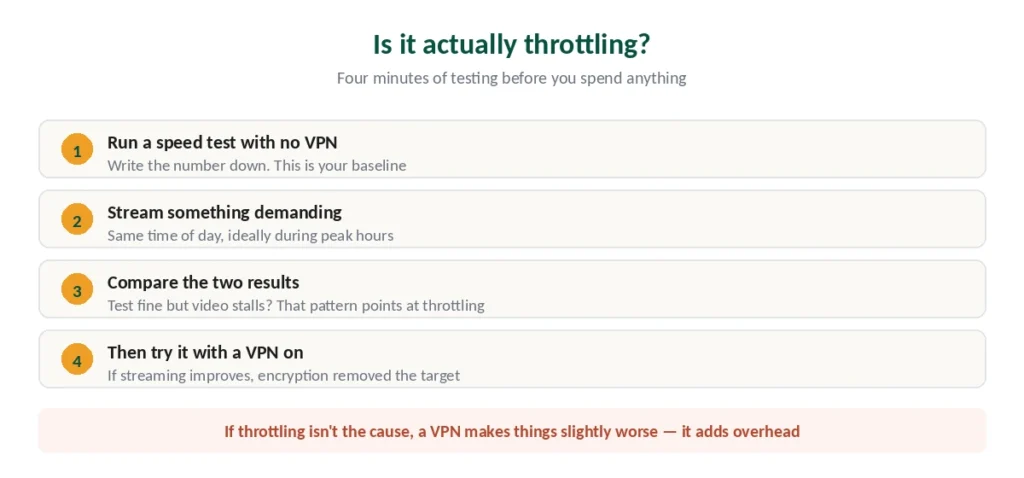
How it works. The ISP identifies streaming traffic by its pattern and destination, then deprioritises it during busy hours. Your connection tests fine; your video buffers.
Why a VPN addresses it. Encrypted traffic can’t be identified as streaming, so the throttling has nothing to target.
How to check whether it’s happening to you. Run a speed test without the VPN, then stream something. If the test looks normal while playback stalls — especially at peak hours — that pattern points at throttling. Our speed guide covers the diagnosis properly.
⚠️ A VPN adds its own overhead. If throttling isn’t the cause, it makes things slightly worse rather than better.
What Each Direction Needs
From inside Mexico, wanting out. US Netflix carries substantially more titles than the Mexican library, and connecting to a US server switches which catalogue you see.
⚠️ Though the gap has narrowed. Mexican Netflix has improved considerably with exclusive Spanish-language originals, so check whether what you want is actually elsewhere before assuming.
From abroad, wanting in. ViX, Blim TV, Azteca, Televisa and Vudu restrict access to Mexican IP addresses. Expats and diaspora viewers need a Mexican server, and that’s where provider coverage matters.
For everyday privacy. Mexico’s competition authority COFECE and digital rights advocates have documented cases of surveillance and data retention by both government and corporate actors. Local privacy protections are weaker than in the EU, which makes the ISP’s view of your browsing a live concern rather than a hypothetical one. Colombian banking apps add another dimension — they reject foreign connections outright.
Who Actually Has Mexican Servers
This matters more than the usual feature comparisons, because a provider without them can’t give you a Mexican IP at all.
NordVPN operates around 30 servers in Mexico — the largest presence among providers we rank — with published testing recording roughly 96% speed retention on its NordLynx protocol.
ExpressVPN, Surfshark and CyberGhost all have Mexico City servers.
Proton VPN does not. Its nearest options are in US border cities, which works for privacy but won’t give you a Mexican IP address.
⚠️ Ask whether servers are physical or virtual. A virtual Mexican server assigns a Mexican IP while the machine sits elsewhere — fine for unblocking, worse for latency if you’re actually in Mexico.
What a VPN Doesn’t Change
Mexican law still applies. Copyright, fraud and cybercrime remain what they were regardless of encryption.
Terms of service still bind you. Watching another region’s Netflix library breaches the platform’s agreement — a contractual matter rather than a criminal one, as our legality guide explains.
And your ISP still sees that you’re using a VPN. What it stops seeing is where you go afterwards — what a VPN actually hides covers the distinction precisely.
Which to Choose
If throttling is the problem: speed matters most, since you’re already fighting for bandwidth. NordVPN posted the best result in independent benchmark testing.
If you want a Mexican IP from abroad: server count in Mexico specifically. NordVPN’s 30 gives you the most alternatives when one gets flagged by a streaming platform.
If you’re a household: Surfshark’s unlimited connections, with Mexico City coverage.
If price decides it: our cheap VPN guide compares four-year totals across all five providers we rank.
⚠️ Test on the refund window. Every provider gives at least 30 days — enough to confirm the Mexican services you want actually open.
How We Research
This guide draws on published testing from named sources including Comparitech, VPNpro and country-specific testing published in 2026, alongside our own full reviews of the providers we rank — cross-checked and verified at publication. Reports of ISP throttling come from published analysis rather than our own measurement, and we’ve attributed them accordingly. Several sources carry commercial interests in VPN services. This is not legal advice. Our full approach lives on the About Us page.
Mexico VPN FAQ
Yes, entirely. No law restricts personal VPN use, and the Mexican government has not enacted internet censorship comparable to China or Russia. Using one remains a personal choice. What was illegal without a VPN — fraud, copyright infringement, cybercrime — remains illegal with one.
Published reports indicate Telmex, Telcel and AT&T México throttle streaming traffic. The tell is a speed test that looks normal while video buffers, particularly at peak hours. Because encrypted traffic can’t be identified as streaming, a VPN removes what the throttling targets.
NordVPN operates around 30, the largest presence among providers we rank. ExpressVPN, Surfshark and CyberGhost all have Mexico City servers. Proton VPN does not — its nearest options are in US border cities, which works for general privacy but won’t give you a Mexican IP.
Yes, by connecting to a US server, which switches your library from the Mexican catalogue to the American one. Worth noting that Mexican Netflix has improved considerably with exclusive Spanish-language originals, so check whether the specific title you want is actually only available elsewhere.
Both restrict access to Mexican IP addresses, so you need a provider with servers in Mexico. Connect to a Mexican server before opening the service. If it detects the VPN, switch to a different Mexican server — platforms flag individual addresses rather than blocking providers wholesale.
With a VPN, largely — your provider sees encrypted traffic to a VPN server rather than which sites you visit. This matters because Mexico’s competition authority COFECE and digital rights advocates have documented cases of surveillance and data retention by both government and corporate entities, with weaker legal protections than in the EU.
The Short Version
Legal, and the strongest reason is throttling. Telmex, Telcel and AT&T México have been reported to slow streaming traffic, and encryption removes the target.
Check your provider has Mexican servers. Proton VPN doesn’t — a detail that matters if a Mexican IP is the point.
And check whether US Netflix is still the upgrade you assume. The Mexican catalogue has grown considerably, particularly in Spanish-language originals.