
Disclosure: VPNFin is reader-supported. If you buy a VPN through links on this page, we may earn a commission at no extra cost to you. This never affects our ratings — here’s our full disclosure.
Is a VPN legal in Mexico? Yes. No Mexican law restricts VPNs, and the country does not block VPN services. The internet change that matters in 2026 is elsewhere: every Mexican mobile line must now carry its owner’s identity. Registration began on 9 January 2026, and existing lines had until 30 June 2026 before suspension, law firm Hogan Lovells explains.
A VPN and that registry do different jobs, and this page explains both, along with the 2025 telecoms law whose most controversial clause the government dropped before it passed.
Is a VPN Legal in Mexico? The Short Answer
Using a VPN is legal. Mexico has no law against VPNs and no national blocking of them. Our guide to a VPN for Mexico covers streaming, travel and what works.
Does NordVPN work in Mexico? Yes. Nothing in Mexican law or network policy stops VPN connections, so NordVPN and other major services connect normally. Our NordVPN review covers the provider.
Your phone line is now tied to your identity. The mobile line registry links each Mexican number to an ID such as a CURP. A VPN does not change that link.
The 2025 Telecoms Law and the Clause That Was Dropped
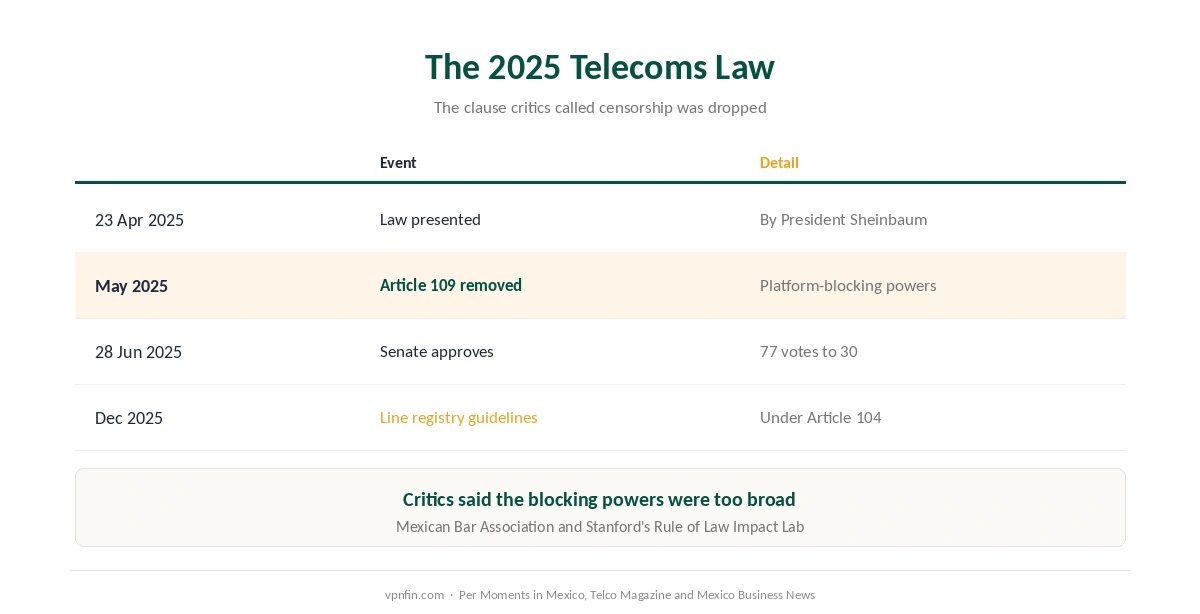
President Sheinbaum presented the new law on 23 April 2025, and the Senate approved it on 28 June 2025 by 77 votes to 30, after more than 70 revisions.
The government dropped Article 109 before the vote. Critics said it would have let authorities suspend broadcasts and temporarily block digital platforms. The Mexican Bar Association and Stanford Law School’s Rule of Law Impact Lab called the platform-blocking powers excessively broad and ambiguous, Telco Magazine reported.
The government said there would be no censorship. José Antonio Peña Merino, head of the Digital Transformation Agency, said the government removed the article to prevent misinterpretation, Mexico Business News reported.
The Mobile Line Registry
| Line | Requirement | Deadline |
|---|---|---|
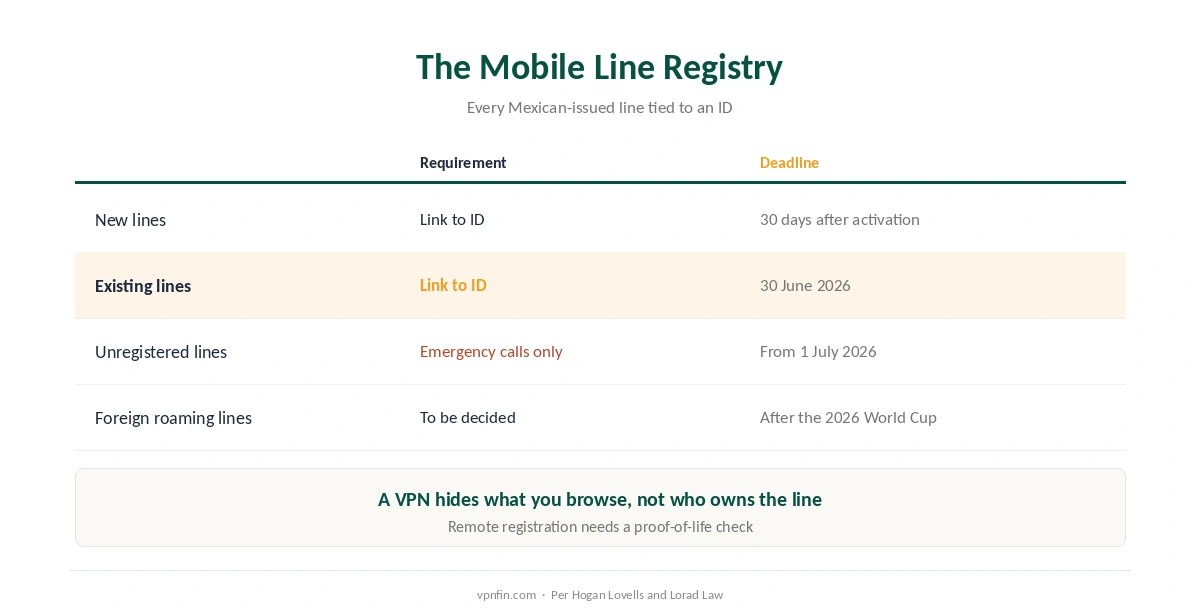
| New lines from 9 January 2026 | Link to an ID such as a CURP | Within 30 days of activation |
| Existing lines | Link to an ID | 30 June 2026 |
| Unregistered lines | Suspended; emergency calls only | From 1 July 2026 |
| Foreign lines roaming in Mexico | Mechanism to be set after the 2026 World Cup | Not yet defined |
It applies to Mexicans and foreigners alike who hold Mexican lines, Hogan Lovells notes; remote registration requires a proof-of-life check. The stated aim is to fight extortion and fraud carried out through anonymous numbers.
Digital rights groups have challenged it. R3D and others filed challenges to the biometric element, one eSIM seller’s guide reports. We flag that source as commercial.
Is a VPN legal in Mexico under the registry? Yes, and it does a different job. It hides which sites you visit from your mobile provider, as our guide to what a VPN hides explains. It does not hide who owns the line.
Is a VPN Legal in Mexico for Visitors?
Yes. Mexico draws millions of tourists and remote workers each year, and the rules are the same for them as for residents. Visitors use VPNs for banking, work and hotel Wi-Fi without issue, as our public Wi-Fi guide and our travel guide explain.
Streaming is a terms question. Watching your home library from Mexico may breach a service’s terms but is not a crime, as our Netflix guide explains.
How Mexico Compares
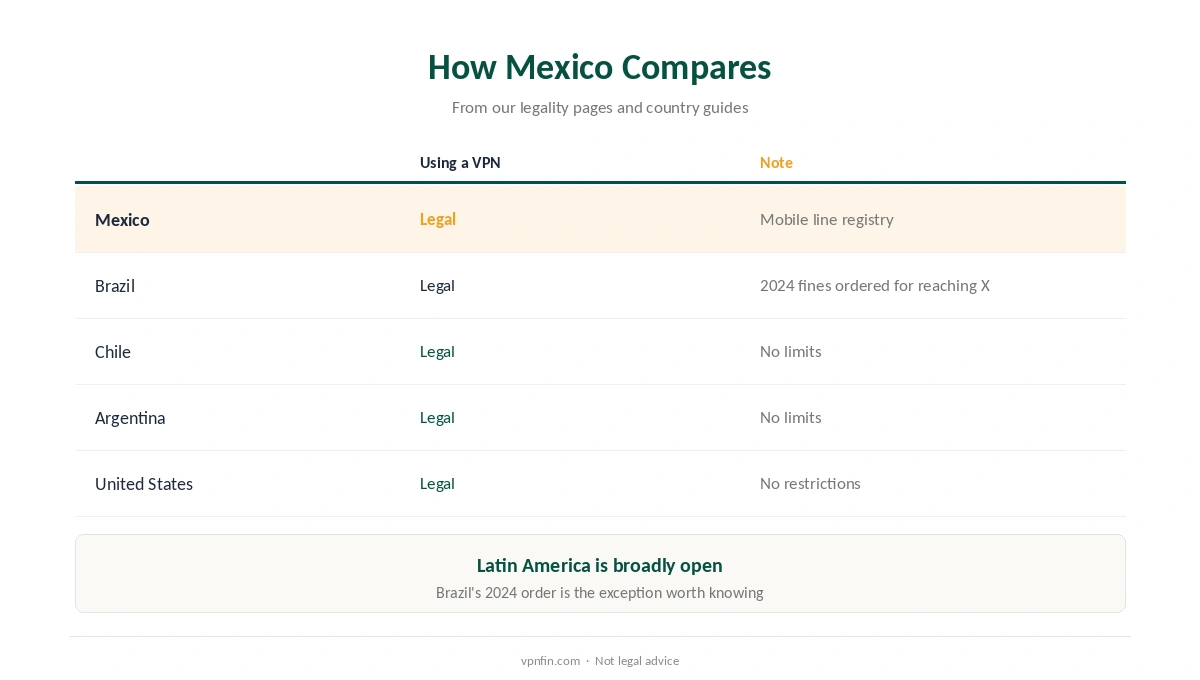
Latin America is broadly open. Brazil is the exception worth knowing: in 2024 a court ordered daily fines of 50,000 reais for using VPNs to reach X during its block.
Elsewhere in the region, Chile and Argentina place no limits on VPNs. So is a VPN legal in Mexico by regional standards? Yes, as clearly as anywhere nearby.
North of the border, the US has no VPN restrictions either, as our US legality page explains. Our country-by-country guide compares every country we cover.
How We Research
The mobile line registry comes from Hogan Lovells via Lexology and from Lorad Law, the telecoms law from Moments in Mexico, Telco Magazine and Mexico Business News, and the legal challenges from an eSIM seller’s guide, which we flag. We are not lawyers, and this is not legal advice. We name each source where used; all were read on 27 September 2026. Our full approach lives on the About Us page.
Mexico VPN Legality FAQ
Yes. No Mexican law restricts VPNs, and Mexico does not block VPN services.
Yes. VPN connections are not blocked in Mexico, so NordVPN and other major services work normally.
Since 9 January 2026, every Mexican mobile line must carry its owner’s ID. Existing lines had until 30 June 2026; providers suspend unregistered lines except for emergency calls.
It applies to Mexican-issued lines, including those held by foreigners. Foreign lines roaming in Mexico were left for a later decision, after the 2026 World Cup.
The draft’s Article 109 would have, but the government removed it before the Senate approved the law in June 2025.
The Verdict
A VPN is legal in Mexico, and NordVPN and other services work normally there.
The 2026 change is the mobile line registry, which ties your number to your identity. A VPN protects what you browse, not who owns the line.