
Disclosure: VPNFin is reader-supported. If you buy a VPN through links on this page, we may earn a commission at no extra cost to you. This never affects our ratings — here’s our full disclosure.
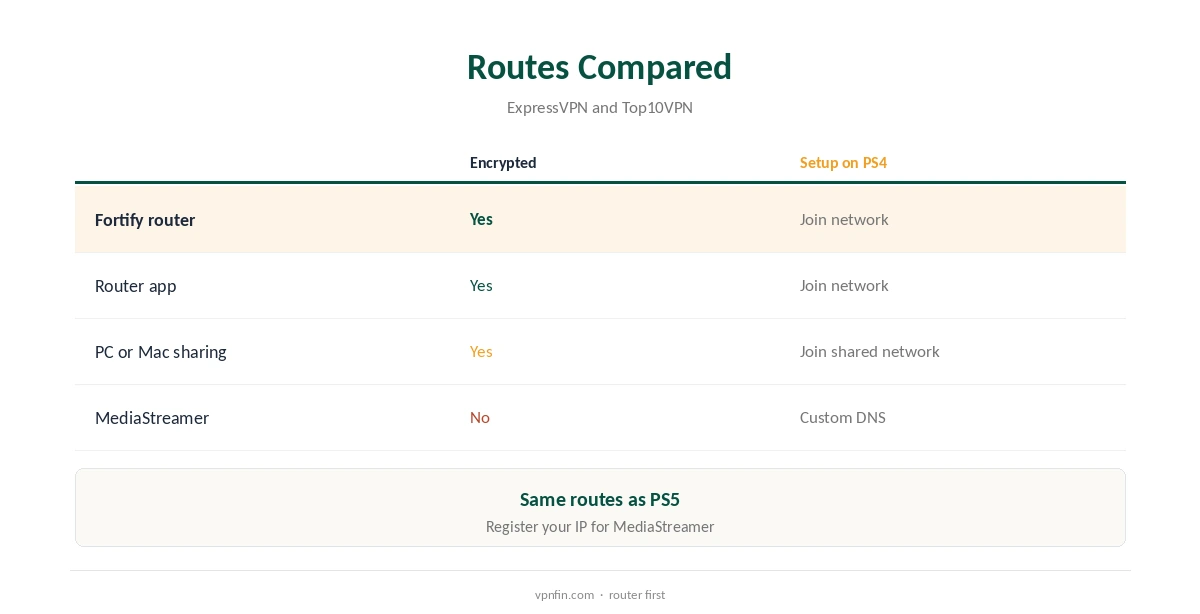
ExpressVPN PS4 use follows the same rules as the PS5: the console cannot install VPN apps, so ExpressVPN’s PlayStation page points to its Fortify router, a connection shared from a Windows PC, or MediaStreamer, its smart DNS service. Only the first two encrypt the console’s traffic. ExpressVPN says MediaStreamer adds no encryption and should not carry sensitive information.
This guide covers each route with the PS4’s own menus, the MediaStreamer DNS steps, gaming trade-offs and how to check it works.
The Three Routes for PS4
A router running ExpressVPN covers the PS4 and everything else on the network. Sharing from a PC routes the console through the computer’s VPN while it stays on. MediaStreamer changes how the PS4 resolves addresses for streaming apps, without a tunnel, so it hides nothing from your provider.
ExpressVPN’s PlayStation page covers PS5, PS4 and older models with these same routes. Our ExpressVPN PS5 guide covers the newer console.
Router: Fortify or the Router App
Fortify has ExpressVPN built in, and compatible routers from brands such as Asus can run ExpressVPN’s router app, which Top10VPN describes as a firmware upload followed by sign-in. On the PS4, open Settings, Network, Set Up Internet Connection and join the router’s network.
ExpressVPN’s router app can group devices and send each group to a different location, its MediaStreamer guide shows, so the PS4 can sit in its own group. Our ExpressVPN router guide covers the options.
Sharing From a PC or Mac
On Windows, connect ExpressVPN first, then share it through Mobile hotspot or over an Ethernet cable. On a Mac, use Internet Sharing in System Settings, with an Ethernet adapter if needed, Top10VPN describes.
Join the shared network from the PS4’s Set Up Internet Connection screen, choosing Wi-Fi or LAN cable to match how it is connected. The computer must stay on and connected while you play, so this suits occasional sessions.
ExpressVPN PS4 MediaStreamer Setup
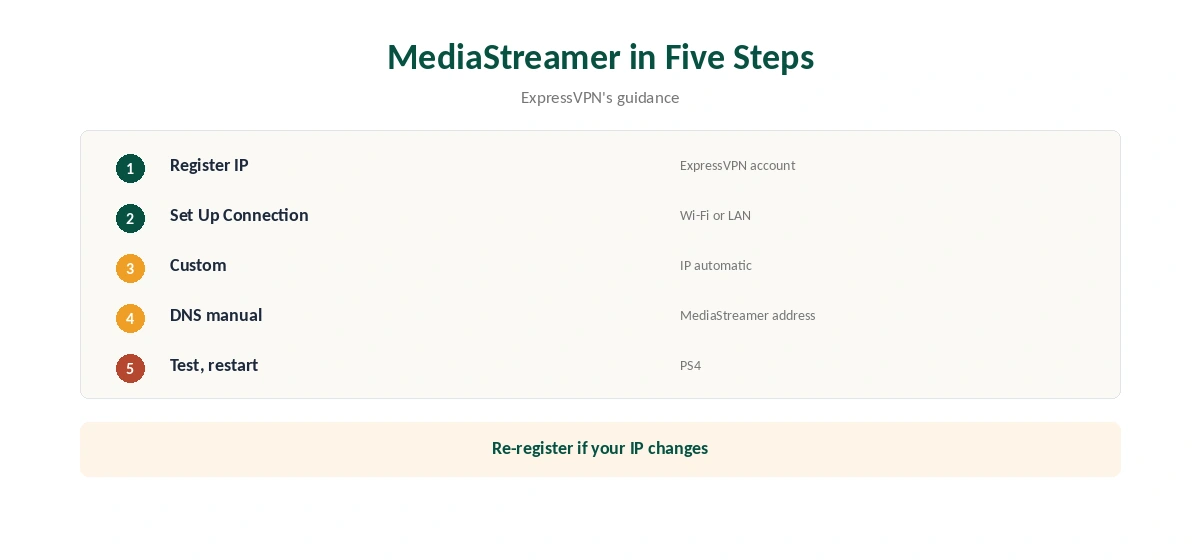
In your ExpressVPN account, open MediaStreamer, register your home IP address and note the DNS address. On the PS4, choose Set Up Internet Connection, pick Wi-Fi or LAN cable, then Custom, leave IP Address Settings on Automatic, and enter the MediaStreamer DNS manually.
Finish the setup, run Test Internet Connection and restart the console. If your home IP changes, register the new one in your account.
What MediaStreamer Does Not Do
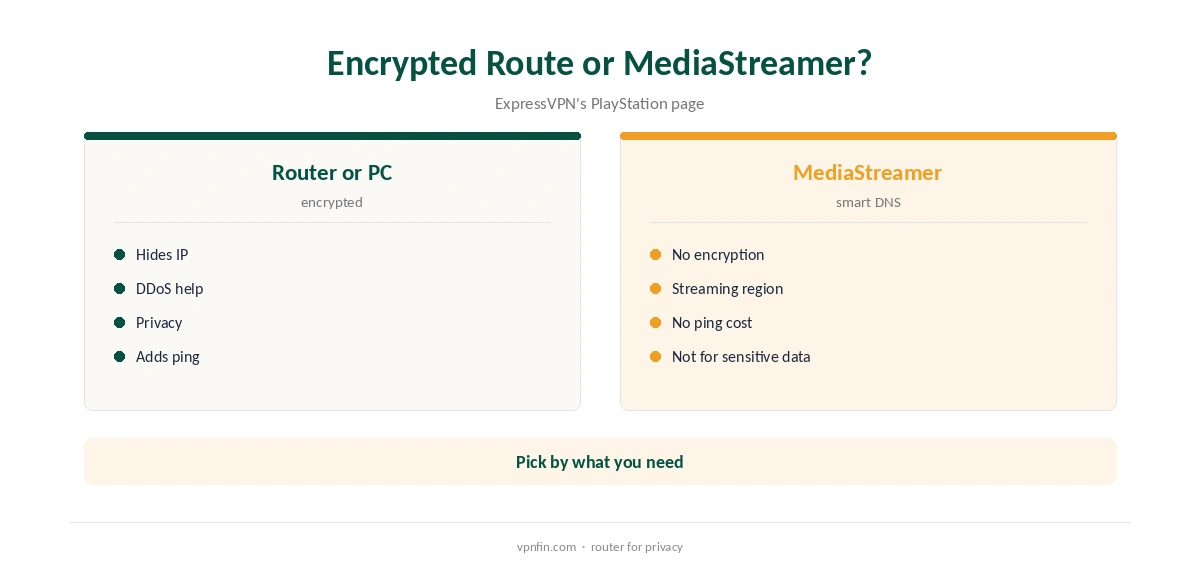
MediaStreamer changes the apparent region for some streaming apps, but it does not encrypt traffic or hide your address, ExpressVPN says, and offers no DDoS protection for games.
Use it for streaming only, and a router or shared PC for privacy, on public networks or anywhere you want your traffic hidden. Our Smart DNS vs VPN guide explains the difference.
Streaming Apps on PS4
Netflix, YouTube and other PS4 apps use the console’s connection, so a router or shared PC changes the region they see, while MediaStreamer changes it only for supported services. Streaming services may still block VPN addresses.
Close an app fully after switching location before reopening it, so it checks your region again. Our ExpressVPN Netflix guide covers what testing shows.
Fixing Common Problems
When the PS4 cannot join a shared network, restart the hotspot and run Set Up Internet Connection again. When MediaStreamer stops working, check that your current home IP is still registered in your ExpressVPN account.
For slow play, test without the VPN to compare, and use a cable where you can; the PS4’s Wi-Fi is slower than its wired port.
Gaming Trade-Offs and Price
A full VPN adds a hop, so ping usually rises, our gaming VPN guide explains. The PS4’s Test Internet Connection screen shows the NAT type, which a VPN can change.
ExpressVPN says a full connection helps against DDoS attempts, since your home address stays hidden from other players. For competitive play, keep the PS4 direct if latency matters more.
ExpressVPN’s Basic plan covers 10 devices and renews at $99.95 a year, our tables record; a router counts as one. New users get a 30-day refund, and Fortify is a separate purchase.
Which Route to Choose
Choose a router if the PS4 should be protected every time it goes online, a shared PC for occasional sessions, and MediaStreamer if you only want another region’s streaming apps and accept no encryption.
You can also combine them: a router for the console and MediaStreamer on a TV that cannot run apps, each doing the job it suits.
Checking It Works
Run Test Internet Connection on the PS4 after any change; it shows whether the console is online and its NAT type. For a router or shared PC, check the public address from a phone on the same network.
For MediaStreamer, open a supported streaming app and confirm the catalogue matches the region you expect. If it does not, check the registered IP and restart the console.
How We Research
This page draws on ExpressVPN’s PlayStation and MediaStreamer pages, Top10VPN’s PlayStation VPN guide and our ExpressVPN tables. We cross-checked these sources against each other, and where they conflict or something can’t be verified, we say so in the text rather than guessing. We checked time-sensitive figures, including prices in US dollars, on 8 October 2026. The main source we relied on is ExpressVPN’s PlayStation page. Our full approach lives on the About Us page.
ExpressVPN PS4 FAQ
No; use a router, a shared PC connection or MediaStreamer.
Register your IP, then enter the DNS address in a custom network setup.
No; ExpressVPN says it adds no encryption.
A full VPN can; check in Test Internet Connection.
No; the same three routes apply.
The Verdict
ExpressVPN PS4 use means a router, a shared PC or MediaStreamer. Use a router for protection and MediaStreamer only for streaming.