
Disclosure: VPNFin is reader-supported. If you buy a VPN through links on this page, we may earn a commission at no extra cost to you. This never affects our ratings — here’s our full disclosure.
PrivadoVPN vs AirVPN pits an easy, free-to-start VPN against a tool built for technical users. PrivadoVPN, an Iceland-registered service, gives 10 GB a month free, opens Netflix in five regions and charges $1.11 a month for Premium. AirVPN, founded in Italy in 2010 by privacy activists, offers open-source apps, up to 20 forwarded ports and sign-up without an email, but no free plan.
This guide compares free use, openness, torrenting, anonymity, China, ease, price and fit.
PrivadoVPN vs AirVPN: Free and Easy or Open and Technical
Also, PrivadoVPN’s free tier needs no card.
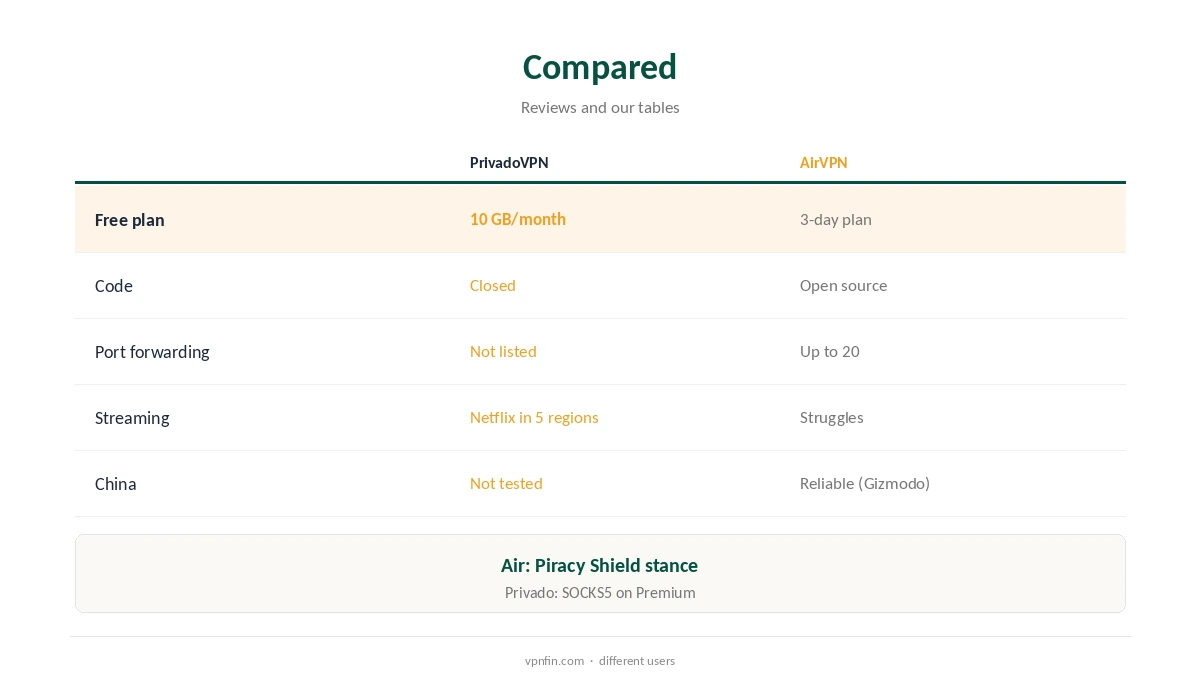
PrivadoVPN’s free tier runs at full speed for 10 GB a month on one device, and its apps include split tunnelling and a per-app kill switch that passed TechRadar’s stress tests. AirVPN’s Eddie client has 12 tabs of settings and no iOS version, Cloudwards found.
Beginners will feel at home on PrivadoVPN; tinkerers will enjoy Eddie.
Openness and Evidence
Weigh that before a long plan.
Published code helps, though it is no substitute for an audit.
AirVPN publishes its client code and real-time server figures, and it chose to leave the Italian market in 2024 instead of enforcing Piracy Shield blocks. PrivadoVPN has no audit in our table, and PCWorld notes it collects device and traffic data to enforce limits.
AirVPN offers more to inspect. Our VPN audit tracker lists audited providers.
Torrenting and Anonymity
Also, check your client’s IP first.
Secure any service you expose through an open port.
AirVPN forwards up to 20 ports, ProPrivacy notes, which suits seeding and home servers. PrivadoVPN offers SOCKS5 on Premium and P2P on selected servers, without port forwarding in our sources.
Seeders and self-hosters should pick AirVPN.
Write down your AirVPN account details somewhere safe.
You can open an AirVPN account without any email, and ProPrivacy says it takes several cryptocurrencies. PrivadoVPN’s free plan needs no card, but paid plans use a normal checkout.
For anonymous paid use, AirVPN is ahead.
Streaming and China
Even so, access in China is never guaranteed.
Install before travelling.
VPNOverview found PrivadoVPN opening Netflix in five regions in 2026, while reviewers report AirVPN struggling with major streaming platforms. Gizmodo, however, found AirVPN reliable in China in 2026; we found no China test for PrivadoVPN.
Streamers lean towards PrivadoVPN; travellers to China towards AirVPN.
Cost
Compare renewals too.
Therefore, budget users save most with PrivadoVPN.
Also, AirVPN accepts several cryptocurrencies.
Compare renewals too.
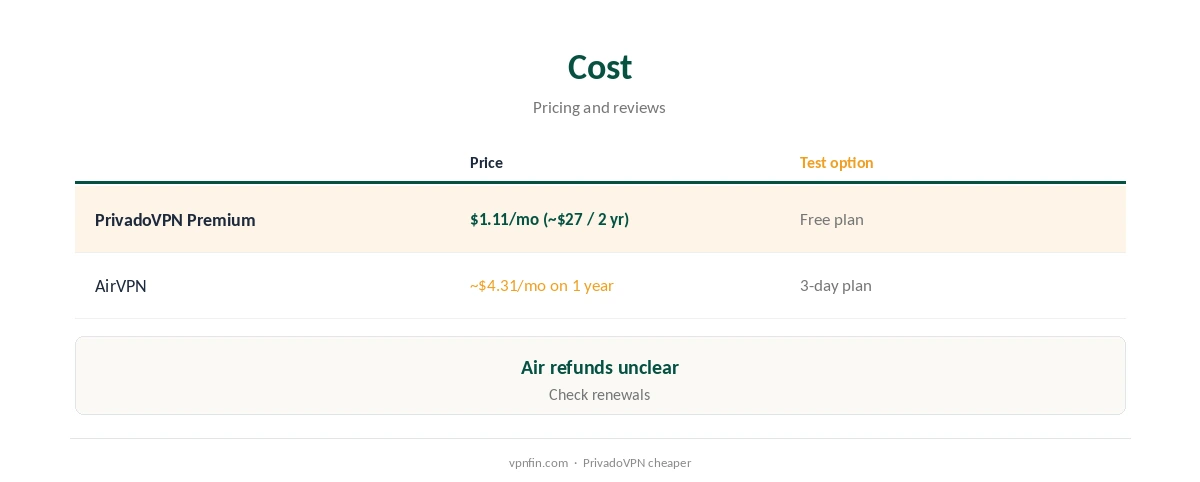
PrivadoVPN Premium costs about $27 for two years. AirVPN works out to about $4.31 a month on a one-year plan, Cloudwards notes, with a three-day plan for testing.
PrivadoVPN is far cheaper. Our renewal price guide compares renewals.
Devices and Network
Devices without apps can sit behind a router running either VPN.
Count every device before choosing.
A router covers devices without apps.
PrivadoVPN covers 10 devices on Premium and runs servers in 60 cities across 49 countries. AirVPN allows five connections and runs about 200 servers in some 22 countries, vpnpro counts.
PrivadoVPN covers more devices and countries.
A Simple Test, and Who Each Is For
Both are easy to test cheaply.
Try PrivadoVPN’s free plan for everyday use first. If you need open ports, anonymity or China access, buy AirVPN’s three-day plan and test Eddie before committing.
Keep notes on speed and stability for each.
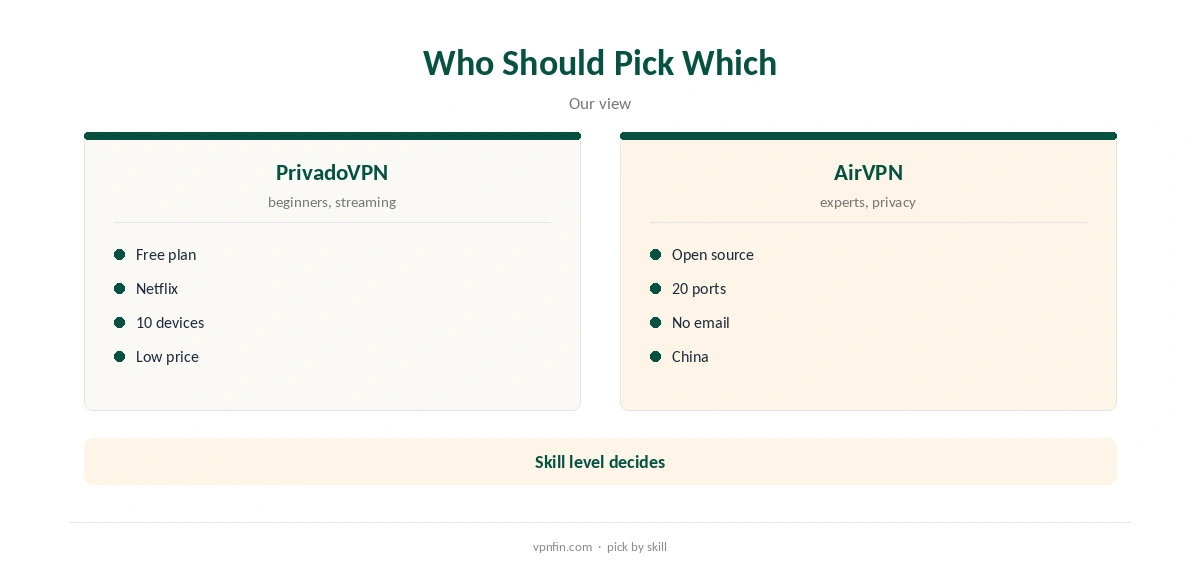
PrivadoVPN suits beginners and budget streamers who want a free start and 10 devices. AirVPN suits technical users, seeders and privacy purists who want open source, ports and China access.
Neither suits people who need a full recent audit.
Protocols, Kill Switch, Live Stats and Blocking
AirVPN runs WireGuard and OpenVPN, including OpenVPN over TCP ports 22 and 443, and Eddie’s Network Lock blocks traffic outside the tunnel. PrivadoVPN runs WireGuard, OpenVPN and IKEv2 with its stress-tested per-app kill switch.
Drop your Wi-Fi briefly while connected to test either.
AirVPN publishes live load for every server, and Eddie can route through Tor first, ProPrivacy notes. PrivadoVPN’s Control Tower blocks malicious sites and ads at the DNS level.
Each adds a different kind of extra.
Speed
Test first.
Pick a nearby location.
PrivadoVPN’s free tier keeps full speed until its 10 GB cap, then slows, the company told App Store users. We found no recent independent speed figures for AirVPN in our sources, though its live server stats help you pick a quiet one.
Test both from home at the same hour.
Keeping Your Account, and Who Should Look Elsewhere
An AirVPN account can exist without an email, so if you lose the login there may be no easy reset; store it offline. PrivadoVPN accounts use an email address for recovery.
Anonymity trades off against convenience.
People who need a recent full audit should look beyond both, since neither has one in our sources.
Our audit tracker lists providers with repeated checks.
How We Research
This page draws on Cloudwards’, ProPrivacy’s and Gizmodo’s AirVPN reviews, our AirVPN review, PrivadoVPN’s Wikipedia entry and VPNOverview’s, PCWorld’s and TechRadar’s PrivadoVPN coverage. We cross-checked these sources against each other, and where they conflict or something can’t be verified, we say so in the text rather than guessing. We checked time-sensitive figures, including prices in US dollars, on 8 October 2026. The main source we relied on is Cloudwards’ AirVPN review. Our full approach lives on the About Us page.
PrivadoVPN vs AirVPN FAQ
PrivadoVPN for a free plan, streaming and ease; AirVPN for open source, ports and China.
No; it sells a three-day plan. PrivadoVPN offers 10 GB a month free.
AirVPN, up to 20 ports.
AirVPN, in Gizmodo’s 2026 tests.
PrivadoVPN, at about $27 for two years.
The Verdict
PrivadoVPN vs AirVPN: PrivadoVPN for a free start, streaming and price; AirVPN for open source, anonymity, ports and China.