
Disclosure: VPNFin is reader-supported. If you buy a VPN through links on this page, we may earn a commission at no extra cost to you. This never affects our ratings — here’s our full disclosure.
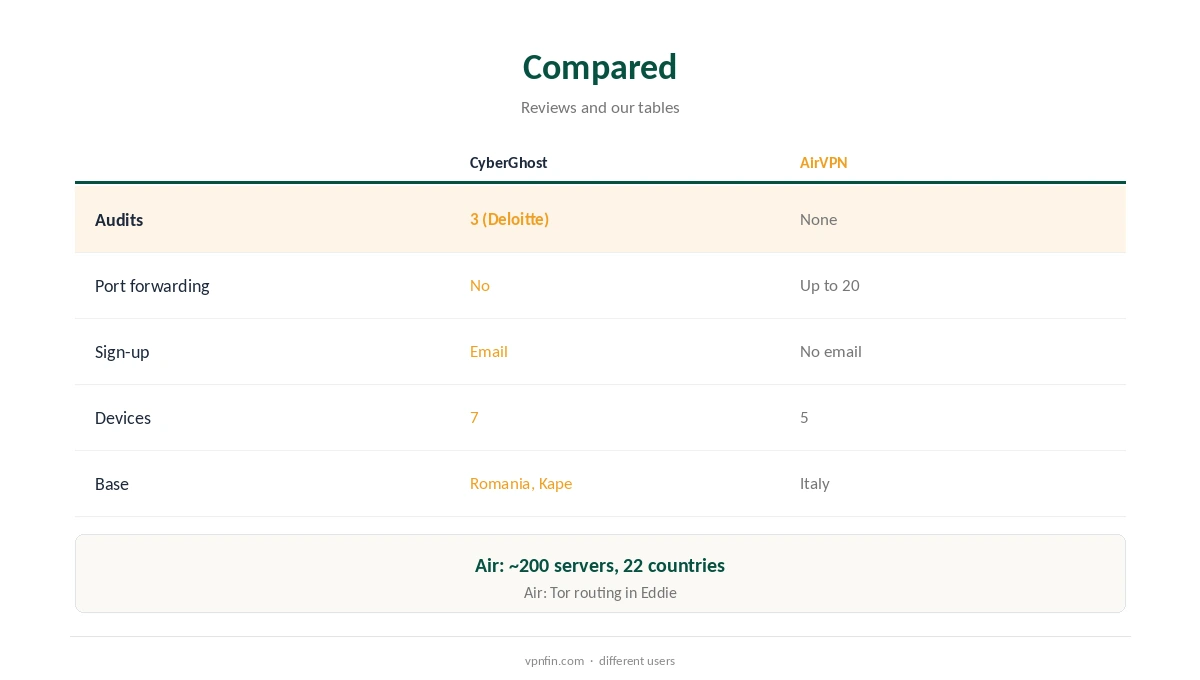
CyberGhost vs AirVPN compares a VPN built for easy streaming with one built for people who want control. CyberGhost, a Kape brand based in Romania, has three Deloitte no-logs audits in our table, allows seven devices and renews at $56.94 a year after a 26-month first term, with 45 days for refunds on longer plans. AirVPN, from Perugia, Italy, has no audit but runs the open-source Eddie client, needs no email, accepts cryptocurrency and lets you forward up to 20 ports for incoming connections, ProPrivacy notes.
This guide compares evidence, torrenting, anonymity, apps, streaming, price and fit.
Ease or Control
Neither approach is wrong. Simple apps reduce mistakes; detailed settings let experts tune every part of the connection.
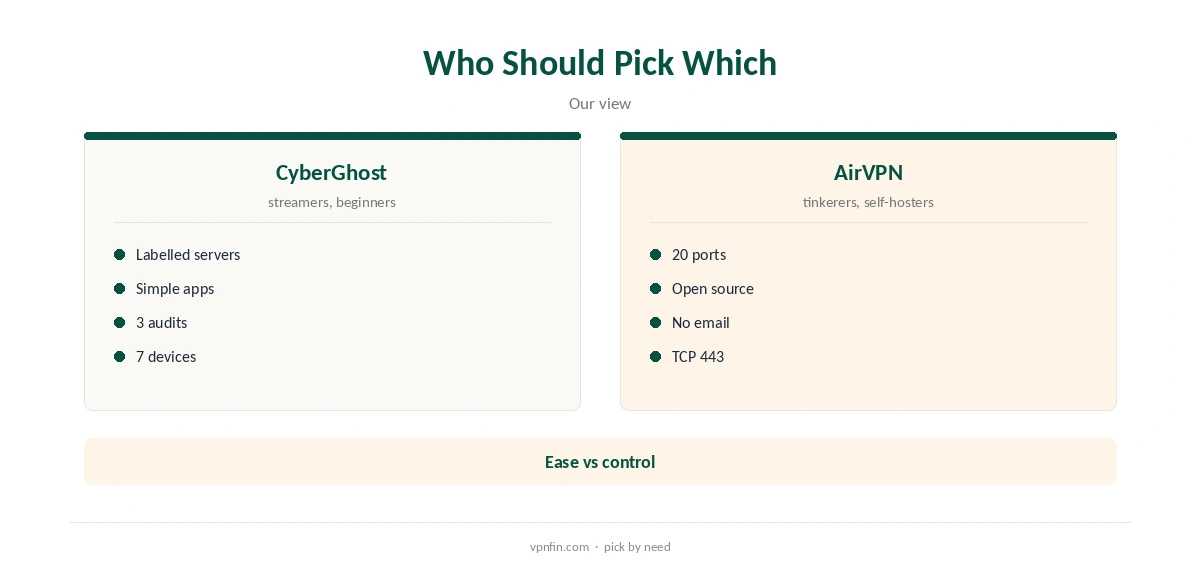
CyberGhost’s apps hide settings behind simple menus and labelled servers. AirVPN’s Eddie client has no fewer than 12 tabs of preferences, Cloudwards found, covering ports, packet sizes, DNS and proxies, and it can route through Tor.
Beginners will feel at home on CyberGhost; tinkerers will enjoy Eddie.
CyberGhost vs AirVPN on Evidence
CyberGhost has three Deloitte audits. AirVPN has none, but its open-source clients let outside experts read the code, and it publishes live load and user counts for each server. In 2024 it stopped serving users in Italy rather than apply the Piracy Shield blocklists, our review notes. We put the two side by side in our Hotspot Shield vs AirVPN comparison.
Each offers a different kind of transparency. Our AirVPN review explains AirVPN’s record.
Torrenting, Home Servers and Anonymous Sign-Up
AirVPN lets you forward up to 20 ports, which suits torrent clients, self-hosted websites and game servers, ProPrivacy notes. CyberGhost runs dedicated P2P servers but offers no port forwarding.
Torrent users who want open ports should pick AirVPN. Our torrenting guide covers others.
With AirVPN, your account need not be linked to your name. With CyberGhost, the email you use is the main link.
AirVPN needs no email and accepts several cryptocurrencies. CyberGhost uses an email account and standard payments.
For anonymity, AirVPN is clearly ahead.
Streaming
A smaller network gives fewer servers to switch to when a streaming service blocks one.
CyberGhost groups servers by streaming service, Gizmodo notes. Reviewers report AirVPN struggling with major streaming platforms, our review notes, and vpnpro counts about 200 servers in some 22 countries, a far smaller network.
For streaming, CyberGhost is the better fit.
Censored Networks
Test either from the network you will use before relying on it abroad.
AirVPN can run OpenVPN over TCP port 443, the port used by ordinary secure web traffic, which helps against many blocks, and Gizmodo found it reliable in China in its 2026 tests. CyberGhost asks users in heavily censored countries to contact support first.
For travel to filtered countries, AirVPN has the stronger record of the two.
Mobile Apps
AirVPN’s configuration generator produces files for standard apps on any platform.
On Android, AirVPN offers Eddie too, vpnpro notes.
Eddie runs on Windows, macOS, Linux and Android; on iOS there is no Eddie, so you use standard OpenVPN or WireGuard apps with AirVPN’s configuration files, vpnpro and Cloudwards note. CyberGhost’s apps look the same on every main platform.
iPhone users will find CyberGhost simpler.
Price and Testing
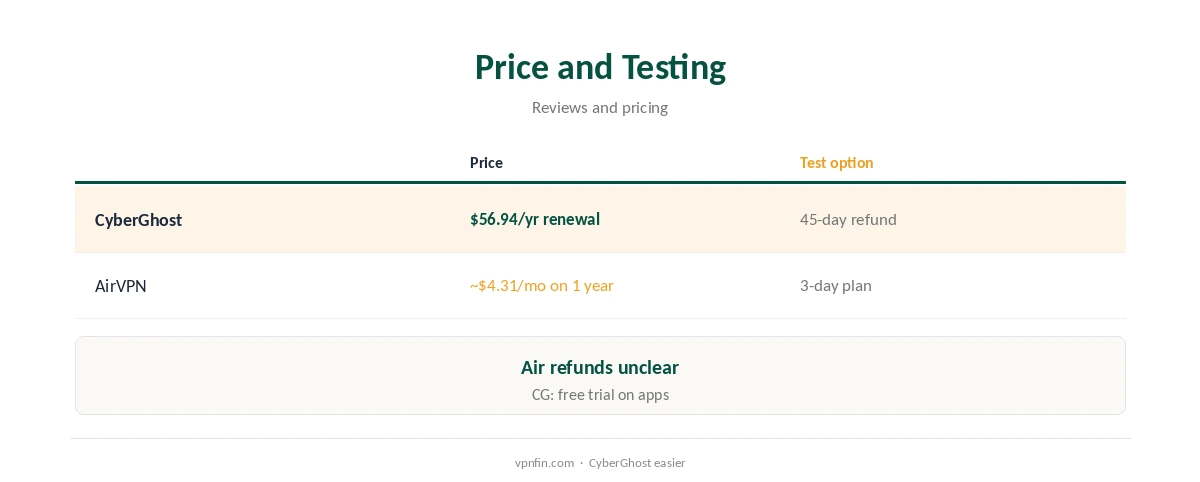
AirVPN’s one-year plan works out to about $4.31 a month, Cloudwards notes, and it sells a three-day plan for testing; its refund position is unclear, our review found. CyberGhost renews at $56.94 a year and gives 45 days for refunds on longer plans.
For most people, it is also the cheaper and easier one to test.
Devices
A router running AirVPN through WireGuard or OpenVPN files can stretch its five connections across a whole home.
Count every phone, laptop and TV before choosing between five and seven connections.
CyberGhost allows seven devices; AirVPN allows five, ProPrivacy notes. A router running AirVPN can cover devices without apps.
Households with six or seven devices fit CyberGhost without a router.
Protocols, Ports, Tor and Network Lock
AirVPN supports WireGuard and OpenVPN and lets you pick unusual ports, such as OpenVPN over TCP port 22 or 443, Gizmodo notes, which helps where networks block common VPN ports. CyberGhost offers WireGuard, IKEv2 and OpenVPN on Windows.
For ordinary home use, WireGuard on either is the fast choice.
Eddie can route your connection through Tor before AirVPN, ProPrivacy notes, and its Network Lock blocks traffic outside the tunnel. CyberGhost includes a kill switch in its main apps.
Tor routing adds anonymity at a large cost in speed.
Who Runs Each
Read each privacy policy carefully before you sign up for either service.
AirVPN was founded in 2010 by a collective of privacy activists, hackers and two lawyers, TechAdvisor reports, and still describes itself in those terms. Kape, a large commercial group, owns CyberGhost, ExpressVPN and PIA.
That difference shapes each service’s priorities: control and activism on one side, mass-market ease on the other.
How We Research
This page draws on Cloudwards’, ProPrivacy’s, Gizmodo’s and vpnpro’s AirVPN reviews, Gizmodo on CyberGhost, our AirVPN review and our audit and price tables. We cross-checked these sources against each other, and where they conflict or something can’t be verified, we say so in the text rather than guessing. We checked time-sensitive figures, including prices in US dollars, on 8 October 2026. The main source we relied on is Cloudwards’ AirVPN review. Our full approach lives on the About Us page.
CyberGhost vs AirVPN FAQ
CyberGhost for streaming and ease; AirVPN for ports, anonymity and control.
Yes, up to 20 ports.
No; CyberGhost has three audits.
Through standard OpenVPN or WireGuard apps; Eddie is not on iOS.
CyberGhost, with seven against five.
The Verdict
CyberGhost vs AirVPN: CyberGhost for easy, audited streaming; AirVPN for open-source control, anonymous sign-up and open ports.