
Disclosure: VPNFin is reader-supported. If you buy a VPN through links on this page, we may earn a commission at no extra cost to you. This never affects our ratings — here’s our full disclosure.
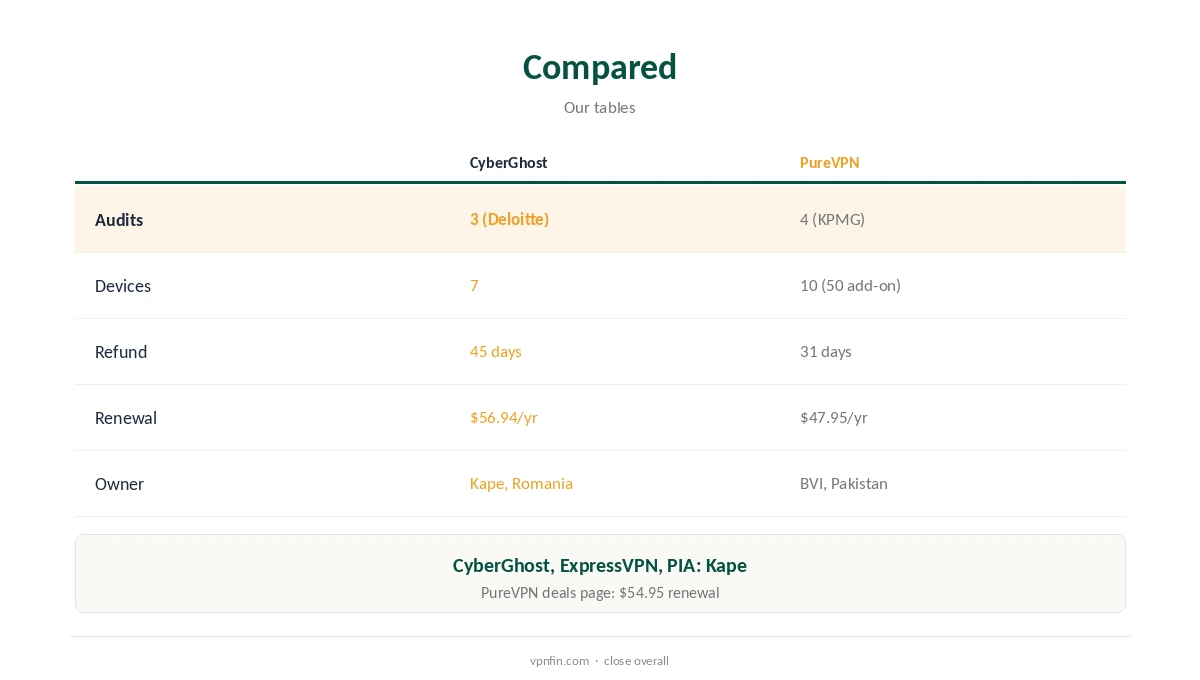
CyberGhost vs PureVPN is close on price and different on the details. CyberGhost, owned by Kape and based in Romania, has three Deloitte audits in our table, allows seven devices and offers a 45-day refund on long plans. PureVPN, based in the British Virgin Islands and operated from Pakistan, has four KPMG audits, allows 10 devices and offers a 31-day refund. Both start around $2.15 to $2.19 a month on two-year plans; PureVPN renews lower, at $47.95 a year against CyberGhost’s $56.94.
This guide compares them on audits, devices, price, refunds and fit.
CyberGhost vs PureVPN on Audits
Our audit table counts three Deloitte audits for CyberGhost and four KPMG audits for PureVPN. CyberGhost belongs to Kape, which also owns ExpressVPN and PIA. PureVPN operates from Pakistan under a BVI company. Our VPN audit tracker explains what each audit covers.
Price and Renewal
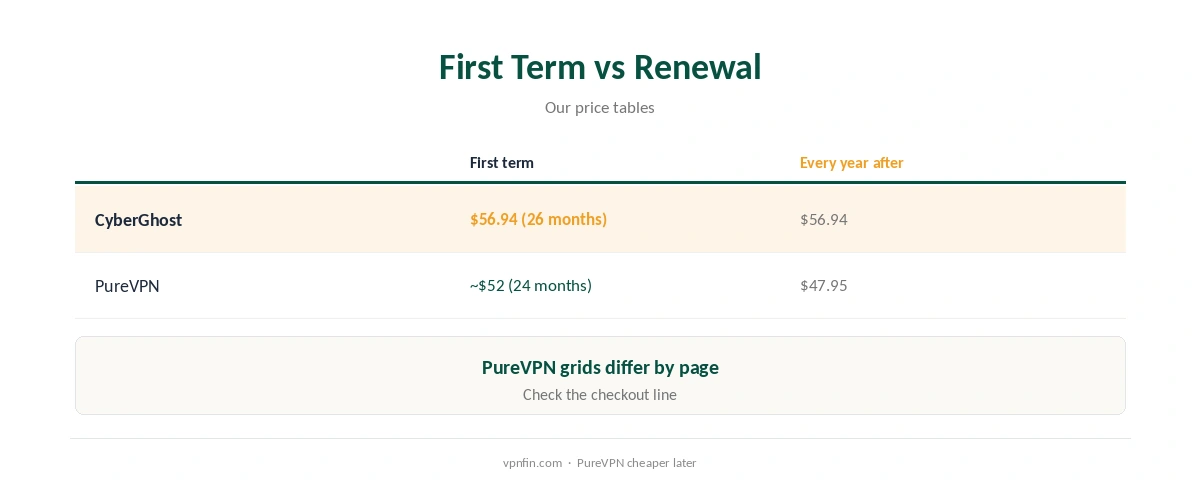
CyberGhost costs about $2.19 a month on a 26-month plan, $56.94 up front, and renews at $56.94 a year. PureVPN costs about $2.15 a month on two years, around $52 up front, and renews at $47.95 a year on its order page; its deals page lists $54.95. Our CyberGhost price guide and PureVPN price guide cover the grids.
Refunds and Trials
CyberGhost refunds within 45 days on long plans, 14 on monthly, and offers a 24-hour desktop trial without a card. PureVPN refunds within 31 days and offers a seven-day paid trial. Our CyberGhost refund guide explains its rules.
Devices
PureVPN allows 10 devices, up to 50 with a paid add-on. CyberGhost allows seven, with a router counting as one. Larger households lean towards PureVPN.
Streaming
Both run streaming-optimised servers. Our CyberGhost Netflix guide and PureVPN troubleshooting guide cover each provider’s libraries and fixes.
Apps and Platforms
CyberGhost covers Windows, Mac, iOS, Android, Android TV and Fire TV, though it has no Vega OS app, Gizmodo and Security.org found. PureVPN lists Fire TV models from the second generation onwards, and its download page does not name Vega OS. Our Vega OS VPN guide covers Amazon’s newest sticks.
Split Tunnelling
PureVPN offers split tunnelling in its Fire TV and Android TV apps, its release notes say. CyberGhost offers it in its Windows and Android apps. Our split tunnelling guide explains the feature.
Routers
CyberGhost supports ASUS routers through VPN Fusion on recent firmware, ASUS’s FAQ notes. A router counts as one of its seven devices. Our router setup guide covers the options.
Free Trials
CyberGhost’s 24-hour desktop trial needs no card, our refund table records, which makes it the easier one to try. PureVPN’s seven-day trial is paid.
Speed
Both run WireGuard in their apps. Test each on your own line during its refund window, at the time you usually stream, since results vary by route and server load.
Torrenting
Both allow P2P on dedicated servers. Neither is the strongest torrent choice; our torrenting VPN guide compares providers with port forwarding.
Support
Check each provider’s support channels during the refund window with a question about your own device, since help with routers and TVs varies.
Several Devices at Home
A family with eight or more devices fits PureVPN’s 10 without the add-on. CyberGhost’s seven can stretch with a router, which counts as one device.
Checking for Leaks
Whichever you choose, run our DNS leak guide after connecting and test the kill switch by switching Wi-Fi off and on.
Price Over Three Years
Using our tables, CyberGhost costs $56.94 for the first 26 months and $56.94 a year after. PureVPN costs about $52 for two years and $47.95 a year after on its order page. The gap grows each renewal, so long-term users save more with PureVPN, while CyberGhost’s longer refund suits cautious first-time buyers.
Quick Check
At checkout, note the first-term price, the renewal price and the renewal date for whichever you pick.
Streaming Servers
CyberGhost’s TV app groups streaming profiles by service, Gizmodo notes, and PureVPN’s Mac app lists more streaming shortcuts than its Windows app, Wizcase found. Both make picking a streaming server quick.
Kill Switch
Turn the kill switch on in either app after installing, then test it by switching Wi-Fi off and on.
Who Each Suits
CyberGhost suits first-time buyers who want time to decide. PureVPN suits households with many devices and anyone planning to renew for several years. Both suit streaming on a budget, with audits behind their no-logs claims and apps for most devices in the home. For a head-to-head, see our PureVPN vs TorGuard comparison.
Ownership Context
CyberGhost sits under Kape with ExpressVPN and PIA. PureVPN is part of a separate group operating from Pakistan. Our VPN ownership guide explains why that matters.
Who Should Pick Which
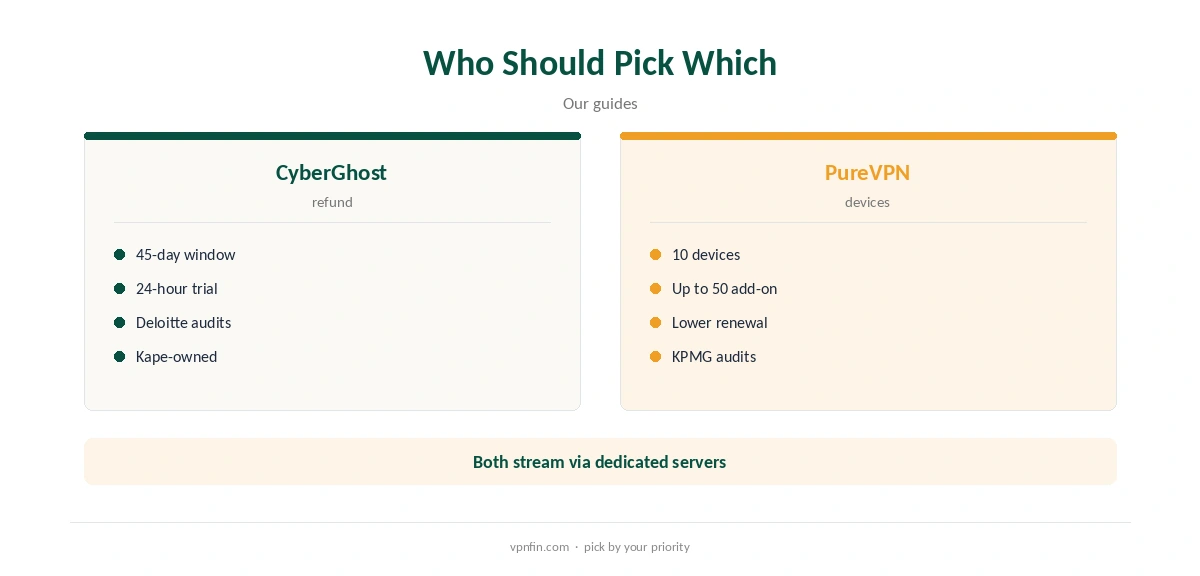
Pick CyberGhost for the longer refund window and Deloitte audits under Kape. Pick PureVPN for more devices and a lower renewal. Our NordVPN vs PureVPN page compares PureVPN with a market leader.
How We Research
This page draws on our audit, device, price, renewal and refund tables and our CyberGhost and PureVPN guides. We cross-checked these sources against each other, and where they conflict or something can’t be verified, we say so in the text rather than guessing. We checked time-sensitive figures, including prices in US dollars, on 8 October 2026. The main source we relied on is CyberGhost’s site. Our full approach lives on the About Us page.
CyberGhost vs PureVPN FAQ
CyberGhost for refunds; PureVPN for devices and renewal price.
PureVPN has four KPMG audits; CyberGhost three Deloitte audits.
Close at first; PureVPN renews lower at $47.95 a year.
CyberGhost, at 45 days on long plans.
Kape, which also owns ExpressVPN and PIA.
The Verdict
CyberGhost vs PureVPN: CyberGhost for a 45-day refund, PureVPN for 10 devices and cheaper renewals. Both are mid-priced with audits behind them.