
Disclosure: VPNFin is reader-supported. If you buy a VPN through links on this page, we may earn a commission at no extra cost to you. This never affects our ratings — here’s our full disclosure.
ExpressVPN vs PrivadoVPN is the widest price gap in this series. ExpressVPN, owned by Kape, lists 27 independent audits by May 2026 and renews its Basic plan at $99.95 a year for 10 devices. PrivadoVPN, organised under Icelandic law since May 2026, has no audit in our table but offers a free plan of 10 GB a month and Premium from $1.11 a month on two years, also for 10 devices.
This guide asks what the extra money buys, then compares free use, owners, features, streaming and fit.
What the Extra Money Buys
ExpressVPN’s price pays for a long audit record, including three KPMG no-logs reports and Cure53 tests of its apps and Lightway protocol, plus servers that run from memory under its TrustedServer design. PrivadoVPN’s price covers the essentials: WireGuard, a kill switch that passed TechRadar’s stress tests, split tunnelling and SOCKS5 on Premium.
If outside proof matters to you, the gap is worth paying. If you mainly want a working VPN for streaming and public Wi-Fi, PrivadoVPN covers that for far less.
ExpressVPN vs PrivadoVPN on Evidence
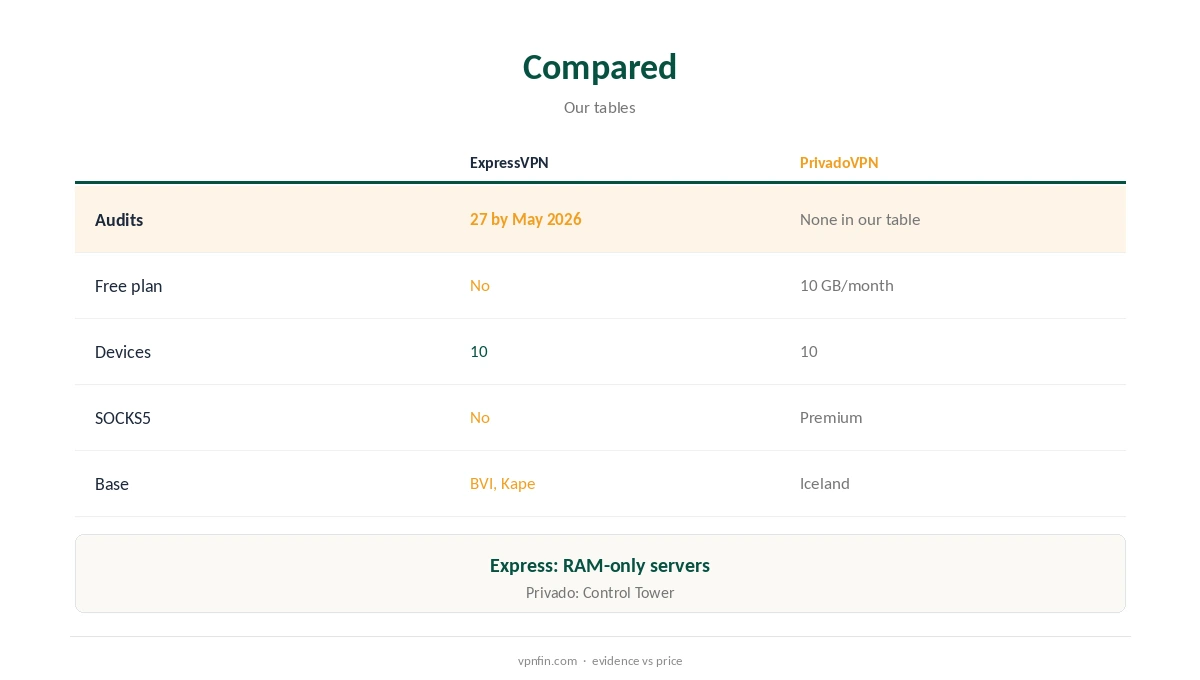
ExpressVPN’s 27 audits by May 2026 outnumber NordVPN’s six and Mullvad’s ten-plus in our table. PrivadoVPN has none in our table; one 2026 review describes its policy as independently audited, which we could not confirm. PCWorld notes PrivadoVPN collects device and traffic data to enforce plan limits.
Our VPN audit tracker explains what audits do and do not prove.
Free Use
The free tier also lets you check speeds on your own connection. If 10 GB runs out often, that is a sign to pay.
PrivadoVPN’s free plan gives 10 GB a month at full speed on one device, then moves you to slower servers, and Top10VPN found it opened US and UK Netflix. ExpressVPN has no free plan; new users get 30 days to ask for a refund.
For trying a VPN without paying, PrivadoVPN is the obvious start, and its free tier is generous for light use.
ExpressVPN vs PrivadoVPN: Yearly Cost
Introductory deals hide the real cost. Always compare renewal prices, not just the first bill.
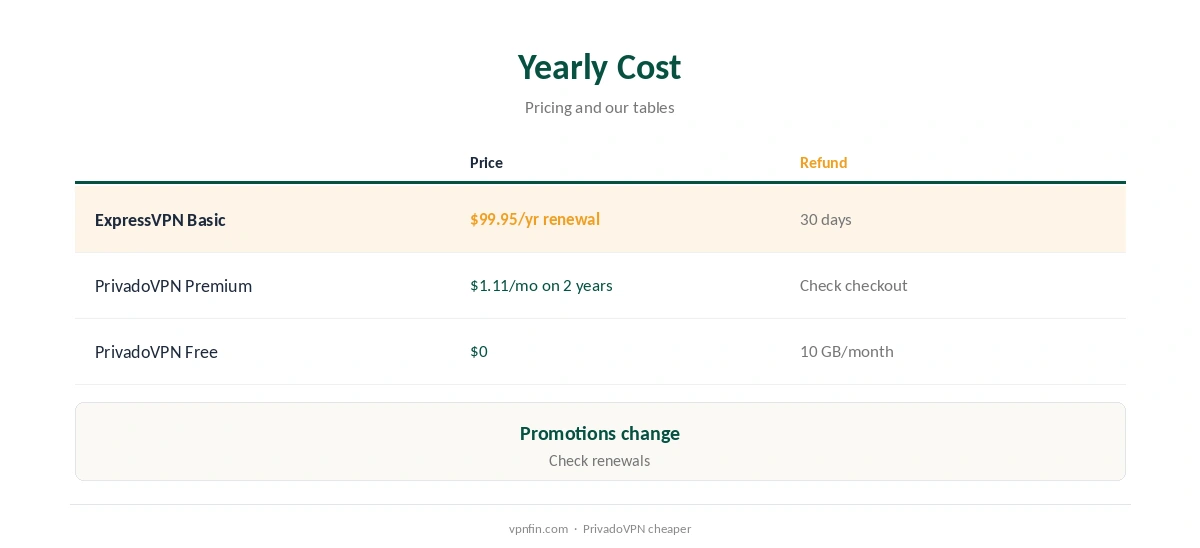
ExpressVPN renews at $99.95 a year on its Basic plan. PrivadoVPN Premium costs $1.11 a month on a two-year plan, a small fraction of that, though you should check its renewal price at checkout.
Over three or four years, the difference adds up to hundreds of dollars. Our renewal price guide shows how renewals change the picture.
Owners and Jurisdiction
The audit record tells you more than the country on the company’s address.
Kape owns ExpressVPN along with CyberGhost and PIA, and review sites including vpnMentor and Wizcase, CyberInsider reports. ExpressVPN is based in the British Virgin Islands. PrivadoVPN moved from Switzerland to Iceland in May 2026, so some reviews still list Switzerland.
Our ExpressVPN safety guide covers Kape’s history.
Features
ExpressVPN’s Network Lock blocks traffic if the tunnel drops; PrivadoVPN’s newer per-app kill switch held up in TechRadar’s stress tests, though its on-screen explanation was imprecise.
ExpressVPN offers Lightway with post-quantum key exchange, Network Lock and split tunnelling on several platforms. PrivadoVPN adds SOCKS5 on Premium and Control Tower, a DNS blocker for malicious sites, ads, social networks and adult content.
Torrent users may prefer PrivadoVPN’s SOCKS5; Mac and iPhone users get a polished Lightway experience from ExpressVPN.
Streaming
For live sport and US channels, more server cities help when a service blocks one; for occasional Netflix, PrivadoVPN’s results show a budget plan can be enough.
VPNOverview found PrivadoVPN opening Netflix in the US, UK, Australia, Brazil and Japan in 2026. ExpressVPN has strong streaming results in our earlier guides, with servers in many US cities.
Test the services you use within each refund or free window, since results change.
Who Each Is For
Neither is a bad choice. They simply aim at different budgets and different levels of proof.
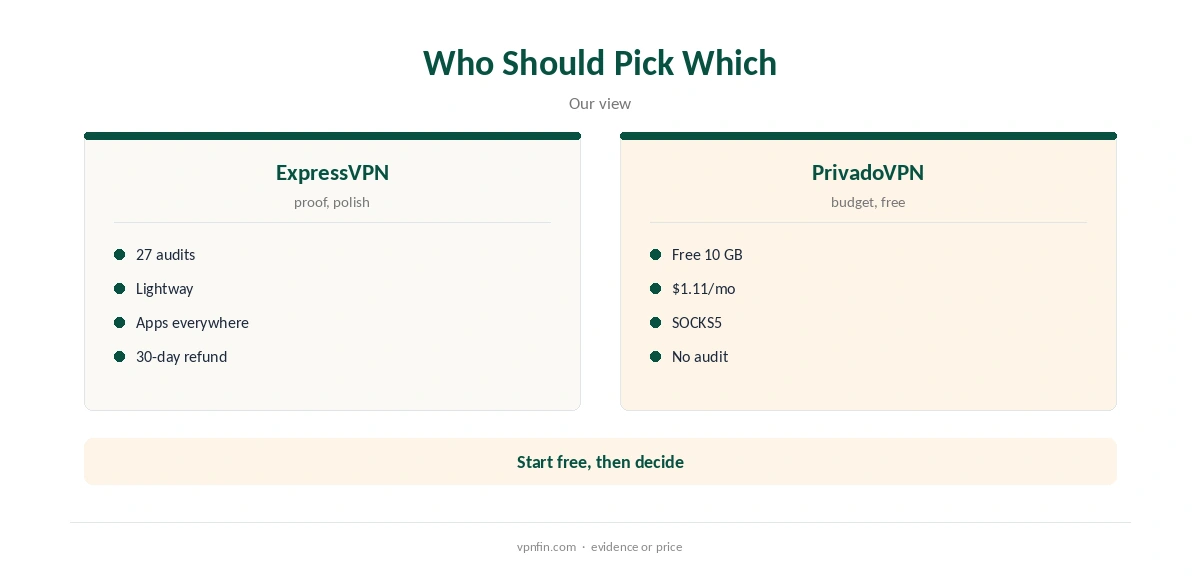
ExpressVPN suits people who want the deepest audit record and polished apps on every platform and accept a premium price. PrivadoVPN suits people who want a free start, the lowest paid price and SOCKS5, and accept a thinner evidence record.
Starting on PrivadoVPN’s free plan costs nothing and shows what you actually need.
TVs and Linux
PrivadoVPN’s Fire TV app works on all its plans, its blog says, while its Linux support is for Premium only, through the command line or Network Manager. ExpressVPN offers TV apps too, with sign-in by QR code on Google TV, our tables record.
Owners of Amazon’s newer Vega OS sticks should check each provider’s support first.
Refunds
Ask in writing before the window closes.
ExpressVPN gives new users 30 days to ask for a refund. PrivadoVPN’s free plan works as a no-cost trial before you pay for Premium. For a head-to-head, see our PureVPN vs PrivadoVPN comparison.
Keep your order number for any refund request.
How We Research
This page draws on CyberInsider’s report on Kape, PrivadoVPN’s Wikipedia entry, VPNOverview’s, Top10VPN’s, PCWorld’s and TechRadar’s PrivadoVPN coverage and our audit and price tables. We cross-checked these sources against each other, and where they conflict or something can’t be verified, we say so in the text rather than guessing. We checked time-sensitive figures, including prices in US dollars, on 8 October 2026. The main source we relied on is PrivadoVPN’s Wikipedia entry. Our full approach lives on the About Us page.
ExpressVPN vs PrivadoVPN FAQ
ExpressVPN for audits and polish; PrivadoVPN for price and a free plan.
Not in our table; ExpressVPN lists 27 audits.
Yes, 10 GB a month on one device.
Its Basic plan renews at $99.95 a year.
Iceland, since May 2026.
The Verdict
ExpressVPN vs PrivadoVPN: ExpressVPN for proven privacy at a premium; PrivadoVPN for a free start and the lowest paid price.