
Disclosure: VPNFin is reader-supported. If you buy a VPN through links on this page, we may earn a commission at no extra cost to you. This never affects our ratings — here’s our full disclosure.
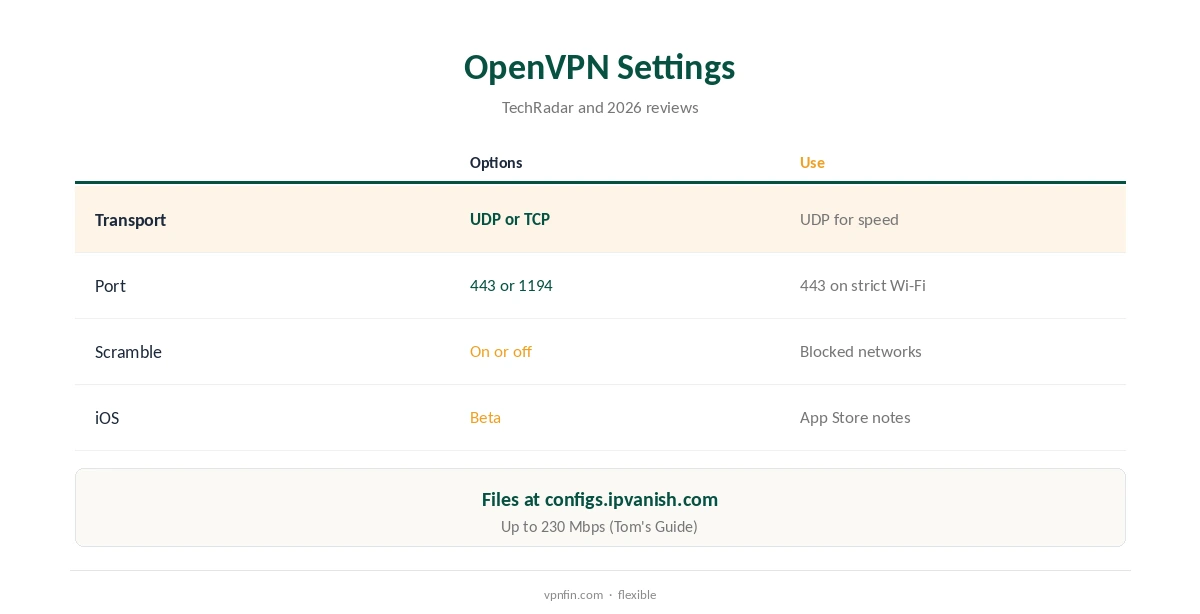
IPVanish OpenVPN support is unusually configurable. The apps let you choose UDP or TCP and port 443 or 1194, TechRadar notes, and add Scramble, which disguises OpenVPN traffic on networks that block VPNs. IPVanish also publishes OpenVPN configuration files for Linux, routers and NAS devices, where it has no app. WireGuard is faster, but OpenVPN is the protocol that gets through.
This guide covers the settings, Scramble, manual setups, speed and when to choose OpenVPN.
IPVanish OpenVPN Settings
On Windows, you can switch between WireGuard, IKEv2 and OpenVPN over TCP or UDP, and pick port 1194 or 443 for OpenVPN, TechRadar’s review describes. The Apple TV app gained OpenVPN with configurable ports and Scramble in July 2026.
The iPhone app added OpenVPN as a beta, IPVanish’s App Store notes say. Our IPVanish WireGuard guide covers the faster default.
UDP or TCP, and Scramble
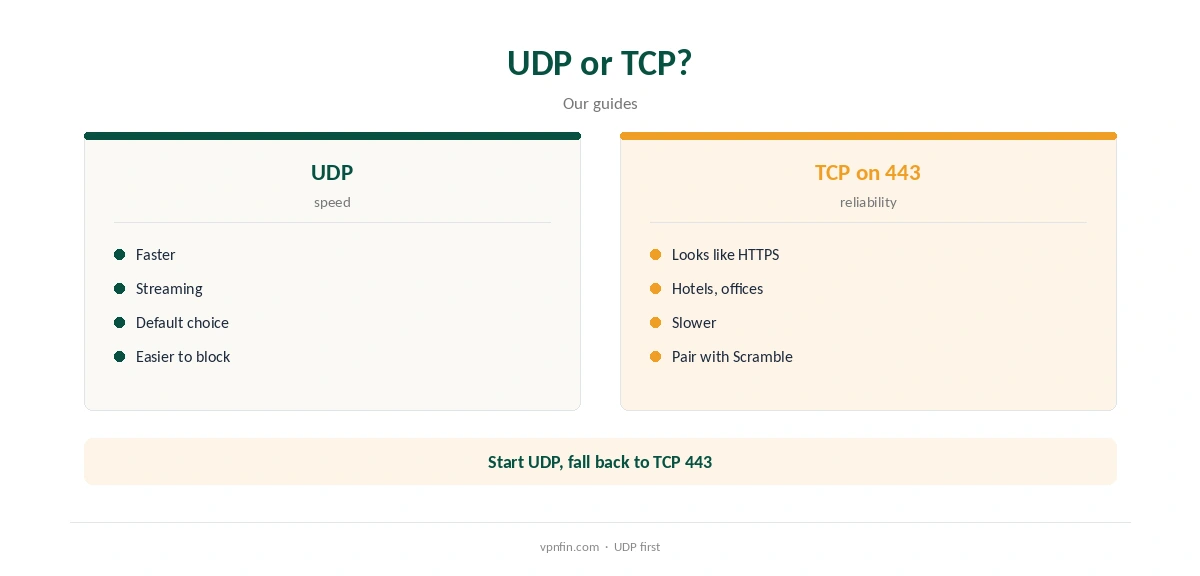
UDP is faster and suits streaming, gaming and everyday use. TCP is more reliable on poor, crowded or filtered networks, and on port 443 it resembles ordinary secure web traffic, which helps on hotel and office Wi-Fi.
Start with UDP, and switch to TCP on 443 if connections drop or will not start; that pair covers most networks.
Scramble disguises OpenVPN traffic so networks that block VPNs are less likely to detect it, TechRadar explains; it works on local Wi-Fi blocks rather than national firewalls such as China’s. It applies only to OpenVPN.
Turn it on only when needed, since it costs some speed on every connection. Our VPN obfuscation guide explains how it works.
Manual Setups and Routers
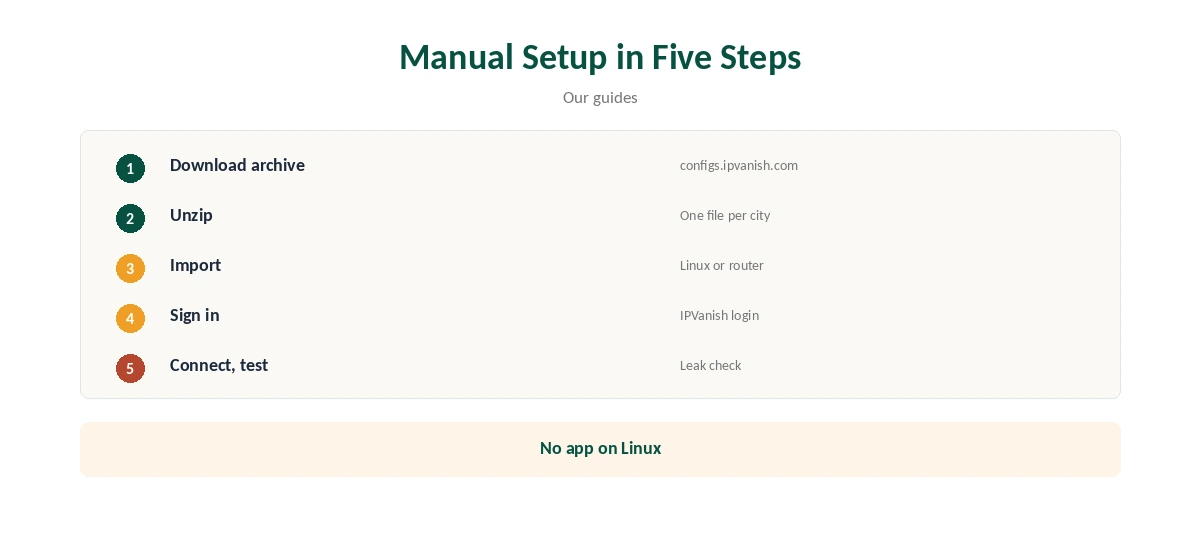
Download the OpenVPN configuration archive from configs.ipvanish.com and sign in with your IPVanish username and password. That covers Linux, Raspberry Pi, Synology NAS devices and routers running DD-WRT, Asus or Tomato firmware.
Each file covers one server location, so download a few files for the countries you use most. Our IPVanish Linux guide walks through it.
Routers running DD-WRT, Asus or Tomato firmware use IPVanish’s OpenVPN files, while GL.iNet routers connect over WireGuard with IPVanish built in, GL.iNet’s documentation shows. OpenVPN loads a router’s processor more heavily.
Our IPVanish router guide covers each firmware.
Kill Switch, Leaks and Troubleshooting
In the apps, IPVanish’s kill switch covers the connection whichever protocol you choose; Security.org found it cut traffic within a second in desktop tests. Manual OpenVPN setups on Linux or routers have no kill switch, so add your own firewall rules.
Run a DNS leak test after any manual setup, and repeat it after changing servers.
Speed, and When to Choose IPVanish OpenVPN
Tom’s Guide measured OpenVPN at up to 230 Mbps, up from 180 Mbps in an earlier test round, while WireGuard is faster still, VPNpro found. On a router, OpenVPN loads the processor more than WireGuard.
Use OpenVPN where you need its reach, and WireGuard where speed matters most, such as 4K streaming or big downloads.
If OpenVPN will not connect, switch from UDP to TCP, then from port 1194 to 443, then turn on Scramble. With manual files, re-download the archive, since server addresses change over time.
Authentication errors usually mean a mistyped username or password in the client, or an expired subscription.
Choose OpenVPN for networks that block WireGuard or IKEv2 outright, for manual setups on Linux and older routers, and when you want TCP on port 443. Keep WireGuard for everyday speed on phones and computers.
Our WireGuard vs OpenVPN guide compares the protocols.
Price and Privacy
IPVanish costs $57.22 for the first 24 months and renews at $89.99 a year, VPNOverview lists, with no device limit. Yearly website plans carry a 30-day refund; monthly plans carry none.
IPVanish’s no-logs policy has two audits in our table, by Leviathan in 2022 and Schellman in 2025.
Encryption
IPVanish documents AES-256-GCM for OpenVPN with TLS-based key exchange, a 2026 review notes, the same family of ciphers most providers use. OpenVPN’s long track record and open code are its main security strengths.
The protocol choice affects speed and reach more than security, since WireGuard and IKEv2 are also strong choices.
On Apple TV and iPhone
IPVanish’s Apple TV app, updated in July 2026, offers OpenVPN over UDP or TCP with configurable ports and Scramble, a 2026 comparison notes. On iPhone, OpenVPN arrived as a beta, the App Store notes say.
On both, WireGuard remains the faster everyday choice; keep OpenVPN for networks that block it.
OpenVPN on Linux
IPVanish has no Linux app, so OpenVPN files are the route there: install the openvpn package or use NetworkManager’s OpenVPN plugin, import a configuration file and sign in. Scramble is an app feature, so it is not available in a manual Linux setup.
Our IPVanish Raspberry Pi guide covers the same steps on a Pi.
How We Research
This page draws on TechRadar’s and Tom’s Guide’s IPVanish reviews, IPVanish’s App Store notes, a 2026 comparison covering the Apple TV update and our IPVanish tables. We cross-checked these sources against each other, and where they conflict or something can’t be verified, we say so in the text rather than guessing. We checked time-sensitive figures, including prices in US dollars, on 8 October 2026. The main source we relied on is TechRadar’s IPVanish review. Our full approach lives on the About Us page.
IPVanish OpenVPN FAQ
Yes, over UDP or TCP, in its apps and as manual files.
443 or 1194, selectable in the apps.
Disguises OpenVPN traffic on networks that block VPNs.
No; WireGuard is faster.
configs.ipvanish.com.
The Verdict
IPVanish OpenVPN is the flexible option: TCP on 443 and Scramble for blocked networks, and files for devices without apps. Use WireGuard for speed.