
Disclosure: VPNFin is reader-supported. If you buy a VPN through links on this page, we may earn a commission at no extra cost to you. This never affects our ratings — here’s our full disclosure.
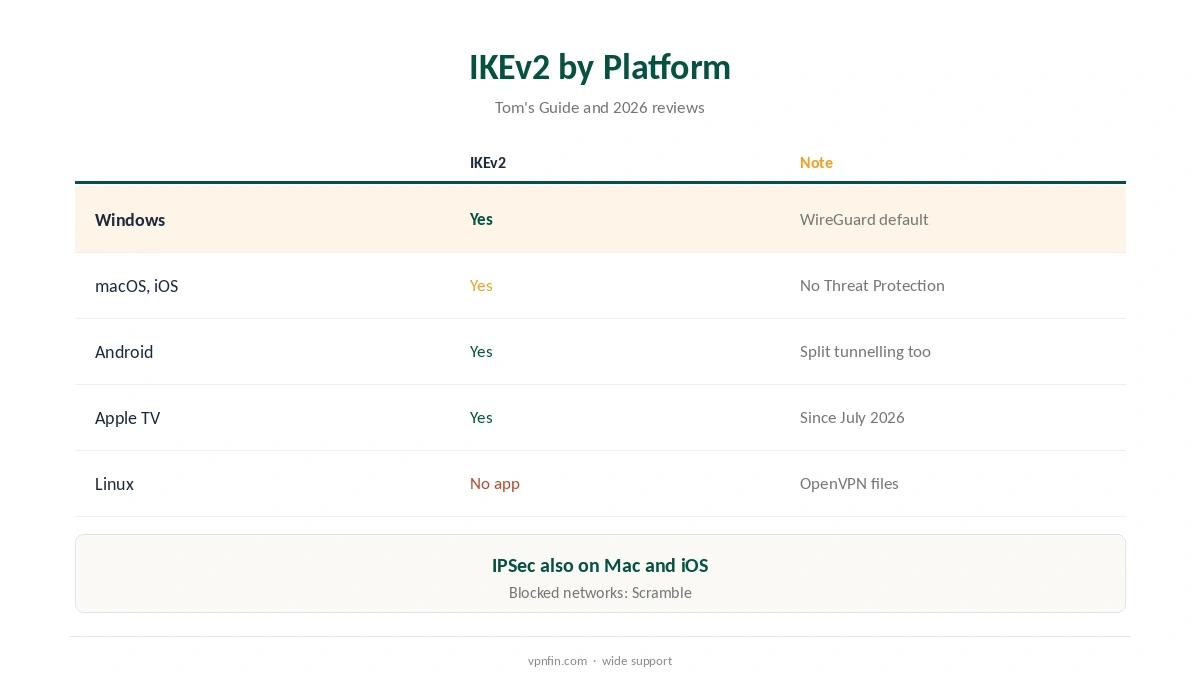
IPVanish IKEv2 support is broad: Tom’s Guide lists it in the Windows, macOS, iOS and Android apps, and IPVanish’s Apple TV app added it in July 2026 alongside WireGuard and OpenVPN. IKEv2 reconnects quickly when a phone moves between networks, which suits iPhones. One catch: on macOS and iOS, IPVanish’s Threat Protection does not work over IKEv2, Tom’s Guide notes.
This guide covers where IKEv2 works, how to switch, when it helps, its limits and how it compares with WireGuard.
Where IPVanish IKEv2 Works
The Windows, macOS, iOS and Android apps support WireGuard, OpenVPN and IKEv2, Tom’s Guide reports, and the Mac and iOS apps add IPSec. IPVanish’s Apple TV app gained IKEv2 in its July 2026 update, a 2026 comparison notes, alongside WireGuard.
On Linux, IPVanish has no app, so IKEv2 is not an app option there. Our IPVanish WireGuard guide covers the default protocol.
Switching to IKEv2, and When It Helps
Open the IPVanish app’s settings menu, choose the connection or protocol option and select IKEv2, then reconnect to a nearby server. On iPhone, the app may prompt you to allow a VPN configuration again; tap Allow and enter your passcode.
Note which protocol you used before, so you can switch back easily if IKEv2 does not suit your networks.
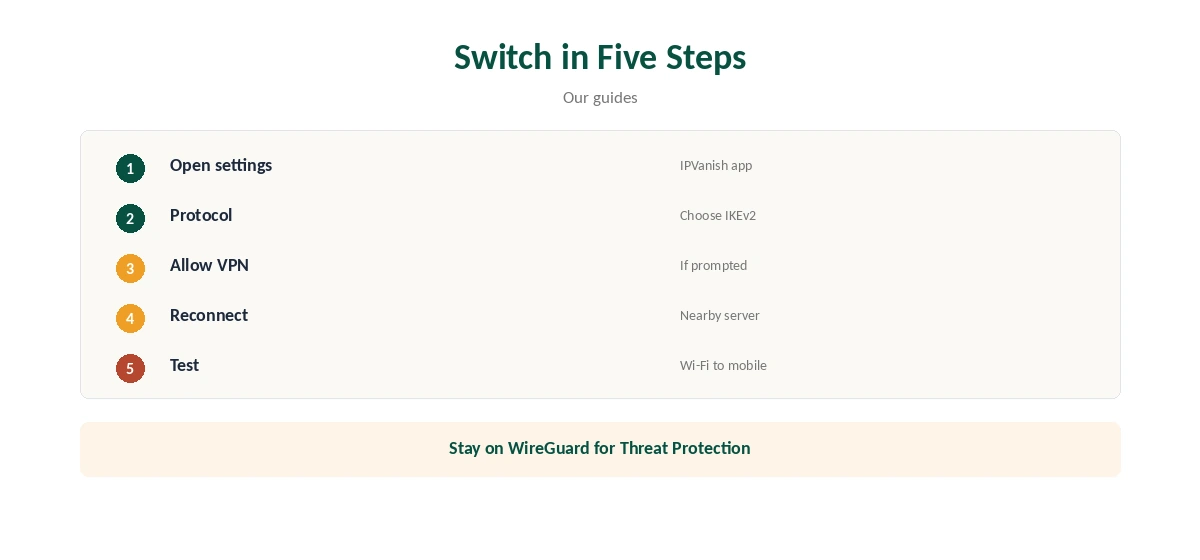
IKEv2 keeps connections steady as a phone switches between Wi-Fi and mobile data, and iOS handles it natively, a 2026 review notes, describing it as a good everyday choice on iPhone.
On a laptop that stays on one network, WireGuard is usually the faster option and keeps Threat Protection available.
IPSec on Mac and iOS, and Battery Use
The Mac and iOS apps also list IPSec, Tom’s Guide notes, an older option kept for compatibility. Like IKEv2, it disables Threat Protection on those platforms.
There is little reason to choose it over WireGuard or IKEv2 today, unless a specific network only accepts it.
Because iOS handles IKEv2 natively, a 2026 review found it among the lightest options on iPhone battery. WireGuard is also light, so test both on your own phone over a normal day.
If battery matters most, compare an ordinary day on each protocol rather than relying on general claims.
The Threat Protection Catch and Other Limits
IPVanish’s Threat Protection, which blocks malicious sites, ads and trackers, works only with WireGuard and OpenVPN on macOS and iOS, Tom’s Guide notes. Choosing IKEv2 or IPSec there switches it off.
If you rely on Threat Protection on an iPhone or Mac, stay on WireGuard, or use similar protection from another tool.
IKEv2 uses UDP port 500, which some networks block, and it offers no obfuscation, so firewalls can spot it easily. On restrictive networks, OpenVPN with Scramble is IPVanish’s better option.
Our IPVanish OpenVPN guide covers Scramble and ports.
IPVanish IKEv2 or WireGuard, and Price
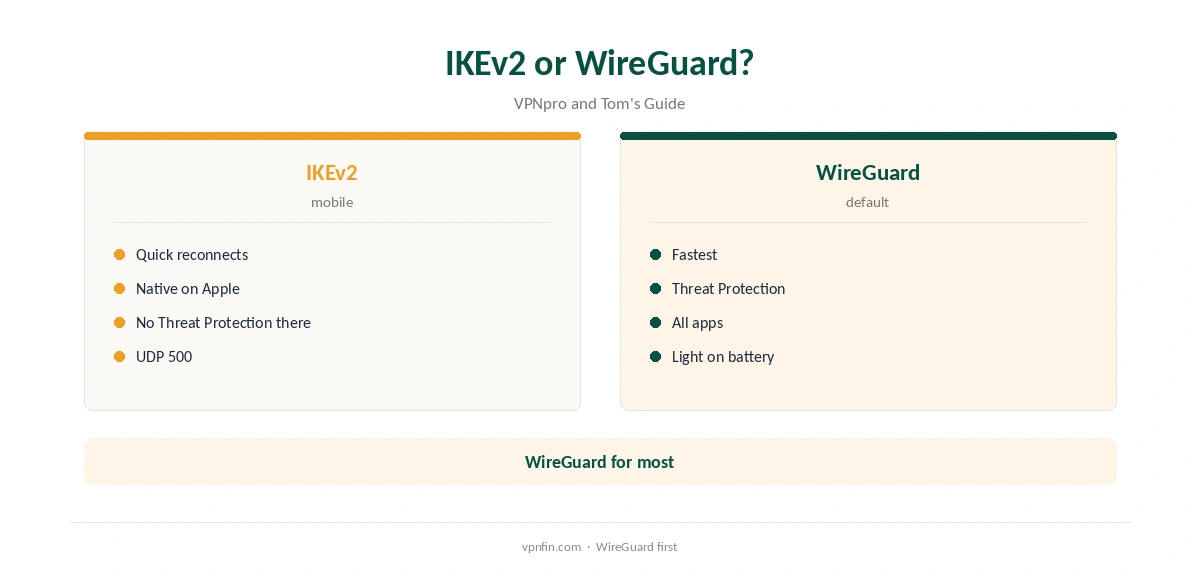
WireGuard is IPVanish’s fastest protocol, VPNpro found, and the apps’ default, Comparitech notes. IKEv2’s advantage is smooth reconnection on mobile and native handling on Apple devices. For a desktop on a stable connection, WireGuard wins.
Our IKEv2 vs WireGuard guide compares them in more depth.
Troubleshooting
If IKEv2 will not connect, the network may block UDP port 500; switch to WireGuard or OpenVPN with Scramble. If connections drop when you move between Wi-Fi and mobile data on other protocols, try IKEv2 for that phone.
Update the app first; protocol options change between versions. Our IPVanish troubleshooting guide lists more fixes.
IPVanish costs $57.22 for the first 24 months and renews at $89.99 a year, VPNOverview lists, with no device limit. Yearly website plans carry a 30-day refund; monthly plans carry none.
IPVanish’s no-logs policy has two audits in our table, by Leviathan in 2022 and Schellman in 2025.
What IKEv2 Does Differently
IKEv2 negotiates the keys for an IPsec tunnel and can keep that tunnel alive when your device’s address changes, which is why it copes well with a phone moving from home Wi-Fi to mobile data. WireGuard reconnects quickly too, but IKEv2 is built directly into Apple’s systems.
On Windows and Android, IPVanish keeps WireGuard as the default and IKEv2 as an alternative for networks where WireGuard misbehaves.
On Apple TV
The July 2026 update gave IPVanish’s Apple TV app WireGuard, OpenVPN with Scramble and IKEv2 together. On a TV that stays on one network, WireGuard is the faster pick for streaming in 4K.
Our IPVanish Apple TV guide covers setup.
Checking Your Connection
After switching, confirm the app clearly shows IKEv2 as the active protocol, then test by moving from Wi-Fi to mobile data and back. The VPN should stay connected or reconnect within a few seconds.
Run a DNS leak test as well, since leaks are usually a setup issue rather than a protocol one.
How We Research
This page draws on Tom’s Guide’s and Comparitech’s IPVanish reviews, a 2026 IPVanish comparison covering the Apple TV update, a 2026 protocol review and our IPVanish tables. We cross-checked these sources against each other, and where they conflict or something can’t be verified, we say so in the text rather than guessing. We checked time-sensitive figures, including prices in US dollars, on 8 October 2026. The main source we relied on is Tom’s Guide’s IPVanish review. Our full approach lives on the About Us page.
IPVanish IKEv2 FAQ
Yes, on Windows, macOS, iOS, Android and Apple TV.
Not on macOS and iOS, Tom’s Guide notes.
Yes, for quick reconnection between networks.
Usually not; WireGuard is IPVanish’s fastest.
Switch to OpenVPN with Scramble.
The Verdict
IPVanish IKEv2 support is wide and suits iPhones that hop networks. Use WireGuard elsewhere, and on Apple devices if you want Threat Protection.