
Disclosure: VPNFin is reader-supported. If you buy a VPN through links on this page, we may earn a commission at no extra cost to you. This never affects our ratings — here’s our full disclosure.
Is a VPN legal in Vietnam? Using one is, and nothing in Vietnamese law penalises it. What changed in August 2026 is the rule for helping others. The government issued Decree 330/2026 on 19 August. It fines individuals 10 to 20 million đồng for instructing others or sharing methods to reach sites and platforms restricted by law, The Vietnamese Magazine reported. Organisations face double that.
So the tool is legal, and teaching people how to reach blocked sites now carries a fine. This page explains both rules, and why no one can say exactly which sites count as blocked.
Is a VPN Legal in Vietnam? The Short Answer
Using a VPN is legal. Tuổi Trẻ, one of Vietnam’s largest newspapers, wrote in October 2025 that Vietnamese law does not prohibit using VPNs. Users must still follow cybersecurity and intellectual property rules.
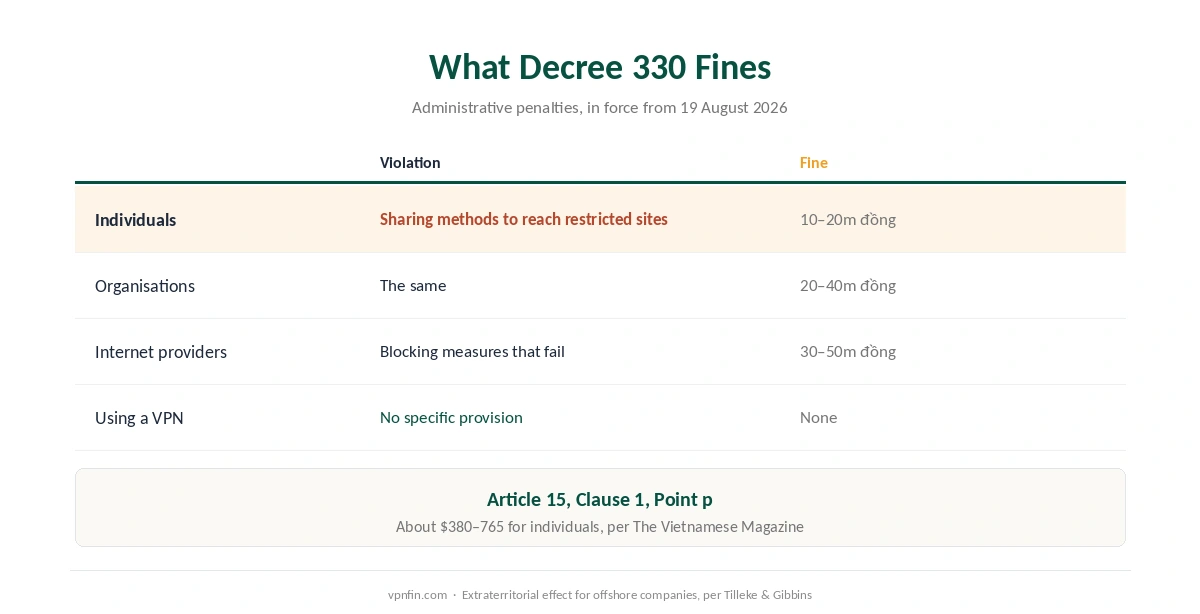
Sharing methods to reach blocked sites is now fined. Decree 330 adds this to the list of administrative cybersecurity violations for the first time. Individuals face 10 to 20 million đồng, a few hundred US dollars at current rates.
Illegal acts stay illegal. The Cybersecurity Law targets what you do, not the tool, a corporate services firm, PCA, notes. Our guide to a VPN for Vietnam covers the practical picture.
What Decree 330 Changed
| Who | Violation | Fine |
|---|---|---|
| Individuals | Instructing or sharing methods to reach restricted sites | 10–20 million đồng |
| Organisations | The same | 20–40 million đồng |
| Internet providers | Failing to keep blocking measures working | 30–50 million đồng |
| Anyone fined | Confiscation of tools; deletion of information | Additional measures |
The decree took effect the day the government issued it, 19 August 2026. The fine for sharing methods sits in Point p, Clause 1 of Article 15, per The Vietnamese Magazine’s translation of a Luật Khoa report.
Before it, there was no such rule. No provision specifically penalised using VPNs or changing DNS settings to reach blocked sites, the report notes. Lawyers regarded that as a legal gap. A 2020 Luật Khoa analysis concluded that reaching information sites this way did not break Vietnamese law.
It also reaches beyond Vietnam. Law firm Tilleke & Gibbins notes that Decree 330 has extraterritorial effect and applies to offshore companies as well.
The Problem: No Published Block List
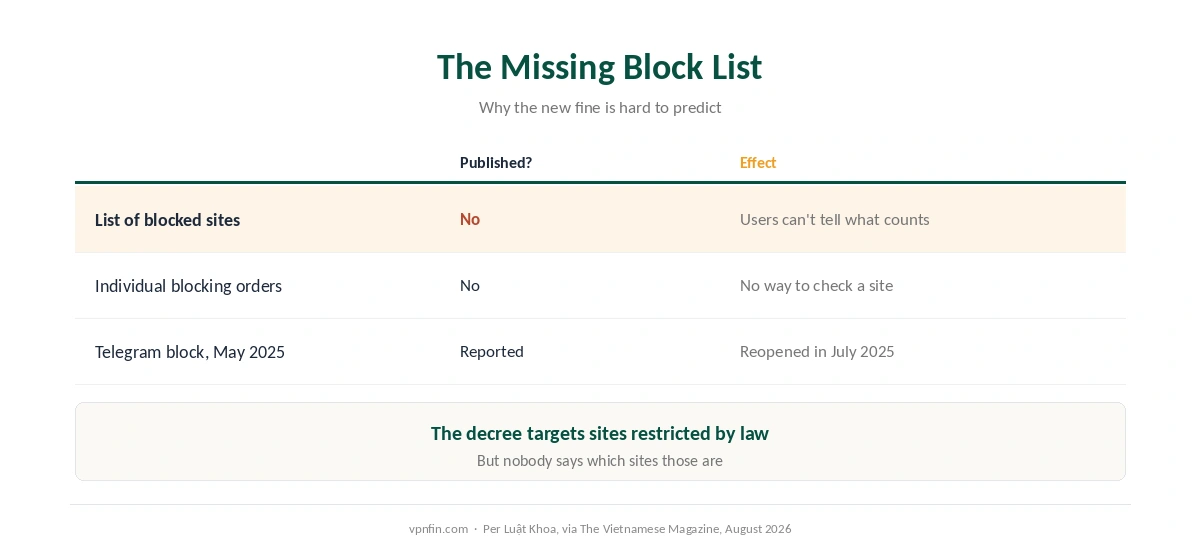
Nobody publishes which sites the state blocks. No government agency or legal document lists them, The Vietnamese Magazine reports. Authorities have not released the individual blocking decisions either.
That makes the new fine hard to predict. The decree targets methods for reaching sites restricted in accordance with the law, but the public cannot tell which sites those are.
Blocks do happen, which is why the question of whether a VPN is legal in Vietnam keeps coming up. Authorities ordered providers to block Telegram in May 2025, and it reopened unexpectedly in July, as our Vietnam guide records.
Is a VPN Legal in Vietnam for Travellers and Workers?
Yes, for ordinary use. Remote work, company networks, banking and protecting a connection on hotel Wi-Fi are uses that neither law targets. Our public Wi-Fi guide and our travel guide cover these.
What we will not do is tell you how to reach blocked sites. Our editorial policy for restricted countries already rules that out. Decree 330 now fines sharing such methods, and it can apply to offshore companies.
Decree 147 governs the platforms. Issued on 9 November 2024 and in force since 25 December 2024, it sets rules for offshore service providers, KPMG notes. It regulates services, not individual VPN users.
What a VPN hides, and what it doesn’t. Your provider sees a connection to a VPN server rather than the sites you visit, as our guide to what a VPN hides explains. An audited no-logs provider such as NordVPN keeps no record of that activity either.
How Vietnam Compares
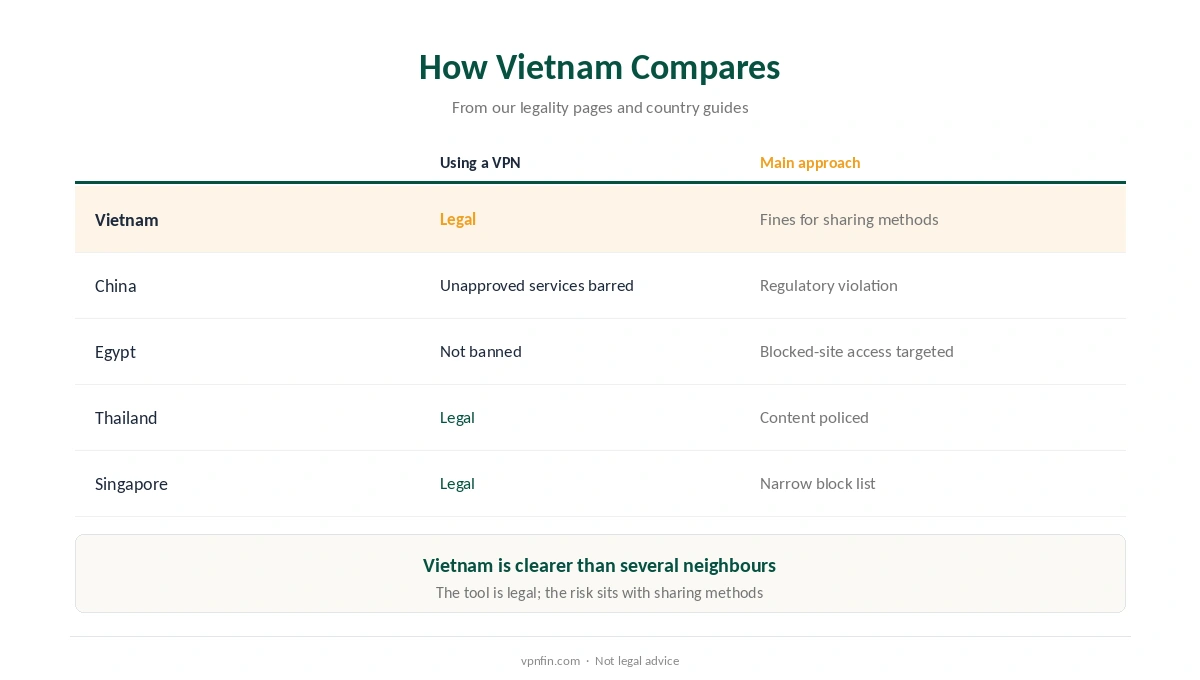
China treats unapproved VPN services as a regulatory violation, as our China legality page explains; Vietnam does not ban the tool. Egypt targets access to blocked sites itself, as our Egypt page sets out.
Further west, Pakistan relies on registration rather than bans, a softer model than either.
In Southeast Asia, Thailand and Singapore also allow VPNs while policing content.
So is a VPN legal in Vietnam by regional standards? Yes, and more clearly than in several neighbours. Our country-by-country guide compares every country we cover.
How We Research
Decree 330’s provisions come from The Vietnamese Magazine’s translation of Luật Khoa’s August 2026 report, which quotes the decree’s articles. Its extraterritorial scope comes from Tilleke & Gibbins. The position on VPN use comes from Tuổi Trẻ and Luật Khoa as cited there, the Cybersecurity Law reading from PCA, and Decree 147 from KPMG. We are not lawyers, and this is not legal advice. We name each source where used; all were read on 27 September 2026. Our full approach lives on the About Us page.
Vietnam VPN Legality FAQ
Yes. Vietnamese law does not prohibit using a VPN. Illegal acts remain illegal with or without one.
A decree on administrative penalties in cybersecurity and data protection, in force since 19 August 2026. It fines individuals 10 to 20 million đồng for sharing methods to reach restricted sites.
Explaining how to reach sites restricted by law is now an administrative violation under Decree 330. Explaining VPNs in general is not what the decree describes.
The government publishes no official list. Authorities have not released the individual blocking decisions, which makes the new rule hard to apply.
Yes, for ordinary uses such as work, banking and protecting a connection on public Wi-Fi.
The Verdict
A VPN is legal in Vietnam, and using one for work, travel or privacy raises no legal issue.
Since August 2026, though, sharing methods to reach restricted sites carries a fine, and no one publishes which sites those are.