
Disclosure: VPNFin is reader-supported. If you buy a VPN through links on this page, we may earn a commission at no extra cost to you. This never affects our ratings — here’s our full disclosure.
Is a VPN legal in Ukraine? Yes, including under martial law, which has been in force since February 2022. Ukraine does block some sites, but the blocks date from 2017 and aim at Russian services. The government placed VK, Mail.ru, Yandex and Kaspersky under sanctions that year and has renewed them repeatedly, Freedom House notes. The sanctions bind providers; we found no penalty for individuals who use a VPN.
This page explains the sanctions, the 2024 Telegram restriction that applies only to official devices, and the different position in occupied areas.
Is a VPN Legal in Ukraine? The Short Answer
Using a VPN is legal. No Ukrainian law restricts VPNs, and they are widely used, including by the millions of Ukrainians abroad. Our guide to a VPN for Ukraine covers Megogo, Ukrainian TV and servers.
Sanctions block Russian services. The blocks target the services and the providers that must block them. Freedom House notes that enforcement has been inconsistent and poorly monitored.
Occupied areas are different. Connections there run through Russian-controlled networks, and our Ukraine guide notes that VPN use carries real personal risk in those areas.
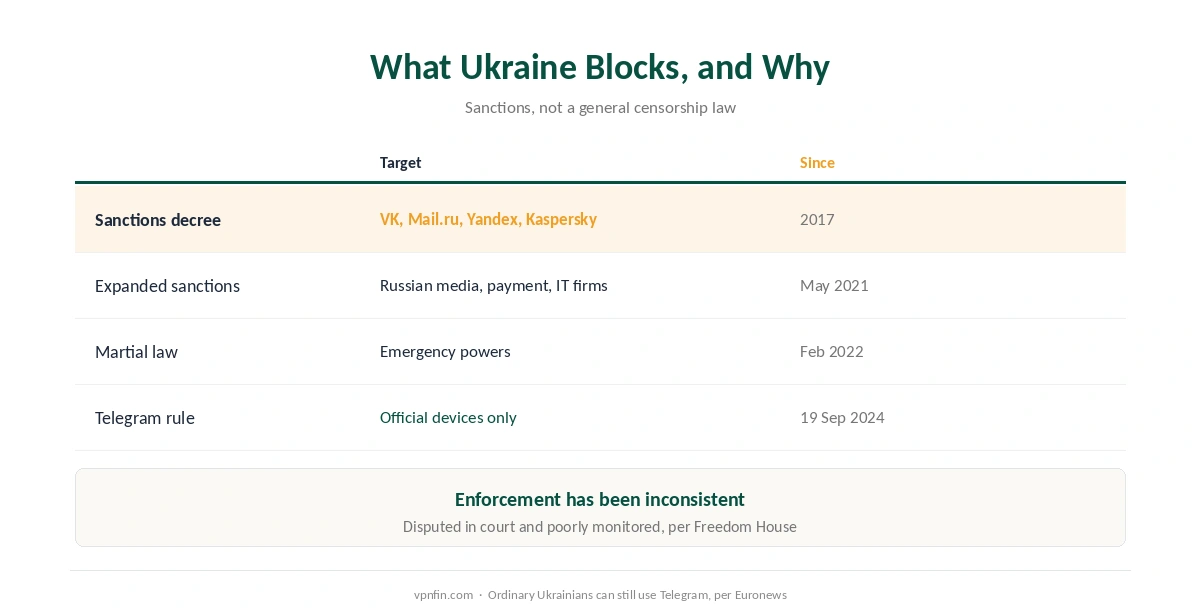
What Ukraine Blocks, and Why
| Measure | Target | Since |
|---|---|---|
| Sanctions decree | VK, Mail.ru, Yandex, Kaspersky and others | 2017, repeatedly renewed |
| Expanded sanctions | Russian and pro-Russian media, payment and IT firms | May 2021 |
| Martial law | Broad emergency powers | February 2022 |
| Telegram restriction | Official devices of state, military and critical infrastructure staff | 19 September 2024 |
The sanctions route is unusual. Blocking comes from national security sanctions decisions rather than a general censorship law, and its implementation has been disputed in court, Freedom House reports.
The Telegram restriction is narrow. Ukraine’s National Coordination Centre for Cybersecurity banned the app on official devices, citing Russian access to user data, but ordinary Ukrainians remain free to use it on personal devices, Euronews reported.
Is a VPN Legal in Ukraine Under Martial Law?
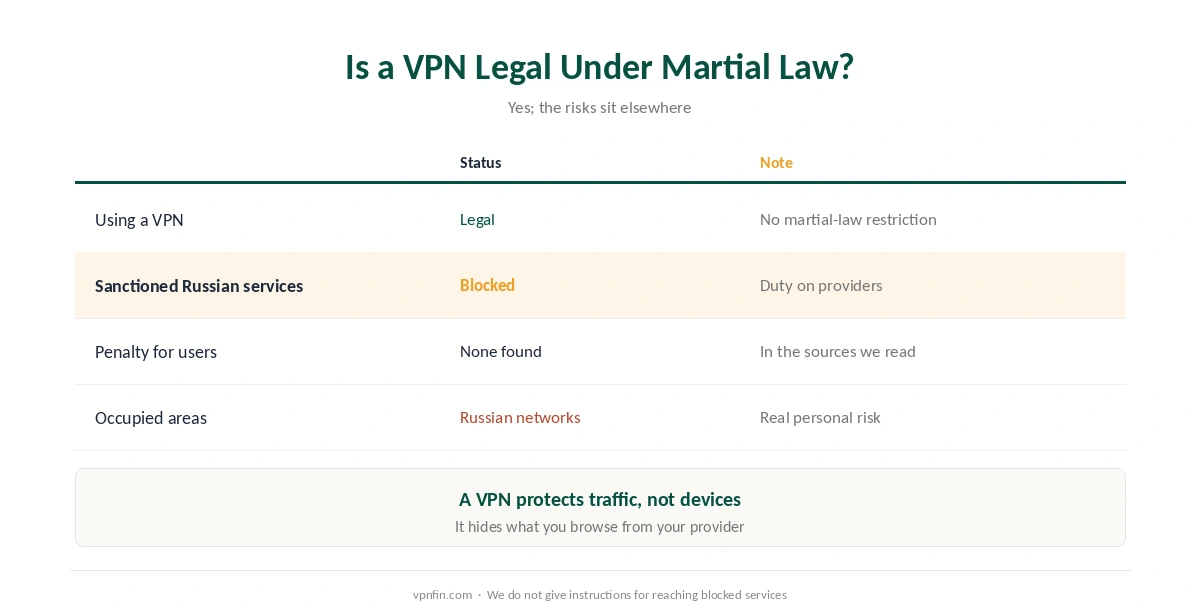
Yes. Martial law has not introduced any VPN restriction, and our Ukraine guide notes that officials have encouraged encrypted tools.
Reaching sanctioned Russian services is a different question. The sanctions oblige providers to block them; we found no rule penalising individuals, but we do not give instructions for reaching blocked services.
A VPN protects traffic, not devices. It hides what you browse from your provider, as our guide to what a VPN hides explains. For people near the front line, that distinction matters, and a provider’s no-logs record matters too.
Ukrainians Abroad
The diaspora uses VPNs to reach home. Megogo, Kyivstar TV and Ukrainian channels restrict full catalogues to Ukrainian addresses. That is a terms question, not a crime, as our Ukraine guide and our Netflix guide explain.
Server location matters. Of the providers Gizmodo tested, NordVPN alone opened both Megogo and Netflix Ukraine from Kyiv, as our NordVPN review covers. After connecting, check the address reads as Ukrainian.
Everyday uses need no permission, from travel and public Wi-Fi to banking abroad.
How Ukraine Compares
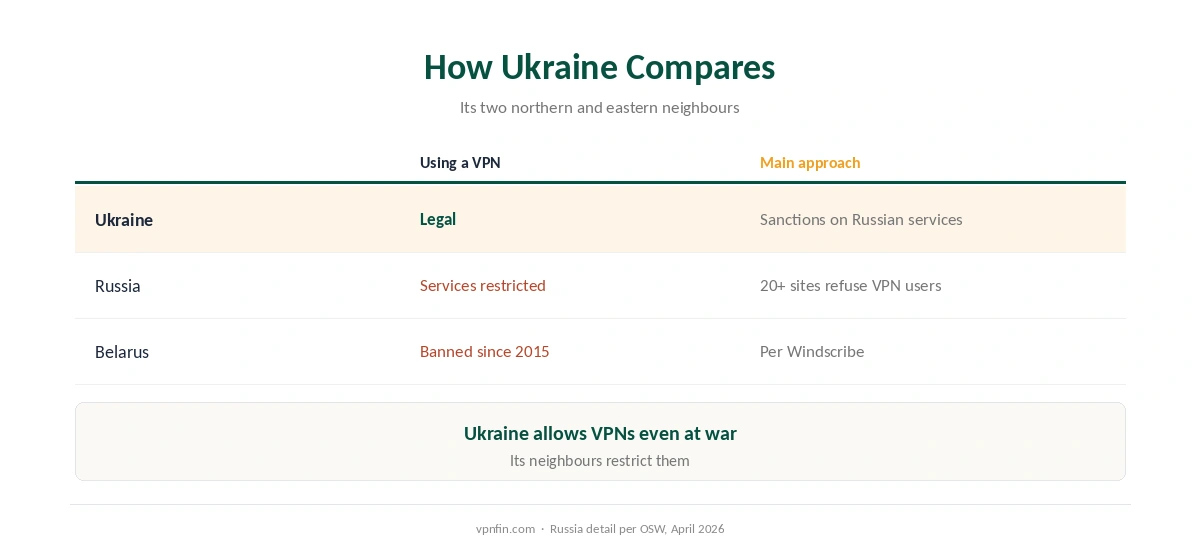
Russia is the contrast. It restricts VPN services, and since April 2026 more than 20 Russian services, including Gosuslugi and VK, restrict users on VPNs, OSW reported. Our Russia page explains the rules.
Belarus has banned VPNs since 2015, Windscribe’s legality guide notes. So is a VPN legal in Ukraine compared with its neighbours to the north? Clearly yes. Our country-by-country guide compares every country.
How We Research
The sanctions history comes from Freedom House’s Freedom on the Net 2024 report, the Telegram restriction from BleepingComputer and Euronews, and the Russian comparison from OSW. Streaming results come from our Ukraine guide and its sources. We are not lawyers, and this is not legal advice. We name each source where used; all were read on 27 September 2026. Our full approach lives on the About Us page.
Ukraine VPN Legality FAQ
Yes, including under martial law. No Ukrainian law restricts VPNs.
Ukraine placed them under national security sanctions in 2017 and has renewed the sanctions repeatedly. Providers must block them.
Only on official devices of state, military, security and critical infrastructure staff, since September 2024. Ordinary Ukrainians can still use it.
Yes. It is a terms question for each service, not a crime.
Connections there run through Russian-controlled networks, and VPN use carries real personal risk.
The Verdict
A VPN is legal in Ukraine, even under martial law.
Russian services remain blocked by sanctions, Telegram is barred only on official devices, and occupied areas carry risks of their own. For Ukrainians abroad, the answer to whether a VPN is legal in Ukraine matters less than whether a service allows it.