
Disclosure: VPNFin is reader-supported. If you buy a VPN through links on this page, we may earn a commission at no extra cost to you. This never affects our ratings — here’s our full disclosure.
Both of these give away ten gigabytes a month. Neither has ever published an audit. And both changed country during 2026.
So the comparison comes down to what each free tier actually contains. On that, it is not close.
⚠️ Each also makes a claim its own pages contradict. Those two contradictions are the most interesting thing here, and both sit on the providers’ own sites.
The Short Answer
PrivadoVPN for the free tier. Thirteen locations, full AES-256 rather than a cut-down cipher, a kill switch, split tunnelling, an ad blocker and torrenting support.
ZoogVPN for a cheaper paid plan. Around $2.49 a month on two years, against PrivadoVPN’s renewal which roughly doubles after the first term.
⚠️ Neither belongs in a privacy shortlist. No audit at either, and seven of the twenty-three providers we count are in that position.
Two Providers Contradicting Themselves
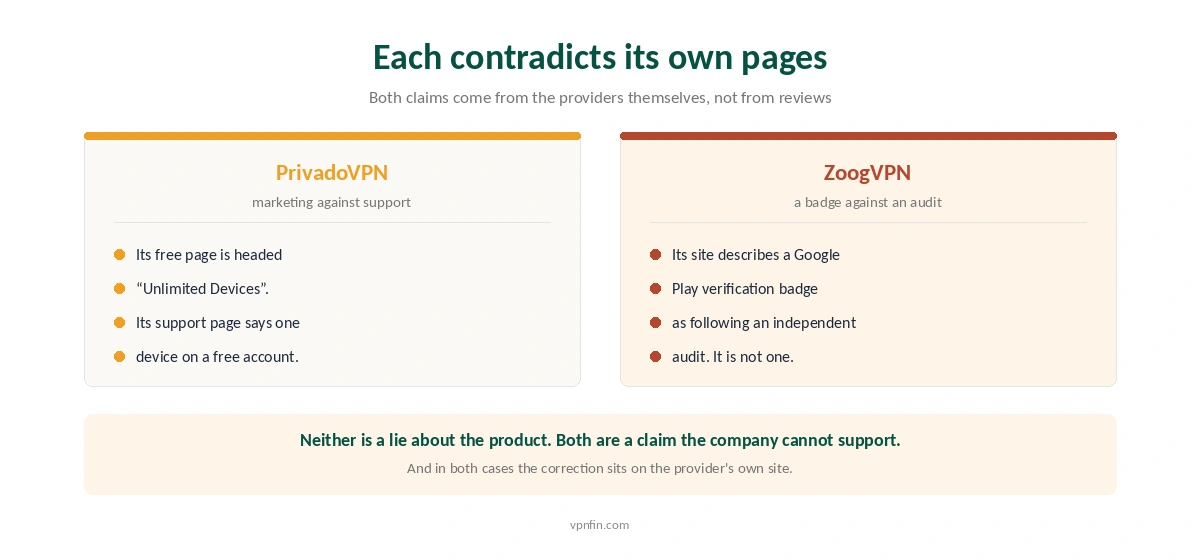
PrivadoVPN’s free page carries the heading “Unlimited Devices”. Its own support article says one device on a free account. The same page also offers, in one sentence, unlimited data and ten gigabytes.
ZoogVPN’s site describes a Google Play verification badge as following an independent audit. A store badge checks an application listing. A no-logs audit checks whether records exist.
⚠️ Neither is a lie about the product. Both are claims the company cannot support, and in both cases the correction sits on the provider’s own site — which is the habit our page on no-logs claims keeps finding.
We are naming them because the pattern repeats. Marketing pages and support pages are written by different people, and the support page is usually the accurate one.
The Free Tiers, Behind the Same Number
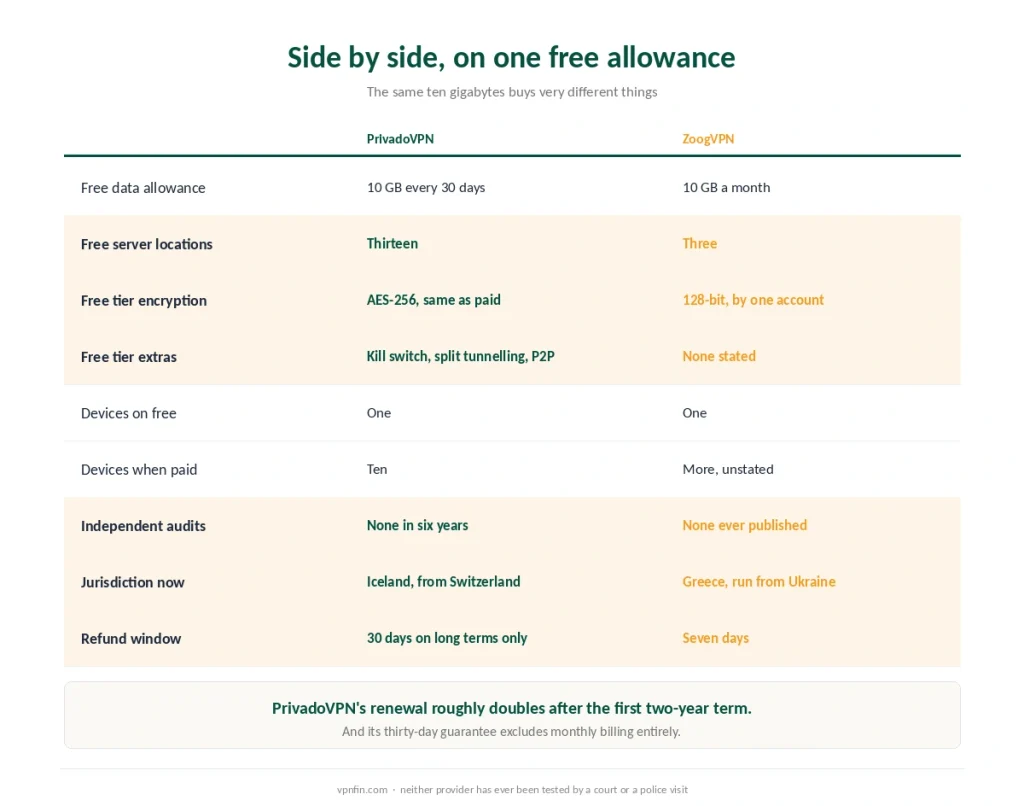
Ten gigabytes at both, and one device at both. PrivadoVPN’s resets every thirty days and unused traffic does not carry over.
Then they separate. PrivadoVPN gives thirteen locations against three, and uses the same AES-256 encryption as its paid plan. ZoogVPN’s free tier uses 128-bit, by one published account.
PrivadoVPN also includes the features most free tiers strip. A kill switch, split tunnelling, an ad blocker and peer-to-peer support, none of them reserved for paying users.
⚠️ An encryption downgrade is the one a reader cannot see. A data cap is visible in the app; a shorter key is not — and our free VPN guide covers what else free tiers quietly remove.
Both Changed Country This Year
PrivadoVPN moved from Switzerland to Iceland. Published accounts place the relocation in early 2026, and Iceland also sits outside the intelligence-sharing arrangements.
ZoogVPN moved a registration from the Isle of Man to Greece. One account reports its headquarters and most staff are in Ukraine, so the registration and the operation may sit apart.
⚠️ PrivadoVPN’s own no-logs page still referenced Switzerland after the move. We found that writing its review. A no-logs claim is a statement about a jurisdiction, so naming the wrong one weakens it.
Neither move came with an audit. A better jurisdiction and no verification is a thinner combination than it sounds — which is why our privacy ranking weighs jurisdiction lowest.
What the Paid Plans Cost
PrivadoVPN: around $1.99 a month on two years, billed near $47.76 for the first term and roughly $95.76 for the next. So the renewal roughly doubles.
⚠️ And its thirty-day guarantee covers long terms only. Monthly billing at $10.99 has no refund window at all — the same trap our refund page describes.
ZoogVPN: around $2.49 a month on two years with three months added, and seven days to claim a refund.
Both raise the price after the first term. That figure decides the total rather than the headline rate — as our renewal table shows across the market.
Who Each Is For
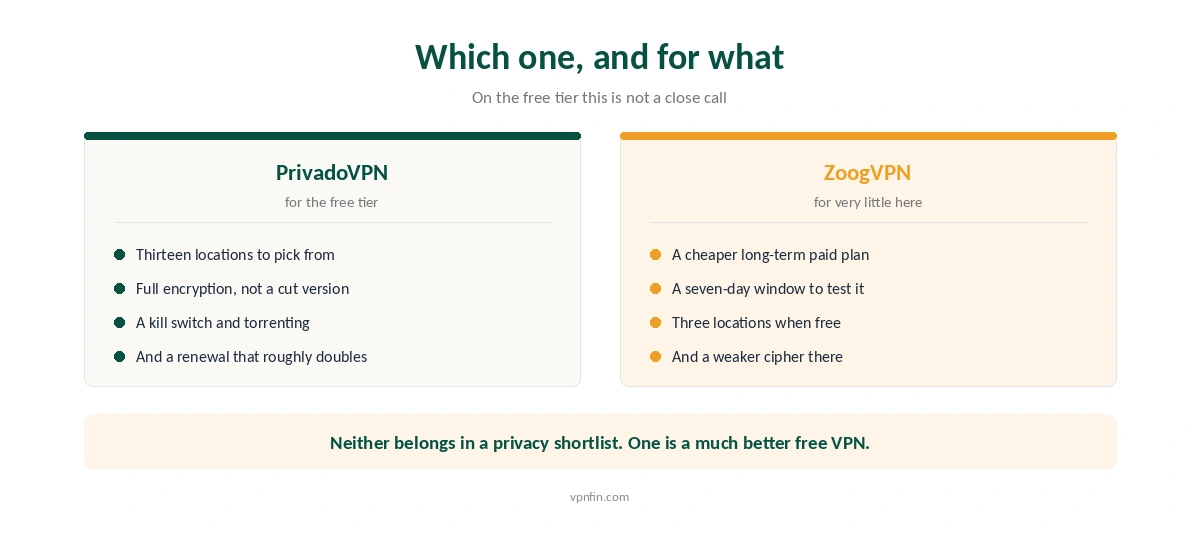
PrivadoVPN if you want a free VPN that behaves like a paid one. Thirteen locations, full encryption and the safety features intact.
ZoogVPN if the Greek registration and the low paid price are what you want, and you accept that neither has been checked by anyone.
⚠️ And Proton VPN’s free tier has no cap at all. It assigns your server automatically and excludes streaming — but it has five published audits behind it, which neither of these two can match.
How We Research
PrivadoVPN’s free tier limits, the one-device restriction, the thirteen locations and the pricing come from the company’s own pricing, free-plan and support pages. The heading that says unlimited devices appears on its free-plan page, and the one-device figure on its support page. ZoogVPN’s free tier details, the 128-bit encryption and the seven-day refund window come from published reviews we cite in that provider’s review. The Play Store badge described as an audit appears on ZoogVPN’s own site. The Ukrainian headquarters comes from one published account and no other source we found mentions it. Neither provider has published an audit, and neither has faced a court test. We do not run our own tests. Our method lives on the About Us page.
PrivadoVPN vs ZoogVPN FAQ
PrivadoVPN’s, clearly. Both give ten gigabytes a month on one device, but PrivadoVPN offers thirteen server locations against three, the same AES-256 encryption as its paid plan, plus a kill switch, split tunnelling, an ad blocker and torrenting support.
No. Its free-plan page carries that heading, while its own support article states one device on a free account and ten on paid plans. Where a company’s marketing and support pages disagree, the support page is usually the accurate one.
Neither. PrivadoVPN has published nothing in six years of operation. ZoogVPN has published nothing either, though its support has described an audit as underway and then as planned. Its site also calls a Google Play badge an independent audit, which tests something else.
PrivadoVPN moved from Switzerland to Iceland in early 2026. ZoogVPN moved a registration from the Isle of Man to Greece, and one account places its headquarters and most staff in Ukraine. Both new locations sit outside the intelligence-sharing arrangements.
ZoogVPN, at around $2.49 a month on a two-year term with three months added. PrivadoVPN starts lower at around $1.99 but its renewal roughly doubles, and its thirty-day guarantee excludes monthly billing entirely.
The Verdict
The same ten gigabytes buys thirteen locations or three. Full encryption or a shorter key. Safety features intact or unstated.
Neither has published an audit. Both moved country this year, and a favourable registration without verification proves very little.
And both oversell something their own pages correct. One claims unlimited devices where support says one. The other calls a store badge an audit. Read the support page, not the sales page.