
Disclosure: VPNFin is reader-supported. If you buy a VPN through links on this page, we may earn a commission at no extra cost to you. This never affects our ratings — here’s our full disclosure.
Several countries in this series now block something at the network level. In France, Italy and Spain a blocked page simply fails.
In Canada it explains itself. The blocked address serves a notice naming the court order, linking the judgment, giving an email address for the applicants’ counsel, and stating that anyone who believes the block is wrong has thirty days to object to the Federal Court.
Two Systems, Both Running
Canada is unusual in having both mechanisms at once, and they do different jobs.
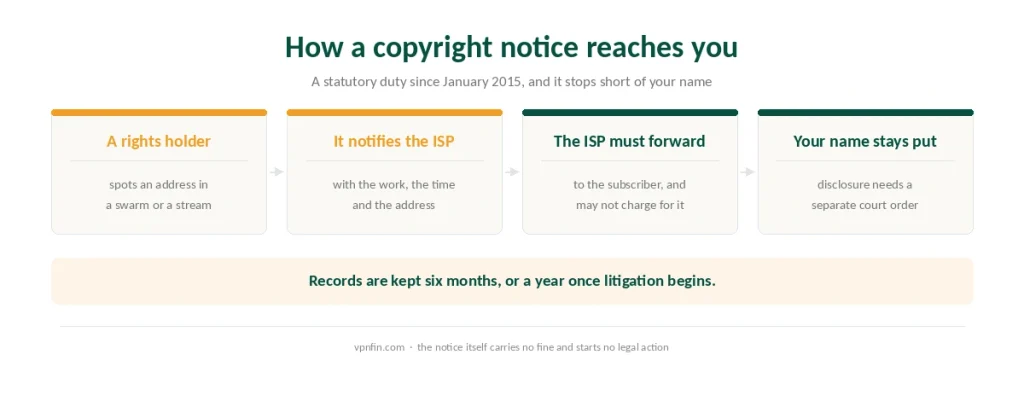
Notice and notice has been law since January 2015. Sections 41.25 to 41.27 of the Copyright Act require an internet provider to forward a rights holder’s infringement notice to the subscriber whose address was identified.
The provider does not hand over your identity. That requires a separate court order, and the point was settled by the Supreme Court in 2018.
But it must keep the records. Six months, or a year where litigation follows, with statutory damages between $5,000 and $10,000 for failing to do so. Providers may not charge for the work.
⚠️ Compare that with the Netherlands, where a court ruled the largest provider need not forward such warnings at all. Canada made forwarding a duty; the Dutch system stalled on a data protection licence.
The Blocking Order of July 2026
The second system, and the more recent development.
Justice Richard Southcott signed a two-year order on 3 July 2026, docket T-1127-26, requiring eight providers — Bell, Rogers, Telus, Videotron, Cogeco, Eastlink, SaskTel and TekSavvy — to block an initial list of eighteen domains belonging to thirteen named piracy brands.
It was requested by Rogers, TVA, Netflix and several Hollywood studios, and none of the named operators appeared in court.
It is the first Canadian order covering both subscription IPTV services and open streaming sites in a single proceeding.
⚠️ And it loosens the leash. Earlier orders fixed a list of domains; adding one meant returning to a judge. This one lets applicants file an amended schedule, and if no provider objects within the window the court set, the additions stand without a hearing.
Blocking reached Canada through the courts rather than the regulator. In 2018 the CRTC declined a broadcaster-led proposal to build its own blocking mechanism, so rights holders went to the Federal Court instead, starting with the GoldTV case in 2019.
The Part No Other Country Does
Worth isolating, because it is genuinely rare.
Anyone who lands on a blocked domain sees a notice, not a timeout. It names the order and its date, links the judgment, provides counsel’s email address, and points to a legal-viewing site.
It states the appeal route explicitly. If you believe the order is blocking something you have a right to reach, you may apply to the Federal Court within thirty days of first being affected.
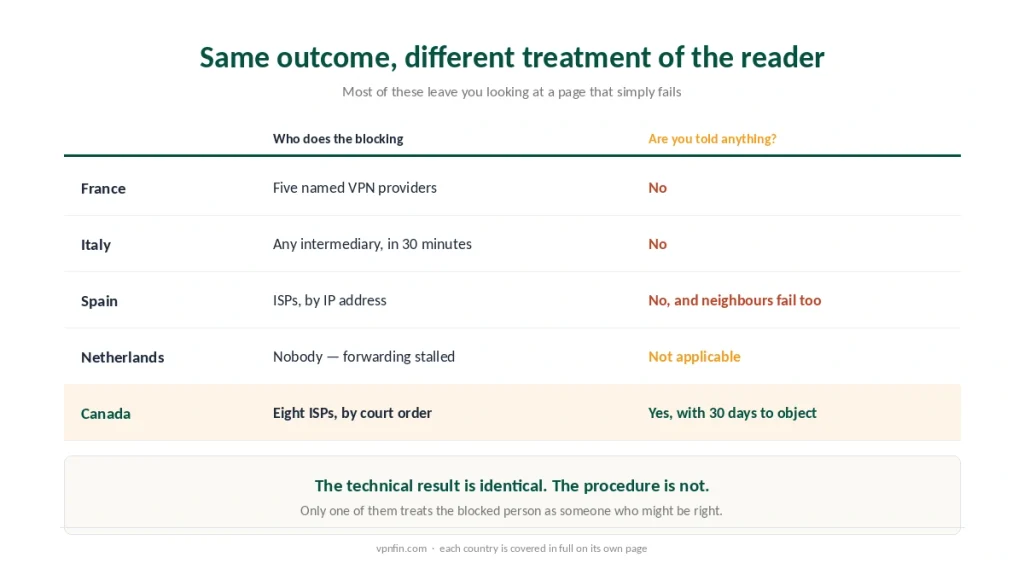
⚠️ Set that beside the alternatives. Italy’s regulator obliges blocking within thirty minutes with no hearing beforehand; French courts ordered the VPN companies themselves to do the blocking; Spain’s version has repeatedly taken unrelated services offline as collateral damage.
None of those tells the person on the other end anything at all. Canada’s does, and that difference is worth more than the technical details of any blocklist.
What This Means If You Live There
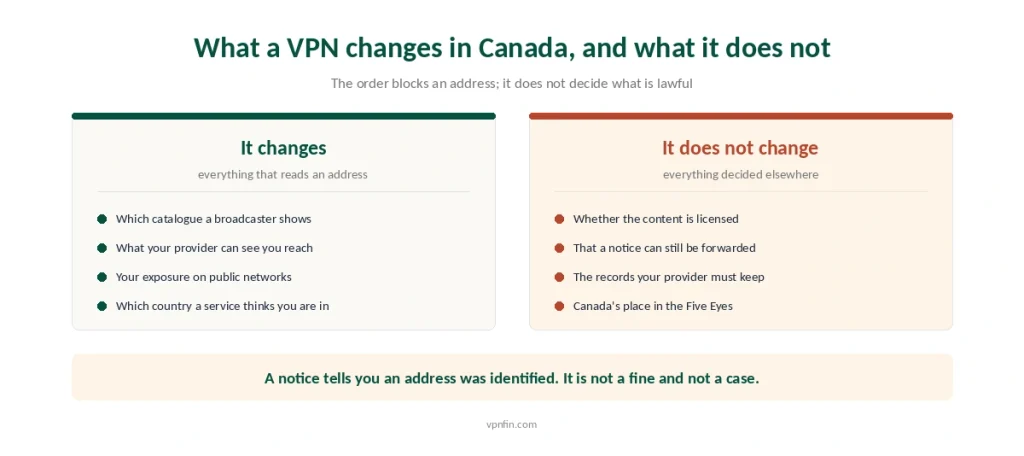
Using a VPN is lawful, and nothing in either system suggests otherwise — as it is nearly everywhere.
A notice is not a fine. It carries no penalty and no legal action by itself; it tells you an address associated with your account was identified. Providers forward them because the statute requires it.
A VPN changes who sees your traffic, not what the law says about it. If the underlying activity infringes copyright, it still does — which is where our torrenting guide draws the same line.
⚠️ Canada is a Five Eyes member, so a provider’s own jurisdiction is the question underneath the marketing. What a no-logs claim is worth matters more here than the server count.
Canadian Television From Abroad
The ordinary half of this guide, and the shorter one.
CBC Gem is free inside Canada and, like every public broadcaster’s service, restricted by territory. A Canadian address is what it wants.
Crave is the paid one, and it checks location as well as your subscription.
Netflix and Prime keep working wherever you are, serving the catalogue of the country you are physically in rather than refusing you — our streaming guide covers why those two behave differently from national broadcasters.
⚠️ We have not tested these platform by platform. Access shifts month to month, so treat this section as orientation and the refund window as the real test.
Choosing a Provider Here
NordVPN scores highest on our scale at 4.8 and keeps servers across several Canadian cities, which matters when one address gets flagged.
Surfshark covers unlimited devices, the sensible answer for a household.
ExpressVPN has the widest country coverage of the providers we rank, useful if you are Canadian abroad rather than the other way round.
⚠️ Set it up before you travel. Our travel guide covers the habit, and public networks are where a VPN earns its keep regardless of which country you are in.
How We Research
This guide draws on the text of the Federal Court order in T-1127-26 dated 3 July 2026 and on the official notification page served to blocked users, on TorrentFreak and Piracy Monitor for the order’s expanded scope and the list of named brands, on the Office of Consumer Affairs and McMillan LLP for the notice-and-notice requirements including the retention periods and the statutory damages for non-compliance, on SaskTel’s own customer documentation for the confirmation that providers must forward notices without disclosing identity, and on the Canadian Bar Association for the 2018 Supreme Court interpretation. We checked the July 2026 order against independent reporting before using it, because a single low-authority source describing a dated court decision is exactly the pattern we declined to repeat on our Netherlands page. Here it held up. We do not run our own tests. Our method lives on the About Us page.
Canada VPN FAQ
Yes. No Canadian law restricts using, buying or installing one, and neither the notice-and-notice regime nor the Federal Court’s blocking orders touch the technology itself. What you do through a VPN remains subject to the same law as if you had done it directly.
It is a message a rights holder sent to your provider, which the provider is required by statute to forward to you. It carries no fine and no legal action by itself. Your provider does not give the rights holder your identity; that needs a separate court order.
Yes, and it must. The Copyright Act requires providers to retain the subscriber records associated with a forwarded notice for six months, extending to a year if the rights holder begins legal proceedings. Failing to do so exposes the provider to statutory damages between $5,000 and $10,000.
You see a notice rather than an error. It names the Federal Court order and its date, links the judgment, gives an email address for the applicants’ counsel, and states that you may apply to the court within thirty days if you believe the block is wrong.
Two things. It became the first Canadian order to cover subscription IPTV services and open streaming sites together, and it allows rights holders to add new domains by filing an amended schedule rather than returning to court, provided no provider objects in the window the court set.
The Verdict
Canada runs both systems at once, and has done longer than most: statutory notice forwarding since 2015, court-ordered blocking since 2019.
The July 2026 order widened the blocklist and loosened the process for adding to it, which is the part worth watching.
And it remains the only one that explains itself. A blocked page in Canada names the order, links the judgment and gives you thirty days to object — which is more than the rest of this series offers combined.