
Disclosure: VPNFin is reader-supported. If you buy a VPN through links on this page, we may earn a commission at no extra cost to you. This never affects our ratings — here’s our full disclosure.
The Netherlands is one of the most common places to route a VPN through, and one of the few European countries where a rights-holder organisation pursues individuals by name.
Both of those are true, and they are less connected than they sound. What matters is which of three quite different problems you actually have.
Which Problem Is Yours
Dutch television from abroad. Three services, three different barriers, and only the first is something a VPN addresses.
Living in the Netherlands and torrenting. The enforcement story is real, older than most articles suggest, and aimed at people who upload rather than people who watch.
Ordinary travel and public networks. The usual reasons, unchanged by anything Dutch.
Three Gates on Dutch Television
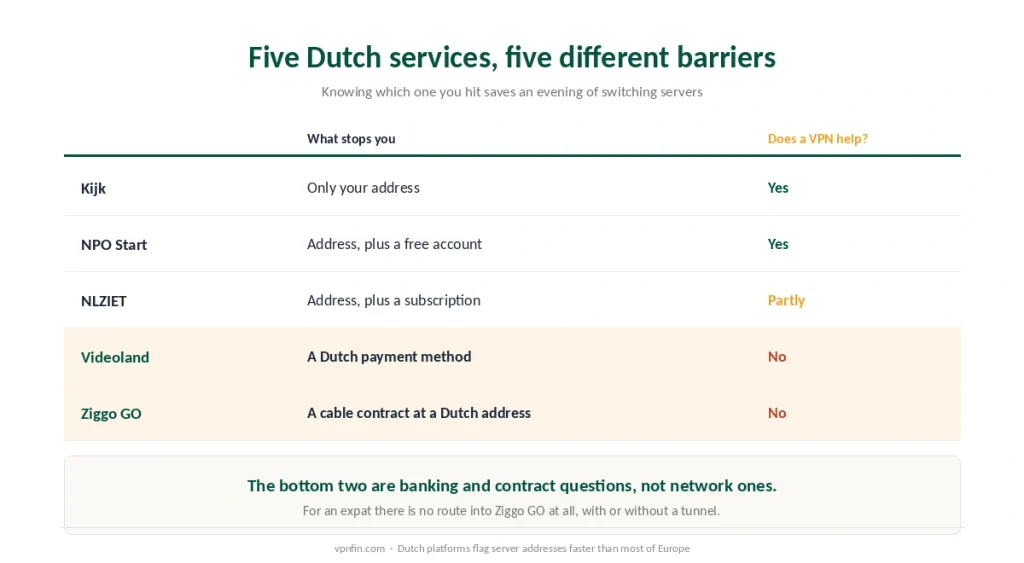
Each platform stops you differently, and knowing which one you have hit saves an evening.
NPO Start blocks by address. The public broadcaster’s service is free inside the Netherlands and unavailable outside it. A Dutch server restores it, and you will need a free NPO account — which anyone can create.
Videoland adds a payment gate. Beyond the geo-block it requires a Dutch payment method, which is a banking fact rather than a network one — exactly the barrier HBO Max uses, and no tunnel touches it.
Ziggo GO goes further still. It requires an active Ziggo cable subscription at a Dutch address. For an expat there is no route in at all, VPN or otherwise.
⚠️ Kijk is the easy one, needing no registration, while NLZIET and Videoland need both an account and an active subscription.
Dutch platforms filter aggressively. Reviewers describe NPO Start, Videoland and Ziggo GO among the harder European services to reach, so expect to change servers rather than succeed first time.
The Enforcement Story, Accurately
This is where most articles overreach, so here is what is actually documented.
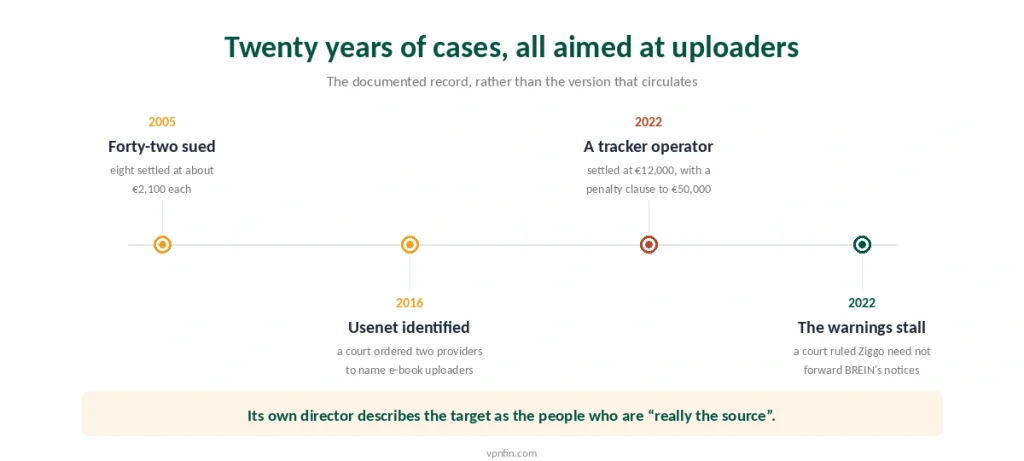
BREIN is the Dutch rights-holder enforcement body, and it has pursued individuals for two decades. In 2005 it sued to identify forty-two file-sharers; eight settled at around €2,100 each. In 2016 a court ordered two Usenet providers to hand over subscriber details over e-book uploads. In 2022 it identified a man running scripts for twenty-five torrent trackers, who settled for €12,000 with a penalty clause running to €50,000.
Its stated target is uploaders, not viewers. Its own director has described the focus as people who are “really the source”, and the organisation has said repeatedly that casual downloaders are not the priority.
⚠️ The mass-warning system stalled. BREIN obtained permission from the Dutch data protection authority to collect and store data on alleged BitTorrent users, but in 2022 a court ruled that the country’s largest provider, Ziggo, was not required to forward the warnings, because Ziggo itself lacked the necessary licence to match addresses to subscribers. Canada made the same forwarding a statutory duty, with damages for providers that fail to keep the records.
Torrenting also means uploading. Anyone using BitTorrent distributes as well as receives, which is precisely the behaviour BREIN watches — our torrenting guide covers what that means for provider choice.
The 2026 Law We Could Not Find
Worth a section of its own, because the search results on this subject are unusually unreliable.
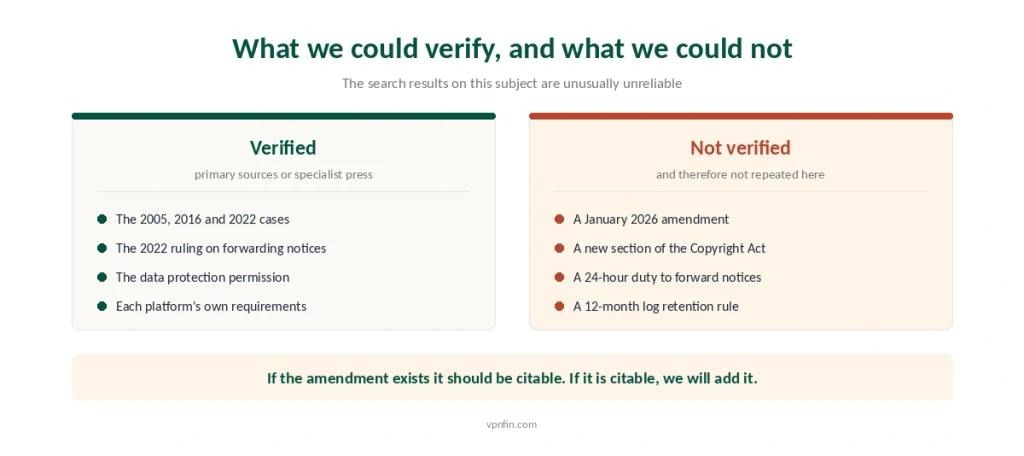
Two widely circulated pages describe a January 2026 amendment to the Dutch Copyright Act in confident detail: a new section number, a twenty-four-hour obligation on providers to forward infringement notices, and a twelve-month log retention requirement.
We could not corroborate any of it. Not in specialist reporting, not in coverage of Dutch copyright practice, and not in any primary source we could reach.
⚠️ The specialist reporting points the other way. The most recent substantive development we could verify is the 2022 ruling that a provider is not obliged to forward those notices at all — the opposite of a tightened forwarding duty.
So we are not repeating those claims, and we would treat any page stating them as unverified. If the amendment exists, it should be citable; if it is citable, we will add it.
What Is Actually Settled
Using a VPN in the Netherlands is lawful, and nothing suggests otherwise — as it is nearly everywhere.
Infringing copyright is not, and a VPN does not change that. It changes who can see the traffic, not what the law says about it — which is the whole of what a VPN does.
The Netherlands sits inside the Nine Eyes arrangement, so a provider’s own jurisdiction matters if that is your concern. What a no-logs claim is worth is the question underneath it.
Choosing a Provider Here
Server count inside the Netherlands matters more than usual, because Dutch platforms flag addresses quickly and you will be switching.
NordVPN is named most often for Dutch services, with a large Dutch server pool and the highest score on our scale at 4.8.
CyberGhost labels servers by platform, which shortens the hunting, and gives 45 days to test rather than 30.
Surfshark covers unlimited devices, which suits a household split between the Netherlands and somewhere else.
⚠️ Test inside the refund window. Our streaming guide explains why we weight that as heavily as any unblocking claim, and Dutch platforms are a good demonstration of why.
Before You Travel
Install and pay before you fly, which avoids app stores and foreign card checks — our travel guide covers the habit.
Test from home. Connect to a Dutch server and open NPO Start before you leave, not in a hotel.
Then check the tunnel itself. A leak test takes a minute and rules out the simplest failure.
How We Research
This guide draws on Cybernews and Comparitech for the behaviour of NPO Start, Videoland, NLZIET and Kijk and their registration requirements, on Gizmodo for the description of Dutch platforms as unusually aggressive filterers, on an expat-focused report for the Ziggo GO subscription requirement and Videoland’s Dutch payment gate, on TorrentFreak for the 2022 ruling that Ziggo need not forward BREIN’s warnings and for BREIN’s data-processing permission, on Piracy Monitor for the 2022 tracker-script settlement, and on contemporary reporting from The Register for the 2005 lawsuits and the 2016 Usenet order. We deliberately excluded two pages describing a January 2026 amendment to the Copyright Act, because we could not corroborate their claims anywhere. Several streaming sources sell VPN subscriptions, so we used them for platform behaviour rather than rankings. We do not run our own tests. Our method lives on the About Us page.
Netherlands VPN FAQ
Usually yes. NPO Start is free inside the Netherlands and blocked outside it, and the block reads your address, so a Dutch server restores access. You will also need a free NPO account, which anyone can create. Expect to try more than one server.
Because it checks two things. Beyond the geo-block it requires a Dutch payment method, and no VPN changes the country that issued your card. Ziggo GO goes further again, requiring an active Ziggo cable subscription at a Dutch address.
Torrenting itself is not; infringing copyright is, and BitTorrent distributes as well as downloads. BREIN, the Dutch rights-holder body, has pursued individual uploaders for two decades, with documented settlements ranging from around €2,100 in 2005 to €12,000 in 2022.
Not automatically. In 2022 a Dutch court ruled that Ziggo, the largest provider, was not required to forward BREIN’s warnings, because it lacked the data protection licence needed to match addresses to subscribers. That ruling stalled the mass-warning campaign.
Yes. No Dutch law restricts using, buying or installing one, and none has been proposed. What you do through it remains subject to the same law as if you had done it directly, which is the position almost everywhere.
The Verdict
For Dutch television abroad, only NPO Start is a VPN problem. Videoland needs a Dutch payment method and Ziggo GO needs a Dutch cable subscription, and neither of those moves.
For torrenting inside the Netherlands, the enforcement is real and narrower than advertised. BREIN pursues uploaders, has done for twenty years, and its mass-warning system remains stuck on a 2022 ruling.
And treat the alarming version with suspicion. The most specific claims circulating about Dutch copyright law in 2026 are the ones we could not verify at all.