
Disclosure: VPNFin is reader-supported. If you buy a VPN through links on this page, we may earn a commission at no extra cost to you. This never affects our ratings — here’s our full disclosure.
Finding a VPN for Russia used to mean finding a provider Roskomnadzor had not blocked yet. That no longer works. By February 2026 the regulator had restricted 469 VPN services. According to VPNPassport’s July tracking, filters have also caught plain WireGuard and OpenVPN connections nationwide since February. What still gets through is traffic disguised as something else.
So the question is not which brand to buy, but which stealth mode it offers and whether you can switch it on. This guide sets out what 2026 reports found working and how to pay when Russian cards fail abroad. It also covers what the law says.
VPN for Russia: The Short Answer
Pick a provider with a stealth protocol, and switch it on before you need it. Proton VPN’s Stealth, ExpressVPN’s automatic obfuscation, NordVPN’s NordWhisper and obfuscated servers, and Surfshark’s Camouflage Mode are the options most often reported working in 2026.
Proton VPN is the most frequently recommended, and its free tier needs no payment at all. That matters, because foreign merchants refuse Russian-issued cards. Our Proton VPN review covers it in full.
Using a VPN in Russia is not an offence. Searching deliberately for material on the extremist register is an offence, fined at 3,000 to 5,000 rubles, as our Russia legality page explains.
Why Most VPNs Stopped Working
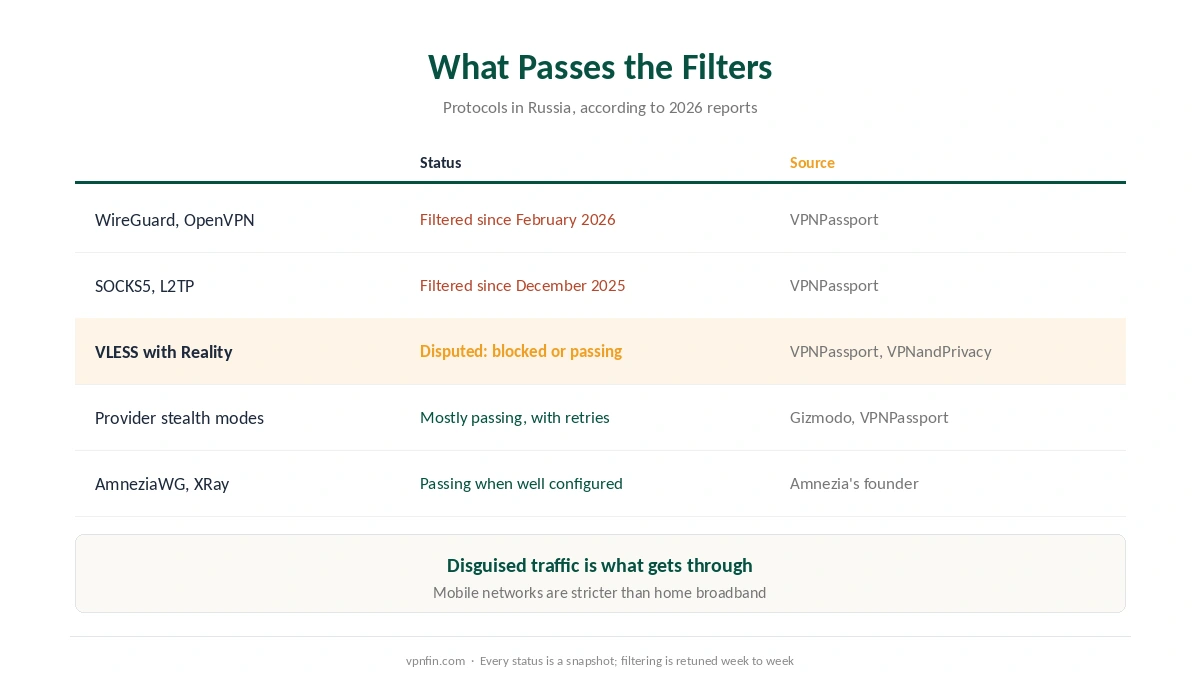
Russia moved from blocking services to blocking protocols. Filtering equipment at internet providers now inspects traffic and drops anything that looks like a standard VPN tunnel. VPNPassport reports WireGuard and OpenVPN blocked nationwide since February 2026, and SOCKS5 and L2TP since December 2025.
Sources disagree on what still passes. VPNPassport lists VLESS among the blocked protocols; VPNandPrivacy found Shadowsocks and VLESS with Reality still getting through at its latest check. The founder of Amnezia VPN told TechRadar that protocols disguised as other traffic generally still work, but can be caught if poorly configured.
Mobile networks are stricter than home broadband. In March 2026 central Moscow saw nearly three weeks of degraded mobile service under a government whitelist, and most VPNs were useless throughout, according to VPNRank. Our obfuscation guide explains how disguised protocols work.
VPNs Reported Working in Russia in 2026
| VPN | Switch on | Notes |
|---|---|---|
| Proton VPN | Stealth, plus alternative routing | Free plan needs no card; one of two survivors in VPNPassport’s July tracking |
| ExpressVPN | Automatic; try Lightway TCP if it fails | No Russian servers since 2019 |
| NordVPN | NordWhisper or obfuscated servers, not NordLynx | Accepts crypto |
| Surfshark | Camouflage Mode and NoBorders | Keeps servers in Russia |
| Mullvad | Shadowsocks bridge or automatic obfuscation | Accepts cash by post |
Every status here is a snapshot. Roskomnadzor retunes its filtering week to week, and reports often come from users rather than controlled tests. Treat any claim that a VPN works in Russia as true on the day someone made it.
Amnezia is the fallback many residents use. It is open source, runs on a server you rent yourself, and uses protocols designed to look like other traffic. VPNRank calls it the most resilient option when commercial apps stumble, though setting it up takes more effort.
The Picks, One by One
Proton VPN. Gizmodo’s September guide ranks it first, for its Stealth protocol and for alternative routing that helps in the hours after a new block. VPNPassport’s July tracking found it and Mullvad still connecting, with retries. Its free plan is also the easiest way to start without a working card. Our free VPN guide explains why that free tier is trustworthy.
ExpressVPN. It obfuscates every connection automatically, which suits someone who wants to install once and forget. It withdrew its Russian servers in 2019, so it cannot give you a Russian address from abroad. Our ExpressVPN review covers it.
NordVPN. Use NordWhisper or obfuscated servers over OpenVPN TCP; the filters catch standard NordLynx connections. Our NordVPN review covers the rest.
Surfshark. Camouflage Mode and NoBorders handle the filtering, and it still keeps servers in Russia, useful if you need a Russian address from outside. It shares a parent, Nord Security, with NordVPN. Our Surfshark review has the details.
Mullvad. A Shadowsocks bridge gets it through, and it accepts cash by post, which solves the payment problem another way. Our Mullvad review covers its privacy record.
Paying for a VPN From Russia
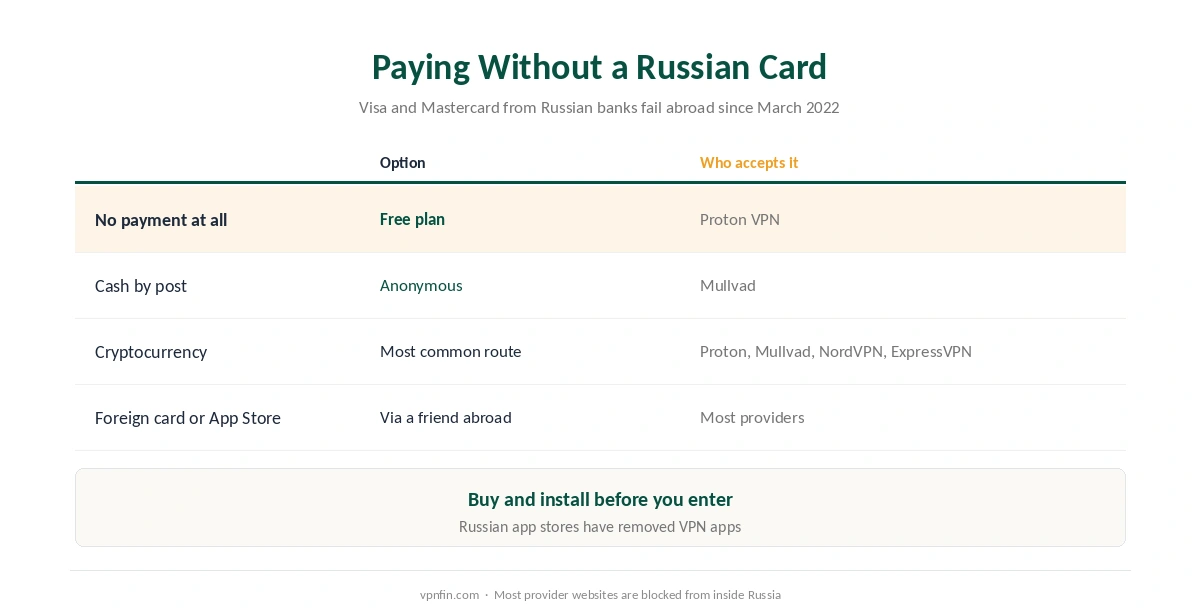
Russian-issued Visa and Mastercard cards have not worked for foreign payments since March 2022, and Roskomnadzor blocks most provider websites. The usual answers are cryptocurrency, which Proton, Mullvad, NordVPN and ExpressVPN accept, a foreign card, or an App Store account from another country.
Two options avoid the problem entirely. Proton VPN’s free plan needs no payment method, and Mullvad accepts cash sent by post. Our travel guide covers buying and installing before a trip.
What the Law Says
Using a VPN is legal for individuals. The 2017 law targets providers, which must connect to the state’s list of blocked resources, and advertising a VPN has carried fines since September 2025.
One provision reaches users. Article 13.53 of the Administrative Code fines knowingly searching for material on the extremist register, at 3,000 to 5,000 rubles, and names circumvention tools as one route to the offence. Mediazona counted six known cases by August 2026. Our China page covers the other country whose rules name the user, and our China VPN guide the tools that work there.
Setting Up Before You Need It
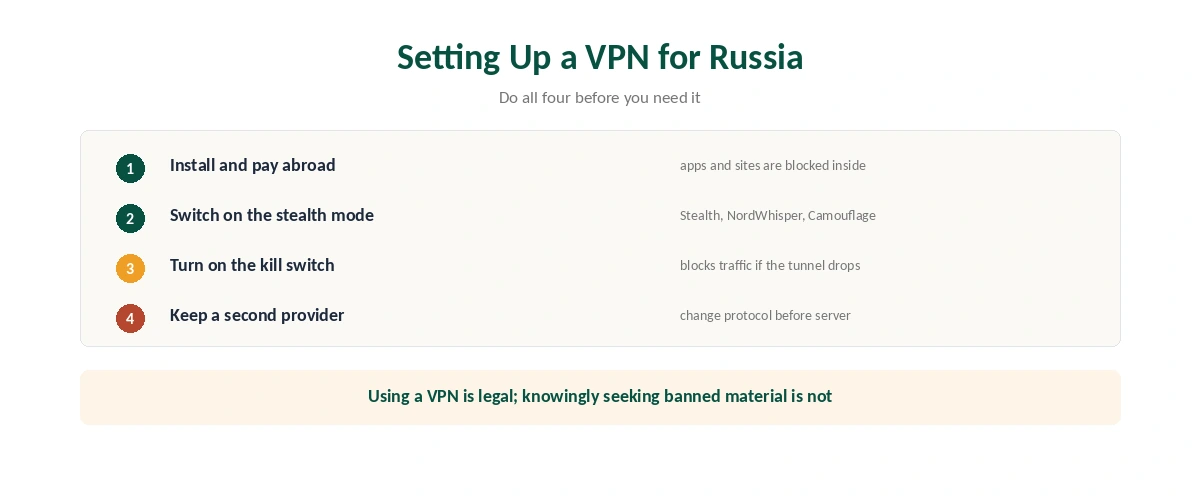
Install and pay before you enter Russia, since Russian app stores have removed VPN apps and provider sites are unreachable. Then switch on the stealth mode in advance and turn on the kill switch, as our kill switch guide explains.
Change protocol before changing server when a block lands; servers in Finland, Estonia, Latvia and Kazakhstan give the lowest latency, according to VPNandPrivacy. And keep a second provider installed, because blocking moves week to week.
How We Research
The blocking picture comes from VPNPassport’s July 2026 tracking, VPNandPrivacy, VPNRank, Gizmodo’s September guide and TechRadar’s interview with Amnezia’s founder, each named where used and read on 26 September 2026. Russia’s legal position comes from our legality page, which cites the Administrative Code, Meduza and Mediazona. We did not test these VPNs from inside Russia ourselves, and every status here is a dated snapshot. Our full approach lives on the About Us page.
VPN for Russia FAQ
Those with stealth protocols: Proton VPN, ExpressVPN, NordVPN with NordWhisper or obfuscated servers, and Surfshark with Camouflage Mode. Proton VPN is the most frequently recommended in guides published this year. Results change week to week.
Yes, for individuals. Advertising a VPN is fined, and knowingly searching for material on the extremist register carries a fine of 3,000 to 5,000 rubles, but using a VPN itself is not an offence.
Most often, the filters have caught its protocol. VPNPassport reports WireGuard and OpenVPN filtered nationwide since February 2026. Switch to a stealth or obfuscated protocol.
Russian cards do not work abroad, so use cryptocurrency, a foreign card or a non-Russian App Store account. Proton VPN’s free plan needs no payment, and Mullvad accepts cash by post.
From a few providers. Surfshark keeps servers in Russia, and Proton VPN offers Russian locations on paid plans. NordVPN and ExpressVPN withdrew their Russian servers.
The Verdict
The right VPN for Russia is the one whose stealth mode you have already switched on. Proton VPN is the most recommended and easiest to pay for; ExpressVPN, NordVPN and Surfshark all work with the right settings.
Install and pay before you arrive, keep a second provider ready, and treat any report that a VPN works as true for the week it was written.