
Disclosure: VPNFin is reader-supported. If you buy a VPN through links on this page, we may earn a commission at no extra cost to you. This never affects our ratings — here’s our full disclosure.
A VPN for Singapore is simple on the surface: using one is legal, the internet is fast, and the state blocks only a narrow set of sites. The detail worth knowing is what the law does not change. If an activity is illegal in Singapore, such as gambling on an unlicensed site, doing it through a VPN does not make it legal.
Singapore is also where much of the region’s VPN traffic actually runs. Providers often host virtual locations for neighbouring countries on servers there. A VPN user in Manila may be passing through Singapore without knowing it. This guide covers what gets blocked, the one legal line to watch, and the picks.
VPN for Singapore: The Short Answer
Using a VPN in Singapore is legal, and FreeVPNPlanet’s May 2026 guide found no individual prosecuted for bypassing the regulator’s content blocks.
NordVPN and Surfshark are the usual picks, both with Singapore servers. Our NordVPN review and our Surfshark review cover them in full.
The line to watch is gambling. Singapore licenses only a handful of operators, and using a VPN to reach an unlicensed site can still lead to prosecution.
What Singapore Blocks
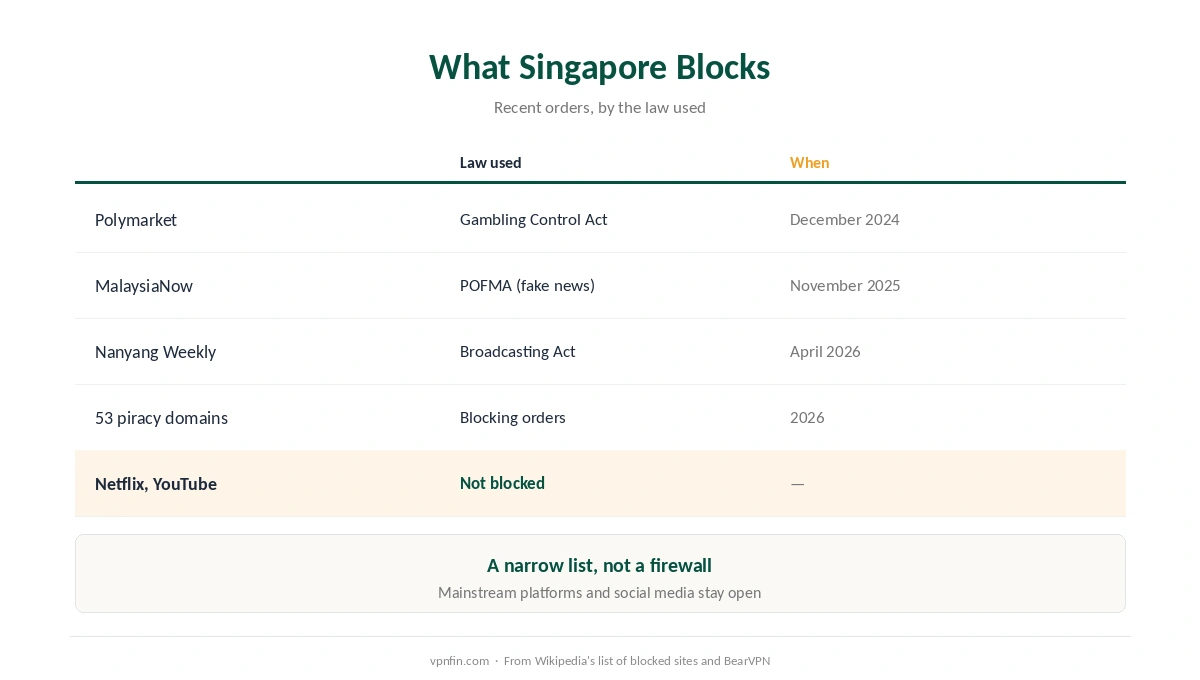
The regulator, IMDA, blocks a narrow set of categories: unlicensed gambling, piracy, adult content and what it calls foreign inauthentic news sites. BearVPN counts 53 piracy domains blocked in 2026 alone, and mainstream platforms such as Netflix and YouTube are not blocked.
Recent orders show the pattern. Singapore blocked Polymarket under the Gambling Control Act in December 2024, MalaysiaNow under the fake-news law POFMA in November 2025, and Nanyang Weekly under the Broadcasting Act in April 2026, according to Wikipedia’s list of blocked sites.
Could bypassing a block be an offence? FreeVPNPlanet notes that the Broadcasting Act could in theory apply to getting around IMDA blocks, but that no individual has faced prosecution for it. Our guide to VPN legality compares Singapore with stricter countries.
The Gambling Line
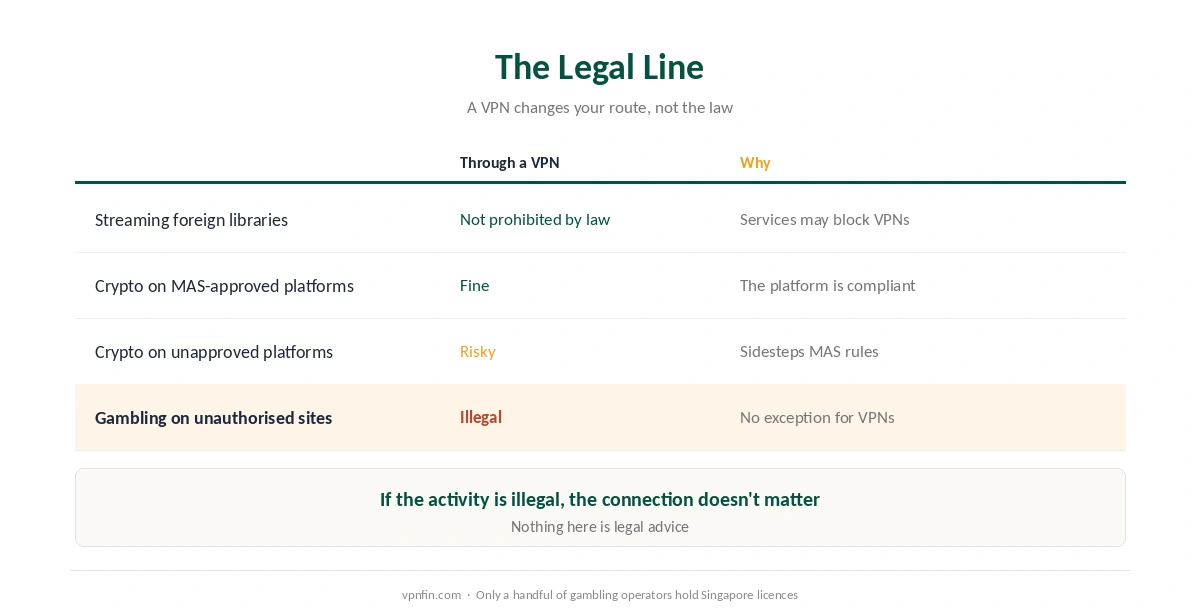
A VPN creates no exception for gambling. FreeVPNPlanet puts it plainly: if the gambling is prohibited, the connection method does not matter. MyGamingLicense adds that using a VPN to gamble on an unlicensed site can still result in prosecution, and that authorities can flag payments linked to offshore gambling.
The same logic covers crypto. Trading on a platform licensed by the Monetary Authority of Singapore through a VPN is not an issue; using one to reach an unlicensed platform and sidestep those rules is where the risk lies.
Why People in Singapore Use a VPN
Public Wi-Fi. Cafés, hotels and airports are the everyday case for a VPN for Singapore, and our public Wi-Fi guide explains what a VPN protects there.
Streaming. No Singapore law prohibits watching foreign TV through a VPN, FreeVPNPlanet notes, though services block VPN addresses, as our Netflix guide explains.
Work and travel. For regional trips, a VPN protects hotel connections and keeps access to home services. Our travel guide covers the preparation, and our China guide the very different rules a short flight away.
Singapore as the Region’s Server Hub
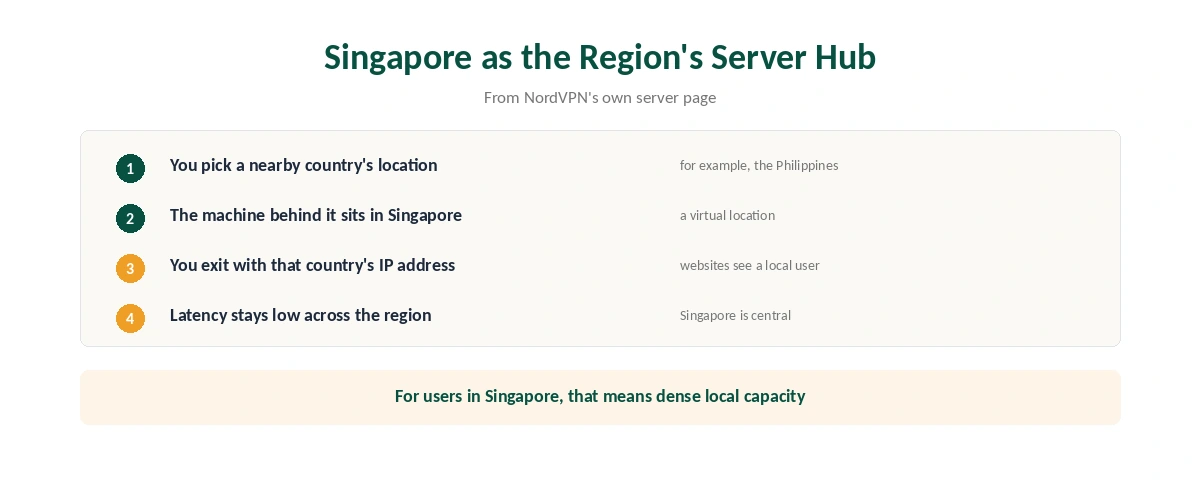
Your VPN may already route through Singapore. NordVPN’s server page for the Philippines says the machine behind that virtual location sits in Singapore. For users in Singapore, that means dense, fast local capacity.
For neighbours, it means low latency. Singapore servers are a common fallback for users in Malaysia, Indonesia and the Philippines. Our Philippines guide explains virtual locations, and our speed guide why distance matters.
The Picks
| VPN | Why it suits Singapore | Note |
|---|---|---|
| NordVPN | Singapore servers, strong all-round record | Six published audits |
| Surfshark | No device limit for a household | Shares a parent with NordVPN |
| ExpressVPN | Polished apps and automatic obfuscation | Useful for China trips |
| Proton VPN | Free plan with no data cap | Swiss foundation, open-source apps |
Surfshark and NordVPN share a parent, Nord Security. Our ExpressVPN review and our Proton VPN review cover the other two.
Audit records differ more than speeds do. NordVPN has six published audits and Proton VPN five, while ExpressVPN and Surfshark have their own reports. Our audit tracker compares all four.
How We Research
The legal picture comes from FreeVPNPlanet’s May 2026 guide and BearVPN’s August 2026 overview, with recent blocking orders from Wikipedia’s list of sites blocked in Singapore. MyGamingLicense supplied the gambling enforcement detail, and NordVPN’s server page the hub detail. Each source is named where used and read on 26 September 2026. Nothing here is legal advice. Our full approach lives on the About Us page.
VPN for Singapore FAQ
Yes. Using a VPN is legal, and FreeVPNPlanet found no individual prosecuted for bypassing IMDA’s content blocks. Illegal activity remains illegal with a VPN.
No. A VPN creates no exception to the gambling laws, and using one to reach an unlicensed site can still lead to prosecution. Only a handful of operators are licensed.
A narrow set of categories: unlicensed gambling, piracy, adult content and foreign inauthentic news sites. Netflix, YouTube and mainstream social media are not blocked.
NordVPN and Surfshark are the usual picks, both with Singapore servers. ExpressVPN suits frequent travellers to China, and Proton VPN offers a free plan.
No Singapore law prohibits it, although streaming services may block VPN addresses under their own terms.
The Verdict
A VPN for Singapore is legal, fast and useful, mainly for public Wi-Fi, streaming and travel. NordVPN and Surfshark are the usual picks.
Remember the one line a VPN does not move: gambling on an unlicensed site is illegal however you connect.