
Disclosure: VPNFin is reader-supported. If you buy a VPN through links on this page, we may earn a commission at no extra cost to you. This never affects our ratings — here’s how we research.
Most comparisons pit a privacy provider against a mainstream one, and the argument writes itself. This is not that.
Mullvad and Proton VPN are the two most verifiable providers we cover. Both publish every audit report in full. Both open-source their applications. Neither answers to a parent company. Both have been tested by something other than a scheduled review — Mullvad by a police warrant, Proton by its own account of more than 400 legal cases.
So this Mullvad vs Proton VPN comparison turns on a different question entirely: whether you need the VPN to do anything besides being trustworthy.
The Short Answer
Proton VPN wins for most people, at 4.6 against 4.2 in our ratings. Ten devices instead of five, streaming that works, port forwarding included, a permanent free tier, and 140-plus countries against 40-odd.
Mullvad wins if the sign-up form is the problem. It never learns your email address, accepts cash by post, has published more than ten audits, and charges the same €5 it charged in 2009.
Head to Head
| Mullvad | Proton VPN | |
|---|---|---|
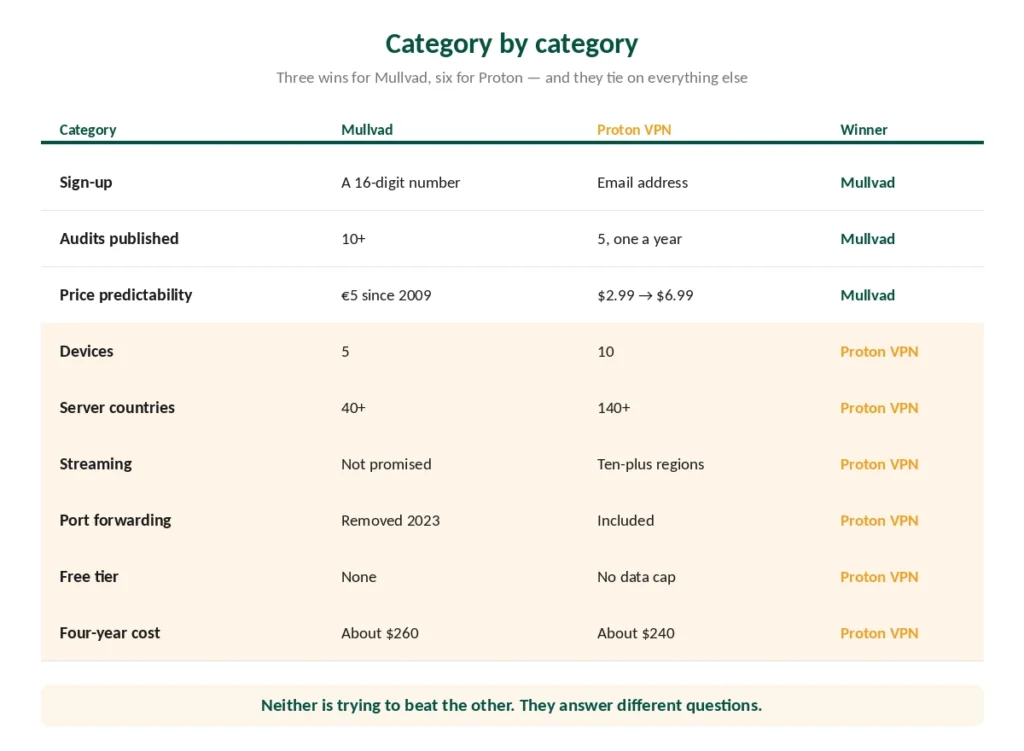
| Sign-up | A 16-digit number | Email address |
| Payment | Cash by post accepted | Card and crypto |
| Audits published | 10+, Cure53 and Assured | 5, Securitum, annual |
| Tested by | Police warrant, 2023 | 400+ cases, provider states |
| Devices | 5 | 10 |
| Servers | ~700, 40+ countries | 20,000+, 140+ countries |
| Streaming | Not promised | Ten-plus Netflix regions |
| Port forwarding | Removed 2023 | Included |
| Free tier | None | Yes, no data cap |
| Jurisdiction | Sweden (14 Eyes) | Switzerland, moving |
| Price | €5 flat, forever | $2.99 → $6.99 |
| Four years | ~$260 | ~$240 |
| Our rating | 4.2 | 4.6 |
Where They Agree, Which Is Most Places
Worth setting out first, because it removes the usual arguments.
Both publish audits in full. Mullvad has more than ten by Cure53 and Assured AB, with findings intact rather than summarised. Proton has five consecutive annual reports by Securitum, each a dated file that opens without an account.
Both open-source every application, on every platform, so the code can be inspected by people with no commercial stake in the answer.
Neither has a parent company. Proton AG funds itself through subscriptions across its own product suite; Mullvad is owned by its Swedish operator. In a category where Kape owns three brands and Point Wild owns a VPN alongside a review site, that is not a small thing.
Both have been tested outside a scheduled audit. Swedish police searched Mullvad’s offices in April 2023 and left with nothing. Proton states its policy has held across more than 400 legal cases, though that figure comes from its own transparency reporting rather than public court records.
⚠️ So privacy is not the deciding factor here. Both clear the bar that most of the category does not reach.
Where They Differ: The Sign-Up Form
This is the difference nothing else compensates for.
Mullvad issues a sixteen-digit number. No email, no username, no password, no recovery. Payment can be cash sent in an envelope with the number written on a slip.
Proton VPN requires an email address. That is ordinary, and Proton is unusually careful with it — but a record exists that would not exist at Mullvad.
⚠️ A no-logs policy and a no-account architecture answer different questions. The first describes what a company chooses not to record about your activity. The second describes what it cannot record about your identity. What a VPN actually hides sets out where each claim stops.
Lose the Mullvad number and the account is gone, because recovery requires the company to know something about you. That is the design working as intended, and it is a genuine cost.
Winner: Mullvad.
Where They Differ: Everything the VPN Actually Does
Here the direction reverses completely.
Devices: ten against five. For one person, five is fine. For a couple with phones, laptops and a tablet, it is not, and Mullvad sells no add-on.
Servers: roughly 20,000 across 140-plus countries against about 700 across 40-plus. Mullvad argues that physical servers in the countries listed beat a padded count of virtual locations, which is a fair position — but it does not put a server where there isn’t one.
Streaming: Proton handles ten or more Netflix regions on paid plans. Mullvad maintains no streaming servers and does not claim it will work. Our streaming guide covers why access shifts monthly for everyone.
Port forwarding: Proton includes it at no charge. Mullvad removed the feature in 2023, citing security risk, which matters if you seed on private trackers — our torrenting guide explains who needs it.
Features: Proton adds Secure Core multi-hop, one-click Tor over VPN, NetShield filtering and the Stealth protocol. Mullvad offers split tunnelling and a free SOCKS5 proxy, and supports WireGuard exclusively since retiring OpenVPN in January 2026.
And the free tier is Proton’s alone to offer. No data cap, no ads, the same no-logs policy as paid, limited to one device and ten countries the app selects — our free VPN guide covers why it stands apart in that category.
Winner: Proton VPN, comfortably.
Price: The Predictable One Costs More
This inverts, and it is the finding most likely to surprise you.
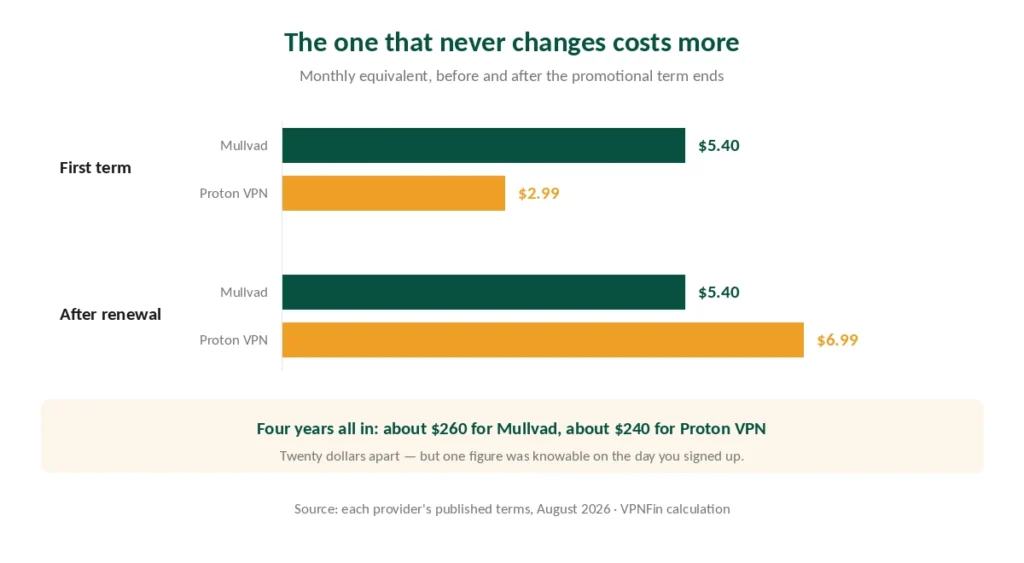
Mullvad charges €5 a month, about $5.40, and has since 2009. No tiers, no annual discount, no renewal increase. Across four years that is roughly $260.
Proton VPN Plus runs about $2.99 a month on the two-year plan, billed at $71.76, then renews near $83.88 a year — about $6.99 monthly. Across four years, roughly $240.
So Proton is about $20 cheaper, despite doubling its price at renewal while Mullvad never moves.
⚠️ The gap is small enough to ignore, and the shapes are not. Mullvad’s cost is knowable on the day you sign up. Proton’s requires you to notice the second-year figure, which is exactly the trap our cheap VPN guide exists to flag.
⚠️ Proton’s refund terms are disputed. Its own FAQ describes a full 30-day money-back guarantee while its terms mention refunds of the unused portion, and reviewers report receiving prorated amounts. Mullvad bills monthly and returns unused time, so the question barely arises.
Winner: Proton VPN on the total, Mullvad on predictability.
Jurisdiction: Both Have an Asterisk
Sweden sits inside the 14 Eyes arrangement, which reads badly on a chart. Mullvad’s answer is architectural: an intelligence-sharing agreement cannot share records that were never created, and the 2023 raid demonstrated exactly that.
Switzerland sits outside every such bloc, which reads well — but the country is revising its surveillance ordinance, and Proton announced in July 2025 that it was moving most physical infrastructure out as a result.
⚠️ One has a bad address and a design that makes it irrelevant. The other has a good address it is packing up to leave. Our legality guide covers how much jurisdiction decides in practice, which is less than most marketing suggests.
Winner: a draw, for opposite reasons.
Winners by Category
| Category | Winner |
|---|---|
| Anonymity from the provider | Mullvad |
| Number of published audits | Mullvad |
| Price predictability | Mullvad |
| Devices | Proton VPN |
| Server coverage | Proton VPN |
| Streaming | Proton VPN |
| Port forwarding | Proton VPN |
| Free tier | Proton VPN |
| Four-year cost | Proton VPN |
| Jurisdiction | Draw |
| Open-source apps | Draw |
| Corporate independence | Draw |
When to Choose Mullvad Instead
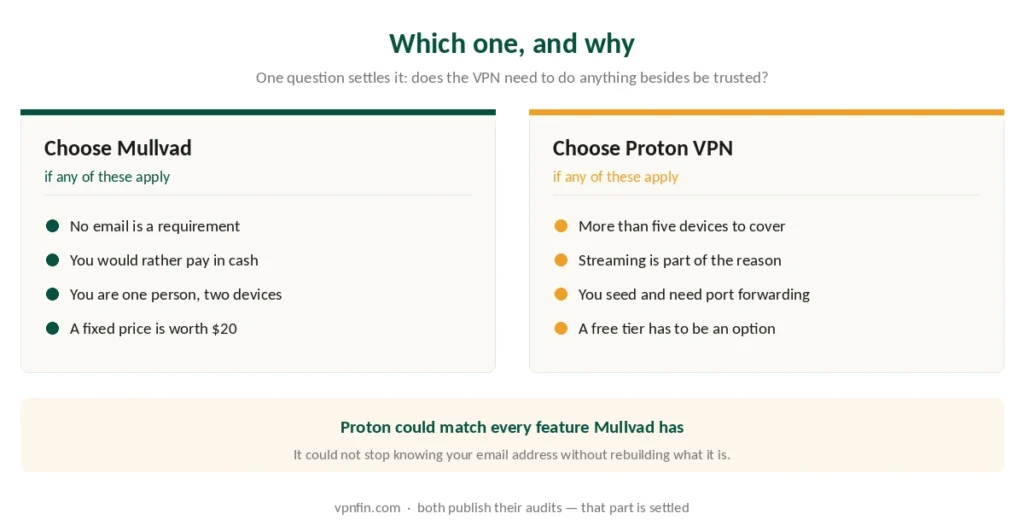
No email is a requirement rather than a preference. If that describes you, nothing on Proton’s side of the table matters.
You want to pay in cash. An envelope with a number on a slip is a payment method Proton has no equivalent to.
You are one person with a phone and a laptop. Five devices stops being a limitation.
Predictability is worth $20. Knowing the price for the next four years has value that a spreadsheet does not capture.
How We Research
This comparison draws on our full reviews of both providers, where every figure was verified against named primary sources at the time of writing — Mullvad’s published Cure53 and Assured AB reports and contemporaneous coverage of the April 2023 police search, Proton’s published Securitum audits and its own documentation of pricing and server coverage. We don’t run our own speed tests, and we have not restated any claim here that was not already sourced in those reviews. Our full approach lives on the About Us page.
Mullvad vs Proton VPN FAQ
Mullvad, on architecture rather than on policy. Both publish audits and open-source their apps, and neither has a parent company. The difference is the sign-up: Mullvad issues a sixteen-digit number and accepts cash by post, while Proton requires an email address. A record exists in one case and not the other.
Mullvad, with more than ten by Cure53 and Assured AB. Proton has five, one a year since 2022, by Securitum. Both publish the reports in full without an account or NDA, so the count matters less than it would if either were withholding them.
Proton VPN, by about $20. Mullvad charges a flat €5 a month, roughly $260 across four years. Proton starts near $2.99 a month and renews at about $6.99, totalling roughly $240. The gap is small; the difference is that Mullvad’s price never changes.
Not reliably, and it makes no claim that it will. Mullvad maintains no streaming-optimised servers. Proton VPN unblocks ten or more Netflix regions on its paid plans, so if regional catalogues are part of why you are buying, that settles it.
Proton VPN allows ten simultaneous connections; Mullvad allows five. Neither sells an add-on to raise the limit. Five suits a single user and becomes awkward for a couple with phones, laptops and a tablet between them.
The Verdict
Proton VPN takes it, and the margin comes entirely from capability. Twice the devices, twenty-eight times the servers, streaming that works, port forwarding included, a free tier that never expires, and $20 less across four years.
Mullvad takes the thing that cannot be added later. Proton could match every feature Mullvad has. It could not stop knowing your email address without rebuilding what it is.
If you want a VPN that is verifiable and also useful, buy Proton. If the point is that nobody holds a record of you, there is one answer and it costs €5 a month. Against NordVPN, Mullvad makes the same argument against a much larger opponent.