
Disclosure: VPNFin is reader-supported. If you buy a VPN through links on this page, we may earn a commission at no extra cost to you. This never affects our ratings — here’s how we research.
Comparisons usually end in a trade-off. One provider is cheaper, the other is better; one covers more devices, the other has more audits. Readers weigh them and choose.
This one does not work that way, and pretending otherwise would waste your time. Surfshark costs less across four years than Hotspot Shield and comes out ahead on devices, verification, jurisdiction, streaming and encryption. We rate them 4.6 and 3.4.
The single place Hotspot Shield competes is raw speed on nearby servers, where its Catapult Hydra protocol is genuinely quick. Everything below explains why that is not enough.
The Short Answer
Surfshark wins, and by more than the ratings suggest. Unlimited devices, two published no-logs audits, post-quantum encryption, streaming that works, and roughly $85 to $155 less across four years.
Hotspot Shield’s case is speed and a free tier. Hydra performs very well on short routes, and the free plan has no time limit.
The price comparison is the surprising part, because the lower-rated provider is the more expensive one.
Head to Head
| Surfshark | Hotspot Shield | |
|---|---|---|
| Devices | Unlimited | 5 or 10, disputed |
| No-logs audits | 2, by Deloitte | None |
| Other audits | Cure53, SecuRing | Protocol only |
| Transparency report | Published | None since 2019 |
| Server storage | RAM-only | Writes to disk |
| Protocol | Dausos, open to audit | Hydra, proprietary |
| Post-quantum | Yes | No |
| Jurisdiction | Netherlands | United States |
| Owner | Nord Security | Point Wild |
| Streaming | Reliable | Inconsistent |
| Free tier | None | Yes, no time limit |
| Refund window | 30 days | 45 days |
| Four years | $205 | $290 – $360 |
| Our rating | 4.6 | 3.4 |
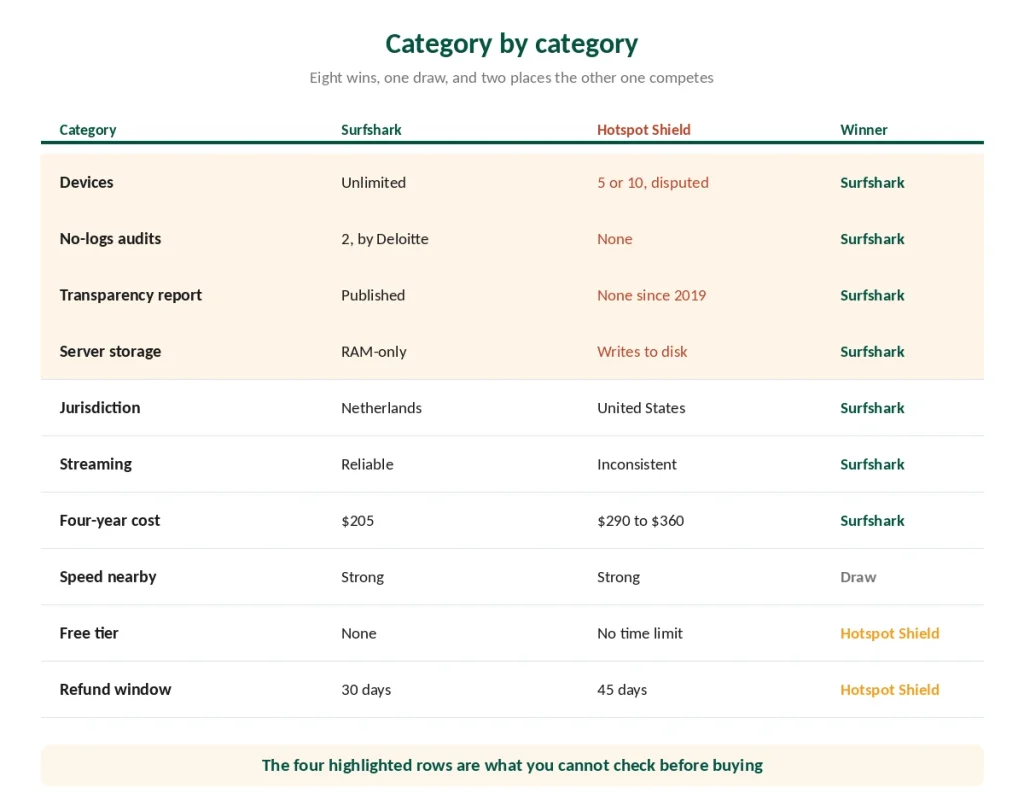
Where the Comparison Stops Being Close
Start with verification, because it produces the ratings gap.
Surfshark has two no-logs assurance reports by Deloitte, in 2023 and June 2025 under the ISAE 3000 standard, plus Cure53 on its browser extensions in 2018, its infrastructure in 2021 and again in 2026, and its Dausos protocol in April 2026. SecuRing reviewed infrastructure security in 2025. All published on its trust page.
Hotspot Shield has no audit of its no-logs policy at all. Its proprietary Catapult Hydra protocol has been examined by outside parties, which the company points to — but a protocol audit asks whether the tunnel is built correctly, while a no-logs audit asks whether the company keeps records of what goes through it.
Transparency reporting runs the same way. Hotspot Shield has published none since 2019.
And the architecture differs. Surfshark runs RAM-only servers that cannot retain data after a reboot. Hotspot Shield writes to disk, so data survives both a restart and a seizure.
⚠️ None of this proves Hotspot Shield is logging you. It means there is no mechanism by which you could find out — which is the basis of our 3.4 rather than any specific allegation.
Winner: Surfshark, decisively.
Devices: Unlimited Against a Number Nobody Agrees On
Surfshark writes no cap into its terms. Every plan, as many connections as you have devices.
Hotspot Shield’s limit is disputed across published sources — some say five, others ten. That is unusual, and it is part of a wider pattern: the same sources give six different prices for the same plan.
⚠️ A device limit you cannot confirm before buying is itself a finding. For a household, unlimited against an uncertain five is not a close call.
Winner: Surfshark.
Speed: The Place They Meet
Being fair here matters, because this is Hotspot Shield’s genuine strength.
Catapult Hydra is fast on nearby servers. Testing on a 250 Mbps line found it among the quickest available on European and US East routes, with servers supporting gigabit throughput.
Consistency is the weakness. The same testing found results dropping noticeably at distance. Surfshark’s Dausos protocol uses AEGIS-256X2 with hybrid post-quantum key exchange, audited by Cure53 in April 2026, and holds up across the network rather than near it.
⚠️ If every server you use is close to you, you will not feel a difference. That is the honest scope of Hotspot Shield’s advantage.
Winner: a draw nearby, Surfshark at distance.
Ownership and Jurisdiction
Surfshark merged with NordVPN under Nord Security in 2022. Two of the five providers we rank answer to one parent, which is worth knowing, though the brands run separate infrastructure and commission separate audits. Its jurisdiction is the Netherlands.
Hotspot Shield’s ownership changed twice and almost nobody noticed. Founded by AnchorFree, which became Pango, acquired by Aura, separated from Aura in September 2024, then merged with Total Security in December 2024 to form Point Wild. Reviews published in 2026 still name all three earlier owners.
⚠️ Point Wild’s own press release lists its brands, and two sit oddly together: Hotspot Shield and Comparitech, a website that reviews VPNs. That is the company’s announcement rather than an allegation, and we have flagged the same structure at Kape and Ziff Davis.
Its jurisdiction is the United States, inside the Five Eyes arrangement.
Winner: Surfshark.
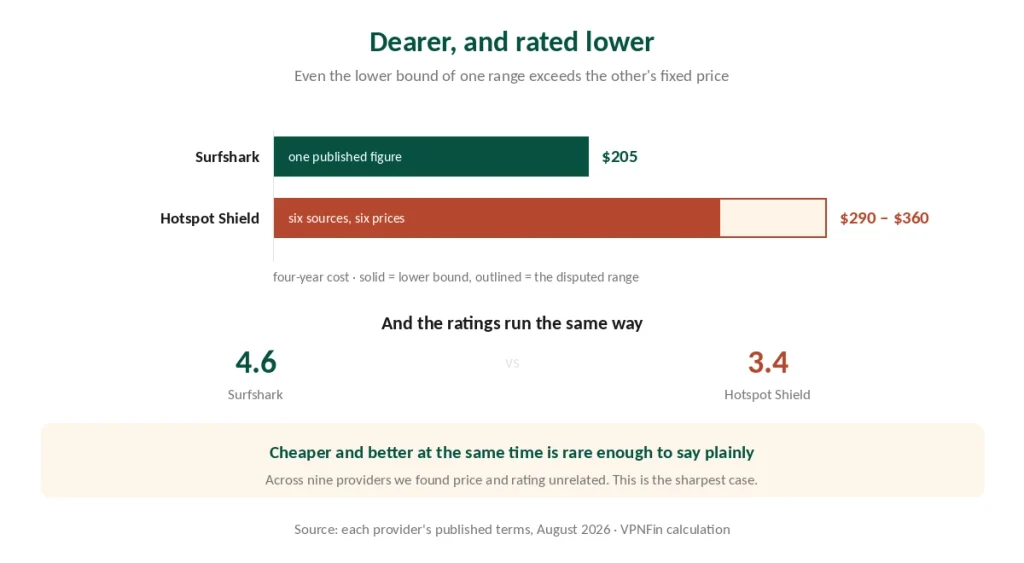
Price: The Lower-Rated One Costs More
This is where the absence of a trade-off becomes concrete.
Surfshark Starter runs about $2.49 a month on the two-year plan with three bonus months, then renews near $79 a year. Across four years, roughly $205.
Hotspot Shield’s annual plan works out near $7.99 a month, with the regular annual rate reported at $95.99 and month-to-month at $12.99. Across four years, $290 to $360 — a range rather than a figure, because published prices for the same plan differ across six sources.
So Surfshark costs $85 to $155 less and rates 4.6 against 3.4.
⚠️ Across nine providers we found price and rating unrelated. This pair is the sharpest illustration in the dataset: the cheaper product is better on every measure except speed on short routes.
⚠️ Hotspot Shield’s 45-day refund window is genuinely good, matching CyberGhost for the longest available. Surfshark gives 30.
What Hotspot Shield Actually Offers
Three things, and they are real.
A free tier with no time limit, ad-supported and restricted to a few locations. ⚠️ The trade is disclosed in the provider’s own terms: location data from free users may be used for ad targeting. Our free VPN guide covers which free tiers avoid that.
Forty-five days to change your mind, which is fifteen more than Surfshark and long enough to test properly rather than once.
Speed on short routes, covered above.
⚠️ What none of those buy is the ability to check anything. No no-logs audit, no transparency report since 2019, disk-based servers and a closed protocol.
Winners by Category
| Category | Winner |
|---|---|
| Devices | Surfshark |
| No-logs verification | Surfshark |
| Transparency reporting | Surfshark |
| Server architecture | Surfshark |
| Post-quantum encryption | Surfshark |
| Jurisdiction | Surfshark |
| Streaming | Surfshark |
| Four-year cost | Surfshark |
| Speed nearby | Draw |
| Free tier | Hotspot Shield |
| Refund window | Hotspot Shield |
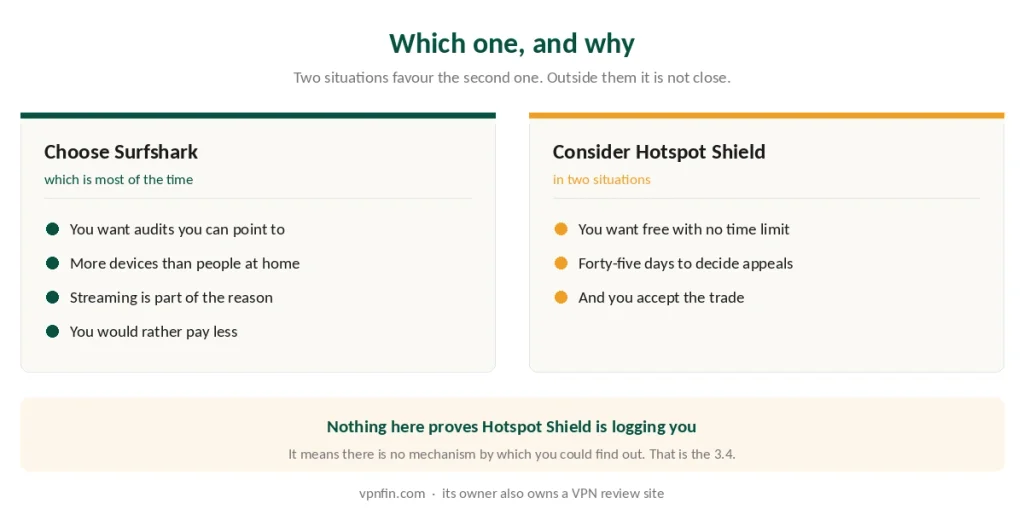
When to Choose Hotspot Shield Instead
Two situations, and we would rather name them than pretend there are none.
You want a free VPN with no time limit and accept that location data funds it.
Forty-five days matters more to you than anything above. It is the longest window available, and for someone unsure whether they want a VPN at all, that is a reasonable way to find out.
⚠️ Outside those two cases the comparison is not close, and the price does not compensate — because Hotspot Shield is the more expensive of the two.
How We Research
This comparison draws on our full reviews of both providers, where every figure was verified against named primary sources at the time of writing — Surfshark’s published Deloitte, Cure53 and SecuRing engagements, Point Wild’s December 2024 merger announcement as carried by the wire services, published speed testing from named reviewers, and each provider’s own pricing terms. We don’t run our own speed tests. Where a provider’s published prices and device limits differ across sources, as Hotspot Shield’s do, we give the range and say plainly that we could not resolve it. Our full approach lives on the About Us page.
Surfshark vs Hotspot Shield FAQ
Surfshark, and it also costs less. We rate them 4.6 and 3.4. Surfshark wins on devices, published audits, transparency reporting, server architecture, jurisdiction, streaming and post-quantum encryption. Hotspot Shield competes on raw speed over short routes and offers a free tier.
Surfshark, by $85 to $155 across four years. It comes to roughly $205 against Hotspot Shield’s $290 to $360 — a range rather than a figure, because published prices for the same Hotspot Shield plan differ across six sources.
Surfshark allows unlimited simultaneous connections with no cap in its terms. Hotspot Shield’s limit is given as five by some published sources and ten by others, which is unusual and worth confirming at checkout before you buy.
Its Catapult Hydra protocol has been examined by outside parties, but there is no independent audit of its no-logs policy, and no transparency report since 2019. Surfshark has two Deloitte no-logs reports plus Cure53 and SecuRing engagements, all published on its trust page.
It has no time limit, which is rare, and the trade is disclosed in the provider’s own terms: location data from free users may be used for ad targeting. The 45-day refund window on paid plans is also genuinely long, fifteen days more than Surfshark offers.
The Verdict
Surfshark takes it on everything except speed on short routes, and it costs less doing so. That combination is rare enough to state plainly rather than dress up as a balanced choice.
Two published no-logs audits against none is the difference that produces the ratings gap, and no amount of throughput closes it.
Hotspot Shield’s free tier and 45-day window are real, and they are the two reasons to consider it.
But it is the dearer option, which removes the argument that usually rescues a lower-rated product. Against NordVPN it faces the same objection at closer prices.