
Disclosure: VPNFin is reader-supported. If you buy a VPN through links on this page, we may earn a commission at no extra cost to you. This never affects our ratings — here’s how we research.
Speed is the reason people buy Hotspot Shield, and it delivers. Its Catapult Hydra protocol performs very well on nearby servers, with gigabit throughput on European and US East routes.
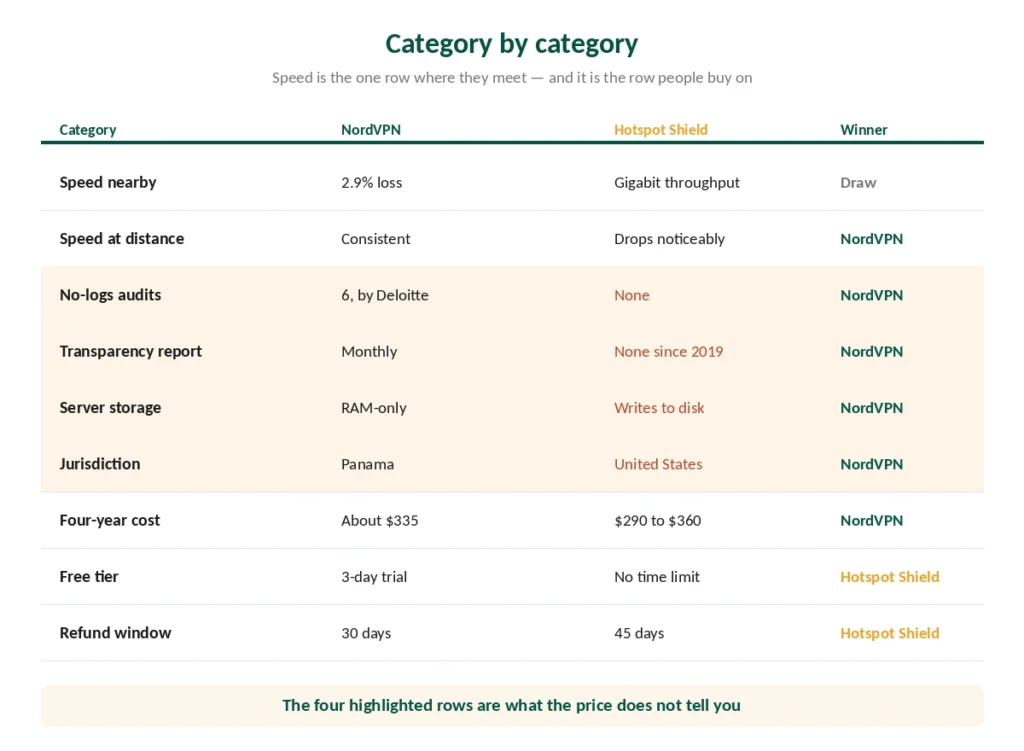
That is also where the similarity ends. NordVPN has six independent no-logs audits, publishes a transparency report every month, runs servers that cannot retain data after a reboot, and operates from Panama. Hotspot Shield has no audit of its no-logs policy, has published no transparency report since 2019, writes to disk rather than RAM, and sits in the United States.
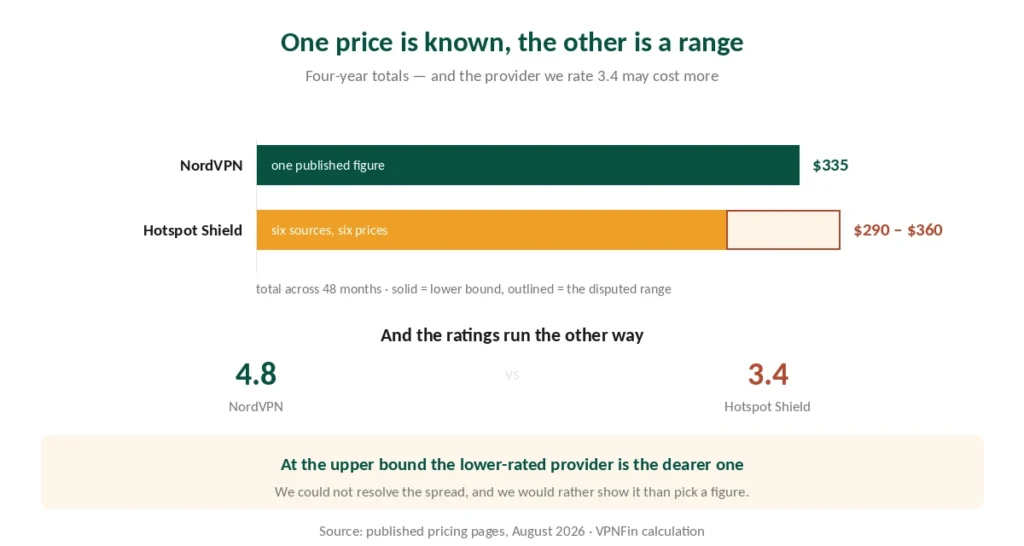
We rate them 4.8 and 3.4 — the widest gap between any two providers we cover. This NordVPN vs Hotspot Shield comparison explains how two fast VPNs end up that far apart.
The Short Answer
NordVPN wins, comfortably. Fastest in independent testing, six published audits, Panama jurisdiction, RAM-only servers, ten devices, and streaming that works.
Hotspot Shield’s case is speed and a free tier. Catapult Hydra is genuinely quick nearby, the free plan has no time limit, and 45 days is the longest refund window we track.
The money is closer than the ratings suggest, which is the part worth reading.
Head to Head
| NordVPN | Hotspot Shield | |
|---|---|---|
| Speed nearby | 2.9% loss (CNET) | Gigabit throughput |
| Speed at distance | Consistent | Drops noticeably |
| No-logs audits | 6, by Deloitte | None |
| Transparency report | Monthly | None since 2019 |
| Server storage | RAM-only | Writes to disk |
| Protocol | NordLynx, open base | Hydra, proprietary |
| Jurisdiction | Panama | United States |
| Owner | Nord Security | Point Wild |
| Devices | 10 | 5 or 10, disputed |
| Free plan | 3-day Android trial | Yes, no time limit |
| Refund window | 30 days | 45 days |
| Renewal | $139.08/yr | $95.99/yr |
| Our rating | 4.8 | 3.4 |
Speed: Closer Than the Rest of This Comparison
Start here, because it is the one place Hotspot Shield competes on equal terms.
CNET measured a 2.9% average download loss for NordVPN across more than 250 tests — the best result in that lineup, achieved with NordLynx, which is WireGuard with a double NAT layer on top.
Hotspot Shield’s Catapult Hydra is fast where it is fast. Testing on a 250 Mbps line found it among the quickest available on European and US East routes, with servers supporting gigabit throughput.
The difference is consistency rather than peak. The same testing found Hotspot Shield dropping noticeably on distant servers. NordVPN’s 2.9% is an average across a full test set, not a best case.
⚠️ So if your servers are nearby, you will not feel the gap. That is a real point in Hotspot Shield’s favour, and it is the reason this comparison needs the rest of the article.
Winner: NordVPN on consistency. Nearby, it is close.
Verification: Six Against Nothing
This is where the ratings separate.
NordVPN has six independent no-logs assessments — PricewaterhouseCoopers in 2018 and 2020, then Deloitte through the end of 2025, most recently between 10 November and 12 December that year under the ISAE 3000 standard. Reports go to subscribers through their account rather than being published openly, which we have criticised elsewhere.
Hotspot Shield has no audit of its no-logs policy at all. Its proprietary Catapult Hydra protocol has been examined by outside parties, and the company points to that — but a protocol audit asks whether the tunnel is built correctly, while a no-logs audit asks whether the company keeps records of what goes through it. Those are different questions.
Transparency reports run the same way. NordVPN publishes monthly, having replaced its warrant canary with them in late 2024. Hotspot Shield has published none since 2019.
And the servers differ structurally. NordVPN runs RAM-only hardware that physically cannot retain data after a reboot. Hotspot Shield writes to disk, so data survives both a restart and a seizure.
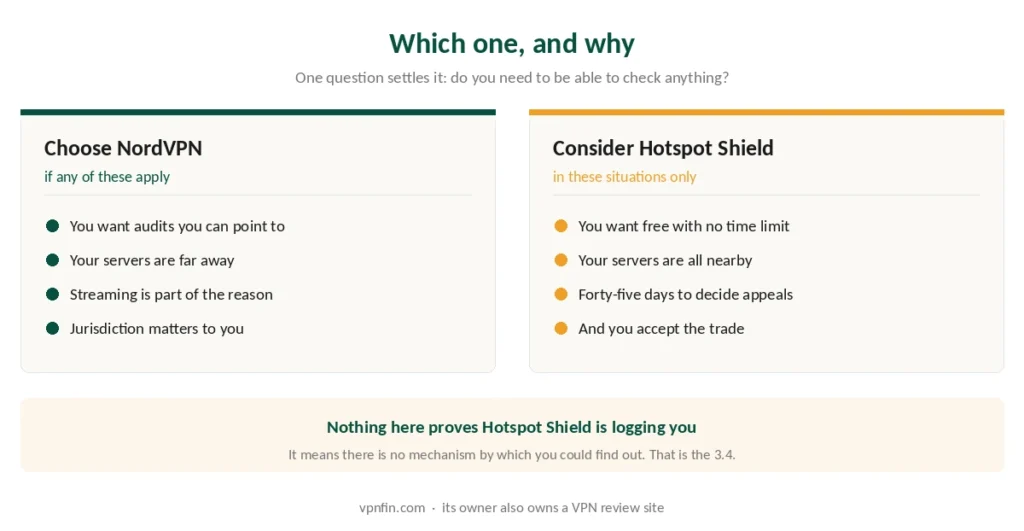
⚠️ None of this means Hotspot Shield is logging you. It means there is no mechanism by which you could find out. Compare with Proton VPN’s five published annual audits or Mullvad’s ten-plus, and the gap is not a matter of degree.
Winner: NordVPN, decisively.
Jurisdiction and Ownership
NordVPN operates from Panama, outside every intelligence-sharing arrangement, with no mandatory data retention. Parent company Nord Security also owns Surfshark, which is worth knowing.
Hotspot Shield sits in the United States, inside the Five Eyes arrangement.
Its owner changed twice and almost nobody noticed. Hotspot Shield was founded by AnchorFree, which became Pango, which was acquired by Aura, which separated in September 2024, which merged with Total Security in December 2024 to form Point Wild. Reviews published in 2026 still name all three of the earlier owners.
⚠️ Point Wild’s own press release lists its brands, and two of them sit oddly together: Hotspot Shield and Comparitech, a website that reviews VPNs. That is the company’s announcement rather than an allegation.
We keep naming these because the pattern repeats. Kape owns ExpressVPN, CyberGhost and PIA; Ziff Davis owns IPVanish alongside several technology publications. Our legality guide covers how much jurisdiction decides on its own, which is less than marketing suggests.
Winner: NordVPN.
Price: Where It Gets Uncomfortable
Ratings of 4.8 and 3.4 imply a price gap. There is one, and it points the wrong way.
NordVPN Basic starts around $3.39 a month on the two-year plan and renews at $139.08 a year — the steepest renewal we track, as our renewal price table sets out.
Hotspot Shield’s annual plan works out near $7.99 a month, with the regular annual rate reported at $95.99 and month-to-month at $12.99.
Across four years: roughly $335 for NordVPN against $290 to $360 for Hotspot Shield. The range exists because published figures for the same Hotspot Shield plan differ across six sources, ranging from $7.99 to $19.99 monthly depending on which you read.
⚠️ At the upper end, the provider we rate 3.4 costs more than the one we rate 4.8. That is not a typo, and it is the strongest practical argument in this comparison. Against Surfshark it costs more at either end.
⚠️ Hotspot Shield’s 45-day refund window is genuinely good, matching CyberGhost for the longest available. NordVPN gives 30.
Winner: NordVPN, and by more than the headline rates suggest.
Features and Free Tiers
NordVPN’s feature list is far deeper: Meshnet linking up to 60 of your own devices, Threat Protection Pro, Smart DNS for televisions that cannot run an app, Double VPN and Onion Over VPN as distinct routing options, and specialty P2P servers.
Hotspot Shield’s is thin: split tunnelling, a kill switch, a Chrome extension. No multi-hop, no port forwarding, no mesh networking. P2P is permitted across the whole network, which is simpler than NordVPN’s server list.
The free tier is Hotspot Shield’s alone to offer, and it deserves a straight assessment. No time limit, ad-supported, limited server locations.
⚠️ The trade is data. Location data from free users may be used for ad targeting, per the provider’s own terms. That is the business model, disclosed rather than hidden — but the free tier is paid for in a currency other than money. Our free VPN guide covers which free tiers avoid that trade.
Streaming favours NordVPN, which unblocks reliably and ships Smart DNS. Hotspot Shield maintains dedicated servers for it, described in published assessments as inconsistent — our streaming guide explains why snapshots go stale.
Winners by Category
| Category | Winner |
|---|---|
| Speed, consistency | NordVPN |
| No-logs verification | NordVPN |
| Transparency reporting | NordVPN |
| Server architecture | NordVPN |
| Jurisdiction | NordVPN |
| Features | NordVPN |
| Streaming | NordVPN |
| Four-year cost | NordVPN, at the upper range |
| Speed nearby | Draw |
| Free tier | Hotspot Shield |
| Refund window | Hotspot Shield |
When to Choose Hotspot Shield Instead
Three situations, and we would rather list them than pretend there are none.
You want a free VPN with no time limit and accept that location data funds it.
Your servers are nearby and speed is the whole purchase. Hydra is genuinely quick, and on short routes you will not notice the difference.
Forty-five days matters to you. It is the longest window available, and long enough to test properly rather than to test once.
⚠️ In every other case the comparison is not close. A provider with no no-logs audit, no transparency report since 2019 and disk-based servers is asking for more trust than the price justifies.
How We Research
This comparison draws on our full reviews of both providers, where every figure was verified against named primary sources at the time of writing — NordVPN’s assurance-engagement announcements and contemporaneous coverage, Point Wild’s December 2024 merger announcement as carried by the wire services, published speed testing from named reviewers, and each provider’s own pricing terms. We don’t run our own speed tests. Where a provider’s published prices differ across sources, as Hotspot Shield’s do, we give the range and say plainly that we could not resolve it. Our full approach lives on the About Us page.
NordVPN vs Hotspot Shield FAQ
Both are fast, and the difference is consistency. NordVPN lost 2.9% of baseline speed on average in CNET’s testing across more than 250 runs. Hotspot Shield’s Catapult Hydra reaches gigabit throughput on nearby European and US East routes but drops noticeably on distant servers.
There is no independent audit of its no-logs policy, no transparency report since 2019, and its servers write to disk rather than running from RAM. None of that proves anything is wrong. It does mean you have no way to verify the claims, which is the basis of our 3.4 rating.
Point Wild, since December 2024. The chain runs from AnchorFree through Pango, Aura ownership, a separation in September 2024 and a merger with Total Security. Point Wild’s own announcement lists its brands, which include Hotspot Shield and Comparitech, a VPN review website.
Closer than the ratings suggest. NordVPN comes to roughly $335. Hotspot Shield lands somewhere between $290 and $360, because published prices for the same plan differ across sources. At the upper end it costs more than NordVPN despite our much lower rating.
It has no time limit and no throttle, which is rare. The trade is disclosed in the provider’s own terms: location data from free users may be used for ad targeting. The free tier is paid for in a currency other than money.
The Verdict
NordVPN takes it by the widest margin in our rankings. Six audits against none, monthly transparency reports against nothing since 2019, RAM-only servers against disk, Panama against the United States.
Hotspot Shield’s speed is real, and so is its free tier, and so is the 45-day window. Those are three genuine things.
What they do not buy is the ability to check anything. For roughly the same money across four years — possibly more — NordVPN publishes six audits, a monthly report and an architecture that cannot retain what it does not have. Against Proton VPN, NordVPN faces a much harder argument about exactly this.