
Disclosure: VPNFin is reader-supported. If you buy a VPN through links on this page, we may earn a commission at no extra cost to you. This never affects our ratings — here’s how we research.
Both of these ask you to accept something before you buy, and the two demands are entirely different in kind.
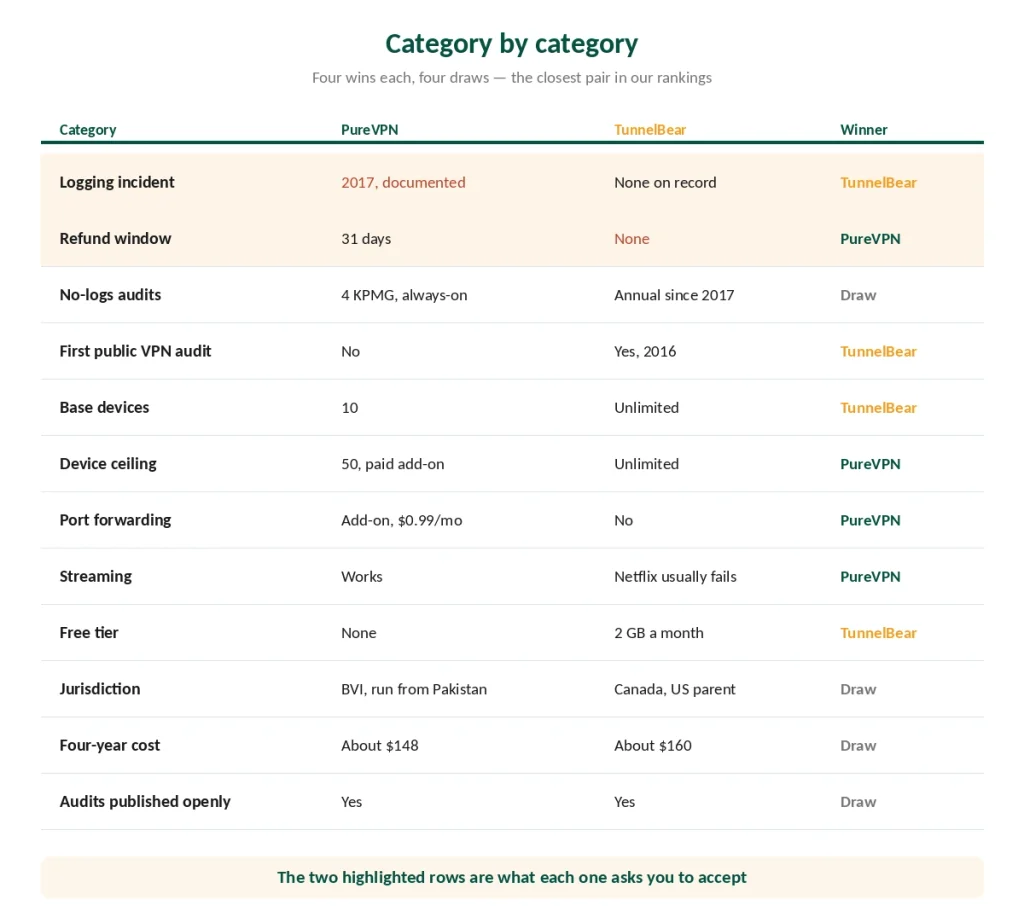
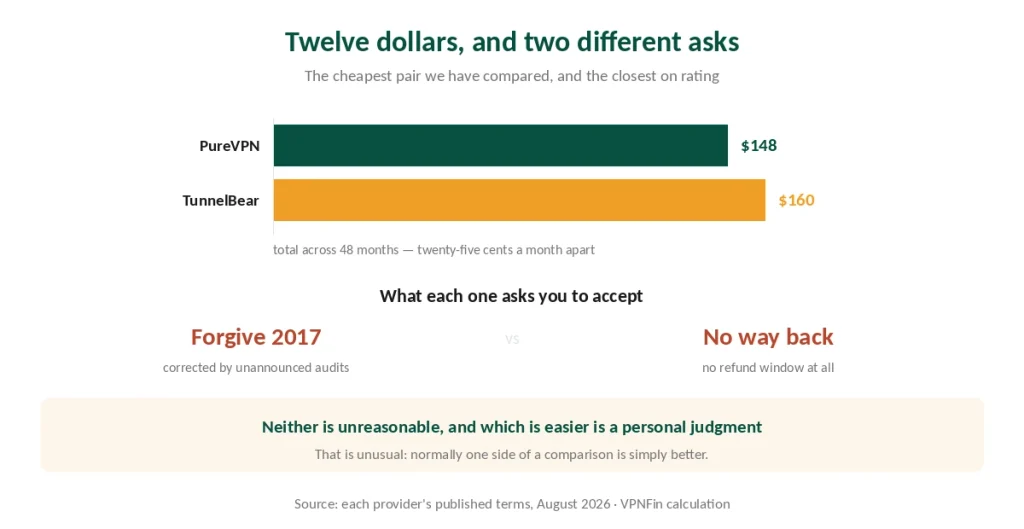
PureVPN asks you to accept 2017, when it handed connection records to the FBI while advertising a no-logs policy. TunnelBear asks you to accept that there is no refund window, so whatever you decide is final.
Twelve dollars separate them across four years — twenty-five cents a month. We rate them 4.1 and 4.0, the narrowest gap in our rankings, which means the compromise you find easier to live with is genuinely the deciding factor.
The Short Answer
PureVPN wins, barely, on the refund window, streaming that works, and the cheapest four-year cost we track.
TunnelBear wins on devices — unlimited against ten — and on the audit run it started in 2016 when nobody else was doing it.
Neither is a comfortable recommendation, and both are cheap enough that the compromise may be worth it to you.
Head to Head
| PureVPN | TunnelBear | |
|---|---|---|
| Logging incident | 2017, documented | None on record |
| No-logs audits | 4 by KPMG, always-on | Annual since 2017 |
| First public VPN audit | No | Yes, 2016 |
| Refund window | 31 days, not on crypto | None — case by case |
| Devices | 10, up to 50 paid | Unlimited |
| Free tier | None | 2 GB a month, no card |
| Port forwarding | Add-on, $0.99/mo | No |
| Streaming | Works | Netflix usually fails |
| Jurisdiction | BVI, run from Pakistan | Canada, US parent |
| Owner | GZ Systems | McAfee |
| Four years | ~$148 | ~$160 |
| Our rating | 4.1 | 4.0 |
The Two Compromises
Worth naming both plainly, because this comparison is mostly a choice between them.
PureVPN handed connection records to the FBI in 2017 in a cyberstalking prosecution, while its marketing claimed a no-logs policy. It is documented, and it is the worst thing on record about any provider we cover.
What followed is also documented. PureVPN moved to an always-on KPMG audit arrangement, in place since 2023, under which the auditor can inspect systems without notice rather than on a scheduled date. Four KPMG engagements have been completed, the most recent in April 2024, alongside an earlier Altius IT audit in 2019.
TunnelBear has no incident. It also has no refund window, deciding case by case rather than granting a fixed period — which sets it apart from every other provider we cover.
⚠️ So one asks you to forgive a past failure that was corrected. The other asks you to commit without a way back. Neither is unreasonable, and which you find easier is a personal judgment rather than a technical one.
Winner: neither, and that is the honest answer.
Audits: Continuous Against Consecutive
Two genuinely different approaches to the same problem, and both are unusual.
PureVPN’s arrangement is continuous. Unannounced inspection rights are rare in this category, and they exist precisely because 2017 happened. Four KPMG engagements sit alongside them.
TunnelBear’s is consecutive. Cure53 did the work in 2016, the report appeared in 2017 with two critical findings published intact, and it has repeated annually since — the eighth by 2024. It commissioned the first public VPN audit anyone had done.
⚠️ Both publish, which most providers do not. NordVPN’s six reports go to account holders through their account rather than onto the website.
The difference is what each proves. Continuous inspection says nothing is hidden right now. An unbroken annual run says nothing has been hidden across nine years. Neither substitutes for the other.
Winner: a draw, on different merits.
Devices and Features
TunnelBear allows unlimited simultaneous connections on every paid plan, changed from a previous cap of five that many reviews still quote.
PureVPN includes ten and sells a paid Multi Login add-on raising the limit to fifty — which is the highest ceiling we have found anywhere, though you pay for it.
Port forwarding is where PureVPN is unusual. It offers the feature as an add-on at $0.99 a month, not included — a distinction many reviews miss, but available, which most providers cannot say at all. Our torrenting guide covers who needs it.
Two gaps on PureVPN’s side: no split tunnelling on macOS, and its obfuscation has been reported as unstable.
Winner: TunnelBear on the base limit, PureVPN on the ceiling and the extras.
Streaming and Jurisdiction
Streaming works on PureVPN. Published testing reports Netflix failing on most TunnelBear servers, which maintains no streaming-optimised servers and no Smart DNS — our streaming guide covers why access shifts monthly for everyone.
Neither jurisdiction is clean, and both are usually reported as though they were.
PureVPN is registered in the British Virgin Islands, outside every intelligence-sharing arrangement, having relocated from Hong Kong in 2021. ⚠️ Its parent company operates from Pakistan, where data protection law is weak. Registration and operation are not the same thing, and most reviews mention only the first.
TunnelBear is Canadian, a Five Eyes member, with an American publicly traded parent since March 2018. The team stayed in Toronto and the audit programme survived intact, which is real evidence.
Winner: PureVPN on streaming, a draw on jurisdiction.
Price: The Cheapest Pair We Have Compared
PureVPN Standard renews at $47.95 a year — the gentlest figure among the ten providers in our renewal price table. Across four years, roughly $148, which makes it the cheapest provider we cover.
⚠️ Note which tier. PureVPN sells Standard and Plus, and Plus renews at $69.95. Most reviews quote one figure without saying which, and the difference is $22 a year.
TunnelBear runs about $3.33 a month on the three-year plan, $4.00 annually and $9.99 month to month. Across four years, roughly $160.
A gap of twelve dollars — three dollars a year, or twenty-five cents a month.
⚠️ These are the two cheapest providers we cover, and they arrive there differently: PureVPN through the lowest renewal in the category, TunnelBear through a flat three-year rate. Across nine providers we found price and rating unrelated, and this pair sits at the bottom of both columns.
Winner: a draw, at twenty-five cents a month.
Winners by Category
| Category | Winner |
|---|---|
| Refund window | PureVPN |
| Streaming | PureVPN |
| Port forwarding | PureVPN |
| Device ceiling | PureVPN |
| Logging incident on record | TunnelBear |
| First public VPN audit | TunnelBear |
| Base device limit | TunnelBear |
| Free tier | TunnelBear |
| Audit approach | Draw — continuous against consecutive |
| Four-year cost | Draw — $12 apart |
| Jurisdiction | Draw — neither is clean |
⚠️ The fifth row is not a typo. TunnelBear has no logging incident on record, and that is a genuine point in its favour — it sits alongside having no refund window either.
When to Choose TunnelBear Instead
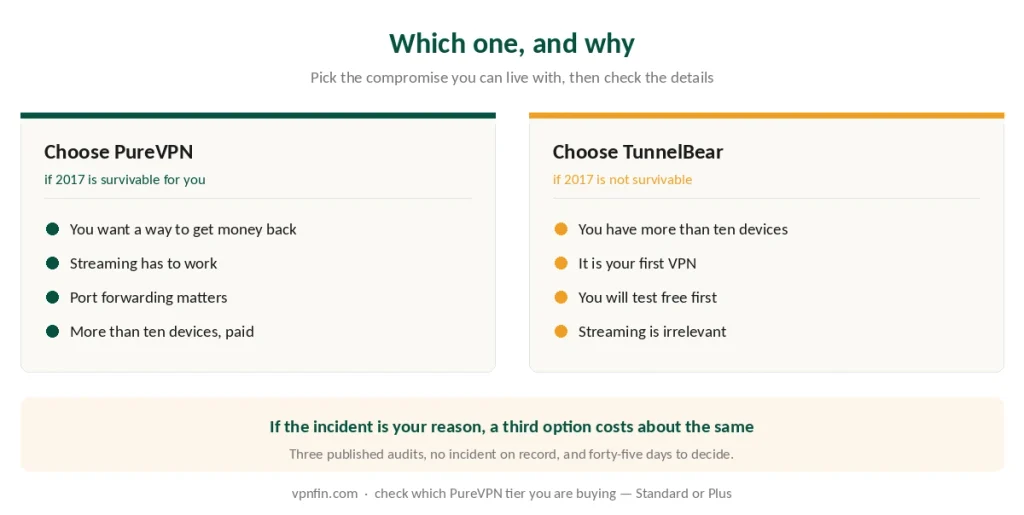
The 2017 incident disqualifies PureVPN for you. A legitimate position, and if you hold it, no amount of subsequent auditing changes it.
You have more than ten devices and would rather not pay for an add-on.
It is your first VPN. The interface is the friendliest in the category by a distance.
Streaming is irrelevant to you, and you will test on the free tier before paying.
⚠️ If 2017 is your reason, note what you are choosing instead: a provider with no way to get your money back if it disappoints. CyberGhost costs about the same with three published audits, no incident, and 45 days.
How We Research
This comparison draws on both providers’ full reviews on this site, where every figure was verified against named primary sources — contemporaneous reporting on the 2017 FBI case, PureVPN’s published KPMG audit arrangement and its four completed engagements, the Cure53 reports TunnelBear commissions annually, and each provider’s own pricing and refund terms. We don’t run our own speed tests, and where a provider’s registration and operating base differ, as PureVPN’s do, we say so rather than reporting only the flattering one. Our full approach lives on the About Us page.
PureVPN vs TunnelBear FAQ
PureVPN, narrowly, at 4.1 against 4.0 — the closest ratings in our rankings. It wins on the refund window, streaming, and the cheapest four-year cost we track. TunnelBear wins on base device limit, its free tier, and the audit run it started in 2016.
Yes, in 2017, in a cyberstalking prosecution, while its marketing claimed a no-logs policy. It responded by moving to an always-on KPMG audit arrangement, in place since 2023, under which the auditor can inspect without notice. Four KPMG engagements have been completed.
Not through a standard guarantee. It considers requests case by case rather than offering a fixed window. PureVPN gives 31 days, though not on cryptocurrency payments. Evaluate TunnelBear on its free tier and treat the subscription as difficult to reverse.
PureVPN, by twelve dollars — roughly $148 against $160, or twenty-five cents a month. These are the two cheapest providers we cover, arriving there differently: PureVPN through the lowest renewal in the category, TunnelBear through a flat three-year rate.
TunnelBear allows unlimited simultaneous connections. PureVPN includes ten and sells a paid add-on raising the limit to fifty, which is the highest ceiling we have found. For most households TunnelBear’s base limit is simpler and costs nothing extra.
The Verdict
Twelve dollars apart, with the two narrowest ratings in our rankings. On the numbers this is close to a tie.
What decides it is which compromise you find easier. PureVPN was caught in 2017 and responded with continuous outside inspection. TunnelBear has never been caught and will not refund you if it disappoints.
PureVPN takes it narrowly on the refund window, streaming, and the cheapest four-year cost we track.
But if 2017 is disqualifying for you, that is a reasonable position, and TunnelBear is a reasonable answer — provided you test it free first, because you will not get a second chance to decide. Against CyberGhost and against NordVPN, it faces the same objection each time.