
Disclosure: VPNFin is reader-supported. If you buy a VPN through links on this page, we may earn a commission at no extra cost to you. This never affects our ratings — here’s how we research.
Every guide to cheap VPNs gives the same advice: buy the two-year plan. It is correct, and it does not help if you need a VPN for one month.
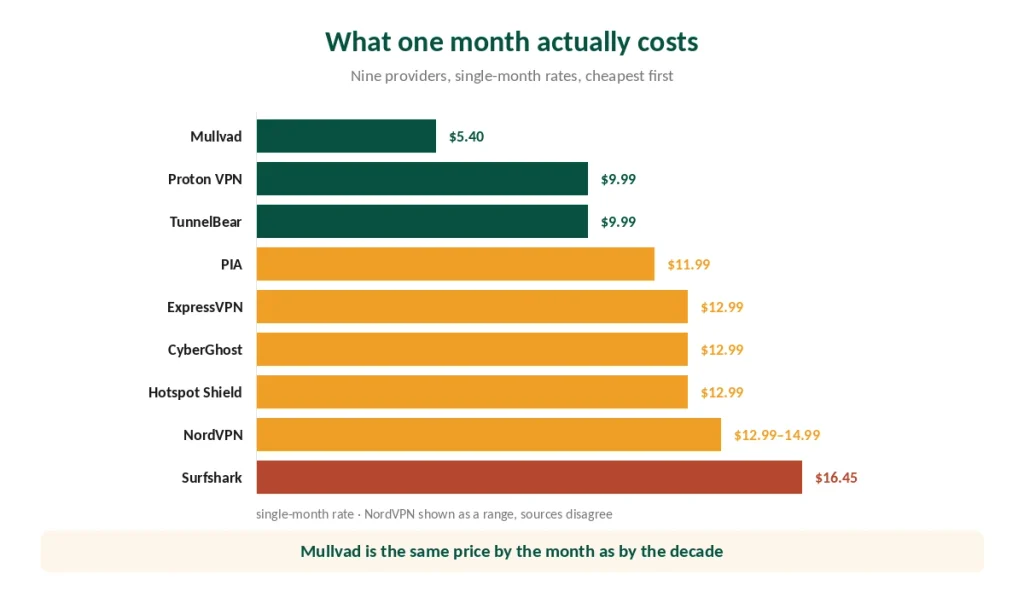
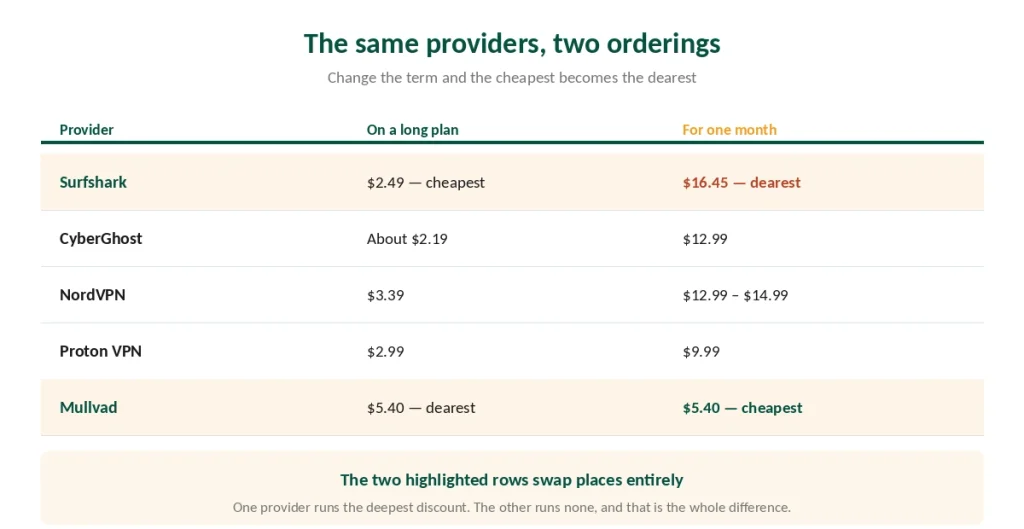
Month to month, the ranking inverts. The provider that never runs a discount becomes the cheapest by a wide margin, and the provider with the lowest advertised price becomes the most expensive one on the list.
Mullvad charges a flat €5, about $5.40, billed monthly with no contract. Surfshark, which advertises $2.49 a month on a two-year plan, charges $16.45 for a single month — a factor of six and a half within one provider.
The Short Answer
Mullvad at about $5.40 is the cheapest genuine month-to-month option we track, and it is the same price it has been since 2009.
Proton VPN and TunnelBear sit near $9.99, which is where the rest of the market starts.
Most premium providers charge $12.99 to $16.45 for one month — three to six times their long-plan rate.
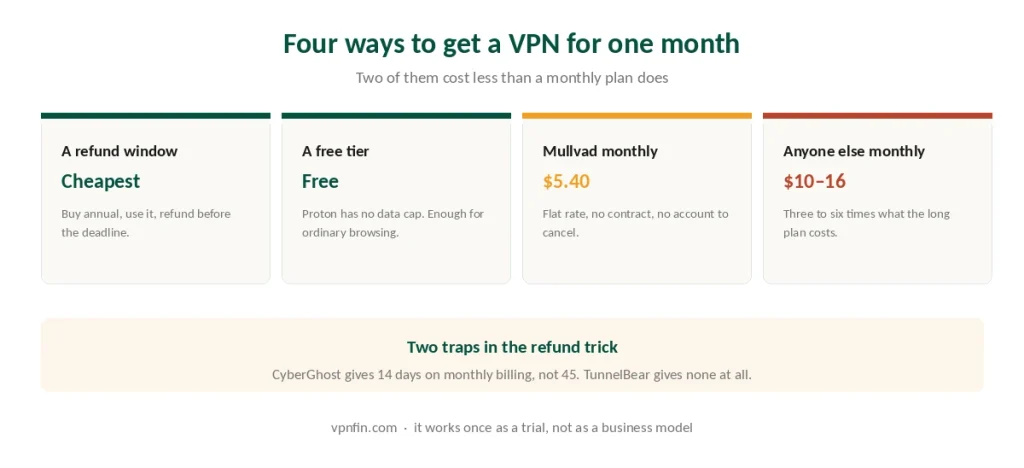
And there is a fourth option: buy an annual plan and use the refund window as a trial.
What One Month Actually Costs
| Provider | One month | Long-plan rate |
|---|---|---|
| Mullvad | ~$5.40 | Same — no discount exists |
| Proton VPN | $9.99 | $2.99 |
| TunnelBear | $9.99 | $3.33 |
| Private Internet Access | $11.99 | ~$2.19 |
| NordVPN | $12.99 – $14.99 | $3.39 |
| ExpressVPN Basic | $12.99 | $3.59 |
| CyberGhost | $12.99 | ~$2.19 |
| Hotspot Shield | $12.99 | $5.99 |
| Surfshark Starter | $16.45 | $2.49 |
⚠️ Two figures are disputed and we give the range rather than choosing. NordVPN appears at both $12.99 and $14.99 across published sources; Surfshark at both $15.45 and $16.45. ExpressVPN’s Advanced and Pro tiers run $13.99 and $19.99.
Why One Month Costs So Much More
The mechanism is the same one behind renewal pricing, seen from the other end.
A discount on a long plan is a customer acquisition cost. Advertising, affiliate commissions and app-store fees are paid upfront, and the provider recovers them across the term. A monthly subscriber can leave after thirty days, so there is nothing to recover it from — and the price reflects that.
That produces the spread. Surfshark advertises $2.49 on a two-year plan and charges $16.45 for one month. Same product, same servers, same apps.
Mullvad has no spread because it has no discount. Five euros is five euros whether you stay a month or a decade, which is why it wins here and finishes mid-table over four years — our renewal price table shows both sides of that.
⚠️ This is the clearest case we have found of price telling you nothing about quality. Across nine providers we measured a correlation of 0.02 between four-year cost and our rating. Monthly, the ordering scrambles again.
The Refund Window as a Trial
If you need a VPN for thirty days or fewer, this usually beats a monthly plan outright.
Buy the annual plan, use it, request the refund before the window closes. Most providers give thirty days. You get the full product at the long-plan rate for as long as you need it.
⚠️ Two warnings. CyberGhost gives 45 days on six-month and two-year plans but only 14 days on monthly billing, and the guarantee applies to direct purchases rather than app stores. And TunnelBear has no refund window at all, so the trick does not work there.
⚠️ Do not do this repeatedly with the same provider. It works once as a trial. Treating it as a business model is a different thing, and providers notice.
When Monthly Is Actually Right
Four situations, and outside them the long plan is better.
A single trip. Two weeks abroad does not justify two years, and our travel guide covers what you actually need for that.
Testing before committing. Though the refund window usually does this better and cheaper.
A short-term need with a known end. A contract job, a house move, a specific project.
You would rather not pay a company two years in advance. A legitimate preference, and Mullvad is built around it — no account, no email, cancel by simply not paying.
⚠️ What monthly does not solve is the renewal problem. It replaces one bad deal with another: instead of a low rate that jumps, you pay the high rate from day one.
Free Tiers, Briefly
If one month is what you need, a free tier may cover it.
Proton VPN’s free plan has no data cap, one device, ten countries the app assigns, and no streaming. For a month of ordinary browsing that is genuinely enough.
TunnelBear gives 2 GB a month with no payment card, which is roughly two hours of HD video.
⚠️ Most other free services are paid for in data rather than money — our free VPN guide covers which are safe and which are not.
The Provider That Ignores All of This
Worth a section, because Mullvad’s model explains why it wins here.
There is one plan at one price. No tiers, no annual discount, no promotional rate, no renewal increase, and no way to pay less by committing longer.
The stated reasoning is that discounts for long commitments extract money from people who stop using the service. Whether you find that principled or inflexible, the effect is that monthly buyers are not penalised.
It also has no account to cancel. Sign-up produces a sixteen-digit number, payment is by card, PayPal, cryptocurrency or cash sent by post, and you stop by not paying again.
⚠️ The trade is real. Five devices, no streaming, around 700 servers, and WireGuard only since it retired OpenVPN in January 2026. Our Mullvad review sets out what you give up.
How We Research
Monthly prices here were checked against published pricing comparisons from named outlets in August 2026, cross-referenced with each provider’s own figures where available and with our own reviews. Long-plan rates come from our reviews, where each was verified against the provider’s terms at the time of writing. We don’t run our own speed tests. Where sources gave different figures for the same monthly plan, as they do for NordVPN and Surfshark, we give the range and say so rather than picking the convenient number. Prices in this category change with promotions, so confirm the live rate at checkout. Our full approach lives on the About Us page.
Monthly VPN FAQ
Mullvad, at a flat €5 — about $5.40 — billed monthly with no contract. That is roughly half the next cheapest option and about a third of the most expensive. It is also the same price Mullvad has charged since 2009, because it runs no promotions at all.
Because the discount on a long plan is a customer acquisition cost recovered across the term. A monthly subscriber can leave after thirty days, so there is nothing to recover it from. Surfshark advertises $2.49 on a two-year plan and charges $16.45 for one month — the same product at six and a half times the price.
Yes, and for thirty days or fewer it usually costs less. Buy the annual plan at the long-term rate, use it, and request the refund before the window closes. Note that CyberGhost gives only 14 days on monthly billing despite advertising 45, and TunnelBear has no refund window at all.
Almost all of them, at $9.99 to $16.45. Proton VPN and TunnelBear sit at $9.99; PIA at $11.99; NordVPN, ExpressVPN, CyberGhost and Hotspot Shield around $12.99; Surfshark at $16.45. Mullvad sells nothing else, which is why it is cheapest.
Possibly. Proton VPN’s free tier has no data cap, though it covers one device, assigns your location, and does not support streaming. TunnelBear gives 2 GB a month without a payment card. For ordinary browsing over a short period, either may be sufficient.
The Verdict
Mullvad is the cheapest month-to-month VPN we track, at about $5.40 against a market that starts near $9.99 and reaches $16.45.
It wins because it does not play the game. No introductory rate means no premium for refusing one, which is the whole mechanism in a sentence.
If you need thirty days or fewer, use a refund window instead. An annual plan at the long-term rate, returned before the deadline, costs less than any monthly plan on this page.
And if you are considering monthly to avoid a renewal jump, note what you are choosing: the high rate from day one rather than a low one that rises later. Our renewal table shows what that jump actually looks like across ten providers.