
Disclosure: VPNFin is reader-supported. If you buy a VPN through links on this page, we may earn a commission at no extra cost to you. This never affects our ratings — here’s our full disclosure.
Ivacy VPN no longer exists. It merged into PureVPN in August 2024, its applications were discontinued on 30 September that year, and new subscriptions have not been available since.
A large part of the search results for it still describes a living product. This page describes what actually happened, and what happened to the people who had bought a lifetime plan.
Why We Earn Nothing Here
No link on this page pays us, including the ones pointing at PureVPN.
That is deliberate. Writing about the difficulties people had migrating into PureVPN while taking a commission from PureVPN would make the account worthless.
What Happened
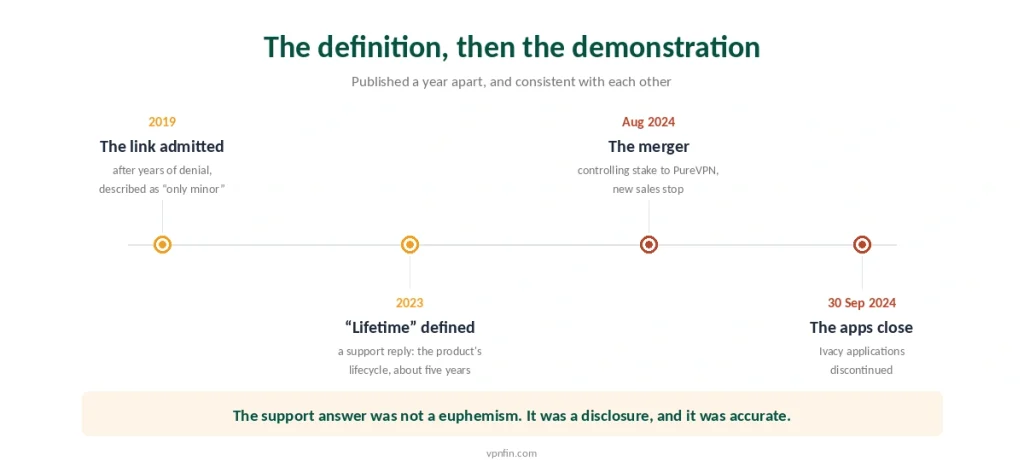
In August 2024 Ivacy announced that PureVPN, described as one of its original backers, had taken a controlling stake. The branding became “Ivacy Powered by PureVPN”.
New subscriptions stopped immediately. Existing users were asked to migrate by logging in, consenting to a data transfer, and continuing with the same credentials.
The applications closed on 30 September 2024.
PureVPN’s own support documentation states the position plainly: existing Ivacy subscriptions and add-ons would be honoured, with no new account required.
⚠️ That is the official account, and much of it worked. Several users reported straightforward migrations. What follows is the part that did not.
What Happened to Lifetime Buyers
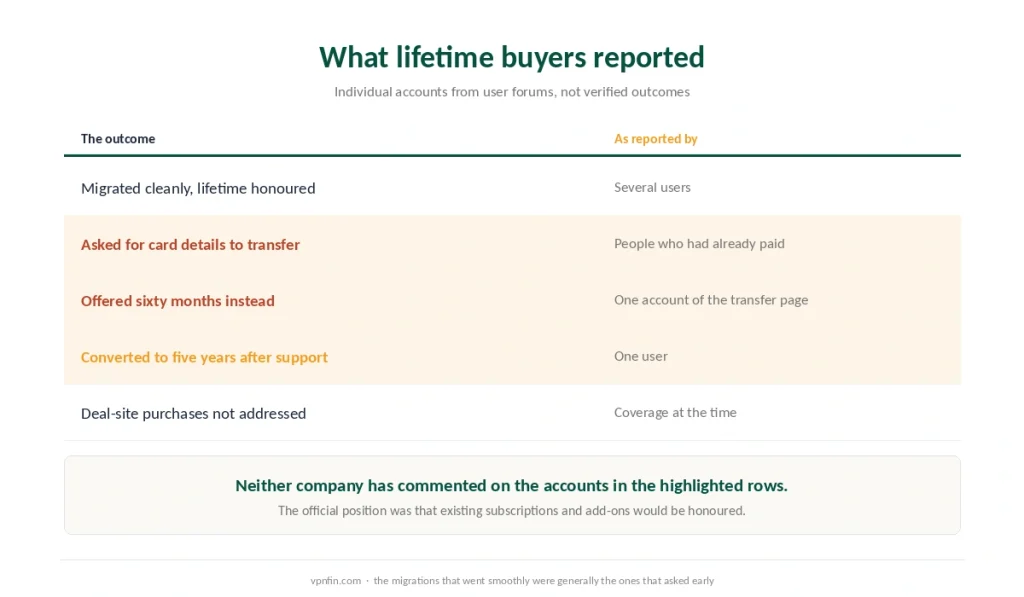
The reports below come from user forums rather than from either company, and we present them as such.
The migration form asked for payment details. People who had already paid once described being unable to complete the transfer without adding a card or a PayPal account.
Some lifetime plans appeared as sixty months. One user described the transfer page offering a subscription at $0.67 a month for sixty months rather than acknowledging a lifetime entitlement.
One reported the outcome directly: after reaching support, the account moved across as a five-year plan.
Others migrated cleanly and reported the lifetime arrangement honoured without argument.
⚠️ Buyers from third-party deal sites had the least clarity. Coverage at the time noted that StackSocial lifetime purchases were not addressed in the announcement, and advised contacting support for a case-by-case answer.
The Sentence That Preceded All of This
Here is why this case matters beyond one company.
In 2023 an Ivacy support representative defined “lifetime” as the lifecycle of a software product, typically around five years. A user published the reply, and it became one of the three documented cases on our page about lifetime plans.
About a year later the company ceased to exist independently, and at least one lifetime holder describes receiving exactly five years.
⚠️ The definition was not a euphemism after all. It was a disclosure, made in a support ticket, and it turned out to be accurate.
The Ownership Question, Which Was Never Answered
Worth recording, because it is the other half of the story.
Ivacy denied a connection to PureVPN for years. Published reporting describes repeated denials before a 2019 blog post acknowledged the relationship as “only minor”.
Both were linked to Gaditek, a Pakistani technology company — the same parent behind PureVPN. Its founder Umair Gadit ran Gaditek; Uzair Gadit runs PureVPN.
Later, references to Ivacy disappeared from Gaditek’s site, and the listed owner became PMG Pte Ltd, a Singapore entity that reviewers described as difficult to trace.
The 2024 announcement then described PureVPN as an original backer — which is the connection that had been denied.
⚠️ Ownership is the first question we ask about any provider, and this is the clearest illustration of why. A company that would not answer it for a decade answered it by merging.
What Ivacy Actually Was
Briefly, because it is now history rather than a purchase decision.
Around ten simultaneous connections, AES-256, streaming and P2P servers, and a large network by the standards of its price bracket.
No independent audit, ever. The no-logs claim rested on the privacy policy alone — and what an audit is actually worth is a low bar this never approached.
A price that made it a fixture on deal sites, which is how most lifetime buyers found it — and a distribution pattern our lifetime guide lists as a warning sign.
If You Still Hold an Ivacy Account
Check whether it migrated. Logging into the old member area redirects to the migration flow; PureVPN’s support pages document the steps.
Contact support before any expiry date rather than after. The guidance circulating at the time asked lifetime holders to make contact one to two weeks in advance, and the accounts that went smoothly were generally the ones that did.
Keep your purchase record. Order confirmations from deal sites were the main evidence people used to argue their case.
⚠️ Do not assume silence means safety. One user described the service continuing to work past the stated end date and then stopping, which is the failure mode nobody watches for. If you find yourself without cover, three free tiers are safe to fall back on.
What This Case Is Evidence Of
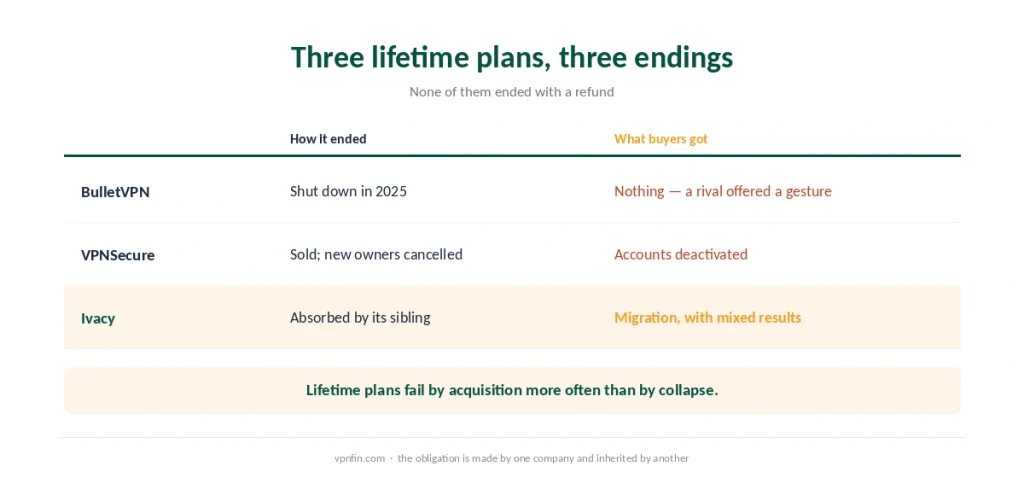
Lifetime plans fail by acquisition more often than by collapse, which is why renewal terms from a company that still exists are worth more than a one-time promise. Atlas VPN closed the same year and handled it far better, which shows the range is a choice rather than a constraint. BulletVPN shut down and VPNSecure was sold; Ivacy was absorbed. In each case the obligation was made by one entity and inherited by another.
The buyer has no contract that survives the transition intact. PureVPN’s stated intention was to honour these plans, and the variation in outcomes shows what an intention is worth against a payment system that expects a card.
And the cheapest signal was available years earlier. A company that will not say who owns it is telling you what it thinks you are entitled to know — which is the same reasoning we applied to the strongest lifetime offer currently on sale.
How We Research
This account draws on TechNadu’s report of the August 2024 merger announcement and PureVPN’s own support documentation for the official migration terms, on contemporaneous user reports from LowEndTalk and MalwareTips for the difficulties described by lifetime holders, on Several.com for confirmation that the service no longer operates independently, and on ProPrivacy, PrivacyJournal, VPNInsights and AlwaysVPN for the ownership history and the earlier denials. User forum reports are individual accounts rather than verified outcomes, and we have labelled them that way throughout. We hold no affiliate relationship with either company on this page. Our method lives on the About Us page.
Ivacy VPN FAQ
No. It merged into PureVPN in August 2024, new subscriptions stopped at that point, and the Ivacy applications were discontinued on 30 September 2024. Existing users were asked to migrate to PureVPN using the same credentials.
PureVPN’s support documentation states that existing subscriptions and add-ons would be honoured. User reports describe mixed outcomes: some migrations went through cleanly, while others describe being asked for payment details, being offered a sixty-month plan, or receiving a five-year term after contacting support.
The listed owner was PMG Pte Ltd, a Singapore entity. Reporting over several years linked the service to Gaditek, the Pakistani company behind PureVPN, a connection Ivacy denied for years before acknowledging it as “only minor” in 2019. The 2024 announcement described PureVPN as an original backer.
No. It never published an independent audit of its no-logs claim in its entire operating history. The claim rested on its privacy policy, which is the weakest form of assurance available in this category.
Log in to the old member area, which redirects to the migration process, and contact PureVPN support before any stated expiry date rather than after. Keep your original purchase confirmation, particularly if you bought through a third-party deal site.
The Verdict
Ivacy stopped existing as a separate service in 2024, and any review presenting it as a current option is out of date.
Its support had already told everyone what a lifetime plan meant. Five years, the lifecycle of a software product — published in 2023, demonstrated in 2024.
PureVPN said it would honour those plans, and for many buyers it did. For others the transfer produced a sixty-month subscription, a request for card details, or a support conversation. Which of those you got appears to have depended on how and when you asked.