
Disclosure: VPNFin is reader-supported. If you buy a VPN through links on this page, we may earn a commission at no extra cost to you. This never affects our ratings — here’s our full disclosure.
Atlas VPN closed on 24 April 2024. Paid subscribers woke up as NordVPN customers, with the time they had paid for intact and their add-ons carried across.
As shutdowns in this industry go, that is close to the best case. Which makes it a useful yardstick — and makes the two groups who got nothing easier to see.
A Note on Our Own Position
NordVPN is the company that took these users, and we earn a commission when someone subscribes to it. That is a real conflict on a page about a decision made by its parent.
We are stating it rather than avoiding it, because the alternative would be to write about a Nord Security decision while quietly benefiting from the outcome.
What Happened
Nord Security acquired Atlas VPN in October 2021, saying it would continue operating independently as a sister brand.
The announcement came on 22 March 2024. The stated reasons were rising costs, technological demands and a market the company described as no longer sustainable for it.
Service ended on 24 April 2024. By the 25th, Atlas had closed every account for good.
Nord Security moved paid users across automatically, so they kept the remainder of whatever they had paid, at no extra cost, with equivalent add-ons where they existed.
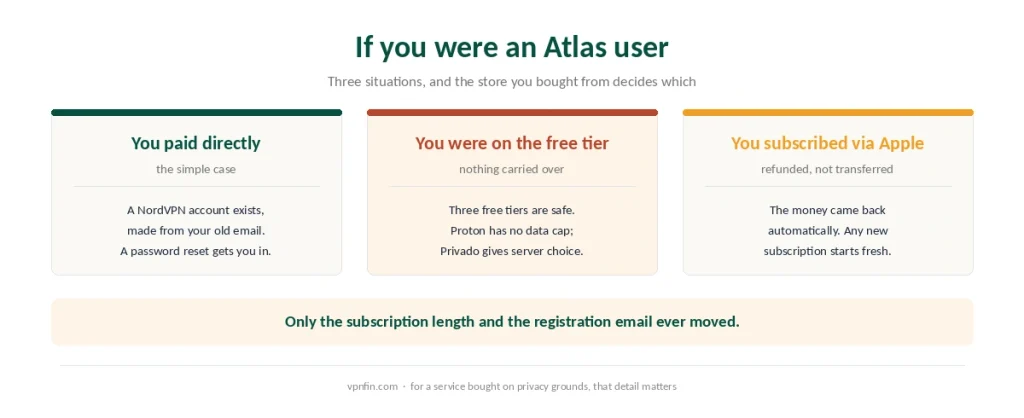
⚠️ Only two things moved. The subscription length and the registration email — nothing else, which is a meaningful detail for a service people bought for privacy reasons.
What Was Done Well
Worth listing, because it is the standard the rest of the industry should be measured against.
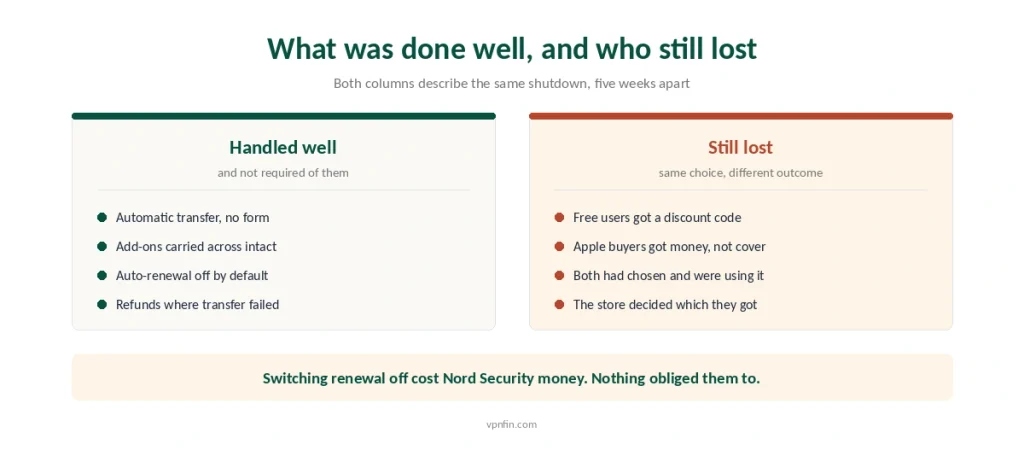
Automatic transfer, no action required. No migration form, no card request, no support ticket — which is where the Ivacy transfer into PureVPN went wrong for some people.
Auto-renewal switched off by default. Every migrated account arrived with renewal disabled, making the next subscription an opt-in decision rather than something to cancel.
An opt-out that actually existed. Users who did not want to be moved could email before 22 April and be excluded.
Refunds where migration was impossible. Apple App Store subscribers could not be transferred for platform reasons, so they were refunded for the time remaining.
⚠️ The auto-renewal decision is the one to notice. It cost Nord Security money and it was not required of them.
Who Still Lost
Two groups, and the coverage at the time mostly mentioned them in passing.
Free-tier users got nothing. Atlas ran one of the better free plans — three locations and a monthly cap of five to ten gigabytes depending on platform — and those users received a discount code rather than a service. A discount is not continuity.
Apple subscribers got money, not protection. The refund was correct and it still left them without a VPN on 25 April, with a new purchase to make.
⚠️ Both groups had made the same decision as everyone else — they had chosen a provider and were using it. The difference was where they had paid, and that decided whether they kept a service or received an apology.
The Comparison That Makes the Point
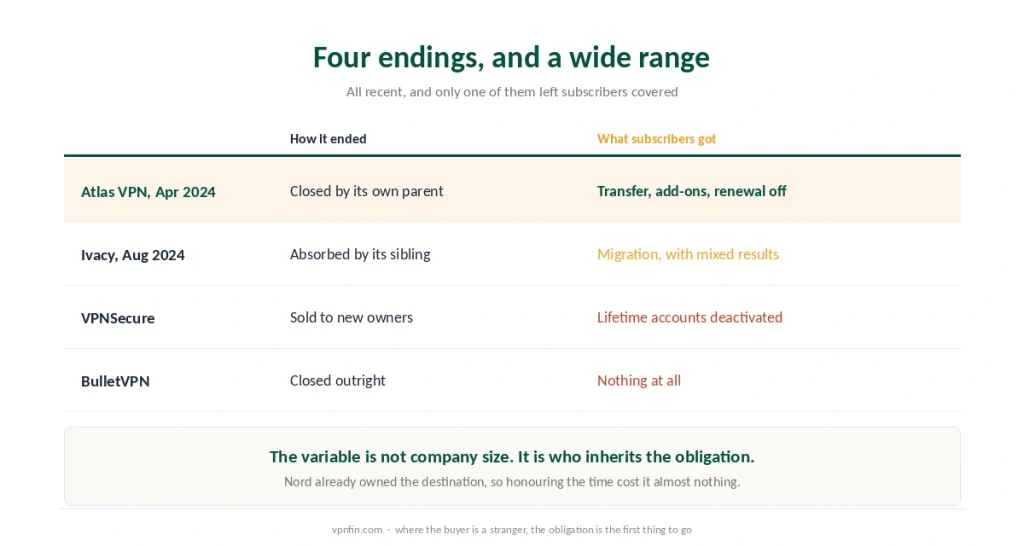
Four endings, all recent, and the range is wide.
Atlas VPN, April 2024. Automatic transfer, add-ons preserved, renewal off by default, refunds where transfer was impossible.
Ivacy, August 2024. Absorbed into PureVPN. The official position was that subscriptions would be honoured; user reports describe card requests, sixty-month offers and support conversations.
VPNSecure. Sold, and the new owners deactivated existing lifetime accounts.
BulletVPN. Closed, with nothing offered — the three cases our lifetime page is built on.
⚠️ The variable is not company size. It is whether the buyer inherits the obligation. Nord Security already owned the destination, so honouring the remaining time cost it almost nothing operationally. Where the acquirer is a stranger, the obligation is the first thing to go.
What It Says About the Market
Atlas was a budget brand inside a group that already owned a premium one — and the two are compared directly on our site. Nord Security holds NordVPN and Surfshark; Kape holds ExpressVPN, CyberGhost and Private Internet Access.
Five of the best-known names still trading answer to two companies — which is what our ownership map is for.
Atlas closing removed a competitor and moved its customers to a sibling. That is not wrongdoing; it is what consolidation looks like from the inside.
⚠️ The practical consequence for a buyer is narrower choice than the shelf suggests. Comparing two brands is not comparing two companies when both belong to one.
If You Were an Atlas User
Paid subscribers: the NordVPN account exists, created from the email you registered with. Password reset gets you in.
Free-tier users: three free tiers are safe to use, and our guide names them — Proton VPN has no data cap, PrivadoVPN gives ten gigabytes with server choice.
Apple subscribers: the refund was processed automatically; nothing carries over, and any new subscription starts fresh — our cheap VPN page covers what a fresh start costs.
How We Research
This account draws on Atlas VPN’s own announcement of 22 March 2024 and NordVPN’s published migration notice for the terms, on CyberInsider, Tech.co, PCWorld and VPNOverview for the treatment of App Store subscribers, the opt-out window and the discount offered to free users, on Android Police for the consolidation argument, and on Wikipedia for the 2021 acquisition date and the server figures. Where the two companies described the process themselves, we have said so. We hold an affiliate relationship with NordVPN and have stated that at the top of this page rather than in the footer. Our method lives on the About Us page.
Atlas VPN FAQ
It shut down on 24 April 2024. Its parent, Nord Security, had acquired it in October 2021 and cited rising costs, technological demands and a market it could no longer sustain. Accounts were closed and inaccessible from 25 April.
Paid subscribers did not. They were transferred automatically to NordVPN for the remainder of their term, at no extra cost and with equivalent add-ons. Only the subscription length and the registration email were passed across.
They lost the service. Free accounts were not migrated, and the compensation offered was a discount of up to 69% on a two-year NordVPN subscription rather than continued access.
Subscriptions bought through Apple could not be transferred between providers, so those accounts were terminated on 25 April and refunded for the unused time. Users who had subscribed through Google Play or Amazon were migrated normally.
NordVPN is where the paid users went and it scores highest on our scale. For a free replacement, Proton VPN offers unlimited data on its free tier. If the reason you liked Atlas was independence from a large group, Mullvad and IVPN belong to nobody.
The Verdict
This is how a VPN should close, and it is worth saying plainly because the comparisons available are so much worse.
The people who kept their service were the ones who had paid the right company in the right store. Free users and Apple subscribers made the same choice and ended the week differently.
And the market has one fewer competitor. A budget brand disappeared into a premium one owned by the same group, which is the quiet mechanism by which choice narrows, and the reason we track who owns what.