
Disclosure: VPNFin is reader-supported. If you buy a VPN through links on this page, we may earn a commission at no extra cost to you. This never affects our ratings — here’s our full disclosure.
A lifetime VPN promises one thing: pay once, never pay again. Against a provider charging $50 to $100 a year, a one-time fee of $40 looks like arithmetic anyone can do.
The problem is the word “lifetime”. It refers to the product’s lifespan, not yours — and in this industry that distinction has been tested repeatedly, with documented outcomes.
In 2023, a Reddit user shared a reply from Ivacy VPN’s support stating the company considered “lifetime” to mean the lifecycle of a software product, typically around five years.
That’s the honest version of what you’re buying.
The Short Answer
Three documented cases show what happens: BulletVPN shut down entirely, VPNSecure cancelled lifetime accounts after being acquired, and Ivacy’s own support defined the term as roughly five years.
The economics explain why. Servers, bandwidth, security updates and support cost money continuously. A one-time payment doesn’t.
The break-even maths is tighter than it looks — and the failure mode isn’t a refund, it’s an app that stops working.
What Actually Happened
Three cases, all recent, all documented.
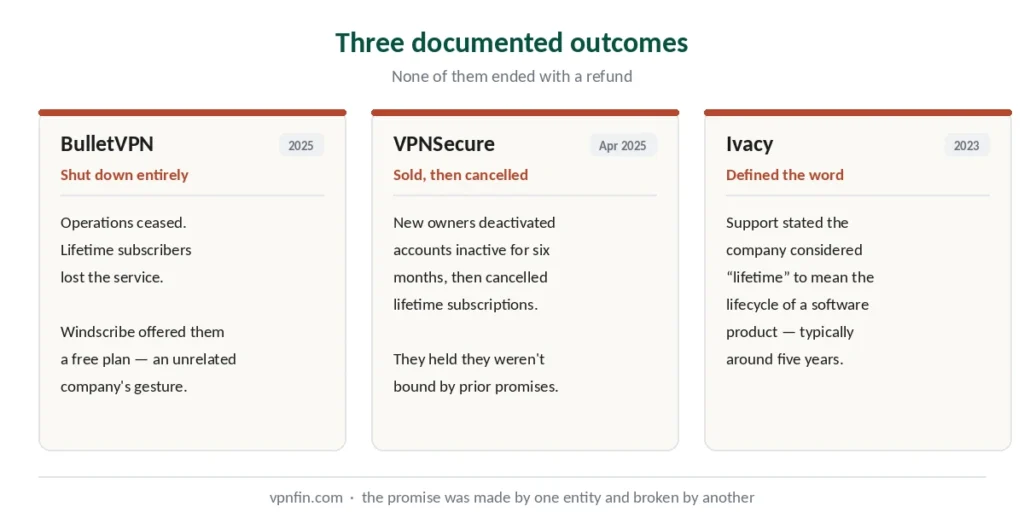
BulletVPN shut down in 2025. Operations ceased entirely. Subscribers who had bought what they understood to be lifetime access lost the service. Windscribe subsequently offered affected users a free subscription — a gesture from an unrelated company rather than anything BulletVPN provided.
VPNSecure cancelled lifetime subscriptions in April 2025. The service changed hands, and roughly two years after the acquisition the new owners began deactivating accounts inactive for six months, then cancelled lifetime subscriptions outright. The new ownership took the position that it was not bound by the previous owner’s commitments.
Ivacy defined the term, and then demonstrated it. In 2023 a user published a support response stating the company considered “lifetime” to mean the lifecycle of a software product — typically five years. About a year later Ivacy merged into PureVPN and its apps closed.
The pattern across all three: the promise was made by one entity and broken by circumstances that entity either couldn’t control or wasn’t obliged to honour. None of the three resulted in refunds.
Why the Lifetime VPN Model Doesn’t Work
This isn’t about bad actors, though some exist. It’s arithmetic.
Running a VPN costs money every second. Server rental, bandwidth, security patches, protocol development, app updates for new operating systems, customer support staff. All continuous, all recurring.
A lifetime payment is not. After the initial sum, that subscriber generates no further revenue while continuing to consume bandwidth and support indefinitely.
So lifetime subscribers become a liability on the balance sheet — and published analysis notes the resolution is rarely in the customer’s favour. Speeds get throttled, updates stop, support goes unanswered, or the company sells and the new owner doesn’t honour the arrangement.
⚠️ A related pattern worth knowing: lifetime offers sometimes appear when a provider needs cash quickly. Published commentary describes them as, in some cases, the last funding push before a company winds down.
The Break-Even Maths
Worth running honestly, because it’s not automatically a bad deal — it’s a bet with specific odds.
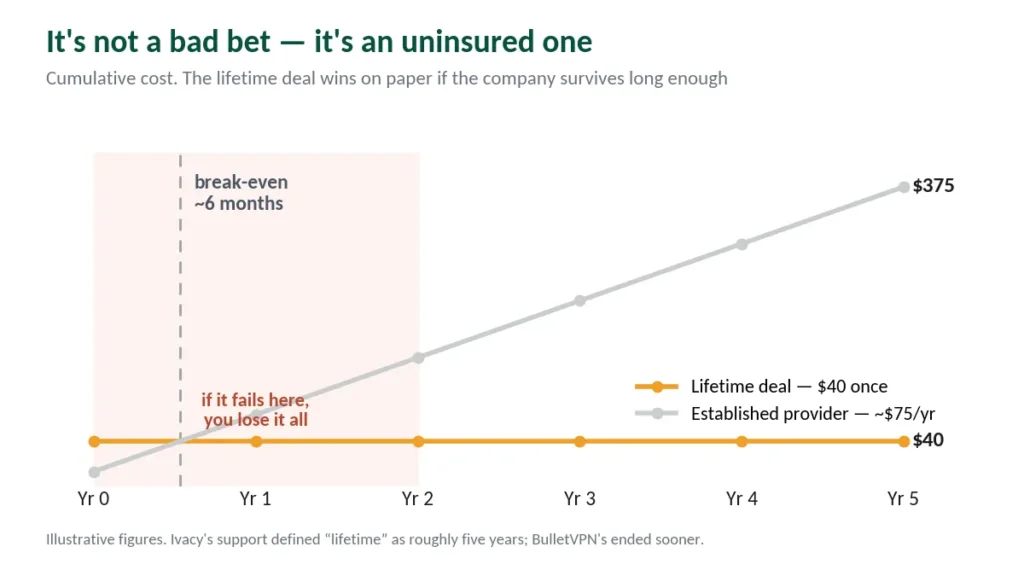
A lifetime offer at $40 against a mainstream provider at roughly $50 to $100 a year.
Break-even is about six to nine months. If the service survives that long and works properly, you’ve come out ahead on cost.
Survive five years — Ivacy’s own stated definition — and you’ve saved a few hundred dollars.
If it shuts down in year two, you’ve lost the difference plus the time spent migrating, and you have no refund. And you were unprotected for however long it took to notice.
The real question isn’t the price. It’s whether a company selling $40 lifetime access will still be maintaining servers, patching protocols and answering support tickets in 2031. Our cheap VPN guide works out what established providers actually cost over four years, and the gap is smaller than the lifetime pitch implies.
How to Spot the Bad Ones
If you’re still considering one, these are the signals published sources agree on.
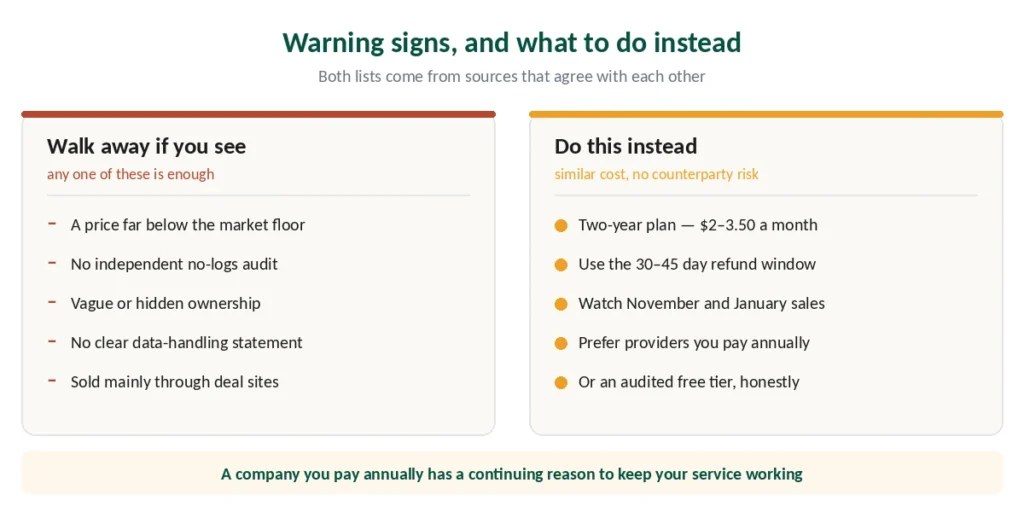
A price far below the market. Running a VPN network has a floor cost. A service priced dramatically under established providers either has a different revenue model or won’t last — and the alternative revenue model in this business is usually your data.
No independent audit. Every provider we rank publishes third-party audits of its no-logs claim. A lifetime service that has never been audited is asking you to take a permanent bet on an unverified promise.
Vague ownership. Reputable providers state who owns them and where they’re incorporated. Ambiguity there is a poor sign for a purchase you cannot undo.
No transparency about data handling. If you can’t find a clear privacy policy or any statement about what’s logged, that’s the answer.
Sold primarily through deal sites. Nothing wrong with discount platforms, but a provider whose main distribution is one-off bundle offers is optimising for one-time revenue rather than retention.
What to Do Instead
Buy a long term from an established provider. Two-year plans from mainstream services cost roughly $2 to $3.50 a month — not far off what lifetime deals work out to, without the counterparty risk.
| Provider | Renewal price | Per month | Tier |
|---|---|---|---|
| NordVPN | $139.08/yr | ~$11.59 | Basic |
| Surfshark | ~$79/yr | ~$6.58 | Starter |
| ExpressVPN | $99.95/yr | ~$8.33 | Basic |
| CyberGhost | $56.94/yr | ~$4.75 | 2-year |
| PureVPN | $47.95/yr | ~$4.00 | Standard |
| IPVanish | $89.99/yr | ~$7.50 | Essential |
| Windscribe | ~$69/yr | ~$5.75 | Pro |
| Proton VPN | ~$83.88/yr | ~$6.99 | VPN Plus |
| Mullvad | ~$65/yr | ~$5.40 | flat, no tiers |
| Norton VPN | $79.99/yr | ~$6.67 | Standard |
| Hotspot Shield | ~$95.99/yr | ~$8.00 | Premium annual |
Use the refund window. Every provider we rank offers at least 30 days, and CyberGhost gives 45 on longer plans. That’s a genuine guarantee from a company that will still exist to honour it — our free trial guide covers the conditions attached.
Watch for seasonal pricing. Established providers discount heavily around November and January. Those deals are temporary but real, and they don’t require betting on corporate survival.
Prefer providers with recurring revenue. It sounds counterintuitive, but a company you pay annually has a continuing reason to keep your service working. That alignment is the thing a lifetime purchase removes.
If you genuinely can’t pay recurring, a free tier from an audited provider is a more honest arrangement than a lifetime promise — our free VPN guide covers the three that are safe.
The One Scenario Where It’s Defensible
To be fair, published commentary identifies one case: as a secondary option.
Some people keep a main subscription with an established provider and hold a cheap lifetime service as a backup — a second IP source, a fallback when the primary is blocked, something to run on a spare device.
In that arrangement, the downside is bounded. You lose $40 and an occasional convenience rather than your entire privacy setup. We examined the strongest lifetime offer on the market — a jurisdiction outside every alliance and a real audit — and it still comes down to whether the company outlives the arithmetic.
What doesn’t work is treating it as the primary. That’s tying your privacy to a company that may not exist next year, to save the price of a few coffees per month.
How We Research
This guide draws on published reporting from named sources including TechRadar, Yahoo Tech, Cybernews, VPN Pro and Gizmodo, alongside documented user reports of the BulletVPN, VPNSecure and Ivacy cases — cross-checked and verified at publication. Two sources are VPN providers with a commercial interest in discouraging lifetime deals; we used them only for claims confirmed by independent outlets. Our full approach lives on the About Us page.
Lifetime VPN FAQ
For most people, no. “Lifetime” refers to the product’s lifespan rather than yours — Ivacy’s support defined it as roughly five years, BulletVPN’s ended when the company shut down in 2025, and VPNSecure’s ended when new owners cancelled them after an acquisition. Break-even is six to nine months, but there’s no refund if the service disappears.
You lose access with no refund and no fallback. When BulletVPN closed in 2025, lifetime subscribers were left without service — Windscribe offered affected users a free subscription, but that was a gesture from an unrelated company rather than anything the provider arranged.
Yes, and it has happened. After VPNSecure changed hands, the new owners began deactivating accounts inactive for six months and then cancelled lifetime subscriptions entirely, taking the position that they were not bound by the previous owner’s commitments.
Usually for immediate cash. Running a VPN costs money continuously while a lifetime payment arrives once, so those subscribers become an ongoing expense with no ongoing revenue. Published commentary notes that lifetime offers sometimes appear as a final funding push before a company winds down.
Look for a price far below established providers, no independent audit of the no-logs claim, vague ownership information, no clear statement about data handling, and distribution primarily through one-off deal sites. Running a VPN network has a floor cost — a service priced dramatically under it has a different revenue model.
As a secondary option. Some people keep a main subscription with an established provider and hold a cheap lifetime service as a backup — a spare IP source or something for an unused device. The downside is bounded to what you paid. As a primary VPN it means tying your privacy to a company that may not exist next year.
The Short Version
“Lifetime” means the product’s life, not yours. Ivacy’s support put that at about five years. BulletVPN’s ended in 2025. VPNSecure’s ended when the company was sold.
The economics guarantee the tension. Servers cost money continuously; your payment happened once. Lifetime subscribers become a cost centre, and the resolution is rarely in your favour.
Break-even is six to nine months — so it’s not automatically a bad bet, just an uninsured one with no refund if it fails.
A two-year plan from an established provider costs about the same per month and comes with a company that has a continuing reason to keep it working.