
Disclosure: VPNFin is reader-supported. If you buy a VPN through links on this page, we may earn a commission at no extra cost to you. This never affects our ratings — here’s our full disclosure.
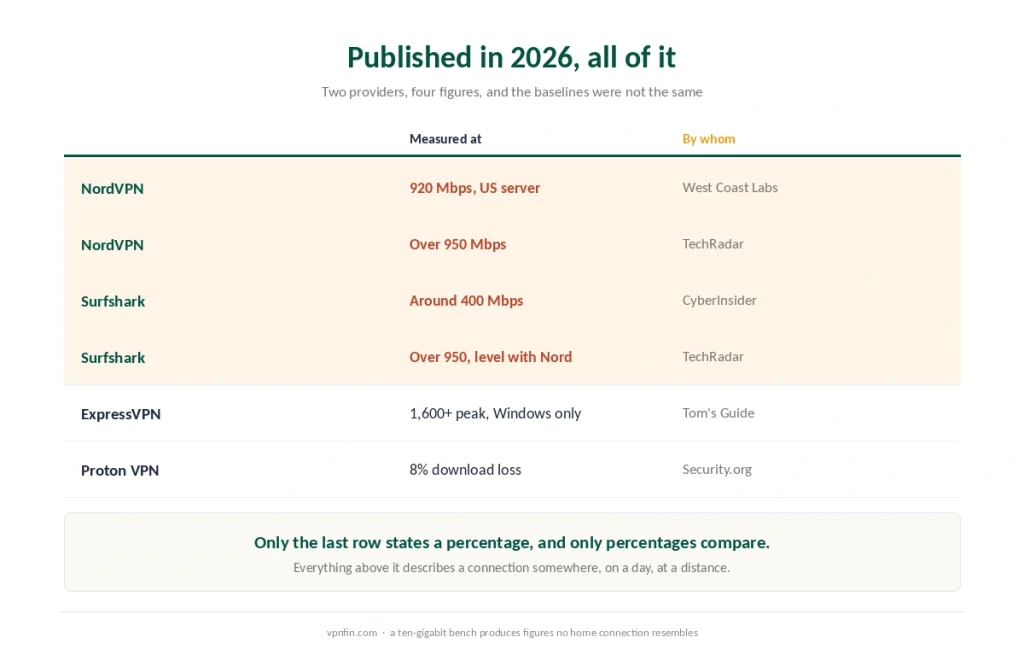
NordVPN has been measured at 400 megabits per second, at 920, at 950 and at over 8,000 — all in 2026, all by people describing their work as testing.
None of them is lying. They were measuring on different connections, and the headline number describes the tester’s line at least as much as it describes the VPN.
Why the Figures Cannot Be Compared
A VPN cannot exceed the connection it runs on. Test on a gigabit line and nothing can report more than a gigabit. Test on a ten-gigabit laboratory bench and the numbers multiply — without any provider becoming faster.
So a provider measured at 400 on one review and 950 on another has not changed. The baseline did.
The only comparable figure is the percentage retained. How much of the available connection survives the tunnel — that number travels between tests, and the absolute one does not.
⚠️ Which is why we rank on percentages below, and why the megabit figures scattered through this page appear with the source that produced them rather than as facts.
What Independent Testing Actually Found
Aggregated across the labs that publish methodology, the picture is consistent even where the numbers are not.
NordVPN leads most rounds. One published assessment recorded 920 megabits on a US server and connection times about a third faster than the industry average. Another placed it above 950, tied with Surfshark.
Proton VPN leads on upload. Independent testing recorded an eight per cent drop in download and four per cent in upload — first overall for upload in that round.
ExpressVPN is close enough that the gap stops mattering. Its newest protocol was measured above 1,600 megabits in peak testing, though that version runs only on Windows.
Five providers came in under ten per cent loss in one published set: NordVPN, Surfshark, Proton VPN, IPVanish and Private Internet Access. A separate round put Surfshark at 21% and ExpressVPN at 18% — the same spread, in percentages rather than megabits.
⚠️ And Surfshark is where the labs disagree most. One review placed it near 400 megabits; another put it level with NordVPN above 950. Both were published in 2026.
The Ranking, on Percentages
1. NordVPN. The most consistent leader across independent rounds, on a WireGuard-based protocol of its own. It also wins the measurement nobody quotes: time to establish a connection.
2. Proton VPN. First for upload in published testing, and its acceleration feature is reported to add substantially on distant servers — which is where losses are largest.
3. ExpressVPN. Peak figures higher than anything else recorded, on Windows only. Elsewhere it sits alongside the two above rather than behind them.
4. Surfshark. Fast in every round and inconsistent between them, which is a real finding rather than a hedge.
5. Private Internet Access. Under ten per cent loss in published testing, and rarely the one that leads.
⚠️ The gaps between these five are smaller than the gaps between test conditions. Anyone telling you one is decisively faster is quoting a single round.
What Actually Decides Your Speed
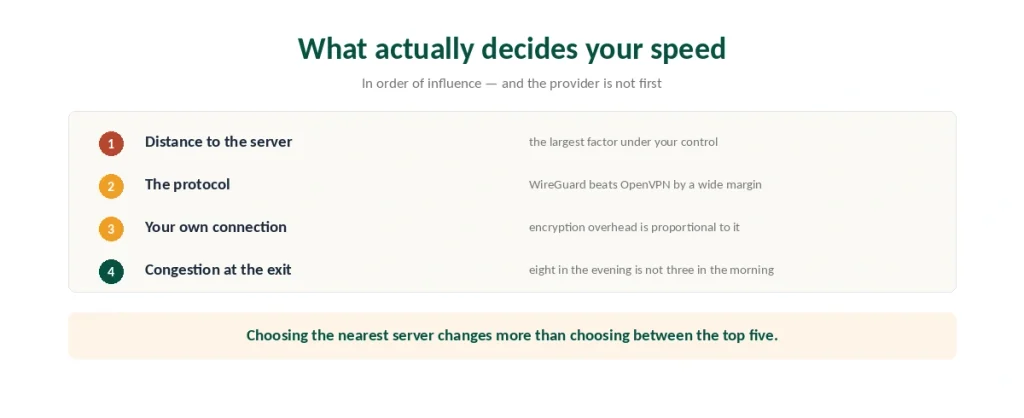
Four things, and the provider is not first among them.
The protocol. WireGuard and its variants outperform OpenVPN by a wide margin — our protocol comparison has the detail. One provider’s OpenVPN performance was measured rising from 110 to 173 megabits between two rounds of the same publication’s testing — while a separate comparison put OpenVPN near 480 against 940 for WireGuard on identical hardware. The direction is consistent; the magnitude is not.
Distance to the server. The single largest factor under your control. A server in the next country costs a few per cent; one across an ocean costs a great deal more.
Your own line. The mechanics are on our page about VPN slowdown, and the short version is that encryption overhead is proportional.
Congestion at the exit. A popular server at eight in the evening is slower than an obscure one at three in the morning, whatever the provider.
The Number That Matters More Than Any of This
4K streaming needs about 25 megabits. Video calls need under ten. Competitive gaming needs low latency rather than throughput, and downloads are limited by the far end as often as by you.
Above roughly 100 megabits, more speed stops changing what you can do. It shortens large downloads and nothing else.
⚠️ So a page comparing 850 against 920 is comparing two numbers that produce identical experiences. We are saying this on a page about speed because it is true, and because the alternative is selling a difference nobody will notice.
Latency is the exception. For gaming it decides everything, and a nearby server matters more than any provider’s headline figure. Live sport is similar — a steady connection beats a fast one.
What We Did Not Use
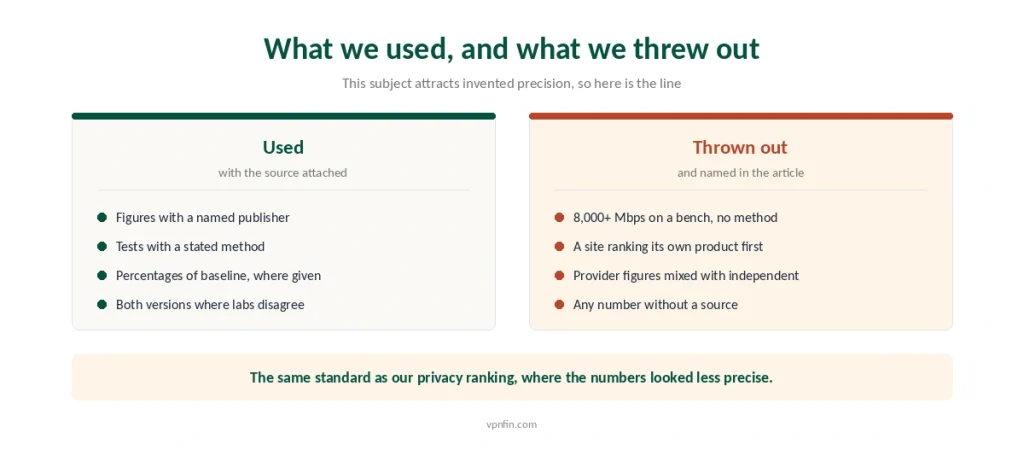
Being specific, because this subject attracts invented precision.
A ten-gigabit laboratory benchmark reporting over 8,000 megabits. No home connection resembles that, no methodology was published alongside it, and the figure is roughly nine times the next highest.
A site whose fastest VPN was its own product. It appears in search results for this term and ranks a service nobody else has measured.
Provider-published figures presented as independent. One provider’s own page cites a testing organisation accurately and then adds its own results beside them — both are real, and only one is independent.
⚠️ We have used published figures with named sources and stated methodology, and where those disagree we have shown the range. This is the same standard as our privacy ranking, applied to a subject where it matters more because the numbers look so precise.
How to Get the Speed You Paid For
Pick the nearest server, not the fastest country. Distance costs more than anything in the app.
Use the WireGuard-based protocol. It is the default on most clients now, and switching away from it is usually the reason someone’s connection is slow.
Turn off obfuscation and multi-hop unless you need them. Both add work, and both are on by default in some configurations.
Use a cable where you can. Wireless loses more than the tunnel does on most home networks.
⚠️ And test before you commit. Every provider we rank offers at least thirty days, and our main ranking weighs that window as heavily as the speed figures.
How We Research
This ranking draws on published testing from Security.org, CyberInsider, Tom’s Guide and TechRadar, on a West Coast Labs assessment cited by both a provider and independent press, and on an aggregation by Analytics Insight that names the same labs. We do not run speed tests and do not claim to — every figure here carries the source that produced it. We excluded a benchmark claiming over 8,000 megabits on a ten-gigabit bench without published methodology, a site ranking its own service first, and provider figures presented without the distinction between their own measurements and third-party ones. Where labs disagree, as they do on Surfshark, we have given both. Our method lives on the About Us page.
Fastest VPN FAQ
NordVPN leads most independent rounds, and it also records the shortest connection times. The gaps between the top five are smaller than the gaps between testing conditions, so treat any single result as one round rather than a verdict.
Because a VPN cannot exceed the connection it runs on. A test on a gigabit line caps at a gigabit; a laboratory bench on ten gigabits produces figures no home connection resembles. The same provider has been measured at 400 and at over 950 megabits in the same year.
About 25 megabits for 4K streaming, under ten for video calls, and low latency rather than throughput for gaming. Above roughly 100 megabits, extra speed shortens large downloads and changes nothing else you do.
Considerably. WireGuard and its variants outperform OpenVPN by a wide margin, and switching away from the default is the most common reason a connection feels slow. One publication measured a single provider’s OpenVPN performance rising from 110 to 173 megabits between two rounds.
Choose the nearest server rather than the most interesting country, use the WireGuard-based protocol, switch off obfuscation and multi-hop unless a network requires them, and use a cable instead of wireless where you can. Distance costs more than any setting in the app.
The Verdict
NordVPN leads the most rounds, and it also wins the measurement nobody quotes — how quickly a connection is established.
But the gaps between the top five are smaller than the gaps between test conditions. The same provider has been measured at 400 and at 950 in the same year, by different people on different lines.
And above about 100 megabits the difference stops mattering. Choose on distance to the server, on the protocol, and on everything else in our main ranking — speed is the criterion where the top five have effectively converged.