
Disclosure: VPNFin is reader-supported. If you buy a VPN through links on this page, we may earn a commission at no extra cost to you. This never affects our ratings — here’s our full disclosure.
Is a VPN legal in South Korea? Yes, completely. No law restricts VPNs, and many residents use them. South Korea is nonetheless one of the more active blockers among democracies. Its regulator, the Korea Communications Standards Commission (KCSC), keeps a blacklist of sites, and since 2019 providers have filtered encrypted HTTPS traffic by reading the Server Name Indication field, BleepingComputer reported.
The legal risk sits with what the blocks protect: illegal gambling, child abuse material and content that falls under the National Security Act. This page explains the system and where a VPN makes no legal difference.
Is a VPN Legal in South Korea? The Short Answer
Using a VPN is legal. There is no law against it, Top10VPN notes; what is illegal is the underlying activity.
Blocked sites redirect to warning.or.kr. That page, or a connection error for HTTPS sites, means the KCSC has listed the site. Our guide to a VPN for South Korea covers the practical side.
The National Security Act is the sharpest edge. It prohibits praising or sympathising with North Korea, and people have been prosecuted for sharing North Korean content online, according to Sitesblocked. A VPN does not change that.
How South Korea Blocks Sites
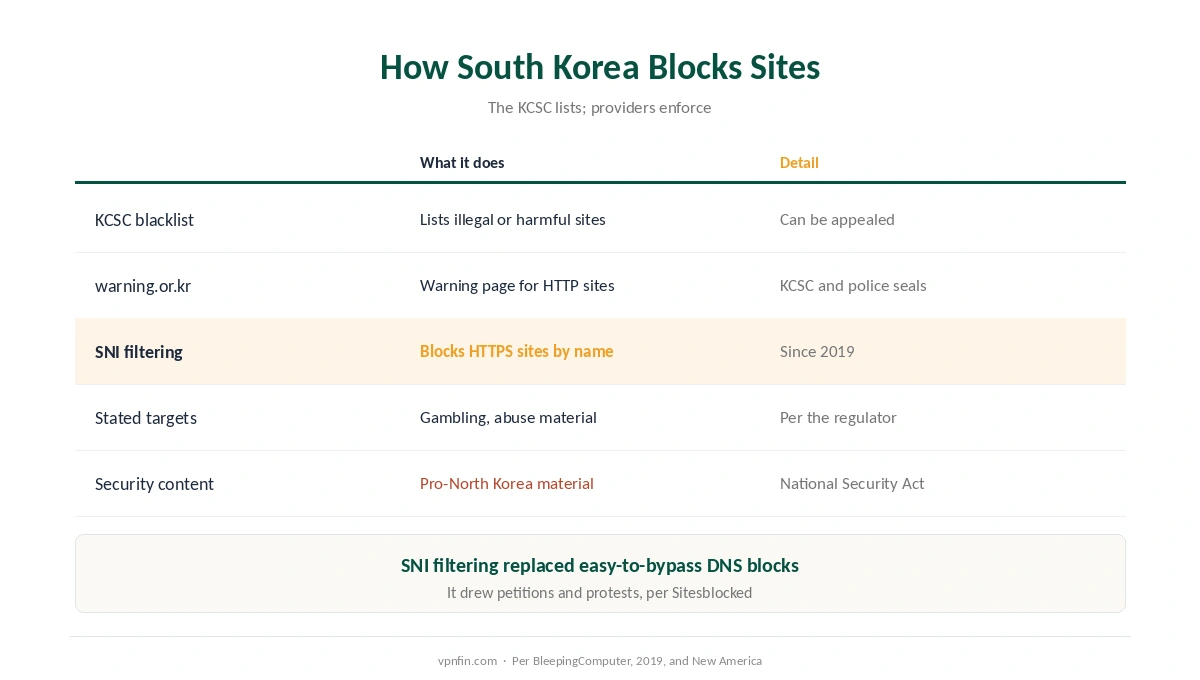
| Element | What it does | Detail |
|---|---|---|
| KCSC blacklist | Lists sites deemed illegal or harmful | Can be appealed |
| warning.or.kr | Warning page for blocked HTTP sites | Bears KCSC and police seals |
| SNI filtering | Blocks HTTPS sites by name | Since 2019 |
| Main targets | Illegal gambling, child abuse material | Per the Korea Communications Commission |
| National security content | Pro-North Korea material | National Security Act |
SNI filtering replaced DNS blocking because DNS blocking was easy to bypass with encrypted connections, BleepingComputer reported. The switch prompted petitions and protests at the time.
The stated targets are narrow, but the KCSC has in some cases blocked political content such as material praising North Korea, the think tank New America notes. Wikipedia’s summary puts its annual blocks in the tens of thousands of pages as far back as 2013.
Where a VPN Makes No Legal Difference
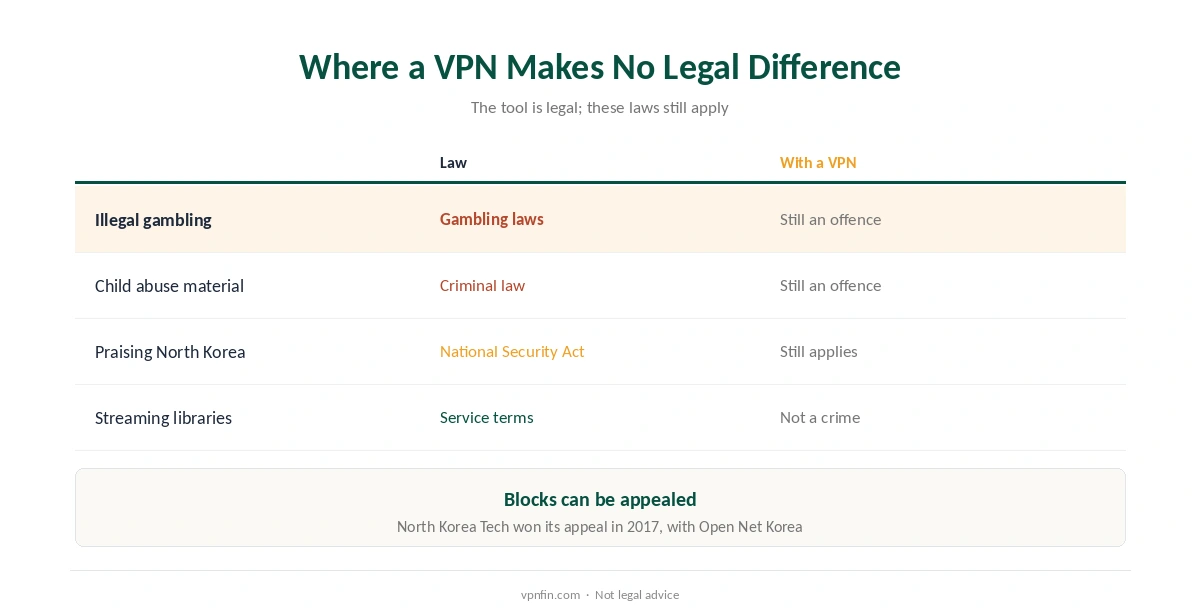
Illegal gambling and abuse material are crimes regardless of connection. A VPN hides traffic from your provider, not the activity itself, as our guide to what a VPN hides explains.
North Korean content. The National Security Act reaches sharing and praising, and prosecutions have followed. We do not give instructions for reaching blocked sites.
Blocks can be challenged. KCSC decisions can be appealed; the blog North Korea Tech won its appeal in 2017 with help from the digital rights group Open Net Korea, Wikipedia records.
Is a VPN Legal in South Korea for Everyday Use?
Yes. Residents, expats and visitors are in the same position. Work, banking, travel and public Wi-Fi raise no legal issue, as our public Wi-Fi guide and our travel guide explain.
Streaming is a terms question. Using a VPN to reach Korean or foreign streaming libraries may breach a service’s terms but is not a crime, as our Netflix guide explains.
SNI filtering sees site names. Because providers read the Server Name Indication field, they know which sites you ask for unless your traffic is tunnelled. An audited no-logs provider keeps no record of its own.
That is the practical answer to whether a VPN is legal in South Korea for privacy: yes, and it is the main way to keep site names away from your provider. Our NordVPN review covers one audited option.
How South Korea Compares
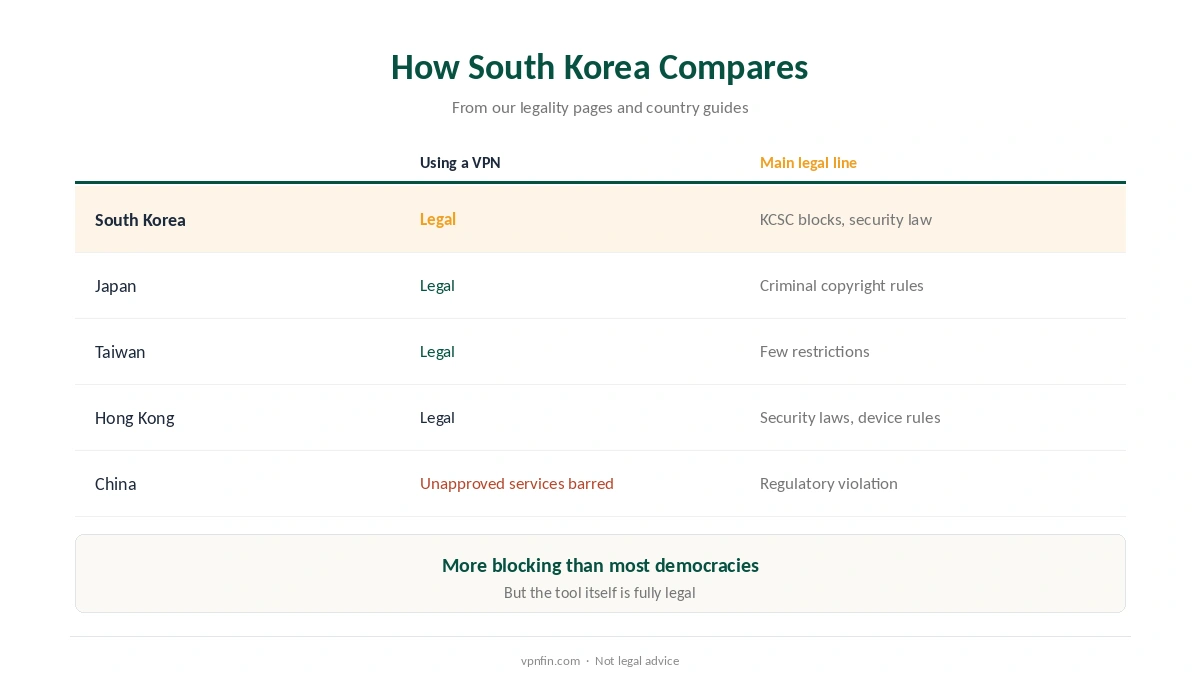
Japan blocks almost nothing, as our Japan legality page explains, though its copyright law is strict. Taiwan also has few restrictions.
Hong Kong allows VPNs under tightening security laws, as our Hong Kong page explains. So is a VPN legal in South Korea by regional standards? Yes, with more blocking than Japan or Taiwan.
China restricts unapproved VPN services, as our China legality page sets out. Our country-by-country guide compares every country we cover.
How We Research
The blocking system comes from BleepingComputer’s 2019 report and New America’s analysis, the National Security Act and appeals points from Sitesblocked and Wikipedia, and the legal position on VPNs from Top10VPN, a VPN review site. We are not lawyers, and this is not legal advice. We name each source where used; all were read on 27 September 2026. Our full approach lives on the About Us page.
South Korea VPN Legality FAQ
Yes. No law restricts VPNs in South Korea. Illegal activity, such as unlicensed gambling, remains illegal with or without one.
The warning page South Korea shows when you visit a site on the KCSC’s blacklist over HTTP. HTTPS sites blocked by SNI filtering show a connection error instead.
Mainly illegal gambling and child abuse material, plus some content covered by the National Security Act, such as material praising North Korea.
The National Security Act prohibits praising or sympathising with North Korea, and sharing such content has led to prosecutions. Take legal advice before relying on any reading.
Yes. The blog North Korea Tech won an appeal in 2017 with help from Open Net Korea.
The Verdict
A VPN is legal in South Korea, and everyday use raises no legal issue.
The country blocks more than most democracies, and the National Security Act and gambling laws apply whatever your connection.