
Disclosure: VPNFin is reader-supported. If you buy a VPN through links on this page, we may earn a commission at no extra cost to you. This never affects our ratings — here’s how we research.
VPNs are legal in South Korea. No law restricts individuals, businesses or travellers from using one, and adoption is high — the country has some of the world’s fastest connectivity and a permanently online culture.
What surprises people is the filtering. South Korea’s censorship gets far less attention than China’s or the UAE’s, yet as of 2020 more than 160,000 websites were unavailable to Korean users under domestic blocking policies.
And in May 2026 the architecture of that filtering changed in a way that matters for anyone relying on a VPN.
The Short Answer
Legal to use. Tourists, students, expats and businesses use VPNs routinely without legal issue.
Useful for two opposite reasons — reaching Korean content from abroad, or reaching blocked content from inside.
But the new filtering law limits what a VPN can do, because part of it operates before your request reaches Korean networks at all.
What Changed in May 2026
The law traces back to 2020 and the Nth Room case — a network of encrypted chat rooms distributing coerced sexual material, including content involving minors. Public reaction was immediate, and the National Assembly amended the Telecommunications Business Act, adding Article 22-5.
The original obligation looked narrow: large platforms had to take technical measures against redistribution of illegal filmed material.
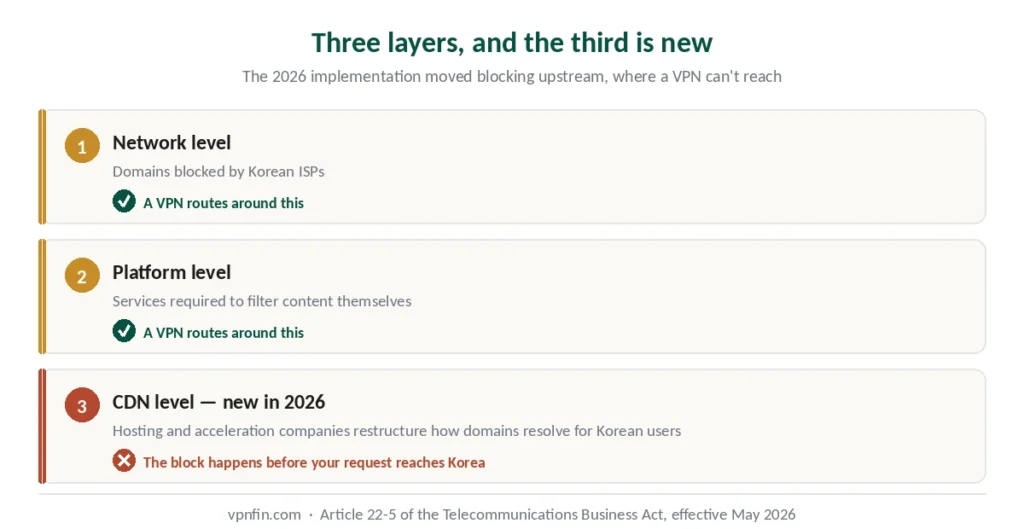
The 2026 implementation goes considerably further, and it works in three layers.
Layer one and two operate at the network and platform level — the familiar approach of blocking domains and requiring platforms to filter content.
Layer three is the new part. Rather than fighting encryption, regulators went upstream to the companies that host and accelerate traffic. If a CDN provider like Cloudflare restructures how a domain resolves for Korean users, the block happens before the request ever reaches Korean infrastructure.
⚠️ Why this matters for VPN users: a VPN changes where your traffic appears to originate. It does not change how a CDN chooses to resolve a domain. This is a genuinely different kind of blocking, and published analysis notes there is no VPN-free workaround for it.
Two Reasons People Want One
The audience splits, as it does with Japan.
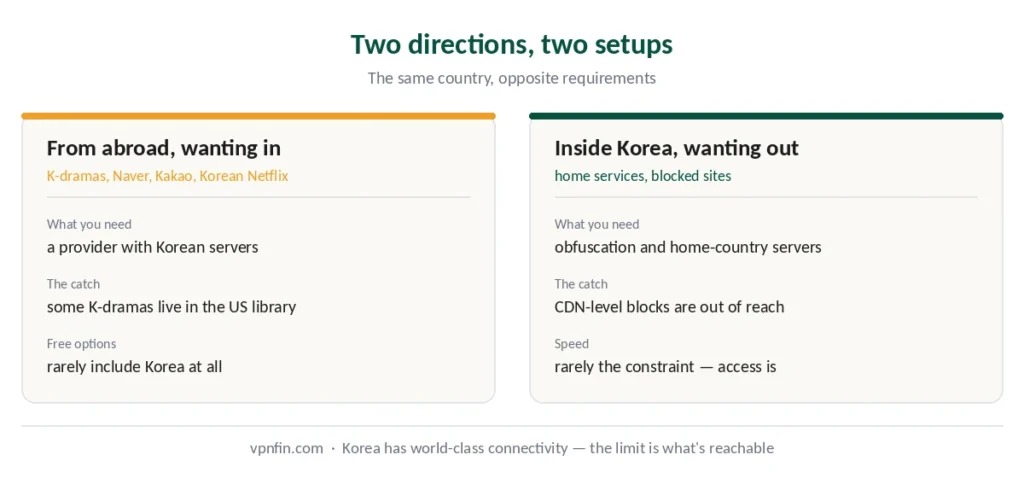
From abroad, wanting in. Korean Netflix carries K-dramas unavailable elsewhere, and Korean services like Naver, Kakao and domestic streaming platforms restrict access by region. A Korean server address handles most of this.
⚠️ One catch worth knowing: some K-drama titles are exclusive to the US or other regional libraries rather than the Korean one. The right server depends on where the specific show is licensed, not on where it was made — our streaming guide covers library counts across providers.
Inside Korea, wanting out. Expats reaching home services, and residents encountering the blocking regime described above. Korea’s infrastructure is excellent, so speed is rarely the constraint — access is.
What a VPN Doesn’t Change
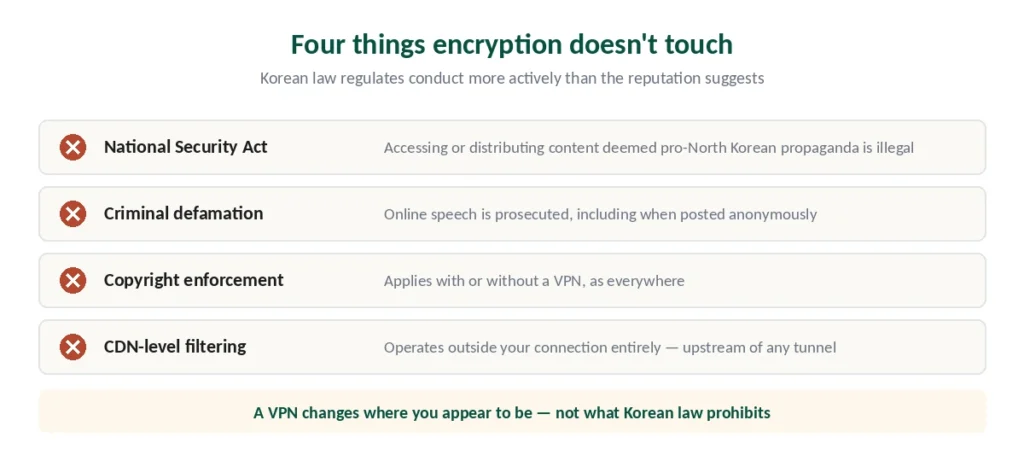
South Korea regulates online conduct more actively than its reputation suggests, and encryption doesn’t alter any of it.
The National Security Act makes accessing or distributing content considered pro-North Korean propaganda illegal. This is specific to Korea and has no equivalent in most jurisdictions.
Defamation is criminal, including online and including when posted anonymously. Korean law treats online defamation as a matter for prosecutors rather than civil courts.
Copyright enforcement applies with or without a VPN.
And the CDN-level blocking described above operates outside your connection entirely. The regional parallel is Indonesia, where access is withdrawn from services that miss a filing — a different mechanism reaching the same place, above anything a tunnel controls.
⚠️ A VPN encrypts your traffic and changes your apparent location. It does not change what Korean law prohibits — our legality guide covers this distinction across countries.
The Other Korea
Worth a paragraph, because searches for “Korea VPN” occasionally mean the wrong one.
North Korea prohibits VPN use entirely for ordinary citizens, who in most cases have access only to a state-controlled intranet rather than the internet. Penalties for accessing outside information are severe: possessing pirated South Korean dramas has drawn labour camp sentences, and reporting indicates a man was sentenced to death for distributing copies of Squid Game.
Security researchers report traces of VPN connections from North Korean IP addresses, which suggests some people take that risk anyway.
Nothing in this guide applies there. The two countries share a peninsula and nothing else on this subject.
Which Provider to Choose
Three things matter for Korea specifically.
Korean servers, if you want a Korean IP. This is less universal than you’d expect — reliable free VPNs generally don’t offer Korean locations, since it’s a niche server region.
NordVPN operates from Panama, outside every intelligence-sharing arrangement, and posted the best speed result in independent benchmark testing. Its obfuscated servers matter if you’re inside Korea dealing with blocking. Australia shows why jurisdiction counts — it co-founded the Five Eyes alliance itself.
ExpressVPN has the strongest published record on restricted networks among the providers we rank, with Seoul servers and reliable obfuscation.
Surfshark covers 100 countries with unlimited devices — useful if K-content you want sits in several different regional libraries.
⚠️ Free options are weak here specifically. Korean servers are a niche offering that free tiers rarely include, so a free VPN often can’t give you a Korean IP at all — our free VPN guide covers what the reputable free tiers actually do.
How We Research
This guide draws on reporting on Korea’s 2026 filtering implementation from Seoulz, published analysis from named sources including Top10VPN, PrivacySavvy and Security.org, and our own full reviews of the providers we rank — cross-checked and verified at publication. One source claimed South Korea belongs to the Five Eyes intelligence alliance; that is incorrect — the alliance comprises the US, UK, Canada, Australia and New Zealand — so we excluded it. Several sources carry commercial interests in VPN services and were used only for claims confirmed elsewhere. This is not legal advice. Our full approach lives on the About Us page.
South Korea VPN FAQ
Yes. No law restricts individuals, businesses or travellers from using a VPN, and adoption is high given the country’s connectivity. Tourists, students, digital nomads and expats use them routinely without legal issue. What remains illegal is what was illegal anyway — cybercrime, copyright infringement and content prohibited under the National Security Act.
The implementation of Article 22-5 of the Telecommunications Business Act added a third blocking layer that operates at CDN level. Rather than filtering traffic inside Korea, regulators worked with the companies that host and accelerate it — meaning a domain can be restructured for Korean users before requests reach Korean infrastructure. A VPN cannot route around that.
Usually, with a Korean server. But some K-dramas are exclusive to the US or other regional libraries rather than the Korean one — the right server depends on where a specific title is licensed, not where it was produced. Checking which library carries the show you want saves guessing.
More than its reputation suggests. As of 2020, over 160,000 websites were unavailable to Korean users under domestic blocking policies. The regime attracts far less attention than China’s or the UAE’s, but the scale is substantial and the 2026 filtering law extends it further.
No. VPN use is prohibited for ordinary citizens, who in most cases have access only to a state-controlled intranet. Penalties for accessing outside information are severe — possessing pirated South Korean dramas has resulted in labour camp sentences. Nothing about South Korea’s rules applies there.
Rarely. Korea is a niche server location that reputable free tiers generally don’t cover, so a free VPN often cannot give you a Korean IP address at all. That’s separate from the usual problems with free services — data caps, slow speeds and streaming blocks.
The Short Version
Legal and widely used. No law restricts VPN use in South Korea, and the country’s connectivity means speed is rarely the limiting factor.
The filtering is heavier than the reputation suggests — over 160,000 sites blocked as of 2020, and a 2026 implementation that operates at CDN level, upstream of anything a VPN touches.
For Korean content from abroad, a Korean server handles most cases, though some K-dramas live in other regional libraries entirely.
And Korean law still applies — the National Security Act, criminal defamation and copyright enforcement all operate regardless of how your traffic is routed.