
Disclosure: VPNFin is reader-supported. If you buy a VPN through links on this page, we may earn a commission at no extra cost to you. This never affects our ratings — here’s our full disclosure.
Is a VPN legal in the Philippines? Yes. No Philippine law restricts VPNs. What has changed is how much the country blocks. The National Telecommunications Commission (NTC) spent 2025 and early 2026 expanding blocking lists against offshore gambling and unlicensed sites, and some senators and officials have publicly discussed restricting VPN tools too, People of Internet reported in May 2026.
No such restriction has been proposed as law. This page explains what is blocked and why, which activities stay illegal with or without a VPN, and a September 2026 legal analysis questioning some blocking powers.
Is a VPN Legal in the Philippines? The Short Answer
Using a VPN is legal. Nothing in Philippine law bans the tool. Our guide to a VPN for the Philippines covers servers, overseas workers and banking apps.
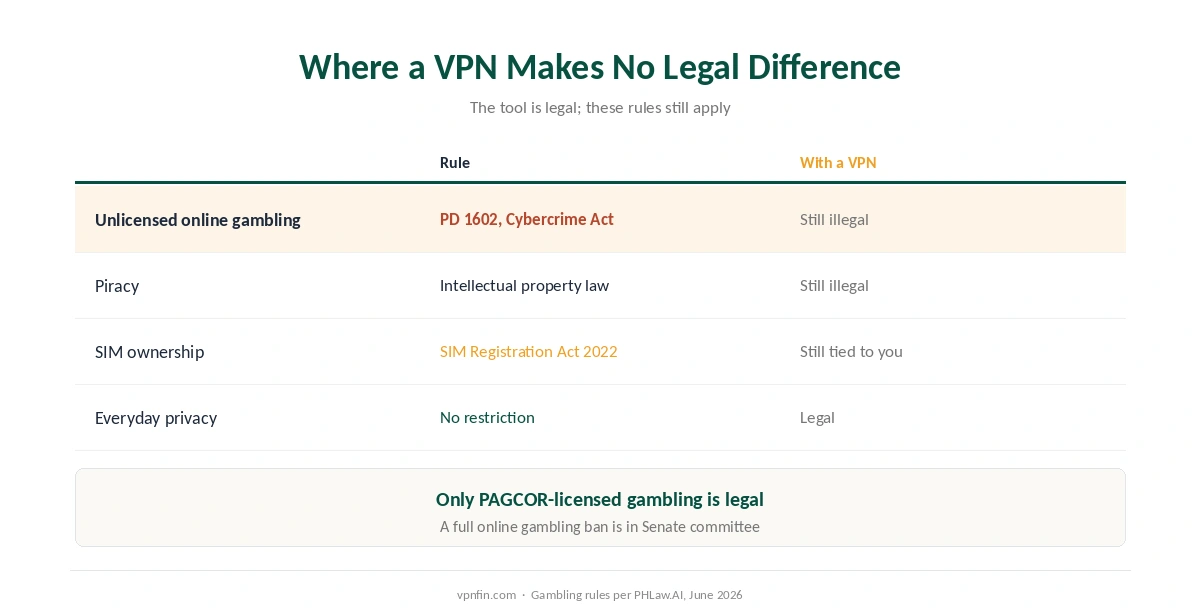
Online gambling on unlicensed sites is the main risk. Only PAGCOR-licensed platforms are legal; playing on unlicensed offshore sites can bring criminal liability, and the Cybercrime Prevention Act raises the penalty when it happens online, PHLaw.AI explains.
Is a VPN legal in the Philippines after the 2026 debate? Yes: talk has started, not a law. Officials have discussed VPN restrictions, but no bill had passed as of September 2026.
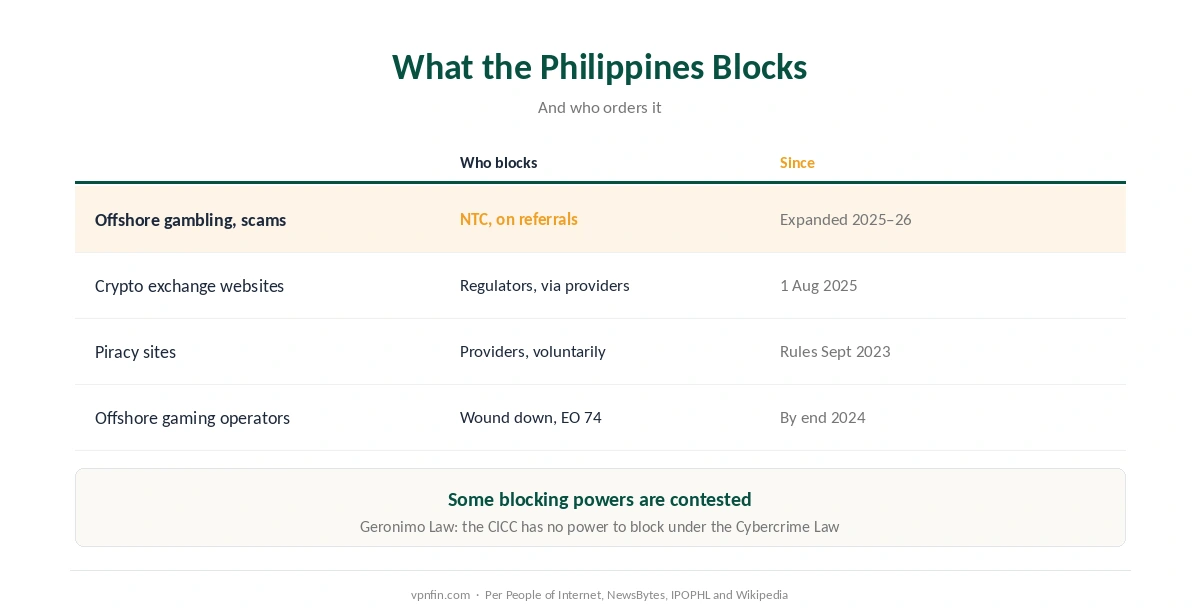
What the Philippines Blocks, and Who Orders It
| Target | Who blocks | Since |
|---|---|---|
| Offshore gambling and scam sites | NTC, on PAGCOR and other referrals | Expanded 2025–2026 |
| Unlicensed crypto exchanges (MEXC, OKX, Phemex) | Regulators, via providers; apps still work | 1 August 2025 |
| Piracy sites | Providers, on IPOPHL request, voluntarily | Rules signed 20 September 2023 |
| Offshore gaming operators (POGOs) | Wound down by Executive Order 74 | By 31 December 2024 |
Piracy blocking is voluntary. IPOPHL’s 2023 rules let providers block infringing sites on request, and Globe, PLDT-Smart, Dito and Sky signed up. A law for compulsory blocking is still pending, according to a September 2026 analysis by Geronimo Law.
Some blocking powers are contested. The same analysis argues the Cybercrime Investigation and Coordinating Center has no power to block websites under the Cybercrime Law, and notes the Supreme Court has not ruled on NTC blocking on another regulator’s referral, NewsBytes reported.
Where a VPN Makes No Legal Difference
Gambling. Unlicensed online gambling stays illegal whatever the connection, and a Senate bill proposing a full ban on domestic online gambling was in committee as of June 2026, PHLaw.AI notes.
Piracy and cybercrime. A VPN hides traffic from your provider, as our guide to what a VPN hides explains, but it does not make unlawful activity lawful. We do not give instructions for reaching blocked sites.
The blocking lists lack a public appeal route, People of Internet argues, and have swept in some legitimate pages by mistake. That is a policy criticism, not a licence to ignore them.
Is a VPN Legal in the Philippines for Everyday Use?
Yes. Work, banking, travel and public Wi-Fi raise no legal issue, as our public Wi-Fi guide and our travel guide explain.
Overseas Filipino workers often use VPNs to reach Philippine services from abroad. Some banking and e-wallet apps may still flag a VPN connection, as our online banking guide explains.
Your SIM is registered regardless. The 2022 SIM Registration Act ties numbers to identities; a VPN does not change who owns the line. It does keep your browsing from your provider, and an audited no-logs service such as NordVPN keeps no record of its own.
How the Philippines Compares
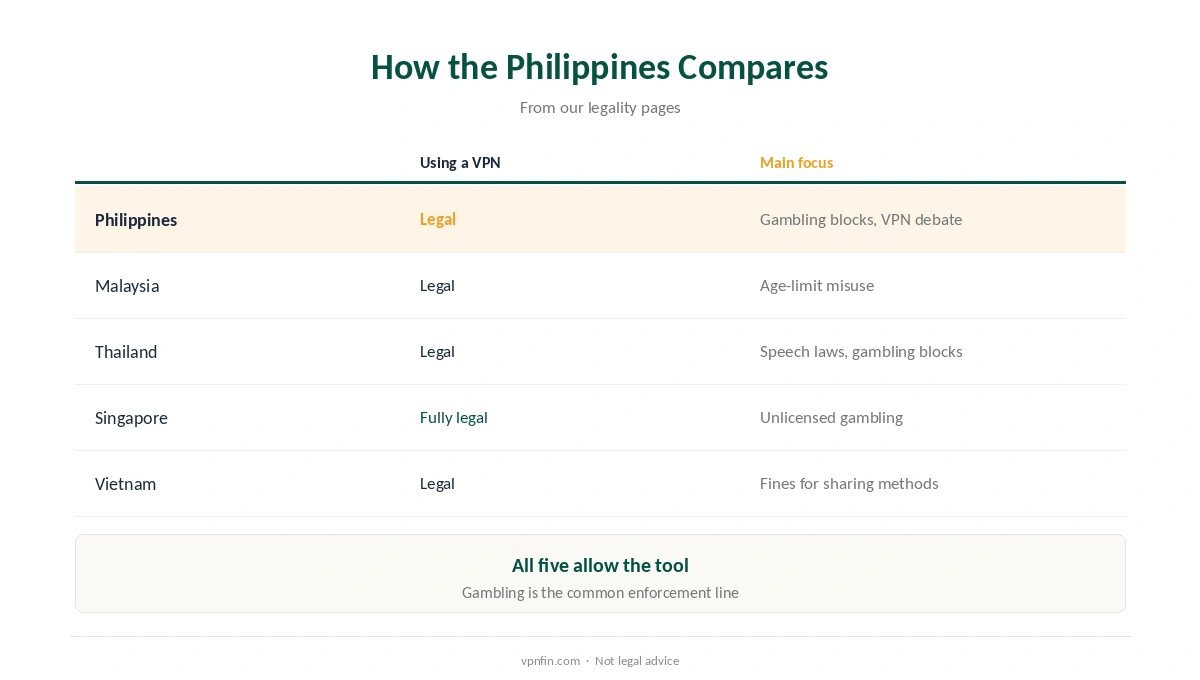
Its neighbours allow VPNs too. Malaysia is targeting misuse around age limits, and Thailand also blocks gambling sites heavily.
Vietnam goes further on one point: since August 2026 it fines sharing methods to reach blocked sites, as our Vietnam page explains. So is a VPN legal in the Philippines by regional standards? Yes, and more plainly than in Vietnam.
Singapore draws the same gambling line, as our Singapore page explains. Our country-by-country guide compares every country we cover.
How We Research
The blocking picture comes from People of Internet, NewsBytes’ report on Geronimo Law’s analysis, IPOPHL’s announcements and Wikipedia’s list of blocked sites. The gambling rules come from PHLaw.AI. We are not lawyers, and this is not legal advice. We name each source where used; all were read on 27 September 2026. Our full approach lives on the About Us page.
Philippines VPN Legality FAQ
Yes. No Philippine law restricts VPNs. Illegal activity, such as gambling on unlicensed sites, remains illegal with or without one.
No law has been proposed. Some senators and officials have publicly discussed VPN restrictions as blocking has grown, People of Internet reported in May 2026.
Only on PAGCOR-licensed platforms. Playing on unlicensed offshore sites can bring criminal liability.
Yes, voluntarily. Since 2023, providers block infringing sites on IPOPHL’s request; a compulsory blocking law is still pending.
Yes. Using a VPN to reach Philippine services from abroad is legal, though some banking apps may flag VPN connections.
The Verdict
A VPN is legal in the Philippines, and everyday use raises no issue.
Blocking has grown fast, mostly against gambling, and officials have floated VPN limits without a bill. Gambling on unlicensed sites stays illegal whatever the connection.