
Disclosure: VPNFin is reader-supported. If you buy a VPN through links on this page, we may earn a commission at no extra cost to you. This never affects our ratings — here’s our full disclosure.
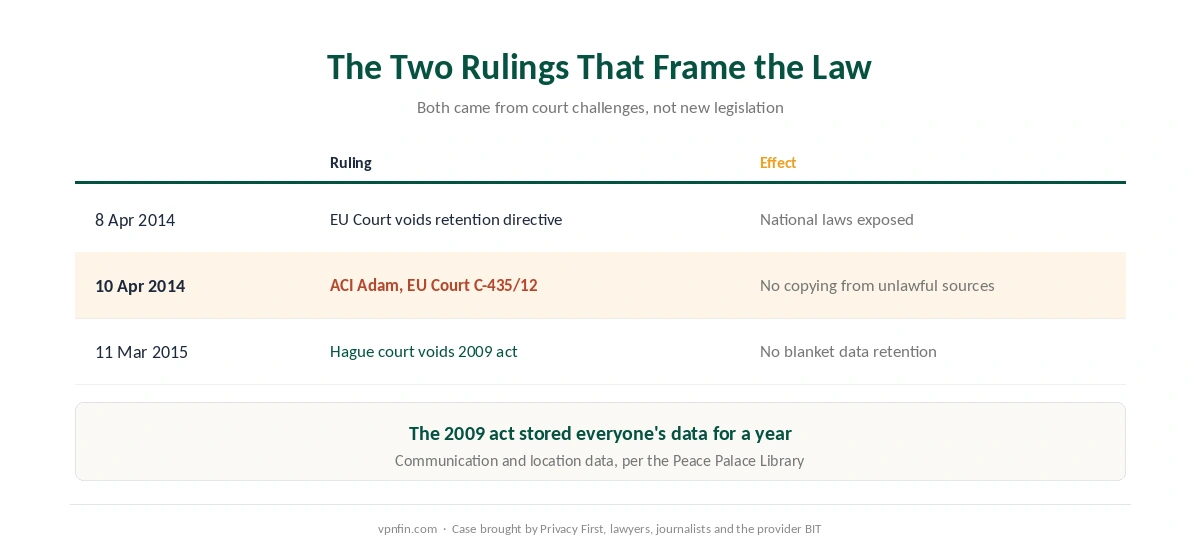
Is a VPN legal in the Netherlands? Yes, entirely. Many providers route traffic through Dutch servers, as our Netherlands guide notes, and no Dutch law restricts VPN use. What changed for Dutch internet users happened in 2014 and 2015, in two court rulings. The EU Court of Justice ruled on 10 April 2014 that downloading from unlawful sources is not covered by private copying, ending years of Dutch tolerance. And on 11 March 2015 a court in The Hague struck down the Dutch data retention law.
Those two rulings frame the answer today: the VPN is legal, piracy is not, and blanket data retention is gone. This page explains all three.
Is a VPN Legal in the Netherlands? The Short Answer
Using a VPN is legal. No Dutch law restricts it, and many providers run large server fleets there. Our guide to a VPN for the Netherlands covers Dutch streaming and enforcement.
Downloading pirated content is not. Since the ACI Adam ruling, private copying no longer covers unlawful sources, as the Kluwer Copyright Blog explains. A VPN does not change that.
So is a VPN legal in the Netherlands for torrenting? The tool is; the files may not be. BREIN, the Dutch rights-holder body, has pursued individuals for two decades but says its focus is people who upload, as our guide records.
The Two Rulings That Frame the Law
| Date | Ruling | Effect |
|---|---|---|
| 8 April 2014 | EU Court strikes down the Data Retention Directive | National retention laws exposed |
| 10 April 2014 | EU Court in ACI Adam (C-435/12) | No private copying exception for unlawful sources |
| 11 March 2015 | Hague court strikes down the 2009 Dutch retention act | No blanket retention of communication data |
ACI Adam started as a dispute over blank-media levies. Manufacturers argued the Dutch home-copying levy wrongly counted copies from unlawful sources, since Dutch law did not distinguish them. The EU Court agreed that private copying covers lawful sources only, Mondaq notes.
A coalition brought the data retention case, including Privacy First, criminal defence lawyers, journalists and the provider BIT. Under the 2009 act, providers had to store everyone’s communication and location data for a year; the court found the safeguards insufficient, the Peace Palace Library records. For VPN users, that means a provider’s own no-logs policy is the main record to check.
How Enforcement Actually Works
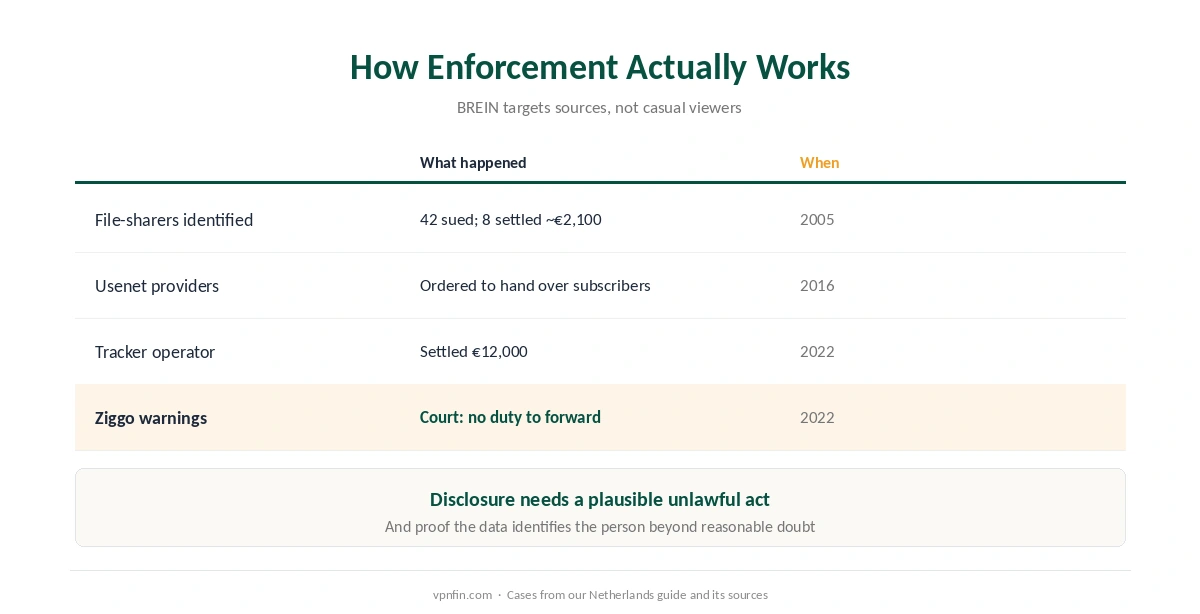
BREIN goes after sources, not viewers. Our Netherlands guide traces its cases from 2005 to 2022, including settlements with uploaders and a 2016 order requiring two Usenet providers to hand over subscriber details.
Providers only hand over subscriber data under strict conditions. Under Dutch law, a court can order disclosure only if an unlawful act is plausible and the data will identify the person beyond reasonable doubt, Wikipedia summarises.
Mass warnings stalled. In 2022 a court ruled that Ziggo, the largest provider, did not have to forward BREIN’s warnings. Our torrenting guide covers the legal side of file sharing.
Is a VPN Legal in the Netherlands for Everyday Use?
Yes. Work, banking, travel and public Wi-Fi raise no issue, as our public Wi-Fi guide explains. A VPN hides your traffic from your provider, as our guide to what a VPN hides explains, but it does not make an unlawful download lawful.
Dutch streaming is a terms question. NPO Start, Videoland and Ziggo GO each restrict viewers differently, and using a VPN to reach them from abroad is not a crime.
We could not verify a rumoured 2026 law that some sites describe as restricting VPNs. If one is enacted, we will update this page.
How the Netherlands Compares
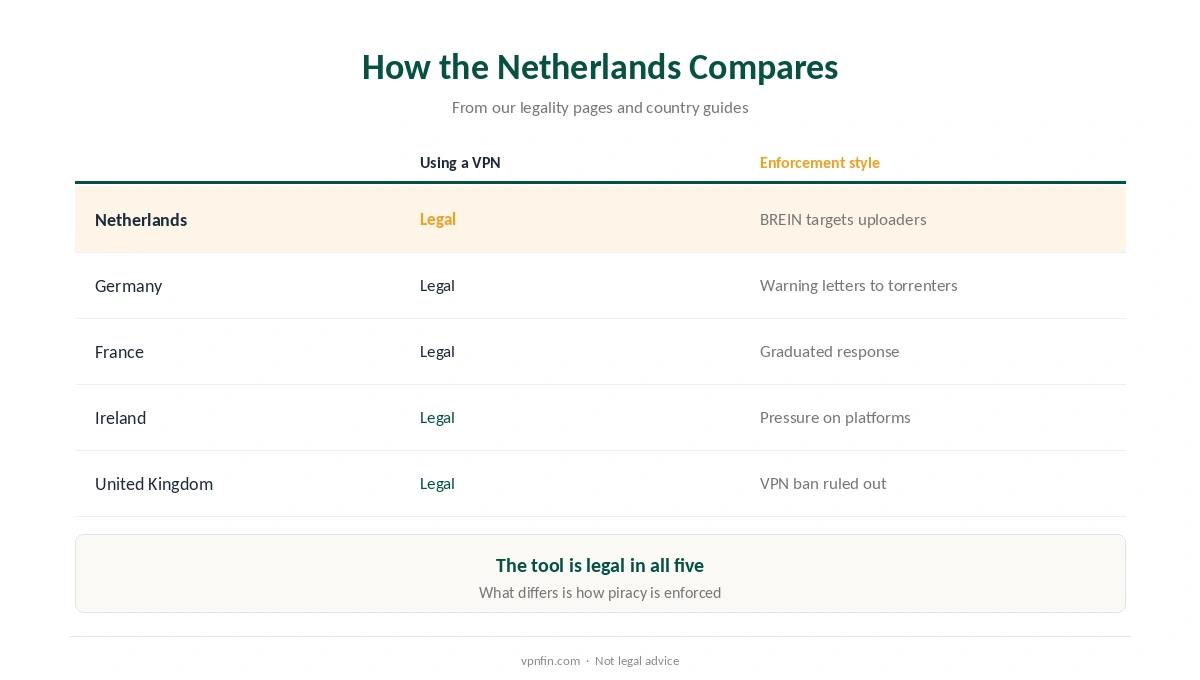
Germany is stricter on torrenting, with law firms sending warning letters, as our Germany page explains. France runs its own graduated-response system.
Is a VPN legal in the Netherlands on the same terms as in the UK? Yes: the UK has also ruled out banning VPNs, while enforcing copyright separately.
Ireland is the mirror image: enforcement falls on platforms rather than individuals, as our Ireland guide explains. Our country-by-country guide compares every country we cover.
How We Research
The ACI Adam ruling comes from Mondaq, the Kluwer Copyright Blog and the Peace Palace Library, and the data retention ruling from the Peace Palace Library. Subscriber disclosure rules come from Wikipedia, and BREIN’s record from our own Netherlands guide and its sources. We are not lawyers, and this is not legal advice. We name each source where used; all were read on 27 September 2026. Our full approach lives on the About Us page.
Netherlands VPN Legality FAQ
Yes. No Dutch law restricts VPNs, and the Netherlands hosts many VPN servers.
No. Since the EU Court’s ACI Adam ruling of 10 April 2014, private copying does not cover unlawful sources.
Not blanket retention. A court in The Hague struck down the 2009 Dutch data retention act on 11 March 2015.
Its stated focus is uploaders and sources rather than casual downloaders, though it has pursued individuals for two decades.
We could not verify any. Claims of a 2026 law circulating online were not supported by sources we could check.
The Verdict
A VPN is legal in the Netherlands, and the country has no blanket data retention. Our NordVPN review covers one provider with a large Dutch server pool.
Downloading from unlawful sources has been unlawful since 2014, and a VPN does not change that. Enforcement focuses on uploaders.