
Disclosure: VPNFin is reader-supported. If you buy a VPN through links on this page, we may earn a commission at no extra cost to you. This never affects our ratings — here’s our full disclosure.
Is a VPN legal in Thailand? Yes. There is no law against using one, as the Bangkok law firm AngloSiam puts it. What Thailand does have is some of the region’s heaviest penalties for what people say and share online: up to 15 years per count under Section 112, the royal defamation law, and up to five years under the Computer Crime Act for false or harmful data.
A VPN changes none of that. This page explains the laws that apply, what Thai providers must keep, and why a VPN offers no legal shield.
Is a VPN Legal in Thailand? The Short Answer
Using a VPN is legal. No Thai law prohibits it, which settles whether a VPN is legal in Thailand as a tool, and the tool is common among residents, expats and visitors.
It gives no immunity. AngloSiam notes that reaching blocked content, such as gambling sites, or committing an offence through a VPN is still an offence.
Speech carries the real risk. Section 112 and the Computer Crime Act punish content, not tools, and apply whatever route you take. Our guide to a VPN for Thailand covers what is blocked in practice.
The Laws That Apply
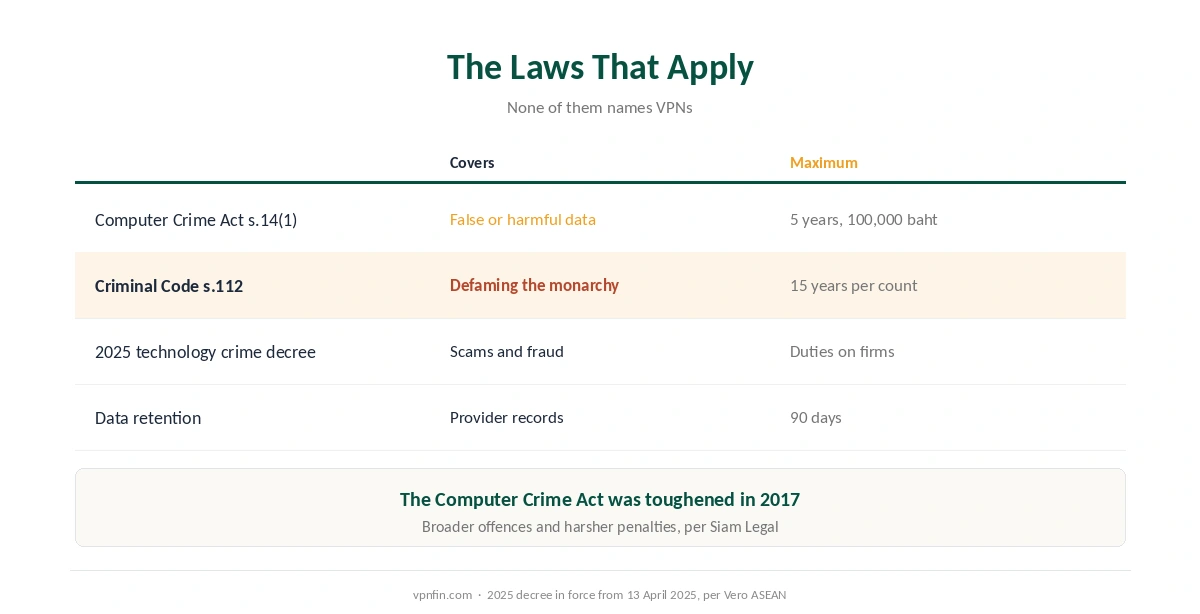
| Law | What it covers | Maximum penalty |
|---|---|---|
| Computer Crime Act 2007, amended 2017 | Unauthorised access, false or harmful data | Section 14(1): 5 years and 100,000 baht |
| Criminal Code Section 112 | Defaming the monarchy | 15 years per count |
| Technology crime decree, 2025 amendment | Online scams and fraud | Duties on payment and digital asset firms |
| Data retention under the Computer Crime Act | Provider records | Kept for 90 days |
The Computer Crime Act dates from July 2007 and was significantly amended in 2017, broadening offences and toughening penalties, the law firm Siam Legal notes. Its offences cover acts such as illegal access to protected systems and interception, according to the Council of Europe’s summary; none mentions VPNs.
The 2025 decree targets scams. In force from 13 April 2025, it places duties on payment providers and digital asset operators, Vero ASEAN reported. It does not regulate personal VPN use.
What Thai Providers Keep
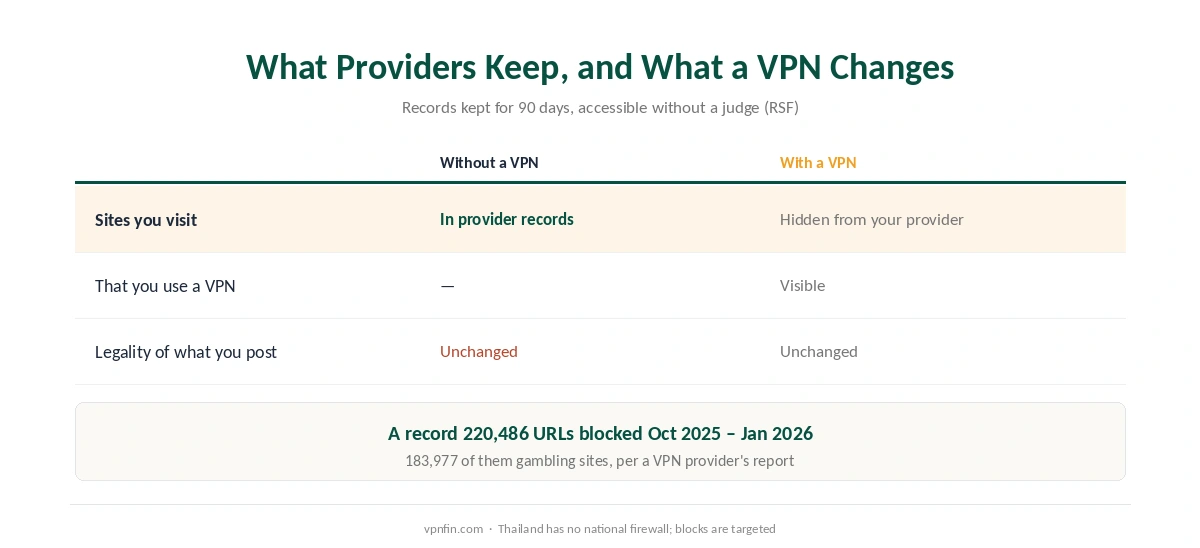
Internet providers must retain records for 90 days, and authorities can access them without a judge, Reporters Without Borders notes of the Computer Crime Act.
A VPN changes what those records show. Your provider sees a connection to a VPN server rather than the sites you visit, as our guide to what a VPN hides explains. It does not hide that you use one, and it does not make an offence legal.
Choose a provider that keeps nothing. With Thai providers holding 90 days of records, the VPN’s own logging policy matters, as our no-logs guide explains. Our NordVPN review covers one audited option.
Blocking is targeted, not nationwide. Thailand has no national firewall; restrictions are specific. Between October 2025 and January 2026 a record 220,486 URLs were blocked, 183,977 of them gambling sites, one VPN provider reported.
Is a VPN Legal in Thailand for Visitors?
Yes, and the same limits apply. Tourists, digital nomads and business travellers are in the same position as residents. Visitors use VPNs for work, banking and hotel Wi-Fi without legal issue, as our travel guide and our public Wi-Fi guide explain.
Viewing and sharing are treated differently. Viewing ordinary sites is not a crime; spreading prohibited content is, one guide notes. Section 112 applies to posts and shares, whoever makes them.
Gambling sites are the common trap. They dominate the block list, and AngloSiam’s point applies: a VPN does not make reaching them lawful. We do not give instructions for reaching blocked sites.
How Thailand Compares
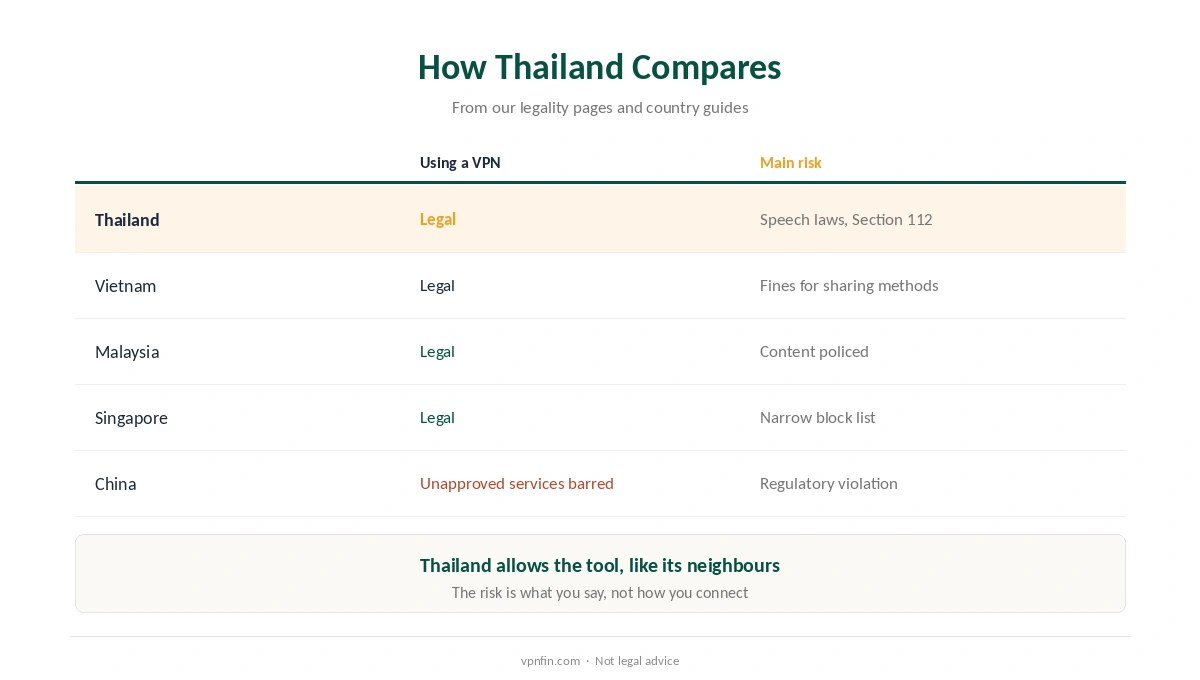
Vietnam also allows VPNs but, since August 2026, fines sharing methods to reach blocked sites, as our Vietnam legality page explains. That makes it stricter than Thailand on one narrow point.
Malaysia and Singapore likewise allow the tool while policing content, as our Malaysia guide and our Singapore guide explain. So is a VPN legal in Thailand by regional standards? Yes, on the same terms as its neighbours.
For stricter regimes, China restricts unapproved services and Iran bans use without a permit.
For the full picture, our country-by-country guide compares every country we cover, from open markets to outright bans.
How We Research
The legal position on VPNs comes from AngloSiam, the Computer Crime Act’s history from Siam Legal and the Council of Europe, data retention from Reporters Without Borders, and the 2025 decree from Vero ASEAN and Wotton Kearney. Block figures come from a VPN provider’s report, which we flag. We are not lawyers, and this is not legal advice. We name each source where used; all were read on 27 September 2026. Our full approach lives on the About Us page.
Thailand VPN Legality FAQ
Yes. No Thai law prohibits using a VPN. Offences committed through one, and access to blocked content such as gambling sites, are still unlawful.
Not for the VPN itself. What you post or share can be an offence under Section 112 or the Computer Crime Act, with or without a VPN.
Defaming the Thai monarchy, with up to 15 years in prison per count. It applies to online posts and shares, including by foreigners.
Yes. Under the Computer Crime Act, providers retain records for 90 days, and authorities can access them without a judge, according to Reporters Without Borders.
Yes. Tourists can use a VPN for work, banking and public Wi-Fi. Thai law on content applies to them as it does to residents.
The Verdict
A VPN is legal in Thailand, and using one for privacy, work or travel raises no legal issue.
It offers no protection from Section 112 or the Computer Crime Act, which punish what you say and share. Take legal advice before relying on anything else.