
Disclosure: VPNFin is reader-supported. If you buy a VPN through links on this page, we may earn a commission at no extra cost to you. This never affects our ratings — here’s our full disclosure.
NordLynx vs WireGuard: what did NordVPN actually change? Not the encryption. NordLynx runs the WireGuard protocol unmodified, with the same handshake and ChaCha20-Poly1305 encryption, a June 2026 technical analysis by Encapsulated found. NordVPN’s addition is a double NAT system around it, designed to fix a privacy gap: plain WireGuard gives each user a fixed internal address that the server must keep, which NordVPN said meant storing some user data. In 2025 it also added post-quantum key exchange.
This page sets out what is the same, what differs, and what the differences mean for you.
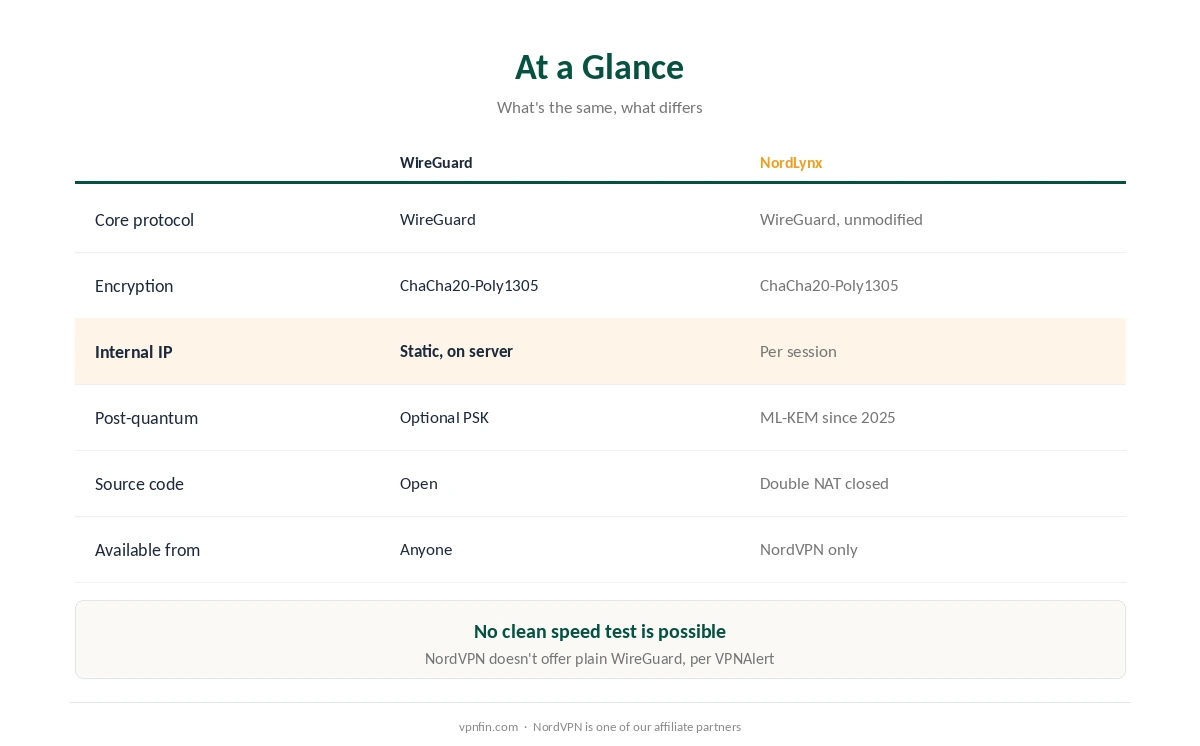
NordLynx vs WireGuard: At a Glance
| WireGuard | NordLynx | |
|---|---|---|
| Core protocol | WireGuard | WireGuard, unmodified |
| Encryption | ChaCha20-Poly1305 | ChaCha20-Poly1305 |
| Internal IP per user | Static, kept on the server | Shared, then assigned per session |
| Post-quantum key exchange | Optional, via pre-shared keys | Added in 2025 (ML-KEM) |
| Source code | Open source | WireGuard open; double NAT closed |
| Who can use it | Any provider or self-hosted | NordVPN only |
Speed can’t be compared cleanly. NordVPN doesn’t offer plain WireGuard, and NordLynx is exclusive to NordVPN, so the same servers can’t be tested both ways, VPNAlert notes. Our WireGuard vs OpenVPN guide covers the bigger speed gap.
The Problem NordLynx Solves
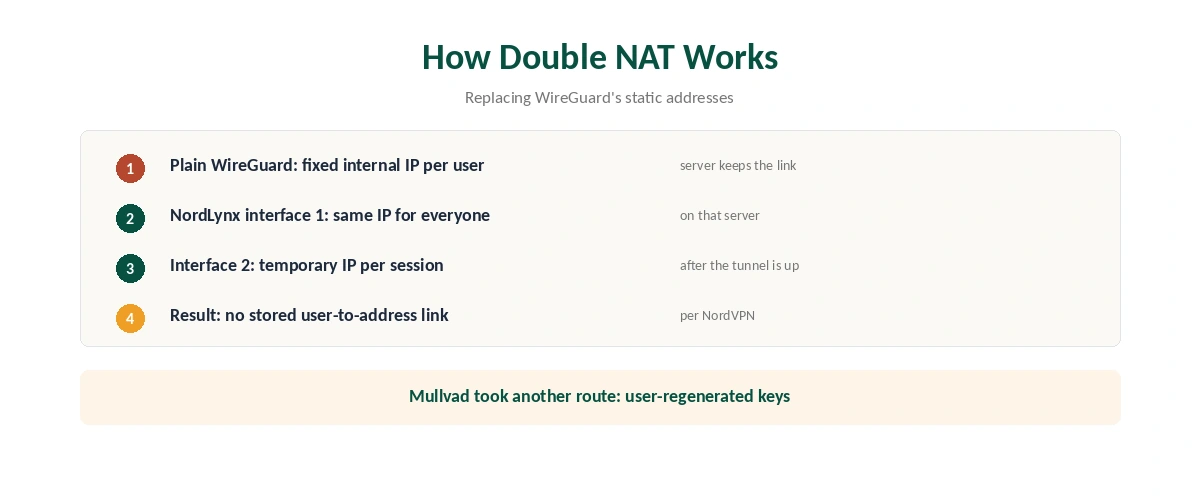
WireGuard doesn’t hand out addresses dynamically. Each user keeps a fixed internal IP tied to their key, so a server must hold at least some user data, NordVPN’s Daniel Markuson told Tom’s Guide in 2020.
Double NAT breaks that link. The first network interface gives every user on a server the same internal address; once the tunnel is up, a second interface assigns a temporary one per session, Embedded Computing Design explains. NordVPN says this lets it run WireGuard without storing identifiable data on servers.
Others solved it differently. Mullvad, for example, let users regenerate their WireGuard keys, and with them their addresses, Tom’s Guide reported at the time. Our Mullvad vs NordVPN comparison looks at both.
What Else Changed
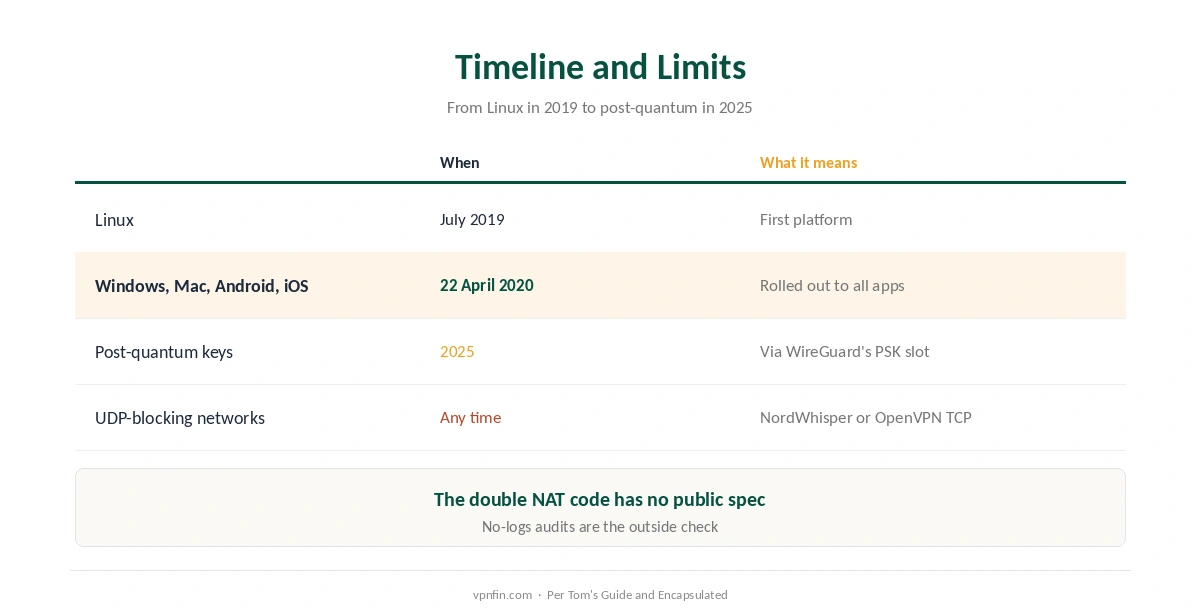
| Change | When | What it means |
|---|---|---|
| NordLynx on Linux | July 2019 | First platform |
| NordLynx on Windows, Mac, Android, iOS | 22 April 2020 | Rolled out to all main apps |
| Post-quantum key exchange | 2025 | ML-KEM through WireGuard’s pre-shared key slot |
Post-quantum support uses WireGuard’s own mechanism. NordVPN delivers ML-KEM keys through the pre-shared key slot built into WireGuard’s specification, not by changing the handshake, Encapsulated explains.
The trade-off is transparency. The double NAT layer is proprietary, with no published specification, so outsiders can’t inspect it the way they can WireGuard. NordVPN’s no-logs audits are the check, as our audit tracker shows and our no-logs guide explains.
When Neither Is the Right Choice
NordLynx and WireGuard both use UDP and have a recognisable traffic pattern, so networks that block UDP block them too, Encapsulated notes. NordVPN points users on such networks to NordWhisper or OpenVPN over TCP; our obfuscation guide explains the idea, and our NordVPN fix guide covers.
Check local rules first. On school and work networks a block is often policy, as our school and work guide explains.
On Linux, NordVPN’s kill switch can block the internet after a manual disconnect; our Linux guide shows the fix. The cipher behind both protocols is explained in our AES-256 vs ChaCha20 guide.
How We Research
NordLynx’s design, post-quantum support and code size come from NordVPN’s blog, updated in January 2026, which we flag as the vendor’s own account. The unmodified handshake, ML-KEM delivery and closed double NAT code come from Encapsulated’s June 2026 analysis; the double NAT mechanics from Embedded Computing Design; the 2020 rollout and Mullvad’s approach from Tom’s Guide; the speed caveat from VPNAlert. WireGuard’s own documentation is at wireguard.com. We read all sources on 28 September 2026. NordVPN is one of our affiliate partners. Our full approach lives on the About Us page.
NordLynx vs WireGuard FAQ
The protocol is the same, unmodified. NordLynx adds NordVPN’s double NAT system around it and, since 2025, post-quantum key exchange.
There’s no clean comparison: NordVPN doesn’t offer plain WireGuard, and NordLynx is exclusive to NordVPN. Both are much faster than OpenVPN.
Plain WireGuard gives each user a fixed internal address the server must store. Double NAT assigns addresses per session instead.
WireGuard is. NordVPN’s double NAT layer is proprietary and has no published specification.
Yes, since 2025, using ML-KEM keys delivered through WireGuard’s pre-shared key slot.
The Verdict
NordLynx vs WireGuard is WireGuard plus NordVPN’s privacy layer, not a different protocol.
You get WireGuard’s speed without static per-user addresses, and post-quantum key exchange since 2025. Whether that makes NordVPN worth paying for is covered in our NordVPN value guide. The cost is a closed layer you have to take on trust, backed by NordVPN’s audits.