
Disclosure: VPNFin is reader-supported. If you buy a VPN through links on this page, we may earn a commission at no extra cost to you. This never affects our ratings — here’s our full disclosure.
Lightway vs WireGuard is a real comparison of two different protocols, unlike NordLynx, which is WireGuard with extras. Lightway is ExpressVPN’s own design, built on the wolfSSL library and DTLS 1.3, and it is not a WireGuard fork, a technical analysis by Encapsulated explains. Since August 2025 ExpressVPN offers both in its apps, so you can choose. In everyday use the speed gap is small; the differences lie in TCP support, post-quantum defaults, dedicated IPs and how each handles network changes. Our guide to ExpressVPN WireGuard covers where it works, and when to pick it over Lightway.
This page compares them feature by feature, and says when to pick each inside ExpressVPN.
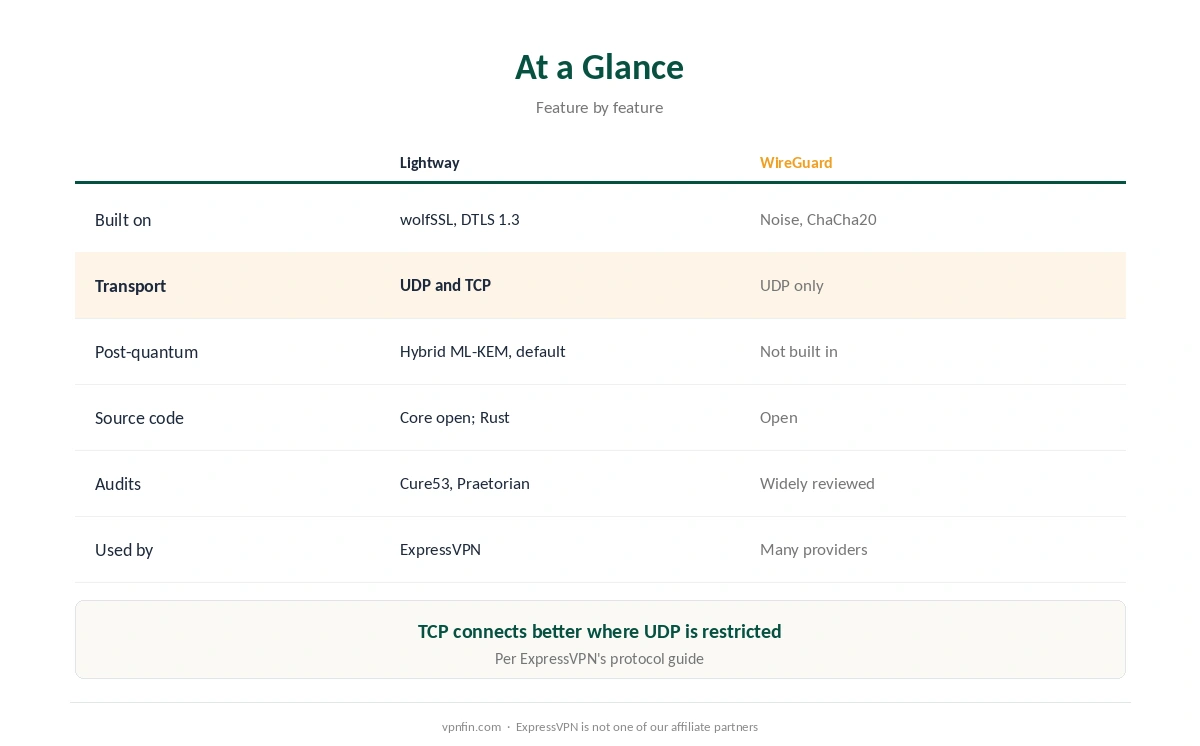
Lightway vs WireGuard: At a Glance
| Lightway | WireGuard | |
|---|---|---|
| Built on | wolfSSL, DTLS 1.3 (TLS 1.3 over TCP) | Noise framework, ChaCha20-Poly1305 |
| Transport | UDP and TCP | UDP only |
| Post-quantum | Hybrid ML-KEM on by default | Not built in; providers add it |
| Source code | Core open source; rewritten in Rust | Open source |
| Audits | Cure53 2021, 2022; Cure53 and Praetorian 2024 | Widely reviewed |
| Who uses it | ExpressVPN | Many providers and self-hosters |
TCP is Lightway’s practical edge. Lightway runs over UDP or TCP, and TCP connects better on networks that restrict UDP, ExpressVPN’s protocol guide notes; WireGuard is UDP-only. Our WireGuard vs OpenVPN guide explains why that matters.
Security: Audits and Post-Quantum Keys
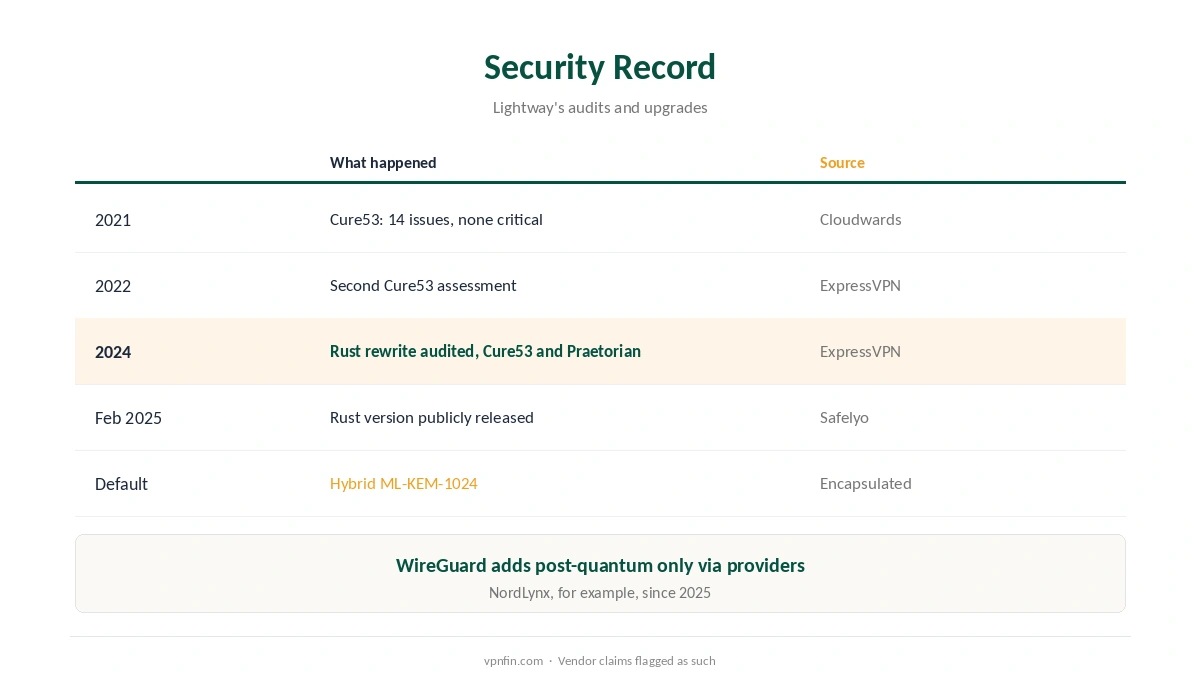
Lightway has been audited repeatedly. Cure53 assessed it in 2021 and 2022, and after its rewrite in the Rust language, Cure53 and Praetorian audited it again in 2024, ExpressVPN says. Cure53’s 2021 review listed 14 issues, none critical, Cloudwards reported.
Post-quantum protection is on by default in Lightway, using a hybrid ML-KEM-1024 key exchange, Encapsulated notes. WireGuard has no built-in post-quantum layer; providers add one, as NordVPN does with NordLynx, covered in our NordLynx vs WireGuard guide.
Both use modern cryptography. wolfSSL’s library has been vetted against the FIPS 140-2 standard, ExpressVPN says, while WireGuard’s small codebase is its main security argument. Our audit tracker covers provider audits.
Speed and Stability
Speed differences are small. In one reviewer’s tests the two performed very similarly, All Things Secured found. Both are far quicker than OpenVPN; our speed guide explains what any VPN costs in speed.
Lightway is built to ride out network changes. When you switch networks or lose signal, the connection goes idle rather than dropping, ExpressVPN says, which suits phones moving between Wi-Fi and mobile data. Our disconnection guide covers other causes.
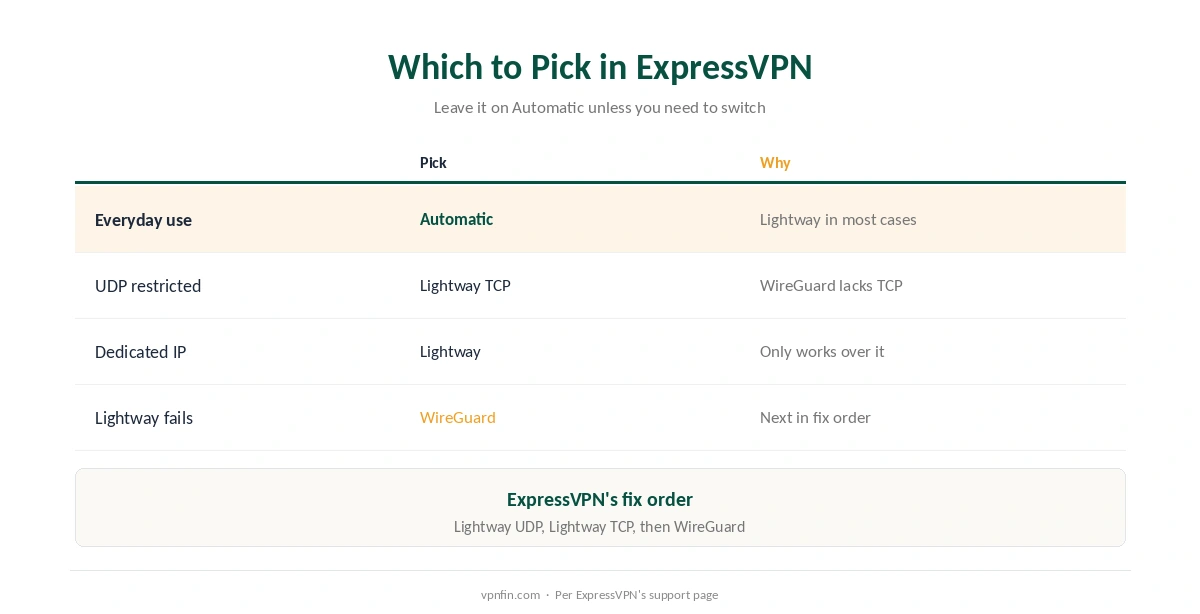
Which to Pick in ExpressVPN
| Situation | Pick | Why |
|---|---|---|
| Everyday use | Automatic | ExpressVPN says it usually picks Lightway |
| Network restricts UDP | Lightway TCP | WireGuard can’t use TCP |
| Dedicated IP | Lightway | Dedicated IPs work only over it |
| Lightway fails to connect | WireGuard | Next in ExpressVPN’s order |
| Router or other device | Whatever it supports | Check the device |
If you rely on a dedicated IP, stay on Lightway. Otherwise, ExpressVPN’s own fix order tries Lightway UDP, then Lightway TCP, then WireGuard, as our ExpressVPN fix guide sets out.
For the full picture of the service, our ExpressVPN review covers speed, apps and pricing.
Using WireGuard Outside ExpressVPN
Lightway is exclusive to ExpressVPN, while WireGuard is open and available from most providers. NordVPN builds NordLynx on WireGuard, and Proton VPN, Surfshark and PureVPN offer it directly.
Our PureVPN WireGuard guide covers one implementation.
Ciphers Underneath
WireGuard uses ChaCha20. Lightway can use either AES or ChaCha20 depending on the device. Both are considered secure; the difference shows mainly in speed on hardware with or without AES acceleration. Our AES-256 vs ChaCha20 guide explains.
Testing Both on Your Network
Run a speed test on each protocol at the same time of day, on the same server. Repeat on mobile data. Keep the one that stays stable when you switch networks, since reconnection speed matters more than peak throughput.
Privacy Behind the Protocol
The protocol protects the tunnel, but the provider’s logging decides what happens at the server. ExpressVPN has three KPMG no-logs audits within 27 independent audits overall; NordVPN has six no-logs audits and Proton VPN five. Choose the provider first, then the protocol. Our no-logs guide explains what audits check.
A Quick Rule
Using ExpressVPN? Try Lightway first, then switch to WireGuard if it suits your home or mobile network better. Using another provider? WireGuard or its variants are the default choice. In both cases, test on mobile data and Wi-Fi at busy times before settling on one.
How We Research
Lightway’s design, audits, Rust rewrite and network handling come from ExpressVPN’s Lightway and protocol pages, which we flag as the vendor’s own account. The architecture comparison and post-quantum defaults come from Encapsulated; Cure53’s 2021 findings from Cloudwards; the Rust release date from Safelyo; speed from All Things Secured; ExpressVPN’s WireGuard addition and fix order from our ExpressVPN guides. ExpressVPN’s own Lightway page is at expressvpn.com/lightway. We read all sources on 28 September 2026. ExpressVPN is not one of our affiliate partners. Our full approach lives on the About Us page.
Lightway vs WireGuard FAQ
No. Lightway is ExpressVPN’s own protocol, built on wolfSSL and DTLS 1.3. NordLynx, by contrast, is WireGuard with additions.
Tests show very similar speeds. Both are much faster than OpenVPN.
Yes, since August 2025. Lightway remains the default, and dedicated IPs work only over Lightway.
Yes. A hybrid ML-KEM key exchange is on by default. WireGuard has no built-in post-quantum layer.
Its core is, and it was rewritten in Rust and audited by Cure53 and Praetorian in 2024.
The Verdict
Lightway vs WireGuard is close on speed; Lightway wins on TCP support, post-quantum defaults and dedicated IP compatibility. Our page on IKEv2 vs WireGuard covers speed tests, network switching and code size compared.
WireGuard wins on reach: it runs across many providers and self-hosted setups. Inside ExpressVPN, leave it on Automatic and switch only when a network demands it. Our page on PureVPN WireGuard covers where WireGuard is available and how to switch.