
Disclosure: VPNFin is reader-supported. If you buy a VPN through links on this page, we may earn a commission at no extra cost to you. This never affects our ratings — here’s our full disclosure.
Do you need a VPN for the US? VPNs are legal in every state, and no federal ban has been proposed, Nym’s August 2026 tracker notes. The live issue is state age-verification laws. Utah’s SB 73, signed on 19 March 2026, became the first state law aimed at VPN use to get around age checks, the Electronic Frontier Foundation reports, and on 24 September 2026 a federal judge blocked its VPN clause while the case continues, KUER reports. For most Americans, though, the reasons to use a VPN are everyday ones: privacy from internet providers, public Wi-Fi, and travel.
This page covers why Americans use VPNs, the state laws to watch, the picks, and the legal position.
VPN for the US: The Short Answer
Legal nationwide. No state bans VPNs outright, as our US legality page explains. Utah’s law targets VPN use around age checks, not VPNs in general.
Everyday privacy is the main use. A VPN hides your browsing from your internet provider and protects you on hotel and airport Wi-Fi, as our public Wi-Fi guide explains.
A VPN doesn’t change your legal location. Utah’s law treated users as being in Utah whatever VPN they use, VPN Atlas notes, though a court blocked that clause in September 2026.
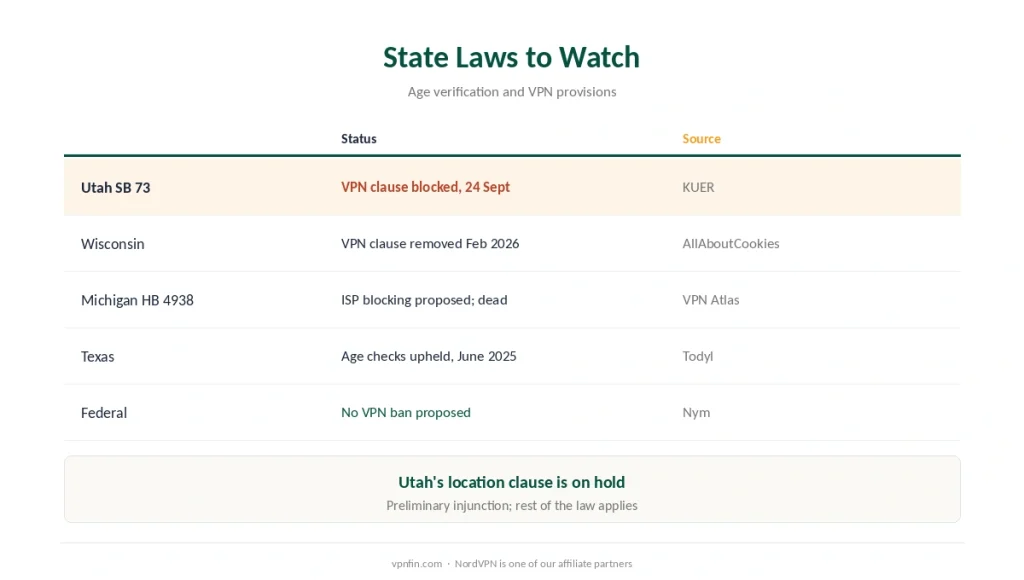
State Laws to Watch
| State | Status | Source |
|---|---|---|
| Utah (SB 73) | Signed March 2026; VPN clause blocked by a federal judge on 24 September 2026 | EFF |
| Wisconsin | VPN provision removed in February 2026 | AllAboutCookies |
| Michigan (HB 4938) | ISP-level VPN blocking proposed; now dead | VPN Atlas |
| Texas | Age-verification law upheld by the Supreme Court, June 2025 | Todyl |
| Federal | No VPN ban proposed | Nym |
A court has now stepped in. Utah had agreed not to enforce the VPN rules while Aylo, Pornhub’s parent company, challenged them. On 24 September 2026, US District Judge David Barlow granted a preliminary injunction against the clause that treats users as being in Utah whatever VPN they use. Perfect geolocation doesn’t exist, the judge noted, so Aylo is likely to win under the dormant Commerce Clause, KUER reports. The rest of the law still applies while the case continues, ID Tech adds.
The target is websites, not users. Sites with a substantial share of material deemed harmful to minors must age-check Utah users, with fines from $2,500 per violation, AllAboutCookies explains. NordVPN called the approach a “liability trap”, TechRadar reported.
Why Americans Use a VPN
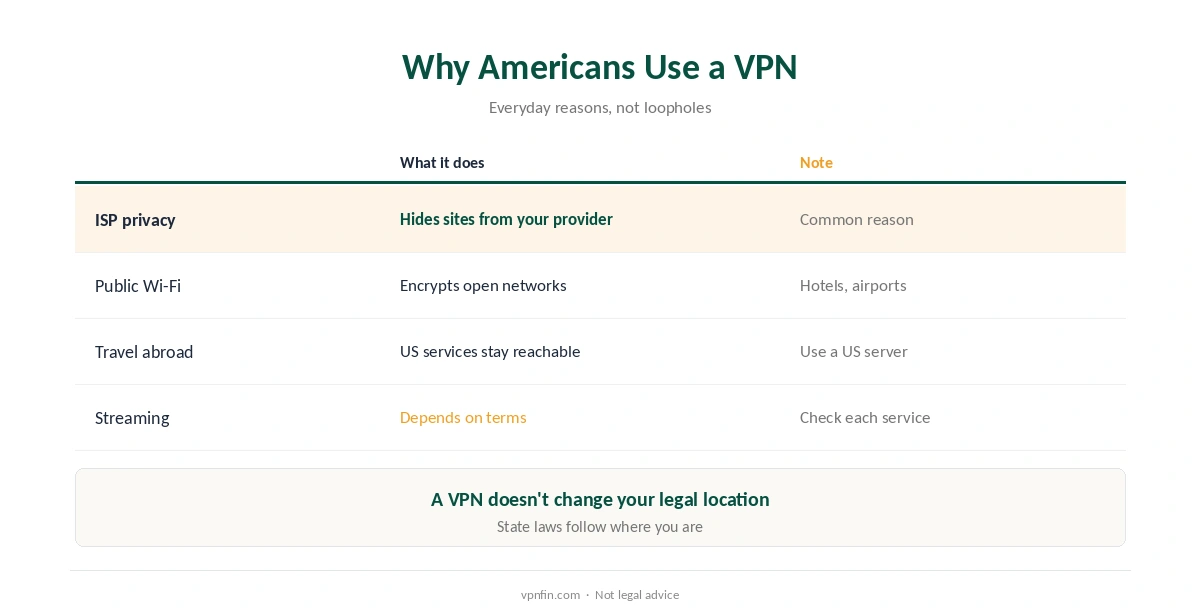
| Use | What a VPN does | Our guide |
|---|---|---|
| Privacy from your ISP | Hides the sites you visit from your provider | What a VPN hides |
| Public Wi-Fi | Encrypts traffic on open networks | VPN for public Wi-Fi |
| Travel abroad | Keeps US services reachable | VPN for travel |
| Streaming | Terms-dependent; check each service | VPN for Netflix |
Travelling Americans use a VPN with a US server to keep their own subscriptions and banking working, as our travel guide covers. Our guide to what a VPN hides sets out the limits, and our Netflix guide covers streaming terms. Banking apps can also react to a foreign address, so a server in the US keeps them calm.
Heading north? Our Canada guide covers Bill C-22, the lawful access bill now before Canada’s Senate.
The Picks
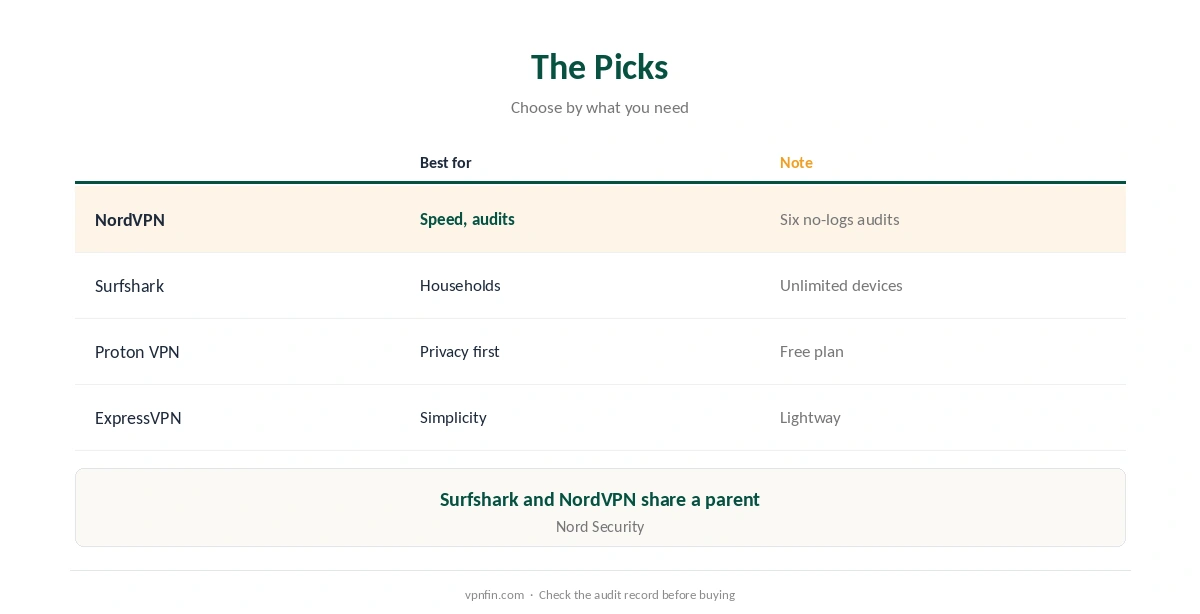
| Provider | Best for | Note |
|---|---|---|
| NordVPN | Speed and audits | Six no-logs audits |
| Surfshark | Households | Unlimited devices |
| Proton VPN | Privacy first | Free plan available |
| ExpressVPN | Simplicity | Lightway protocol |
Pick a VPN for the US by use: audits for privacy, device limits for families, a free plan for light use. Surfshark and NordVPN share a parent, Nord Security. Our audit tracker and our multi-device guide help you choose.
How We Research
Utah’s law and timeline come from the Electronic Frontier Foundation’s updates, and the 24 September ruling from KUER and ID Tech; the deemed-location clause and dead bills from VPN Atlas, which uses partner links; Wisconsin and penalties from AllAboutCookies; the Texas ruling from Todyl; federal status from Nym; NordVPN’s reaction from TechRadar. The EFF’s report is here. We read all sources on 28 September 2026. This is not legal advice. NordVPN is one of our affiliate partners. Our full approach lives on the About Us page.
VPN for the US FAQ
Yes, in every state. No federal ban has been proposed.
SB 73 requires certain adult sites to age-check Utah users and treats users as located in Utah regardless of VPN use. A federal judge blocked that VPN clause on 24 September 2026 while the case continues.
No. Lawmakers removed the VPN provision from the age-verification bill in February 2026.
Mainly for privacy from internet providers, safety on public Wi-Fi, and reaching US services while abroad.
No. State laws apply where you actually are, whatever your VPN shows.
The Verdict
A VPN for the US is legal and mostly about privacy, from your ISP and on public Wi-Fi.
Watch Utah’s case and other age-verification laws, but don’t expect a VPN to change which state’s rules apply to you.