
Disclosure: VPNFin is reader-supported. If you buy a VPN through links on this page, we may earn a commission at no extra cost to you. This never affects our ratings — here’s our full disclosure.
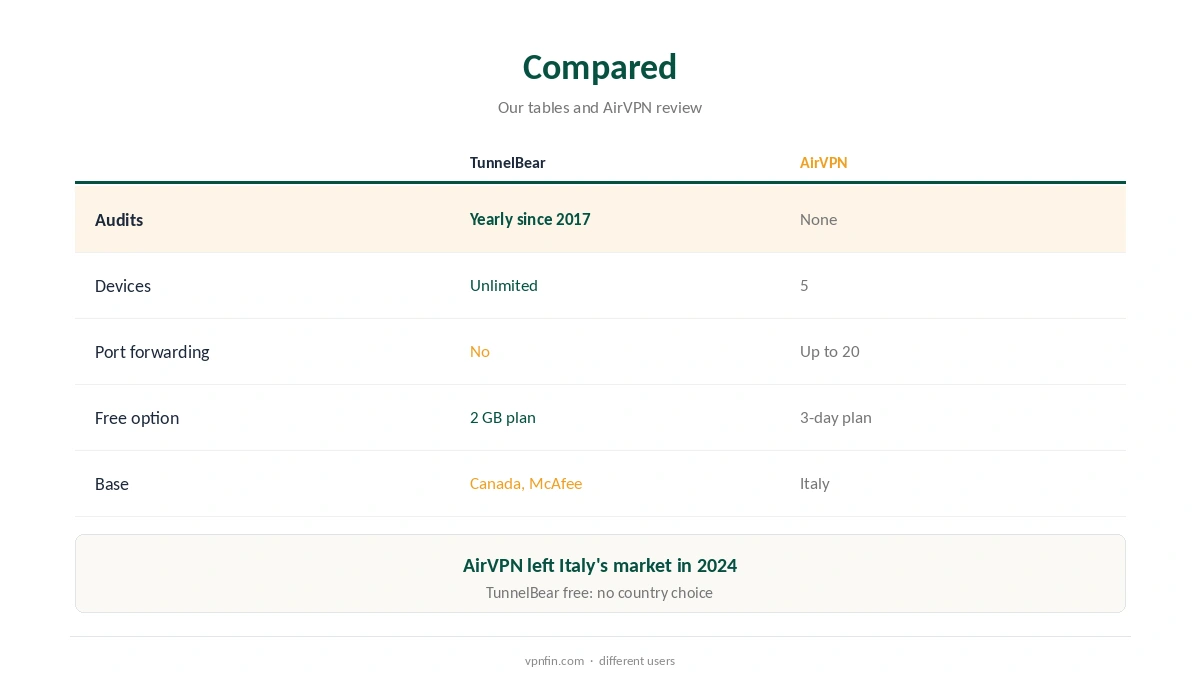
TunnelBear vs AirVPN compares the simplest audited VPN with one of the most technical. TunnelBear, owned by McAfee and based in Canada, has had Cure53 audits every year since 2017, sets no device limit on Unlimited and offers a 2 GB free plan. AirVPN, based in Perugia, Italy, publishes live statistics for every server, runs open-source clients, offers free port forwarding on up to 20 ports and needs no email, our review found. It has no independent audit, allows five devices and fails with major streaming services.
This guide compares them on privacy, ease of use, torrenting and fit.
TunnelBear vs AirVPN on Privacy
TunnelBear’s yearly audits give the stronger evidence. AirVPN offers live server statistics and open-source clients instead, and left Italy in 2024 rather than run Piracy Shield blocklists. Our AirVPN review explains why we still flag its missing audit.
Ease of Use
TunnelBear’s apps are among the simplest, with a map and few settings. AirVPN’s Eddie client has twelve tabs of preferences and no graphical client on iOS, our review notes. Beginners will find TunnelBear far easier.
Torrenting
AirVPN offers free port forwarding on up to 20 ports. TunnelBear has no port forwarding or SOCKS5, Gizmodo found, and reviewers disagree on its torrenting. Our torrenting VPN guide compares providers.
Free Options
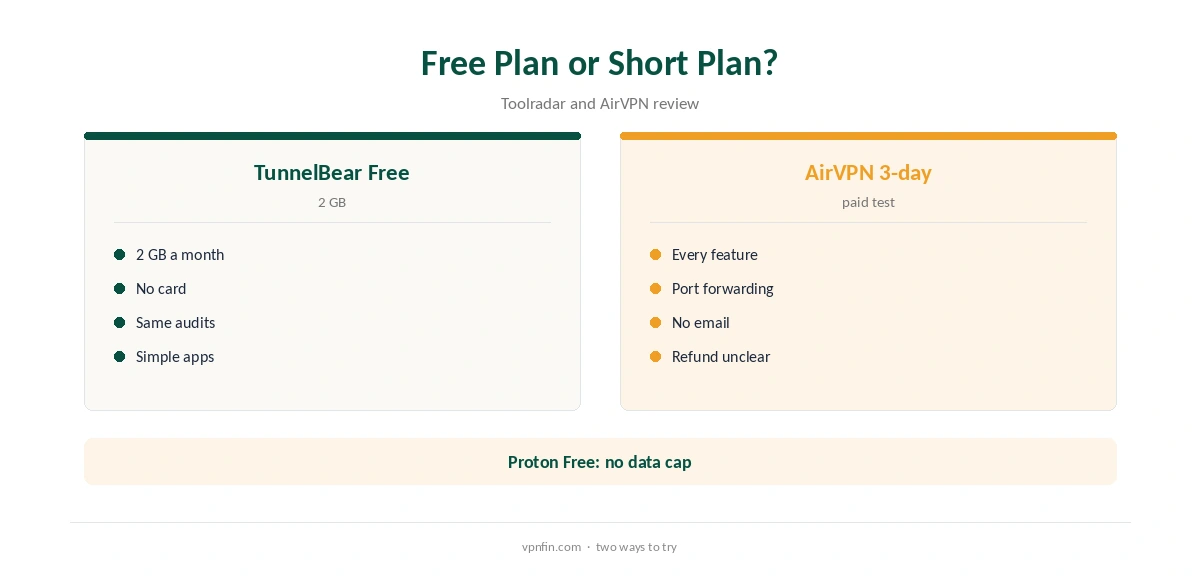
TunnelBear Free gives 2 GB a month; Toolradar reports it removed country choice in January 2026. AirVPN has no free plan but sells a three-day plan, which our review calls the reliable way to test it. Our TunnelBear free guide covers the free plan.
Price and Devices
TunnelBear Unlimited costs about $3.33 a month on yearly or three-year plans and sets no device cap. AirVPN costs around €7 a month, falling to about €2.75 on its longest term, and allows five devices.
Streaming
Testers split on TunnelBear’s Netflix and Disney+ access in 2026. Reviewers report AirVPN failing on the major platforms.
Blocked Networks
TunnelBear’s GhostBear disguises VPN traffic. AirVPN’s Eddie treats every port as its own connection option, which helps where networks block common ports.
Linux and Self-Hosting
AirVPN suits Linux users and self-hosters with its open-source Eddie client and forwarded ports. TunnelBear offers only OpenVPN files on Linux, as our TunnelBear Linux guide explains.
TVs and Routers
TunnelBear has no TV apps and no router support. AirVPN works on routers through manual configs, which can cover TVs. Our router setup guide explains the options.
Kill Switch
TunnelBear’s VigilantBear stops traffic if the tunnel drops. Check Eddie’s network lock settings on AirVPN, and test either by switching Wi-Fi off and on.
Ownership
TunnelBear belongs to McAfee and operates from Canada, a Five Eyes member. AirVPN is Italian, in the Fourteen Eyes. Our VPN ownership guide explains why that matters.
Who Each Suits
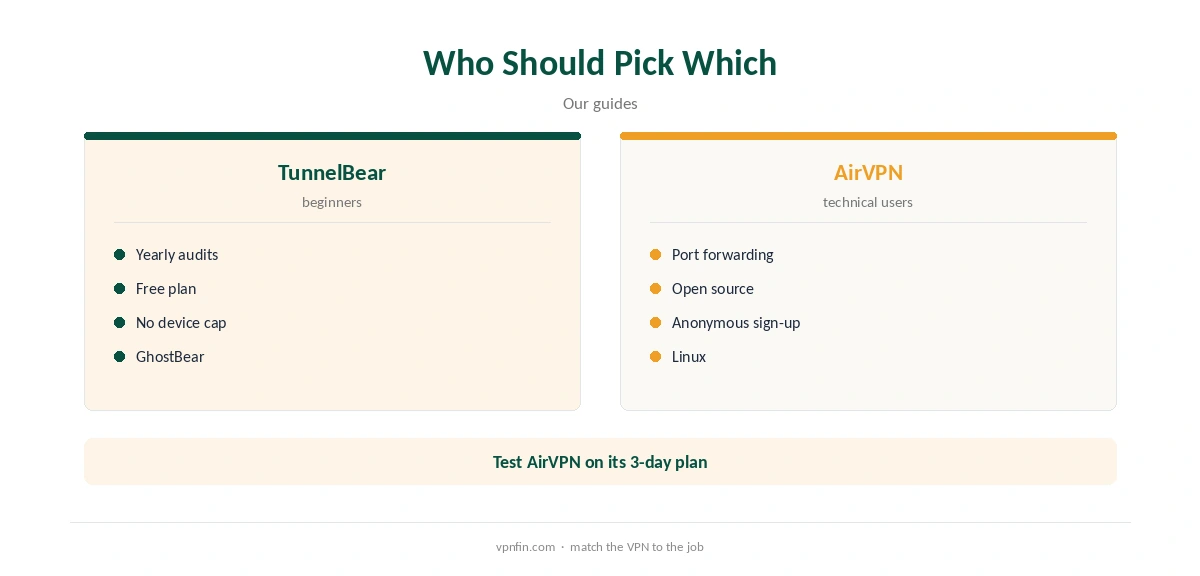
TunnelBear suits beginners, families and anyone who wants audited protection without settings to learn. AirVPN suits home-lab builders, seeders and Linux users who want forwarded ports and open-source clients.
Testing Both
Start with TunnelBear’s free plan, then try AirVPN’s three-day plan. Both cost little to test on the networks you use most.
Keeping It Updated
After app updates, recheck the kill switch or network lock and your protocol on both, since updates can reset them.
Privacy on Public Wi-Fi
Both encrypt traffic on café and hotel networks. Turn on VigilantBear or Eddie’s network lock first. Our public Wi-Fi guide explains the risks.
Support
WizCase notes TunnelBear has no live chat. Check AirVPN’s forum and support pages before relying on it for a server.
Quick Rule
Simple and audited: TunnelBear. Open source with forwarded ports: AirVPN. Try TunnelBear’s free plan and AirVPN’s three-day plan before paying for longer.
Censored Networks
TunnelBear’s GhostBear can slow connections, so turn it off on normal networks. AirVPN’s port flexibility helps on networks that block common ports. Test either before travelling, and check local law first.
Families
TunnelBear Unlimited suits households with many devices, since it sets no cap. AirVPN’s five devices suit one person or a couple.
Price Over Time
TunnelBear’s long plans cost about $3.33 a month; AirVPN’s longest term about €2.75. Both stay inexpensive; AirVPN’s applies to every feature, while TunnelBear’s free plan lets you start at no cost.
Streaming Alternatives
If streaming matters more than either offers, our Netflix VPN guide lists providers that reached several libraries in 2026 testing.
Sign-Up
AirVPN needs no email and accepts seven cryptocurrencies. TunnelBear needs an account but no card on the free plan.
Is TunnelBear vs AirVPN a Close Call?
Rarely, because they serve opposite users: TunnelBear for beginners who want audited simplicity, AirVPN for technical users who want forwarded ports and anonymity.
Who Should Pick Which
Pick TunnelBear for yearly audits, simple apps, a free plan and no device cap. Pick AirVPN for open-source clients, port forwarding and anonymous sign-up. Our Mullvad vs AirVPN page compares AirVPN with another privacy service.
How We Research
This page draws on our AirVPN and TunnelBear guides, Gizmodo, Toolradar and our audit, device and price tables. We cross-checked these sources against each other, and where they conflict or something can’t be verified, we say so in the text rather than guessing. We checked time-sensitive figures, including prices in US dollars, on 8 October 2026. The main source we relied on is AirVPN’s site. Our full approach lives on the About Us page.
TunnelBear vs AirVPN FAQ
TunnelBear for beginners; AirVPN for technical users.
TunnelBear, yearly by Cure53; AirVPN has no audit.
Only AirVPN, free on up to 20 ports.
TunnelBear, with 2 GB a month.
No cap on TunnelBear Unlimited; five on AirVPN.
The Verdict
TunnelBear vs AirVPN: TunnelBear for simple, audited protection; AirVPN for port forwarding and open-source control.