
Disclosure: VPNFin is reader-supported. If you buy a VPN through links on this page, we may earn a commission at no extra cost to you. This never affects our ratings — here’s our full disclosure.
Windscribe vs ExpressVPN sets a premium, heavily audited service against a flexible one with a free plan. ExpressVPN, owned by Kape and registered in the British Virgin Islands, lists 27 independent audits by May 2026, works in China and runs Lightway with post-quantum protection; ExpressVPN added post-quantum WireGuard on 6 August 2025 for Windows, iOS and Android, TechRadar reported, and Salon found it still missing on Mac and Linux in March 2026. Windscribe offers a free plan with 10 GB a month, no device limit and Pro at $69 a year with no renewal jump.
This guide compares them on privacy evidence, devices, price, protocols, China and fit.
Privacy Evidence
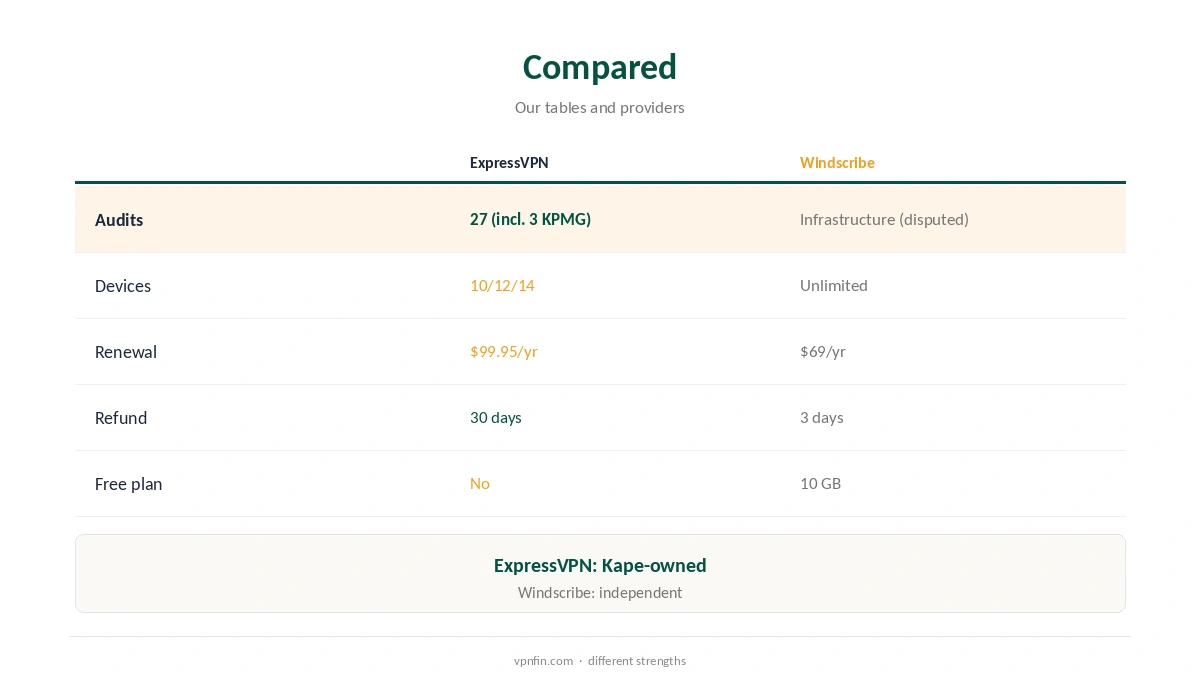
ExpressVPN’s 27 audits include three KPMG no-logs assurance reports and many Cure53 security tests, its Trust Center lists. Windscribe’s no-logs claim held in an Athens court in April 2025; it cites a 2024 PacketLabs infrastructure audit, while Security.org found no audit of its no-logs policy.
Our ExpressVPN audit guide explains what each kind of audit proves, and our Windscribe safety guide covers its court case.
Devices
Windscribe sets no device limit on any plan. ExpressVPN allows 10 devices on Basic, 12 on Advanced and 14 on Pro, its pricing page shows.
Both have TV apps, including Fire TV and Apple TV, and ExpressVPN reached Vega OS sticks in September 2026, our tables record. A router counts as one device on ExpressVPN, which stretches its limit for TVs and consoles.
Price
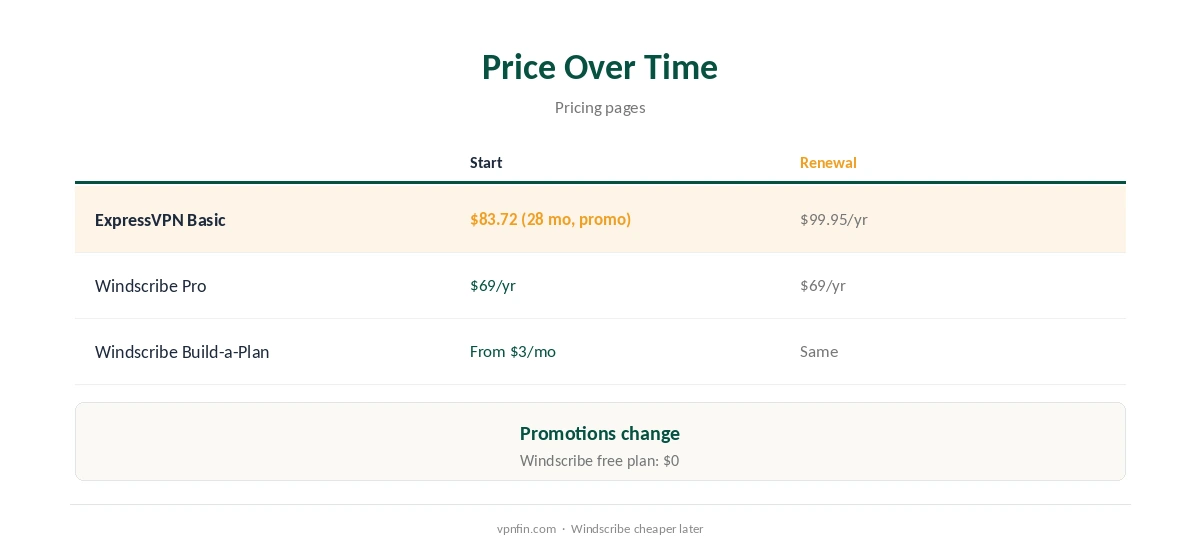
Windscribe Pro costs $9 a month or $69 a year, and the yearly price stays the same on renewal, Windscribe says; Build-a-Plan starts at $3. ExpressVPN’s Basic plan cost $83.72 for 28 months in a September 2026 promotion and renews at $99.95 a year. Advanced and Pro tiers add devices and extras at higher prices.
Refunds differ sharply: 30 days at ExpressVPN for new users, seven days, under 10 GB of use, at Windscribe, its help article says. Windscribe’s free plan offsets that, since you can test for weeks before paying. Our Windscribe price guide covers Build-a-Plan, which suits people who need only a few countries.
Protocols
ExpressVPN defaults to Lightway with post-quantum key exchange and offers WireGuard on Windows, iOS and Android since August 2025, plus OpenVPN. Lightway also runs over TCP, which helps where UDP is blocked. Windscribe offers WireGuard with post-quantum encryption, OpenVPN, IKEv2, Stealth and WStunnel, its App Store listing says. Both therefore give post-quantum protection on their default modern protocol.
Our ExpressVPN WireGuard guide explains when to pick WireGuard over Lightway.
Kill Switch and Split Tunnelling
ExpressVPN’s kill switch is Network Lock, with an always-on mode in its Linux app. Windscribe’s firewall has Automatic, Manual and Always On+ modes, its open-source desktop code shows, and blocks IP, DNS and WebRTC leaks.
Both offer split tunnelling. Windscribe splits by app or by network on desktop, and ExpressVPN by app or IP address depending on the platform; on iPhone it splits by IP, our guides record. Our split tunnelling guide explains the modes.
Free Use
Windscribe has a free plan with 10 GB a month after confirming an email, servers in 10 countries and no device limit. ExpressVPN has no free plan; its free trial runs only on mobile and, our ExpressVPN trial guide notes, costs you the refund option.
For a no-cost start, Windscribe wins clearly, and its free plan includes Stealth for restrictive networks. Our Windscribe Free guide covers its limits.
China and Blocked Networks
ExpressVPN connected on every attempt in vpnpicked’s China testing, our tables record. Windscribe’s Stealth and WStunnel work on many restrictive networks, but we have no comparable China results for it.
For travel to China, ExpressVPN is the safer pick; install it before you arrive, since app stores and sites may be blocked there. Our China VPN guide covers what still works.
Streaming and Ownership
Security.org reported Netflix problems on Windscribe, and our ExpressVPN Netflix guide covers what testing shows for ExpressVPN. Test the services you use within each refund window.
Windscribe’s free plan lets you check before paying, which matters given its seven-day, 10 GB refund limit. ExpressVPN’s 30 days give room to test several services.
Kape owns ExpressVPN along with CyberGhost and PIA. Windscribe Limited is independent of the large VPN groups, our ownership table records, and runs from Toronto, where it says it would leave rather than log.
Our VPN ownership guide explains why parent companies matter.
Windscribe vs ExpressVPN: Who Should Pick Which
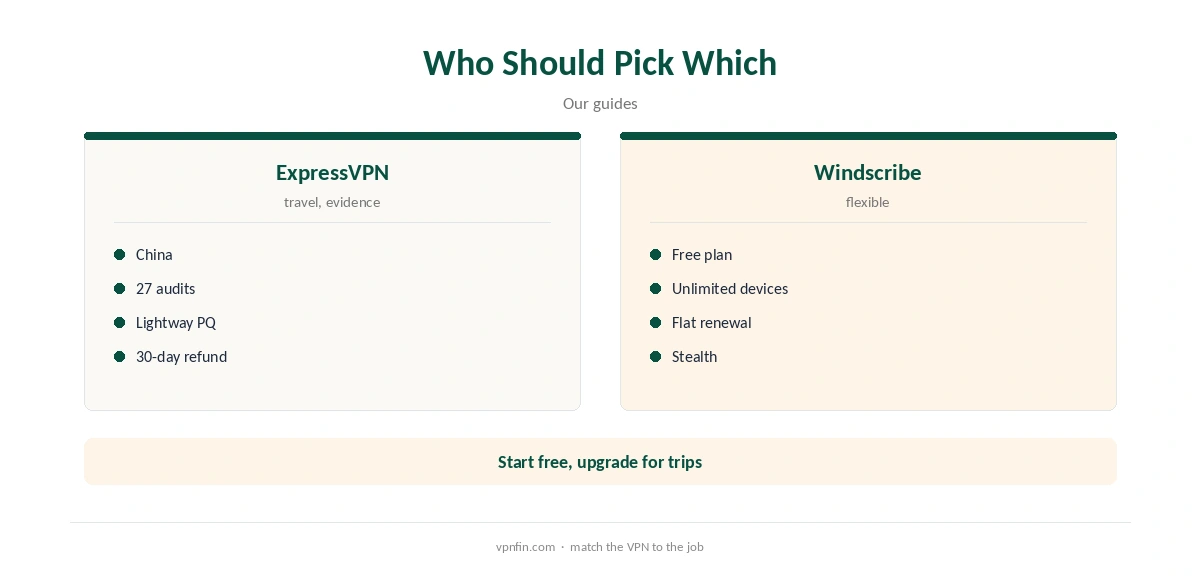
Pick ExpressVPN for China, the broadest audit record, Lightway and a 30-day refund. Pick Windscribe for a free plan, unlimited devices and a price that does not jump. Light users may never need to pay at all, and households save on devices.
Many people start on Windscribe Free and move to ExpressVPN for a trip. Our ExpressVPN alternatives guide weighs it against cheaper options.
How We Research
This page draws on ExpressVPN’s Trust Center and pricing page, TechRadar on ExpressVPN WireGuard, Salon’s 2026 review, Windscribe’s plans and no-logs pages, Security.org and our ExpressVPN and Windscribe tables. We cross-checked these sources against each other, and where they conflict or something can’t be verified, we say so in the text rather than guessing. We checked time-sensitive figures, including prices in US dollars, on 8 October 2026. The main source we relied on is ExpressVPN’s Trust Center. Our full approach lives on the About Us page.
Windscribe vs ExpressVPN FAQ
ExpressVPN for China and audits; Windscribe for a free plan and devices.
On Windows, iOS and Android since August 2025; Lightway stays the default.
Windscribe, with no limit.
Windscribe at $69 a year against $99.95.
ExpressVPN, with 27 by May 2026.
The Verdict
Windscribe vs ExpressVPN: ExpressVPN for evidence and China; Windscribe for flexibility, households and free use.