
Disclosure: VPNFin is reader-supported. If you buy a VPN through links on this page, we may earn a commission at no extra cost to you. This never affects our ratings — here’s how we research.
Both of these providers audit their no-logs claims annually, and both pass. But the difference is what happens next.
NordVPN has completed six independent assessments, the most recent by Deloitte Lithuania between 10 November and 12 December 2025. The full report is not published — subscribers read it inside their Nord Account. Proton VPN has completed five, and every one of them sits on its website as a file anyone can download without an account.
Six beats five on arithmetic. However, five you can read beats six you cannot on evidence. That tension runs through this whole comparison, along with a $55 gap in what you pay every year after the first.
The Short Answer
NordVPN wins for most people. It lost 2.9% of baseline speed in CNET’s testing against Proton’s 8% at Security.org. It also unblocks more reliably and holds our highest rating at 4.8.
Proton VPN wins if you want to check the claims yourself, need a free tier that does not monetise you, or care that renewal costs $83.88 a year instead of $139.08.
Head to Head
| NordVPN | Proton VPN | |
|---|---|---|
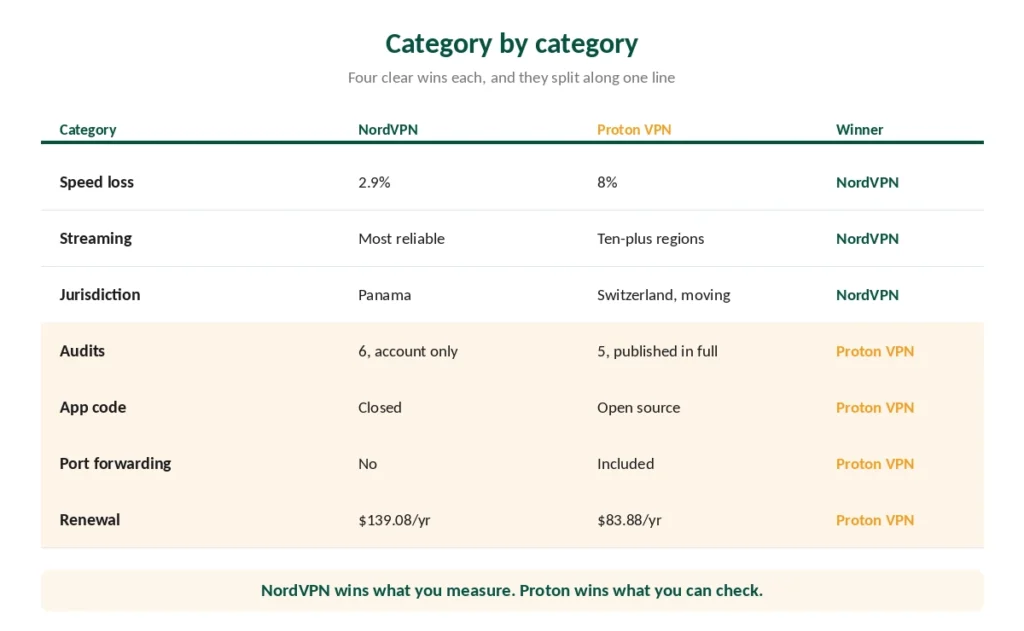
| Speed loss | 2.9% (CNET) | 8% (Security.org), varies by lab |
| No-logs audits | 6 | 5 |
| Reports published? | No — via account only | Yes, open files |
| Auditor | Deloitte | Securitum |
| Jurisdiction | Panama | Switzerland, infrastructure moving |
| Free plan | No | Yes, no data cap |
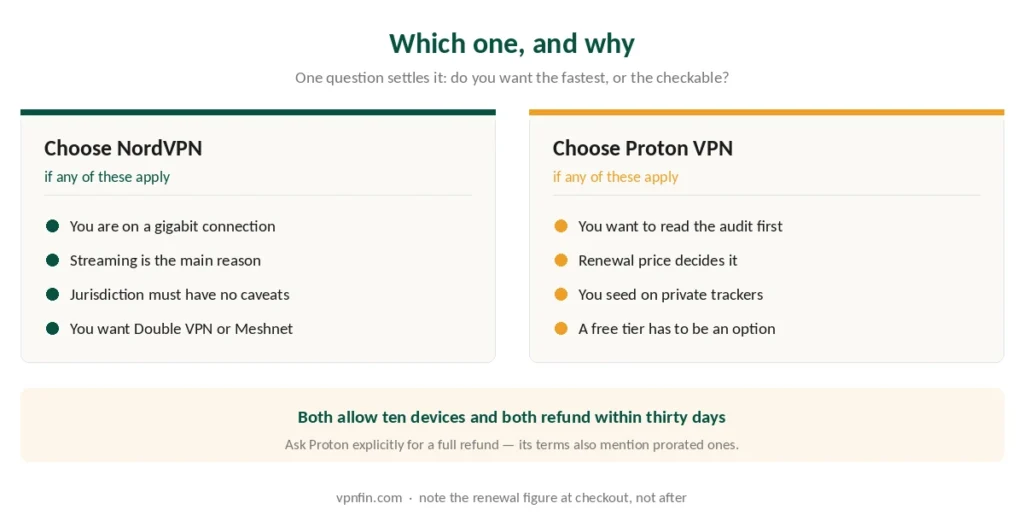
| Devices | 10 | 10 |
| Port forwarding | No | Yes |
| Renewal | $139.08/yr | ~$83.88/yr |
| Our rating | 4.8 | 4.6 |
Speed: NordVPN, and It Is Not Close on the Numbers That Match
CNET measured a 2.9% average download loss for NordVPN across more than 250 individual tests — the best result in that lineup. By contrast, Proton VPN lost 16% in the same round.
Proton’s own best results come from different labs. Security.org recorded an 8% download drop and ranked Proton first for upload speed that round. Similarly, TechRadar measured over 1,400 Mbps locally on WireGuard. CyberInsider reported roughly 88% retention.
Those numbers do not contradict each other — they measure different things. A gigabit-fibre baseline flatters any modern WireGuard implementation, because there is more headroom to lose. A 100 Mbps line testing long hops does not, though. Where both providers appear in the same test run, NordVPN comes out ahead.
⚠️ What it means in practice. Still, both clear the 15 to 25 Mbps that 4K needs by a wide margin. The gap shows up on gigabit connections, large downloads and long-distance hops — one review recorded Proton pings above 300 ms to Australia. How much speed you actually lose puts these percentages in perspective.
Winner: NordVPN.
Privacy: The Interesting Part
Counting audits is the lazy version of this comparison. So here is the useful one.
NordVPN has six, conducted by Deloitte Lithuania under the ISAE 3000 (Revised) standard, covering standard, Double VPN, Onion Over VPN and obfuscated servers. The 2025 engagement ran five weeks. Overall, it is rigorous work by a Big Four firm.
The report is not public. Instead, NordVPN makes it available to subscribers through their Nord Account. You can verify it exists, and you can read it — after you have paid.
Proton VPN has five, by the European firm Securitum, and publishes every report as an open download going back to 2022. No account, no NDA, no paying tier. The 2026 report states that auditors found no persistent records linking a user to activity on a reviewed server.
Proton also open-sources every app, on every platform. NordVPN does not, and ExpressVPN open-sources only its protocol.
⚠️ Neither approach is dishonest. A Big Four assurance engagement carries weight that a smaller firm’s report does not, and NordVPN’s audits cover specialty server types Proton has no equivalent of. But if your reason for buying a VPN is that you would rather verify than trust, one of these lets you and the other asks you to subscribe first. That is a real difference, and it is the one this comparison turns on.
Winner: Proton VPN, on transparency. NordVPN, on auditor weight.
Jurisdiction: One Is Stable, One Is Moving
NordVPN operates from Panama, outside every intelligence-sharing arrangement, with no mandatory data retention. Parent company Nord Security is incorporated in Amsterdam. That structure has not changed in years and shows no sign of changing.
Proton is Swiss, for now. Switzerland is revising its surveillance ordinance, the VÜPF. As drafted, services with as few as 5,000 users would have to identify customers with official documents and retain IP addresses for six months.
Proton’s answer was to start leaving. In July 2025 the company announced it was moving most of its physical infrastructure out of Switzerland and investing over €100 million in the EU. Founder Andy Yen told Swiss broadcaster RTS that the closest European equivalent to the proposed law is Russia’s.
⚠️ Nothing has changed for subscribers today. The ordinance is not in force, Proton AG is still headquartered in Geneva, and no logging obligation applies. But “Swiss privacy” is a selling point with an open question attached, and Panama currently has none. Our full Proton VPN review covers the move in detail.
Winner: NordVPN.
Price: Proton, by $55 Every Year
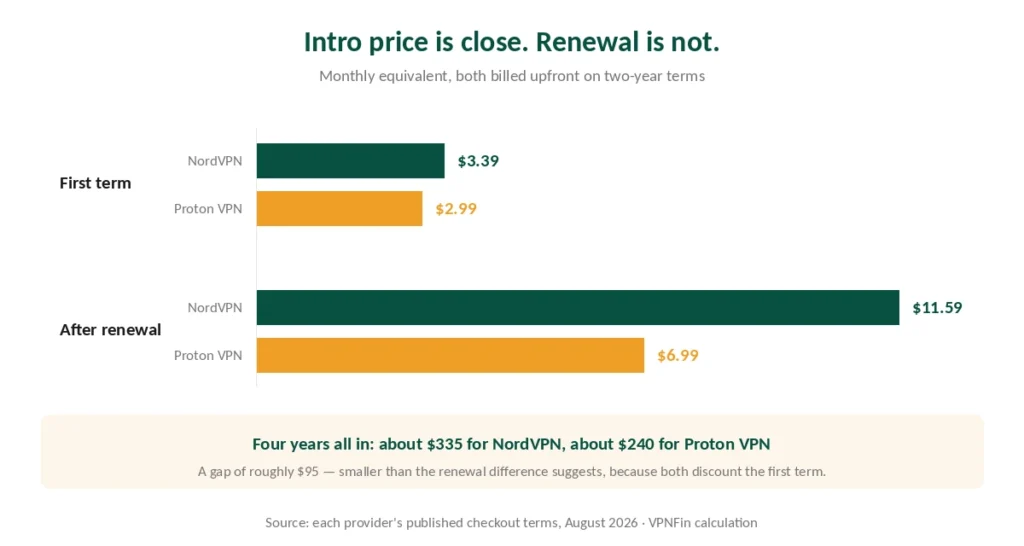
Intro pricing looks similar. NordVPN Basic runs about $3.09 to $3.49 a month on the two-year plan with three bonus months, billed upfront. Proton VPN Plus runs about $2.99, billed at roughly $71.76 for 24 months.
Then the first term ends.
NordVPN renews at $139.08 a year — about $11.59 a month. Proton VPN Plus renews near $83.88 — about $6.99. That is $55.20 a year, indefinitely, and it is the single largest number in this comparison.
Over four years the totals come to roughly $335 against $240 — a gap of about $95, smaller than the renewal difference alone suggests, because both providers discount the first term heavily. Our cheap VPN guide sets out the full category on this measure.
⚠️ Two caveats before you treat this as settled. Proton’s 30-day guarantee is described as a full refund in its own FAQ and as prorated by several reviewers who have been through it — ask explicitly and get the answer in writing. And NordVPN’s higher tiers bundle antivirus, a password manager and cloud storage, as does Proton Unlimited at about $7.99 a month; if you would buy those anyway, compare bundles rather than VPNs.
Winner: Proton VPN.
Streaming and Torrenting
NordVPN unblocks more reliably. Independent reviewers consistently report working Netflix access including foreign libraries, and it holds Smart DNS for devices that cannot run VPN apps. Proton unblocks Netflix across ten or more regions plus Disney+, Prime Video and BBC iPlayer on paid plans, which is strong but a step behind.
Access shifts month to month across the whole category — our streaming guide explains why no snapshot stays true.
Torrenting splits the other way. NordVPN routes P2P through specialty servers and declines to offer port forwarding, treating it as a security risk and pointing to Meshnet instead. Proton allows P2P on designated servers and includes port forwarding at no extra charge — the feature that keeps seeding ratios healthy on private trackers, as our torrenting guide explains.
Winner: NordVPN on streaming, Proton VPN on torrenting.
Features and the Free Tier
NordVPN’s specialty servers have no Proton equivalent in kind: Double VPN and Onion Over VPN as distinct options, Meshnet linking up to 60 of your own devices, Threat Protection Pro from the Plus tier, and Smart DNS.
Proton counters with Secure Core — multi-hop through a hardened server in a privacy-friendly country — plus one-click Tor over VPN, NetShield filtering and the Stealth protocol for restrictive networks.
And the free plan, which NordVPN has no answer to. Proton VPN Free gives unlimited data, no ads and the same no-logs policy, limited to one device and ten countries the app assigns for you. No streaming, no P2P. NordVPN offers a three-day Android trial and a 30-day refund window instead. Our free VPN guide covers why that free tier is the one exception worth trusting.
⚠️ Server counts are unreliable for both. NordVPN is quoted at 6,400 to 9,500 servers across 111 to 224 locations depending on the source; Proton at 17,200 to 20,522 across 120 to 148 countries. We use each provider’s official figure and note that published numbers disagree.
Winners by Category
| Category | Winner |
|---|---|
| Raw speed | NordVPN |
| Streaming reliability | NordVPN |
| Jurisdiction stability | NordVPN |
| Specialty servers | NordVPN |
| Audit transparency | Proton VPN |
| Open-source apps | Proton VPN |
| Renewal price | Proton VPN |
| Port forwarding | Proton VPN |
| Free tier | Proton VPN |
| Devices | Tie — 10 each |
When to Choose Proton VPN Instead
Four situations where the cheaper, slower option is the right one.
You want to read the audit before you pay. This is the whole argument, and it is not a small one for a product whose entire value rests on a promise.
Renewal matters more than benchmarks. $55 a year compounds, and the speed difference is invisible below gigabit.
You seed on private trackers. Port forwarding is not something NordVPN will add — the company has taken a position against it.
You need something free that will not sell you. Proton VPN Free is funded by paying subscribers, which is why it can afford to have no data cap and no ads. Against Surfshark, that free tier is the clearest of Proton’s advantages.
How We Research
This comparison draws on our full reviews of both providers, the published Securitum no-logs reports and Proton’s own audit announcement, NordVPN’s assurance-engagement announcement and contemporaneous coverage of it, reporting on the Swiss VÜPF revision from named outlets including The Record and Tom’s Guide, renewal figures from each provider’s checkout terms, and speed results from named independent testers including CNET, Security.org, TechRadar and CyberInsider — cross-checked and verified at publication. We don’t run our own speed tests. Where results conflicted, most sharply on speed and server counts, we present the range and explain what we think causes it. Our full approach lives on the About Us page.
NordVPN vs Proton VPN FAQ
NordVPN, in testing where both appear in the same run. CNET measured a 2.9% average download loss for NordVPN against 16% for Proton. Proton’s stronger results — 8% at Security.org, over 1,400 Mbps at TechRadar — come from different labs on different baselines. Both clear 4K streaming requirements many times over.
It depends on what counts as proof. NordVPN has six assessments by Deloitte, a Big Four firm, but publishes the report only to account holders. Proton VPN has five by Securitum and posts every report as an open download. More audits versus audits you can actually read.
Not yet, but it removes a tiebreaker. Proton announced in July 2025 that it was moving most physical infrastructure out of Switzerland ahead of a proposed surveillance ordinance. Nothing has changed legally for subscribers. NordVPN’s Panama base has no equivalent question hanging over it.
Proton VPN, by a wide margin. Intro pricing is close — around $2.99 against $3.09 to $3.49 a month — but NordVPN renews at $139.08 a year against Proton’s $83.88. Across four years that works out to about $335 against $240 — a gap near $95, since both discount the first term.
For basic private browsing, yes. It has no data cap, no ads and the same no-logs policy as paid. The limits are one device, ten countries the app picks for you, no streaming and no torrenting. If any of those matter, the free tier stops being an alternative.
Proton VPN, because it includes port forwarding at no extra cost and NordVPN declines to offer it at all. NordVPN routes P2P through specialty servers and is faster on large files, so if you download rather than seed, its speed advantage may matter more than the missing feature.
The Verdict
NordVPN wins this comparison and holds first place in our rankings. Faster by a margin that shows up in like-for-like testing, more reliable on streaming, and based in a jurisdiction with no open questions attached.
But the case for Proton VPN is unusually concrete. Five audit reports you can read without paying, open-source apps, port forwarding included, a free tier that costs nothing and takes nothing, and $55 a year less at renewal.
The mistake would be picking NordVPN because six is more than five without noticing where those six reports live — or picking Proton on Swiss privacy without noticing that Proton is packing.