
Disclosure: VPNFin is reader-supported. If you buy a VPN through links on this page, we may earn a commission at no extra cost to you. This never affects our ratings — here’s how we research.
ExpressVPN has been audited more than any other consumer VPN. However, nobody can tell you how many times.
Reviews published in 2026 credit it with 18, with more than 19, with 27, and with 28 — and several of those numbers come from sources quoting ExpressVPN itself. The company audits its protocol, its servers, its browser extensions, its router firmware and its email relay, then reports a running total that shifts depending on what gets counted.
Proton VPN has five. So you can count them, because each one is a file sitting on the website, dated and downloadable.
That difference sets up this ExpressVPN vs Proton VPN comparison. Still, it is not the whole story: ExpressVPN has something Proton does not, and it happened in an Istanbul evidence room.
The Short Answer
Proton VPN wins narrowly. It is independent rather than Kape-owned, includes port forwarding and a genuinely free tier, publishes every audit in full, and costs about $28 less across four years.
ExpressVPN wins on proof under pressure. In 2017 Turkish investigators seized one of its servers and found nothing, which tests a no-logs policy in a way no audit can. Moreover, it unblocks more streaming services and ships post-quantum encryption by default.
Head to Head
| ExpressVPN | Proton VPN | |
|---|---|---|
| Audits claimed | 18 to 28, unclear | 5, all countable |
| Reports published? | On the blog, totals vary | Yes, as dated files |
| Tested in court | Yes — Turkey, 2017 | Provider states 400+ cases |
| Speed loss (CNET) | 18% | 16% |
| Jurisdiction | British Virgin Islands | Switzerland, moving |
| Owner | Kape Technologies | Independent |
| Devices | 10 on Basic, more above | 10 |
| Post-quantum | Yes, by default | No |
| Port forwarding | No | Yes |
| Free plan | No | Yes, no data cap |
| Renewal | $99.95/yr | ~$83.88/yr |
| Our rating | 4.5 | 4.6 |
The Audit Count Problem
Start with what is not in dispute. ExpressVPN commissions more third-party review than anyone in this category, and no engagement has returned a critical finding.
Named firms and dates are verifiable. Cure53 audited the Lightway protocol in 2021 and again in 2024, TrustedServer in 2022, the browser extensions in 2018, and ExpressMailGuard in May 2026. PricewaterhouseCoopers reviewed the privacy policy in 2019. KPMG covered TrustedServer in 2022 and the privacy commitments again in June 2025. F-Secure tested the Windows app in 2022. Praetorian audited Lightway in 2024.
The total is where it falls apart. One 2026 review says 18. Another says more than 19. Two say 27. Our own review says 28. Each number counts a different set of components, and none of them is wrong — they are simply not measuring the same thing.
Proton VPN’s five are a different kind of claim. Securitum has audited the no-logs infrastructure once a year since 2022, and every report is a dated file you can download without an account. Five is a smaller number that means one specific thing.
⚠️ Which matters more depends on what worries you. If it is whether the apps and protocol are sound, breadth wins and ExpressVPN has more of it than anyone. But if it is whether the company keeps logs, then an annual audit of the logging infrastructure specifically, published in full, answers the question directly.
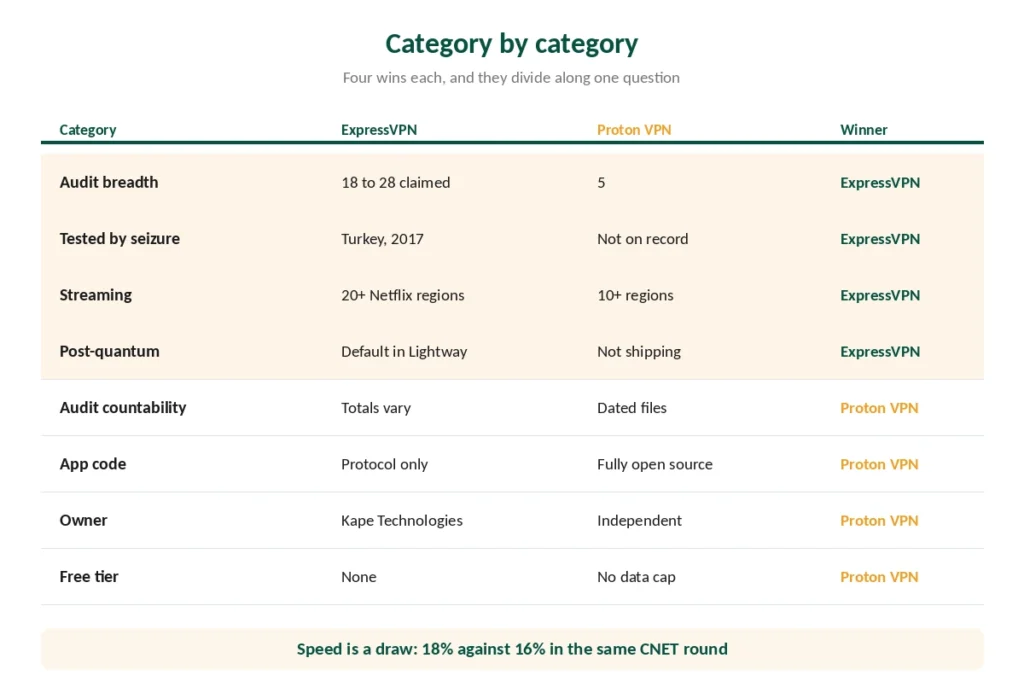
Winner: split. ExpressVPN on breadth, Proton VPN on countability.
Istanbul, 2017
This is ExpressVPN’s strongest card, and most comparisons bury it.
Turkish investigators seized an ExpressVPN server during the inquiry into the assassination of the Russian ambassador. They took the hardware, examined it, and recovered nothing usable, because the TrustedServer architecture holds no persistent data.
That is a live test rather than a scheduled one. An audit examines a system that knows it is being examined. A seizure does not give notice.
Proton states its policy has been tested in over 400 legal cases where it could not comply. That figure comes from the company’s own transparency reporting rather than from court records anyone can count, so it sits in a different evidentiary class. PIA’s three documented federal subpoenas fall between the two, and Mullvad’s 2023 raid sits alongside Istanbul.
Winner: ExpressVPN.
Speed and Streaming
In CNET’s testing, Proton VPN lost 16% of baseline speed and ExpressVPN 18% — close enough that neither result should decide anything. TechRadar, meanwhile, has clocked both above 1,000 Mbps on their respective protocols.
⚠️ Baselines differ between labs, which is why percentages and raw megabits so often disagree. How much speed you actually lose explains the mechanism.
Streaming is a clearer win. ExpressVPN unblocks 20 or more Netflix libraries plus Disney+, BBC iPlayer, Hulu and Max, and its MediaStreamer Smart DNS reaches consoles and smart TVs that cannot run a VPN app at all. Proton handles ten or more Netflix regions on paid plans, which is strong, though a step behind — and it has no Smart DNS equivalent.
Access shifts month to month regardless, so our streaming guide covers the pattern instead of a snapshot.
Winner: ExpressVPN on streaming. Speed is a draw.
Ownership, Jurisdiction and Protocols
ExpressVPN belongs to Kape Technologies, which also owns CyberGhost and Private Internet Access. Consolidation is normal in this market, but it means three of the brands we cover answer to one board.
Proton AG has no parent. Instead, it funds itself through subscriptions across its own product suite.
Jurisdiction favours ExpressVPN today. The British Virgin Islands sit outside the 14 Eyes arrangement with no data-retention law. Switzerland also sits outside every such bloc, yet it is revising its surveillance ordinance, and Proton announced in July 2025 that it was moving most physical infrastructure out of the country in response. Our full Proton VPN review covers what that means in practice.
On protocols, ExpressVPN is ahead. Lightway was rewritten in Rust in 2025, is open-sourced on GitHub, and since January 2026 carries ML-KEM post-quantum protection by default. Proton has no equivalent shipping today.
Proton answers with openness of a different kind: every app on every platform is open source, not just the protocol.
Winner: ExpressVPN on jurisdiction and protocol, Proton VPN on independence and open code.
Price: Closer Than the Reputation Suggests
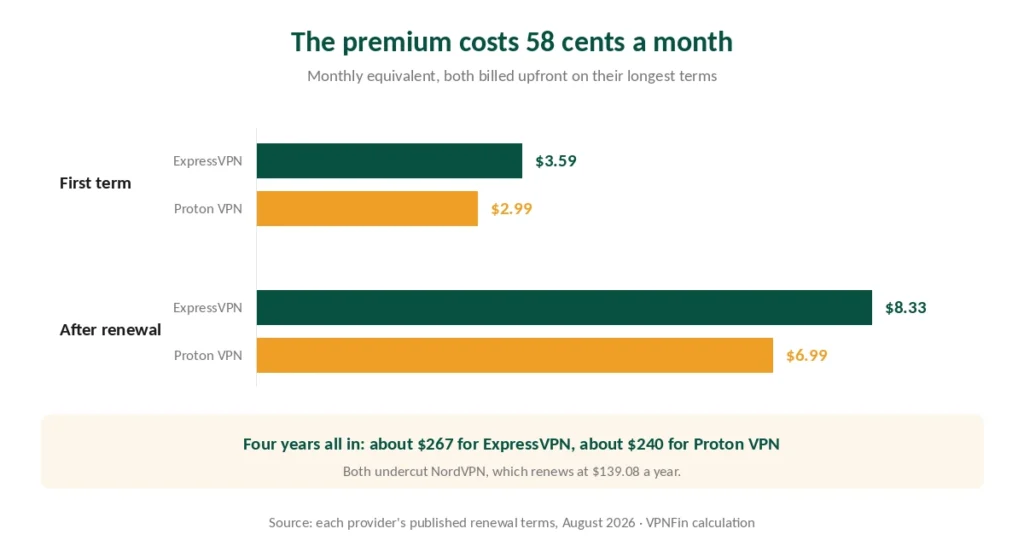
ExpressVPN is treated as the expensive option. Over four years, though, the gap is $28.
Intro pricing: ExpressVPN Basic runs about $3.59 a month on the 28-month plan, billed at roughly $100.58 upfront. Proton VPN Plus runs about $2.99, billed at $71.76 for 24 months.
Renewal: ExpressVPN Basic converts to $99.95 a year. Proton VPN Plus converts to about $83.88.
Four-year totals come to roughly $267 for ExpressVPN and $240 for Proton — about 58 cents a month between them. Notably, both undercut NordVPN, which renews at $139.08. Our cheap VPN guide sets the category out in full.
⚠️ Two things to verify at checkout. ExpressVPN now sells Basic, Advanced and Pro tiers with different device limits, and published figures for Basic vary between 8 and 10 devices as reviews catch up with the change. And Proton’s 30-day guarantee is described as a full refund in its FAQ but as prorated by several reviewers, so ask explicitly and get it in writing.
Winner: Proton VPN, by less than its reputation for value would suggest.
Features Where They Split
ExpressVPN keeps every server feature in every tier: Network Lock kill switch, split tunnelling, obfuscation, MediaStreamer, router firmware, and the Aircove hardware router. Higher tiers add a password manager, identity tools and a dedicated IP rather than gating anything about the VPN itself.
Proton includes Secure Core multi-hop, one-click Tor over VPN, NetShield filtering, the Stealth protocol for restrictive networks, and port forwarding at no extra cost, which ExpressVPN does not offer at any price.
Neither has a mesh network on NordVPN’s model.
The free tier is Proton’s alone. Proton VPN Free carries no data cap, no ads, and the same no-logs policy as paid, limited to one device and ten countries the app selects. ExpressVPN has no free plan whatsoever — just the 30-day refund window. Therefore, if trying before paying matters, our free VPN guide explains why Proton’s tier is the exception in that category.
Winners by Category
| Category | Winner |
|---|---|
| Audit breadth | ExpressVPN |
| Tested by seizure | ExpressVPN |
| Streaming and Smart DNS | ExpressVPN |
| Post-quantum encryption | ExpressVPN |
| Jurisdiction stability | ExpressVPN |
| Audit countability | Proton VPN |
| Open-source apps | Proton VPN |
| Corporate independence | Proton VPN |
| Port forwarding | Proton VPN |
| Free tier | Proton VPN |
| Four-year price | Proton VPN |
| Speed | Draw |
When to Choose ExpressVPN Instead
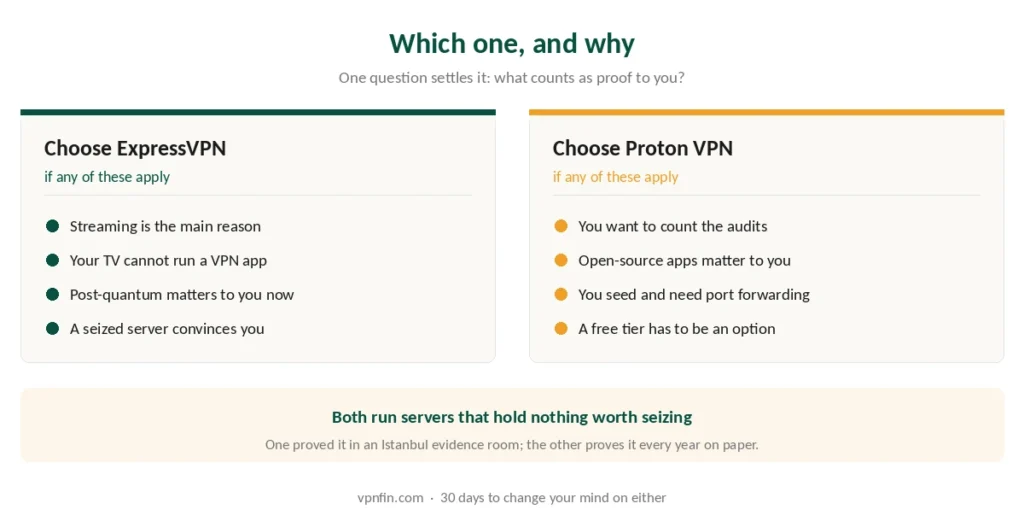
Streaming is the main reason you are buying. MediaStreamer alone settles it if your TV or console cannot run an app.
You want post-quantum protection now. Lightway ships it by default; Proton does not.
You value a jurisdiction with no open questions. The British Virgin Islands are not revising anything, whereas Switzerland is.
Real-world proof outranks scheduled proof for you. A seized server that yielded nothing is evidence of a kind an audit cannot produce.
How We Research
This comparison draws on our full reviews of both providers, ExpressVPN’s published audit history and named engagement reports from Cure53, KPMG, PwC, F-Secure and Praetorian, the published Securitum reports for Proton, contemporaneous coverage of the 2017 Turkish server seizure, renewal figures from each provider’s checkout terms, and speed results from named independent testers including CNET and TechRadar — cross-checked and verified at publication. We don’t run our own speed tests. Where sources conflicted, above all on ExpressVPN’s audit total, we say so rather than picking the flattering figure. Our full approach lives on the About Us page.
ExpressVPN vs Proton VPN FAQ
Nobody can say precisely, which is itself the answer. Reviews published in 2026 credit it with 18, more than 19, 27 and 28, because each source counts a different set of components. The named engagements are verifiable: Cure53, KPMG, PwC, F-Secure and Praetorian, covering the protocol, servers, apps and extensions.
Neither, meaningfully. CNET recorded an 18% download loss for ExpressVPN against 16% for Proton, which is inside the margin where connection and time of day matter more than the provider. Both clear 4K streaming requirements by a wide margin, so speed should not decide this comparison.
ExpressVPN has the stronger single piece of evidence. Turkish investigators seized one of its servers in 2017 and recovered nothing usable. Proton states its policy has held in over 400 legal cases, but that figure comes from its own transparency reporting rather than from public court records.
No. It offers a 30-day money-back guarantee instead, which requires paying first. Proton VPN Free has no data cap, no ads and the same no-logs policy as its paid tier, limited to one device and ten countries the app assigns rather than lets you pick.
Proton VPN, by less than most people expect. ExpressVPN Basic renews at $99.95 a year and Proton VPN Plus at roughly $83.88. Across four years that works out to about $267 against $240 — roughly 58 cents a month.
The Verdict
Proton VPN takes it, narrowly. Independence from a three-brand parent, port forwarding, a free tier, open-source apps on every platform, five audits you can count, and $28 less across four years.
ExpressVPN’s case is stronger than the scoreline. A seized server that gave up nothing is the most convincing evidence any provider in this category has, and no amount of annual auditing produces the same thing. If streaming or post-quantum encryption decides your purchase, buy it without hesitation.
Ultimately, the two agree on more than they differ: RAM-only or bare-metal servers under the provider’s control, no-logs policies backed by outside review, and 30 days to change your mind. Against NordVPN and against Surfshark, Proton makes the same argument from a different angle.