
Disclosure: VPNFin is reader-supported. If you buy a VPN through links on this page, we may earn a commission at no extra cost to you. This never affects our ratings — here’s how we research.
Most comparisons of these two open with the price and stop there, because Surfshark’s intro rate is lower and that looks like an answer.
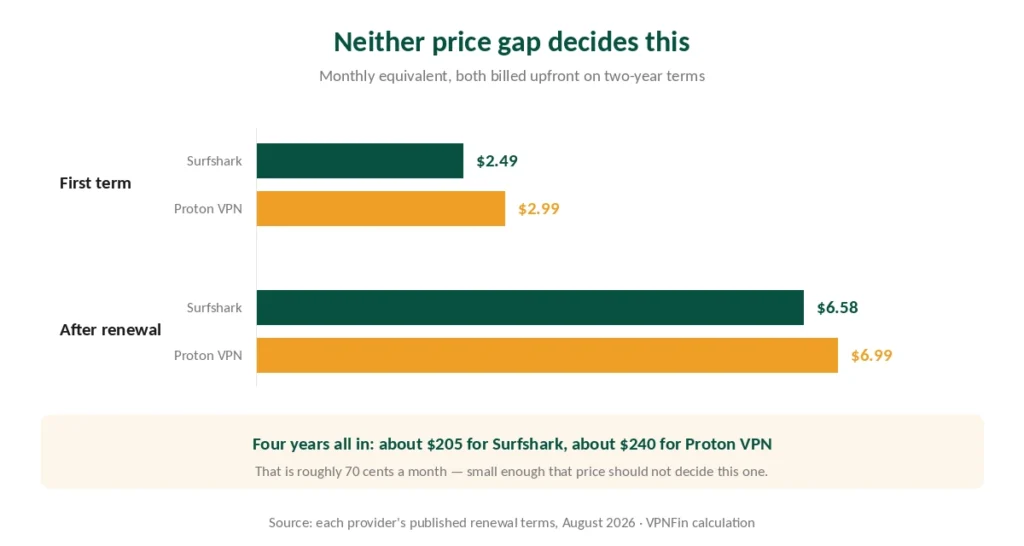
It isn’t. In fact, Surfshark Starter renews at about $79 a year, while Proton VPN Plus renews near $83.88. That is a difference of $4.88 annually — less than a month of either. Once the first term ends, price stops deciding anything.
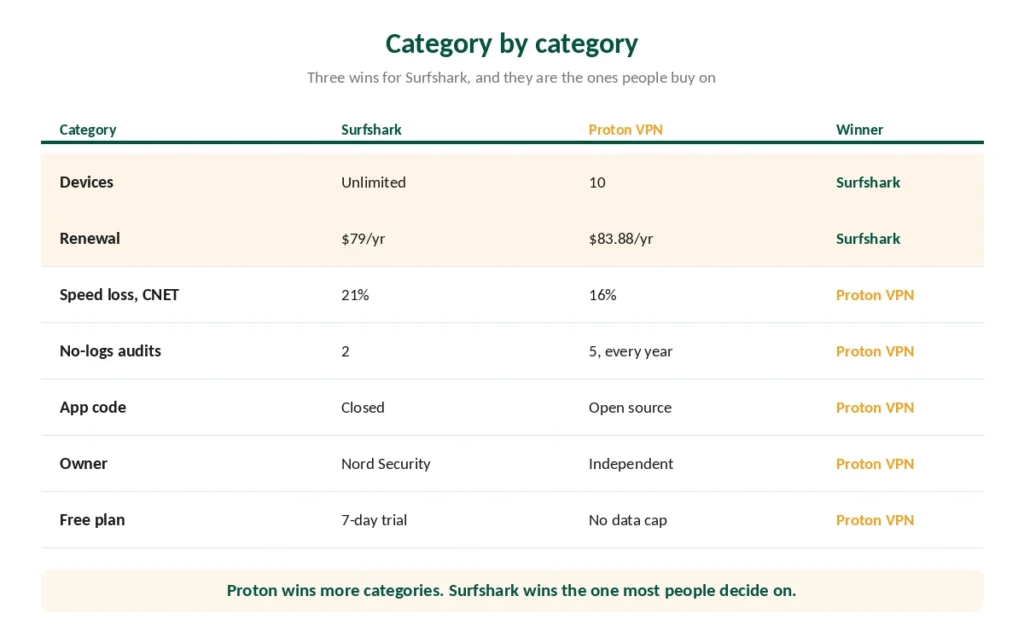
So this Surfshark vs Proton VPN comparison is about what remains: unlimited devices on one side, five consecutive published audits on the other, and a speed result that runs opposite to what most people expect.
The Short Answer
Proton VPN wins narrowly on the merits. It was faster than Surfshark in the one test that measured both in the same round. It also publishes five years of no-logs audits, open-sources every app, and includes port forwarding and a free tier.
Surfshark wins outright if you count devices. Unlimited simultaneous connections against Proton’s ten is not a small gap, and for a household it settles the question before anything else gets a hearing.
Head to Head
| Surfshark | Proton VPN | |
|---|---|---|
| Devices | Unlimited | 10 |
| Speed loss (CNET) | 21% | 16% |
| No-logs audits | 2 | 5 |
| Reports published? | Yes | Yes |
| App code | Closed | Open source |
| Jurisdiction | Netherlands (9 Eyes) | Switzerland, moving |
| Owner | Nord Security | Independent |
| Free plan | 7-day trial | Yes, no data cap |
| Port forwarding | No | Yes |
| Renewal | ~$79/yr | ~$83.88/yr |
| Our rating | 4.6 | 4.6 |
Speed: The Result Runs Backwards
Surfshark is widely described as one of the fastest VPNs. However, in the one test we found that measured both providers in the same round, on the same connection, it finished behind.
CNET recorded a 21% average download loss for Surfshark and 16% for Proton VPN. For context in that same round, NordVPN lost 2.9% and ExpressVPN 18% — so Proton placed third of four and Surfshark last.
Other labs read differently. TechRadar clocked Surfshark above 950 Mbps on WireGuard, level with NordVPN, and separately measured Proton above 1,400 Mbps. Security.org put Proton’s loss at 8% and ranked it first for upload in that round.
Both readings can be true, and the reason matters. Percentage retention on a gigabit line and raw throughput measure different things. What survives across every source is that neither provider is slow, and that Surfshark’s reputation for speed rests on throughput numbers rather than retention ones.
⚠️ What this means for you. 4K needs 15 to 25 Mbps and both clear it by an order of magnitude. If you are on fibre and move large files, how much speed you actually lose explains why the percentage matters more than the headline megabits.
Winner: Proton VPN, on the only like-for-like evidence available.
Devices: Surfshark, and It Is Not Arguable
Surfshark allows unlimited simultaneous connections on every tier. No cap in the terms, no higher plan that adds more.
Proton VPN Plus allows ten. That covers a single user comfortably and a couple without strain.
Count your household honestly: two phones, two laptops, a tablet, a smart TV, a games console, a streaming stick. That is eight before anyone visits or buys anything. Ten is not a generous ceiling in 2026, and Proton has no add-on that raises it.
Winner: Surfshark, decisively. Our Surfshark review covers how the unlimited policy holds up in practice.
Audits: Different Kinds of Proof
Both publish their reports. The difference is what gets audited, and how often.
Proton VPN has five consecutive annual no-logs audits — 2022 through 2026, all by Securitum, each published as an open download requiring no account. The scope is the logging infrastructure itself: production servers, configuration files, data-flow design, staff interviews.
Surfshark has two no-logs assurance reports, both by Deloitte, in 2023 and June 2025, conducted under the ISAE 3000 standard.
But Surfshark audits more than logging. Cure53 examined its browser extensions in 2018, its infrastructure in 2021 and again in 2026, and its new Dausos protocol in April 2026. SecuRing reviewed infrastructure security in 2025. All of those sit on Surfshark’s trust page as full reports.
⚠️ These verify different things, and the distinction gets blurred constantly. A security audit checks whether the system can be broken into. A no-logs audit checks whether the company is keeping what it says it isn’t. Surfshark has more of the first kind; Proton has more of the second, every year without a gap.
Winner: Proton VPN on no-logs cadence, Surfshark on security breadth.
Ownership and Jurisdiction
This section is where the two diverge in a way neither markets.
Surfshark merged with NordVPN under Nord Security in 2022. The brands run separate infrastructure and commission their own audits, but two of the five providers we rank answer to one parent. If you are comparing Surfshark against NordVPN as well, you are comparing siblings.
Proton AG, in contrast, has no parent, funding itself through subscriptions across its own product suite. Nor does Mullvad, which takes the idea considerably further.
Jurisdiction favours Proton today, with a caveat. The Netherlands is a member of the 9 Eyes intelligence-sharing group; Switzerland sits outside every such bloc. Dutch law imposes no retention obligation on VPN providers and Surfshark runs RAM-only servers, so the practical exposure is thin either way.
⚠️ The caveat is real. Switzerland is revising its surveillance ordinance, and Proton announced in July 2025 that it was moving most of its physical infrastructure out of the country in response. Our full Proton VPN review covers what that means; our legality guide covers how much jurisdiction decides at all.
Winner: Proton VPN, on independence more than on geography.
Price: Closer Than Anyone Says
Intro pricing favours Surfshark. Starter runs about $2.49 a month on the two-year plan with three bonus months, sometimes lower during promotions. Proton VPN Plus runs about $2.99.
Renewal is nearly a tie. Surfshark Starter converts to roughly $79 a year; Proton VPN Plus to about $83.88. Under five dollars separates them.
Across four years the totals land near $205 for Surfshark and $240 for Proton — a gap of about $35, which works out to under a dollar a month. Our cheap VPN guide sets both against the rest of the category.
⚠️ Two things to check at checkout. Published Surfshark renewal figures vary between $59.76 and $99 depending on the source and tier; $79 is the most consistently reported for Starter, and Surfshark’s own terms do not let you renew at the two-year rate. And Proton’s 30-day guarantee is described as a full refund in its FAQ but as prorated by several reviewers — ask explicitly.
Winner: Surfshark, but by less than the intro prices suggest.
Features Where They Split
Surfshark puts everything in the cheapest tier: CleanWeb ad blocking, MultiHop double-routing, Bypasser split tunneling, Alternative ID for throwaway signup identities, and P2P across the entire network. Its in-house Dausos protocol uses AEGIS-256X2 with a hybrid post-quantum key exchange, and Cure53 found no critical or high-severity issues within scope.
Proton counters with Secure Core — multi-hop through a hardened server in a privacy-friendly country, the same idea Surfshark calls MultiHop, which our multi-hop guide compares. It adds one-click Tor over VPN, NetShield filtering, the Stealth protocol for restrictive networks, and port forwarding at no extra cost, which Surfshark does not offer at any price.
And the free plan. Proton VPN Free has no data cap, no ads and the same no-logs policy as paid, limited to one device and ten countries the app picks for you. Surfshark offers a seven-day mobile trial and a 30-day refund window instead. Our free VPN guide explains why Proton’s is the exception in that category.
⚠️ Both are strong on streaming, and access shifts monthly regardless — our streaming guide covers the pattern rather than a snapshot.
Winners by Category
| Category | Winner |
|---|---|
| Devices | Surfshark |
| Intro and renewal price | Surfshark |
| Protocol innovation | Surfshark |
| Speed (like-for-like) | Proton VPN |
| No-logs audit cadence | Proton VPN |
| Open-source apps | Proton VPN |
| Corporate independence | Proton VPN |
| Port forwarding | Proton VPN |
| Free tier | Proton VPN |
| Streaming | Draw |
When to Choose Surfshark Instead
Three situations, and the first outweighs everything above it.
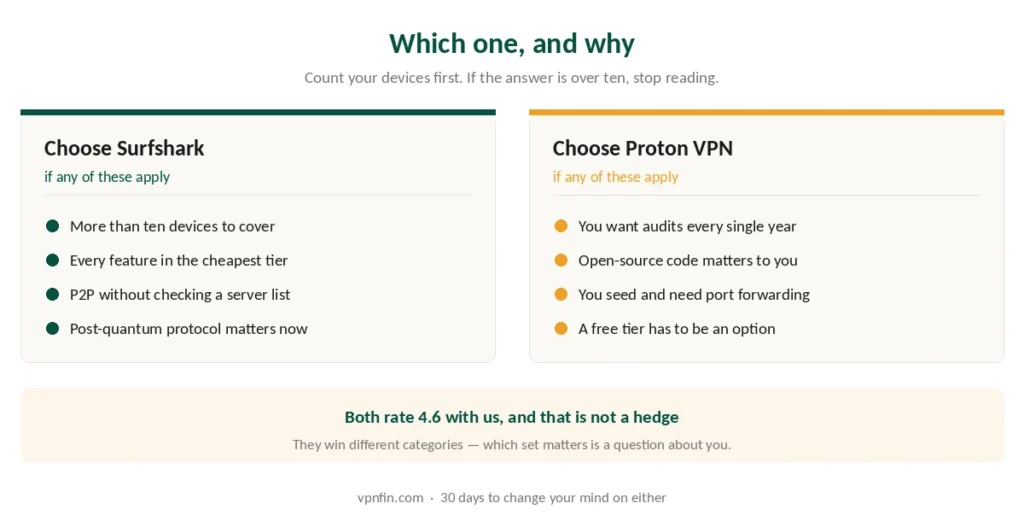
More than ten devices. No argument reaches this one. Proton has no path past its limit, and unlimited connections is the reason Surfshark exists in most shortlists.
You want every feature in the entry tier. Surfshark’s cheapest plan is the whole VPN. Proton reserves Secure Core, NetShield and streaming servers for paid tiers, which is normal — but Surfshark simply has no gated VPN feature.
Post-quantum protocol matters to you now. Dausos ships with hybrid key exchange today and has been audited by Cure53. By comparison, Proton has not matched it.
How We Research
This comparison draws on our full reviews of both providers, the published Securitum and Deloitte reports plus Surfshark’s own trust-centre listings, Cure53’s Dausos audit, speed results from named independent testers including CNET, TechRadar and Security.org, and renewal figures from each provider’s published terms — cross-checked and verified at publication. We don’t run our own speed tests. Where sources conflicted, notably on Surfshark’s renewal figure, we give the range and name the most consistently reported number. Our full approach lives on the About Us page.
Surfshark vs Proton VPN FAQ
Proton VPN, on the only test that measured both in the same round. CNET recorded a 21% average download loss for Surfshark against 16% for Proton. Other labs put Surfshark above 950 Mbps on WireGuard, which is fast enough for anything most people do — the two measurements simply capture different things.
It depends entirely on your household. Ten covers a single user or a couple without strain, and Proton offers no add-on that raises it. Surfshark allows unlimited connections on every tier with no cap written into the terms, which makes it the obvious pick for families and shared households.
Almost. Surfshark Starter renews at roughly $79 a year and Proton VPN Plus at about $83.88 — a gap of $4.88 annually. Intro pricing differs more, at around $2.49 against $2.99 a month, but the difference stops mattering once the promotional term ends.
It depends on the audit type. Proton VPN has five consecutive annual no-logs audits by Securitum, from 2022 through 2026. Surfshark has two no-logs reports by Deloitte, plus security audits of its infrastructure, browser extensions and Dausos protocol by Cure53 and SecuRing. Both publish full reports.
For most people, no. Surfshark merged with NordVPN under Nord Security in 2022, but the brands run separate infrastructure and commission separate audits. It matters if you are comparing the two as independent options, since they are siblings rather than rivals. Proton AG has no such arrangement.
Yes, with a difference that matters if you seed. Surfshark allows P2P across its entire network, so there is no server list to check. Proton restricts P2P to designated servers but includes port forwarding at no extra cost, which Surfshark does not offer at any price.
The Verdict
Proton VPN takes it on the merits, and the margin is narrow. Five consecutive no-logs audits against two, open-source apps, port forwarding, a free tier that costs nothing, corporate independence, and the faster result in the only test that measured both together.
Surfshark takes it on the one thing that decides most purchases. Unlimited devices is not a feature comparison, it is a household comparison, and no amount of audit cadence covers an eleventh device.
Both rate 4.6 with us, which is not a hedge — they win different categories, and which set matters is a question about you rather than about them. Against NordVPN, Proton makes a different case built on the same audit record.