
Disclosure: VPNFin is reader-supported. If you buy a VPN through links on this page, we may earn a commission at no extra cost to you. This never affects our ratings — here’s how we research.
In 2017 PureVPN handed connection records to the FBI in a cyberstalking investigation, while its marketing said it kept no logs. That is the single worst thing any provider in our top five has done.
What happened next is the part worth your attention. PureVPN moved its corporate base from Hong Kong to the British Virgin Islands, rebuilt its logging architecture, and in 2023 signed a standing agreement letting KPMG inspect its production servers without notice, at any time. Every other major VPN, Proton VPN included, books its audits in advance.
Proton VPN has never been caught doing anything. It also has five annual no-logs audits, each published as a file you can download. So this PureVPN vs Proton VPN comparison asks an awkward question: does the strictest verification in the category outweigh being the reason it exists?
The Short Answer
Proton VPN wins, and not narrowly. Five published audits, open-source apps, ten devices, port forwarding at no charge, a free tier, and no incident on its record.
PureVPN wins on price and on audit design. Roughly $92 cheaper across four years, and its unannounced KPMG inspections test the system under real conditions rather than curated ones.
Head to Head
| PureVPN | Proton VPN | |
|---|---|---|
| Logging incident | 2017, FBI | None on record |
| Audit type | Always-on, unannounced | Annual, scheduled |
| Audits completed | 4 by KPMG | 5 by Securitum |
| Reports published? | On the blog, page unreliable | Yes, dated files |
| App code | Closed | Open source |
| Jurisdiction | British Virgin Islands | Switzerland, moving |
| Devices | 10 | 10 |
| Port forwarding | $0.99/mo add-on | Included |
| Free plan | No | Yes, no data cap |
| Renewal | $47.95/yr Standard | ~$83.88/yr |
| Our rating | 4.1 | 4.6 |
What Actually Happened in 2017
A cyberstalking case in Massachusetts. Investigators traced activity to a PureVPN account, and the company supplied connection records that helped identify the user. Its website at the time promised no logs.
The records were metadata rather than browsing history — connection timestamps and originating addresses. However, that distinction matters less than it sounds. Connection metadata is exactly what identifies a person, and it is exactly what a no-logs policy is supposed to make impossible to produce.
The response was structural, not cosmetic. PureVPN relocated to the British Virgin Islands, which has no data-retention requirement, rewrote its privacy policy, and rebuilt the infrastructure so those records are no longer created. Four KPMG assessments since have confirmed no timestamps, originating addresses, browsing activity or session durations are stored.
⚠️ No further incident has been reported in nine years. Whether that outweighs the original failure is a judgement about you rather than about the evidence, and our full PureVPN review sets out both sides in detail.
The Always-On Audit, and Why It Is Undersold
Here PureVPN does something nobody else in this category does.
Most audits are appointments. A firm agrees a date, the provider knows it is coming, and the inspection happens under conditions everyone has had time to prepare. Proton VPN’s five Securitum engagements work this way, as do NordVPN’s six by Deloitte.
PureVPN’s arrangement with KPMG allows surprise inspections of production servers and configuration databases, at any hour, without advance warning. That has been standing since 2023.
Structurally, this is a stronger test. A scheduled audit shows the system in a prepared state; an unannounced one shows it as it runs. Proton’s audits do check for automated alerts if logging is switched on, which addresses part of the same concern, though not by the same route.
⚠️ The weakness is documentation, and it is a real one. One reviewer in June 2026 reported that PureVPN’s dedicated audit page returned a 404, leaving a blog post and a press release as the record. Meanwhile, every Proton report is a dated file that opens without an account. The strongest audit arrangement in the market is also the hardest to check for yourself.
Winner: PureVPN on audit design, Proton VPN on audit evidence.
Price: The Widest Gap in This Series
PureVPN’s two-year plan runs about $2.11 to $2.15 a month, billed upfront at roughly $52. Proton VPN Plus runs $2.99, billed at $71.76 for 24 months.
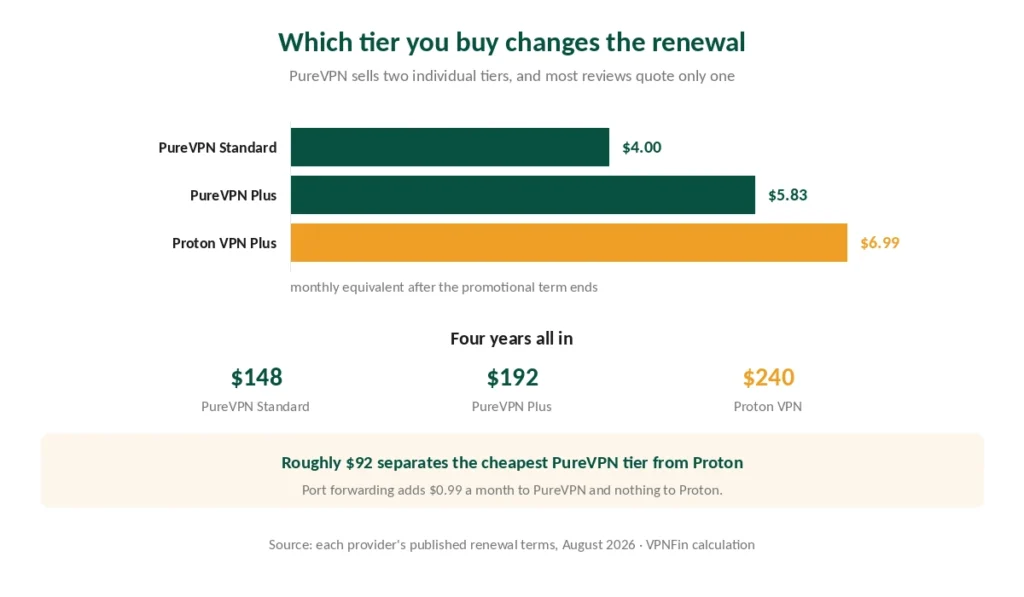
Renewal depends on which tier you bought, and reviews rarely say so. Standard converts to $47.95 a year, about $4.00 monthly. Plus converts to $69.95. Proton VPN Plus converts to about $83.88, or $6.99 monthly.
Across four years that comes to roughly $148 for PureVPN Standard against $240 for Proton — a gap near $92, or $1.92 a month. Notably, that makes PureVPN the cheapest option in our cheap VPN guide, with CyberGhost within a few dollars.
⚠️ Two costs the headline rate hides. Port forwarding is a $0.99 monthly add-on rather than an included feature, despite what several reviews say, and extra device slots beyond ten cost more again. Proton includes port forwarding and gives you the same ten devices.
Winner: PureVPN, by the largest margin of any comparison we have run against Proton.
Features, Speed and Streaming
Both allow ten simultaneous connections. PureVPN sells additional slots in blocks of ten; Proton has no such option.
PureVPN’s network runs 6,000 to 6,500 servers across 80-plus countries, with multi-hop across 40-plus country pairs, which our multi-hop guide explains. Proton runs 20,000-plus servers across 140-plus countries and routes through Secure Core.
Speed is where PureVPN gets criticised consistently. Reviewers report noticeable variance between sessions and between servers, with manual selection improving results — whereas Proton’s results scatter between labs rather than between connections. Neither is the fastest option available.
Streaming favours Proton slightly. Independent testing places PureVPN in the middle tier: Netflix across five regions, Hulu and BBC iPlayer consistently, Disney+ on seven of eight attempts. Proton handles ten or more Netflix regions on paid plans. Access shifts monthly for everyone, as our streaming guide explains.
Two PureVPN gaps worth knowing: no split tunnelling in the macOS app, and obfuscation that reviewers describe as inconsistent on restrictive networks. Proton’s Stealth protocol handles that case more reliably.
And the free tier is Proton’s alone. Proton VPN Free carries no data cap, no ads and the same no-logs policy as paid, limited to one device and ten countries the app assigns. PureVPN has nothing equivalent, so our free VPN guide covers why that matters.
Winners by Category
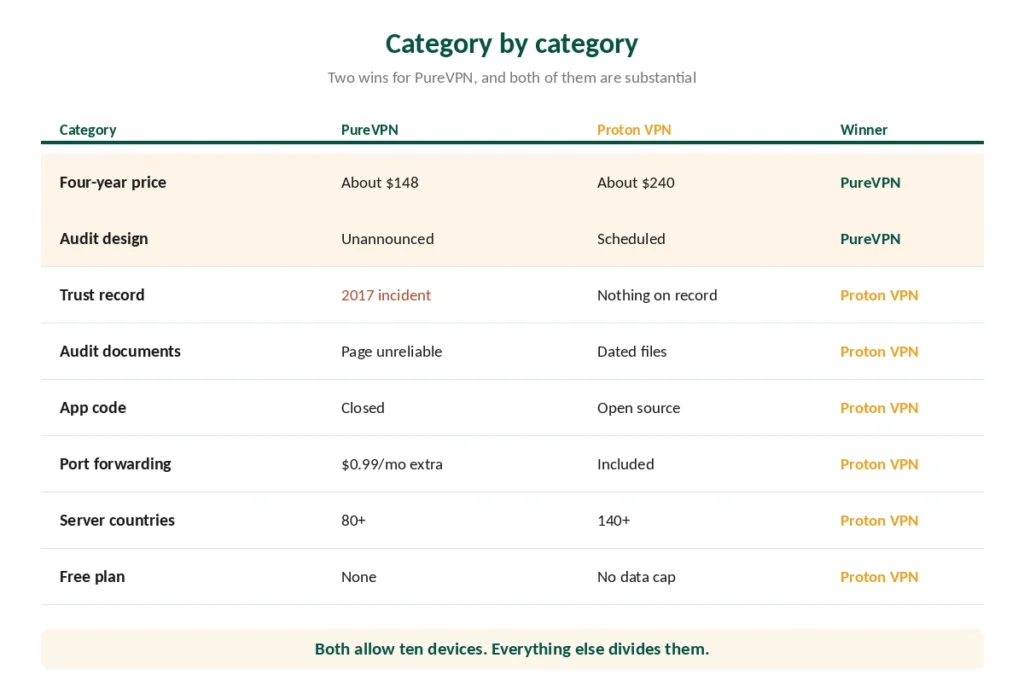
| Category | Winner |
|---|---|
| Four-year price | PureVPN |
| Audit design | PureVPN |
| Trust record | Proton VPN |
| Audit documentation | Proton VPN |
| Open-source apps | Proton VPN |
| Port forwarding | Proton VPN |
| Server countries | Proton VPN |
| Streaming | Proton VPN |
| Free tier | Proton VPN |
| Devices | Tie — 10 each |
When to Choose PureVPN Instead
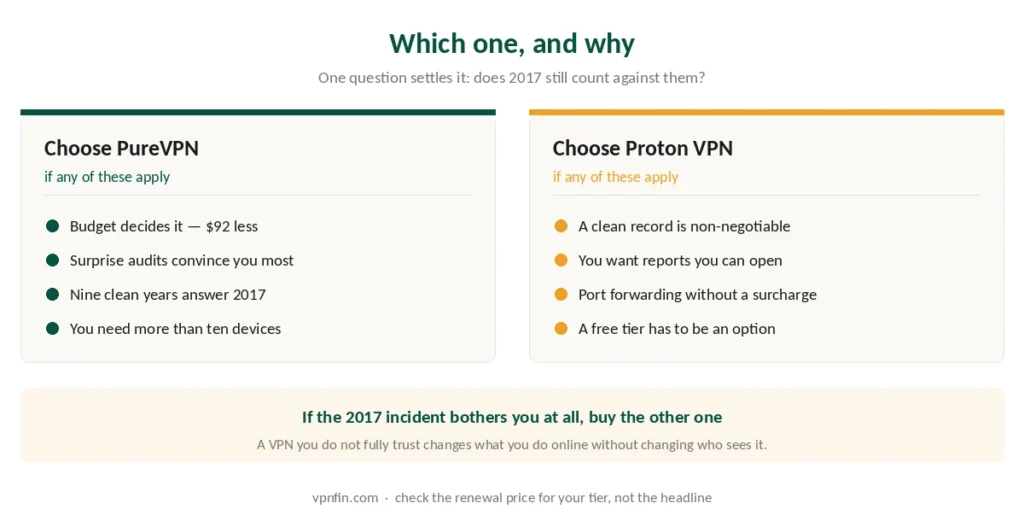
Budget decides it. Ninety-two dollars over four years buys a lot, and PureVPN is genuinely audited at that price rather than unaudited and cheap.
Unannounced inspection convinces you more than published reports. That is a defensible position, and no other provider we cover offers this arrangement.
You accept that nine clean years answer the 2017 failure. Plenty of reasonable people do, and plenty do not.
⚠️ If the incident bothers you at all, buy the other one. A VPN you do not fully trust is worse than no VPN, because it changes what you are willing to do online without changing who can see it.
How We Research
This comparison draws on our full reviews of both providers, contemporaneous reporting on the 2017 case, the published KPMG assessments and PureVPN’s own description of its always-on arrangement, the published Securitum reports for Proton, and renewal figures from each provider’s checkout terms — cross-checked and verified at publication. We don’t run our own speed tests. Where sources conflicted, above all on PureVPN’s renewal price and whether port forwarding is included, we name the tier and the add-on cost rather than quoting whichever figure reads better. Our full approach lives on the About Us page.
PureVPN vs Proton VPN FAQ
No further incident has been reported in nine years, and four KPMG assessments confirm no connection records are stored now. The company also moved to the British Virgin Islands and rebuilt its logging architecture. Whether that answers the original failure is a personal judgement rather than a factual question.
It is a standing arrangement, held by PureVPN since 2023, that lets KPMG inspect production servers and configuration databases without advance notice. Most providers, Proton VPN included, schedule audits in advance, which gives them time to prepare. Unannounced inspection tests the system as it actually runs.
PureVPN, by roughly $92. Its Standard tier renews at $47.95 a year against Proton VPN Plus at about $83.88, putting four-year totals near $148 and $240. Note that PureVPN’s Plus tier renews at $69.95 instead, so check which one you are buying.
No, despite several reviews saying otherwise. PureVPN sells it as an add-on at roughly $0.99 a month, with additional ports costing more. Proton VPN includes port forwarding in the base subscription at no extra charge, which matters if you seed on private trackers.
Both allow ten simultaneous connections on their standard individual plans. PureVPN sells extra slots in blocks of ten if you need more, up to fifty or beyond. Proton VPN offers no equivalent add-on, so ten is a hard ceiling there.
The Verdict
Proton VPN takes it clearly. Five published audits, open-source apps everywhere, port forwarding included, a free tier that never expires, wider server coverage, and no incident to explain.
PureVPN’s case rests on two real things. It costs about $92 less across four years, and its unannounced KPMG inspections are a structurally harder test than anything Proton submits to. Both of those are true, and neither is marketing.
The awkward part is that the strictest audit in the category belongs to the provider that needed one. Whether that reads as rehabilitation or as a warning is the actual decision here. Against NordVPN and against Surfshark, Proton faces cleaner opposition and still wins on the same grounds.