
Disclosure: VPNFin is reader-supported. If you buy a VPN through links on this page, we may earn a commission at no extra cost to you. This never affects our ratings — here’s our full disclosure.
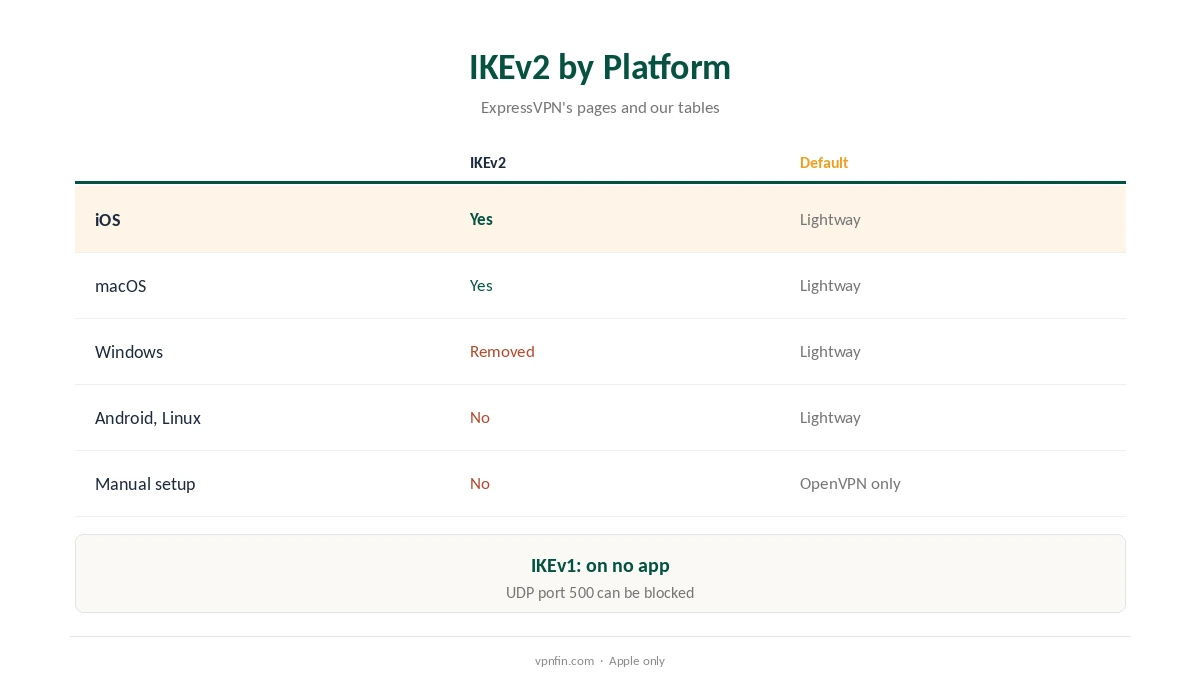
IKEv2 ExpressVPN support is limited to Apple devices. ExpressVPN’s own protocol pages say IKEv2 is available in its Mac and iOS apps, and IKEv1 in none. Its Windows app dropped IKEv2, and its Android and Linux apps never offered it. ExpressVPN’s manual setups use OpenVPN only, so you cannot point Windows’ or Android’s built-in IKEv2 client at its servers. Lightway is the default everywhere.
This guide covers where IKEv2 works, how to switch, when to choose it, its limits and the alternatives.
Where It Works
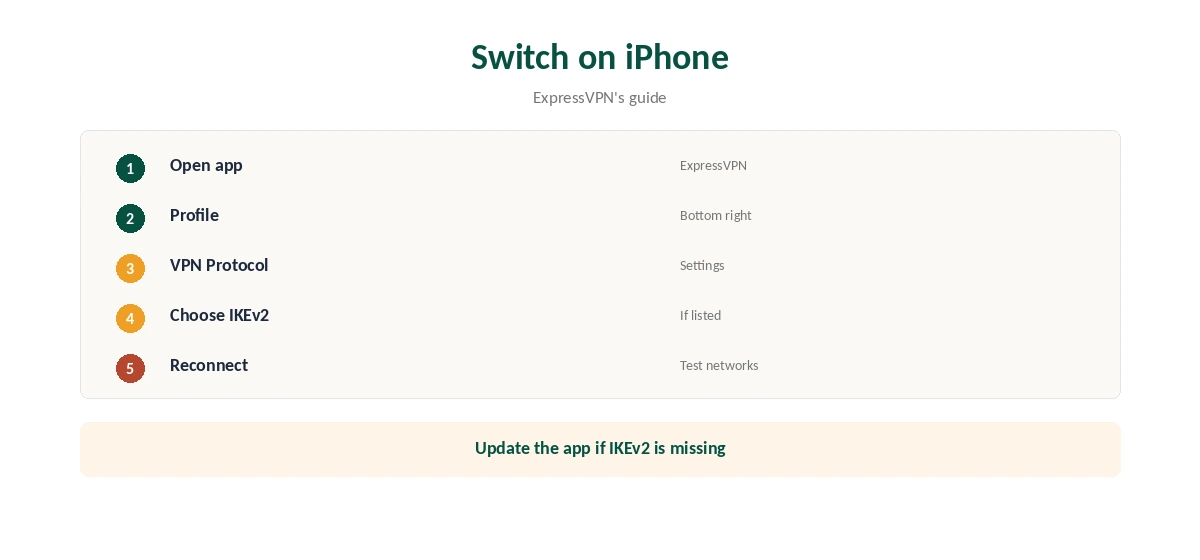
ExpressVPN lists IKEv2 in its Mac and iOS apps, where it appears among the protocols in settings. On iPhone, you find it under Profile, then VPN Protocol, ExpressVPN’s guide shows. The Mac app lists it in the same protocol menu as Lightway.
The Windows app no longer includes IKEv2, our tables record, and the Android and Linux apps offer Lightway plus OpenVPN or WireGuard instead.
No Manual Setup, and Switching in the App
Some providers let you configure this protocol in a device’s built-in VPN settings with their credentials. ExpressVPN’s manual setups are OpenVPN only, so Windows’ or Android’s native IKEv2 client cannot connect to its servers, whatever guides for other providers suggest.
For routers and other devices without apps, use ExpressVPN’s OpenVPN files, or its router app on supported models. Our ExpressVPN OpenVPN guide covers them.
On iPhone, open the ExpressVPN app, tap Profile, then VPN Protocol, and select IKEv2. On a Mac, choose the protocol in the app’s settings.
If IKEv2 does not appear, ExpressVPN notes it only shows when available to you, so update the app first and check again after a restart.
When IKEv2 ExpressVPN Makes Sense, and Its Limits
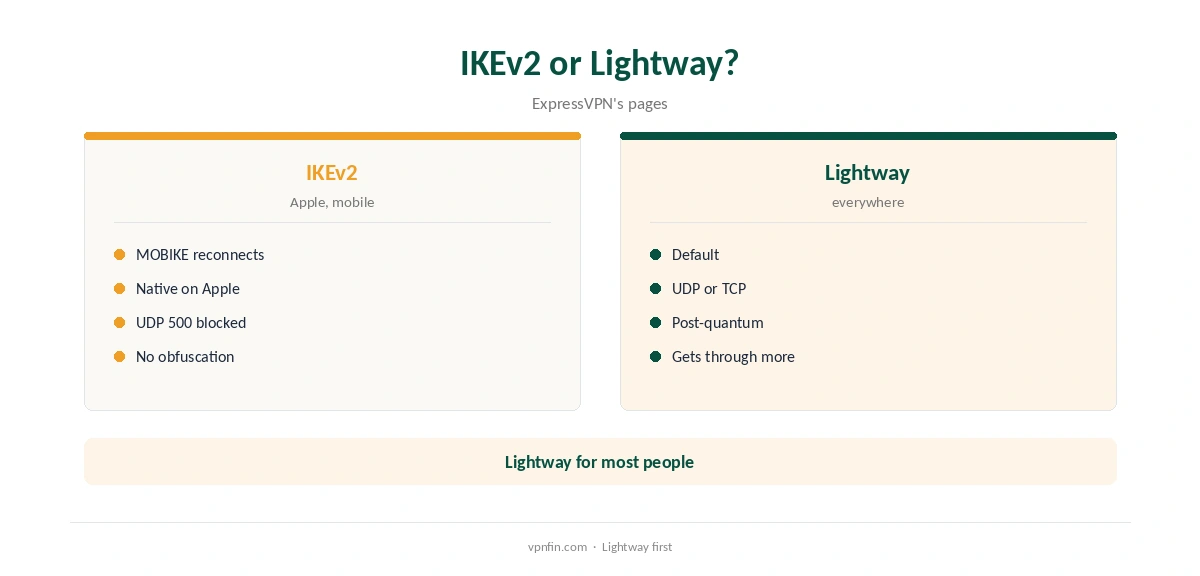
IKEv2 supports MOBIKE, which keeps a connection alive when your phone switches between Wi-Fi and mobile data, ExpressVPN explains, and NAT traversal helps it through home routers. That makes it a solid choice on iPhones and iPads that move between networks during the day.
It is also handled natively by Apple’s operating systems, which can mean steady battery use. If your iPhone drops the VPN when you leave home, IKEv2 is worth a try.
How IKEv2 Works
IKEv2 handles the key exchange that sets up an encrypted IPsec tunnel. ExpressVPN’s guide notes it supports strong ciphers such as AES and ChaCha20, NAT traversal for getting through routers, and MOBIKE for keeping the tunnel up when your address changes.
IKEv2 replaced the older IKEv1, which ExpressVPN does not offer on any of its apps today.
Troubleshooting and Checking Your Protocol
If IKEv2 will not connect, the network may be blocking UDP port 500; switch to Lightway, which can run over TCP. If IKEv2 is missing from the protocol list, update the app.
Reinstalling the app resets its VPN configuration as a last step, and ExpressVPN’s live chat can check your account.
IKEv2 uses UDP port 500, which firewalls and network administrators can block, ExpressVPN warns. On hotel, office or school networks, it may fail where Lightway over TCP gets through.
It also offers no obfuscation, so it is easy to identify as VPN traffic, and censored networks block it quickly.
Lightway and WireGuard Instead, and Price
Lightway, the company’s own protocol, is the default on every app, with post-quantum key exchange, and runs over UDP or TCP. WireGuard arrived on Windows, iOS and Android in August 2025, giving those apps a second fast option.
For most people, Lightway is the better everyday choice on every device; keep IKEv2 for iPhones where it behaves better on your networks. Our Lightway vs WireGuard guide compares them.
The app shows the active protocol in its settings. If you switched to IKEv2 for a trip, switch back to Lightway, or set the protocol to automatic, once you are on a normal network again.
Network Lock, ExpressVPN’s kill switch, protects you whichever protocol you choose, including IKEv2.
ExpressVPN’s Basic plan renews at $99.95 a year for 10 devices, our tables record, with a 30-day refund for new users. It lists 27 independent audits by May 2026.
Our IKEv2 vs WireGuard guide explains the protocol differences in general.
IKEv2 or OpenVPN?
OpenVPN is ExpressVPN’s only manual protocol, for routers and devices without apps, while IKEv2 lives inside the Apple apps. On a Mac or iPhone, there is no reason to set up OpenVPN by hand when the app already offers Lightway and IKEv2 with Network Lock.
ExpressVPN retired older certificates on 31 March 2026, Tom’s Guide reported, so old manual OpenVPN files may need replacing.
Privacy
ExpressVPN lists 27 independent audits by May 2026, including three KPMG no-logs reports, and runs servers from memory under its TrustedServer design. Kape owns it, along with CyberGhost and PIA. Our guide to ExpressVPN for Spotify covers travel rules, privacy and what to avoid.
Protocol choice does not change the no-logs policy; it changes how the tunnel behaves on your particular network.
How We Research
This page draws on ExpressVPN’s IKEv2 protocol pages and blog guide, its IKEv2 vs IKEv1 page and our ExpressVPN tables. We cross-checked these sources against each other, and where they conflict or something can’t be verified, we say so in the text rather than guessing. We checked time-sensitive figures, including prices in US dollars, on 8 October 2026. The main source we relied on is ExpressVPN’s IKEv2 page. Our full approach lives on the About Us page.
IKEv2 ExpressVPN FAQ
The Mac and iOS apps.
No; the Windows app dropped it.
No; its manual setups use OpenVPN only.
Rarely; Lightway is the default and handles blocked networks better.
No, on no app.
The Verdict
IKEv2 ExpressVPN support exists only on Mac and iOS. Use it on iPhones that switch networks often, and Lightway everywhere else.