
Disclosure: VPNFin is reader-supported. If you buy a VPN through links on this page, we may earn a commission at no extra cost to you. This never affects our ratings — here’s our full disclosure.
IKEv2 vs WireGuard comes down to one question: do you switch networks a lot? WireGuard is faster and far simpler. IKEv2 has a feature built for moving between Wi-Fi and mobile data, called MOBIKE. Windscribe, which runs both, sums it up the same way: IKEv2 for phones that hop networks, WireGuard for everything else. Our guide to Windscribe IKEv2 covers where IKEv2 runs in the apps, and manual profiles.
Speed: WireGuard Leads
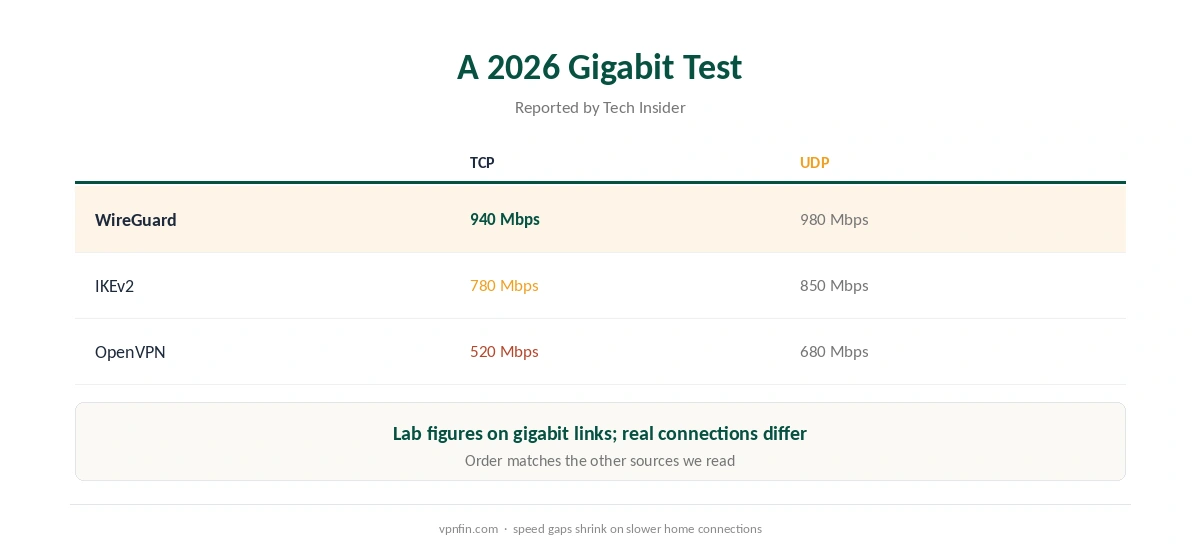
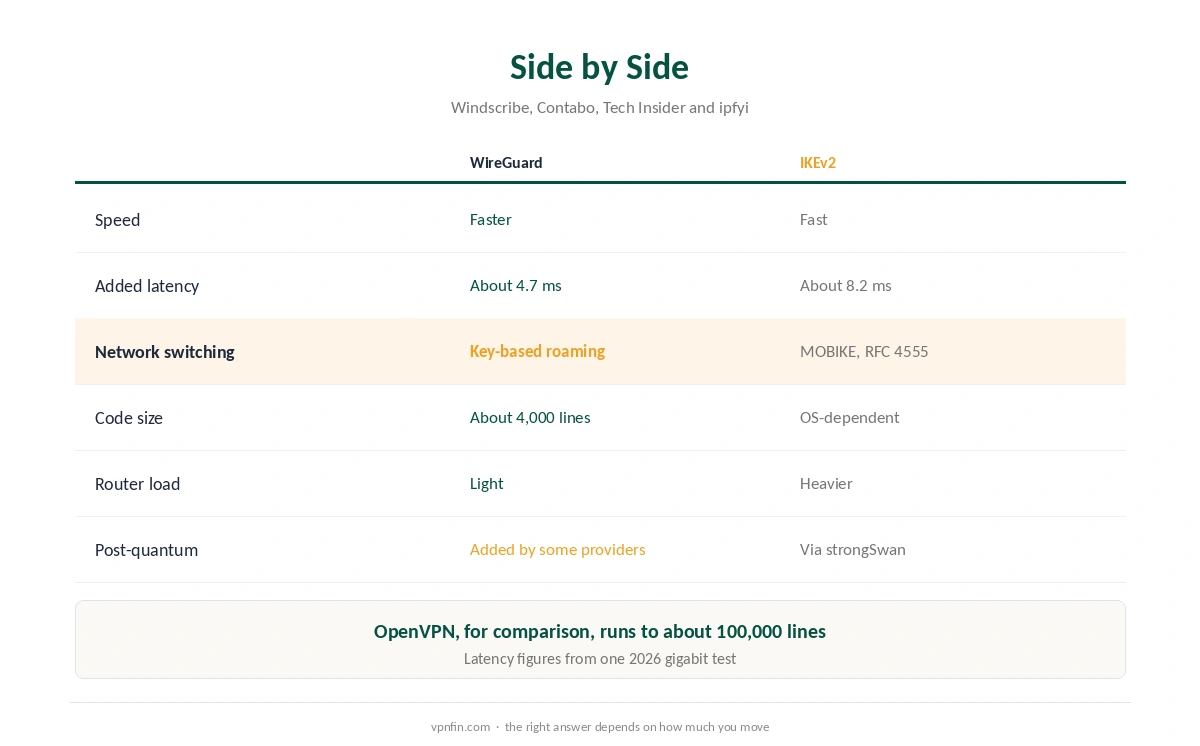
A 2026 test on gigabit links, reported by Tech Insider, measured WireGuard at 940 Mbps over TCP and 980 over UDP. IKEv2 reached 780 and 850, and OpenVPN 520 and 680. WireGuard also added about 4.7 ms of latency against roughly 8.2 ms for IKEv2.
Those are lab figures, and your own connection will differ. Still, the order is consistent across the sources we read. Our Mullvad review covers a provider that now runs WireGuard alone.
Network Switching: IKEv2 vs WireGuard on Phones
IKEv2’s MOBIKE extension, defined in RFC 4555, lets a connection survive a network change without rebuilding the tunnel. Walk out of Wi-Fi range onto mobile data, and the session carries on. WireGuard handles roaming too, through its key-based design, but without a formal standard for it.
Contabo’s comparison makes the same point: WireGuard copes with IP changes, while MOBIKE gives more robust session persistence during rapid switches. If your phone keeps dropping the VPN on the move, IKEv2 is worth a test. Our VPN drop guide covers other causes, and our iPhone VPN guide lists iOS settings that cause drops.
Code Size and Security
WireGuard’s codebase is about 4,000 lines, according to Windscribe, Contabo and ipfyi. OpenVPN runs to roughly 100,000, and IKEv2 depends on the operating system’s implementation. Less code usually means fewer places for bugs to hide, and it makes audits easier.
On post-quantum protection, Tech Insider notes that IKEv2 through strongSwan already supports post-quantum key exchange. Several providers have added it to WireGuard as well. Our post-quantum VPN guide explains why it matters.
Routers and Older Hardware
IKEv2 is heavier on resources. Contabo notes that a router running WireGuard comfortably may struggle with IKEv2 under load. For a VPN on the router, that points to WireGuard, as our router setup guide explains.
Which Apps Offer Each
Support differs by provider and platform. ExpressVPN keeps IKEv2 on iOS only, as our ExpressVPN iPhone guide notes, while CyberGhost offers it on Windows, Mac and iPhone; both belong to Kape Technologies. PureVPN offers both on iPhone and Mac. Mullvad switched off OpenVPN in January 2026 and runs WireGuard alone, according to Tech Insider. Our page on PureVPN IKEv2 covers where the protocol works and the manual Windows setup.
Our CyberGhost iPhone guide and PureVPN iPhone guide show the protocol menus. On a Mac, our PureVPN Mac guide covers the extension that unlocks WireGuard. Check your own app’s settings, since lists change with updates.
IKEv2 vs WireGuard: Which to Choose
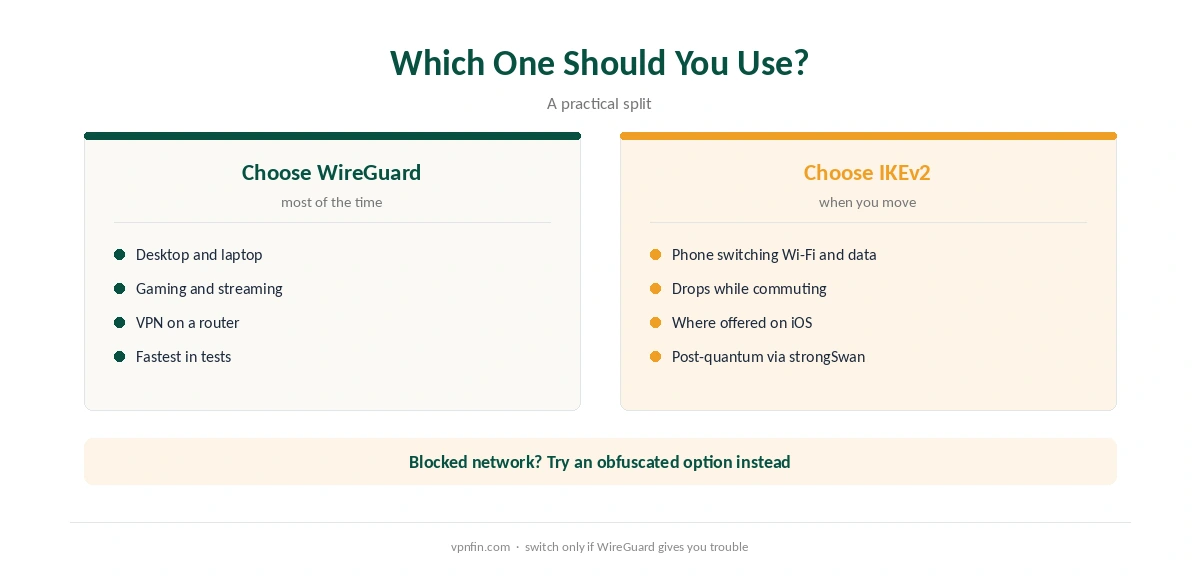
Choose WireGuard for speed, gaming, streaming, routers and desktop use. Our gaming VPN guide covers the latency side. Choose IKEv2 on a phone that moves between networks all day. If a network blocks both, an obfuscated option helps, as our obfuscation guide explains. NordVPN’s NordLynx, covered in our NordVPN review, is built on WireGuard.
Which Providers Offer Which
Most major providers now default to WireGuard or their own variant of it. IKEv2 survives in some apps and in manual setups. NordVPN, for example, keeps IKEv2 for manual configurations, as our NordVPN IKEv2 guide explains, while its apps use NordLynx. Our page on FastestVPN IKEv2 covers the protocol in the apps and manual macOS setups.
Routers
Contabo notes that IKEv2 is heavier on processors. A router that handles WireGuard comfortably may struggle with IKEv2 under load. For a whole-home setup, WireGuard is the safer choice where the router supports it.
Battery Life on Phones
Windscribe suggests IKEv2 for phones that switch often between Wi-Fi and mobile data, and WireGuard for everything else. IKEv2’s MOBIKE extension keeps the session alive during those switches. WireGuard handles roaming through its keys instead, without a formal standard. Our guide to Mullvad and IKEv2 covers why there is no IKEv2, and what WireGuard covers instead.
Testing on Your Own Network
Benchmarks set a ceiling, not a promise. Test both protocols on your own connection, at the same time of day, on the same server. Our WireGuard vs OpenVPN page covers the third option. Our IPVanish IKEv2 page goes into where it works and when to use it.
Security Considerations
Tech Insider notes that IKEv2 through strongSwan already supports post-quantum key exchange. WireGuard’s small codebase, about 4,000 lines according to Windscribe and others, makes it easier to audit. Both are considered secure when implemented well. Our guide to ExpressVPN and IKEv2 covers only on Mac and iOS.
The bigger risk is the provider’s setup and logging policy, not the protocol. Our post-quantum VPN guide explains the quantum threat, and our audit tracker covers provider records. Pick the protocol for the device and network, then review the choice if your habits change.
How We Research
This page draws on protocol comparisons from Windscribe, Contabo, Tech Insider and ipfyi, plus the provider support pages behind our device guides. We cross-checked these sources against each other, and where they conflict or something can’t be verified, we say so in the text rather than guessing. We read every source on 5 October 2026. The main source we relied on is RFC 4555, the MOBIKE standard. Our full approach lives on the About Us page.
IKEv2 vs WireGuard FAQ
In a 2026 gigabit test reported by Tech Insider, yes: 980 Mbps over UDP against 850 for IKEv2, with lower added latency.
For switching networks, often yes. Its MOBIKE extension keeps the session alive when you move between Wi-Fi and mobile data.
Both are secure for everyday use. WireGuard’s small codebase is easier to audit; IKEv2 via strongSwan already supports post-quantum key exchange.
WireGuard. IKEv2 needs more resources, and a router may struggle with it under load.
Yes. NordLynx, NordVPN’s default protocol, is built on WireGuard.
The Verdict
WireGuard wins on speed, simplicity and router load. IKEv2 wins when a phone keeps switching networks. Most people should leave WireGuard on and try IKEv2 only if mobile drops become a problem. Our page on Surfshark IKEv2 covers the app setting, the manual setup and the features it cannot run.