
Disclosure: VPNFin is reader-supported. If you buy a VPN through links on this page, we may earn a commission at no extra cost to you. This never affects our ratings — here’s how we research.
In 2016 the industry standard for proving a no-logs claim was writing it on the website. TunnelBear hired Cure53, published the result including two critical findings, and repeated the exercise every year since. Nobody had done that before.
ExpressVPN’s trust center now lists 28 independent audit reports, by PwC Switzerland, KPMG, Cure53, F-Secure and Praetorian — the deepest published record in the category, and a direct descendant of the practice TunnelBear started.
So this is the inventor against the one who scaled it. We rate them 4.0 and 4.5, and the gap comes less from the audits than from everything around them.
The Short Answer
ExpressVPN wins, at 4.5 against 4.0. Twenty-eight audits, a server seized by police that produced nothing, 113 countries against 47, streaming that works, and thirty days to change your mind.
TunnelBear costs $107 less across four years, allows unlimited devices, and has the longer unbroken audit run.
Test TunnelBear free before paying, because it has no refund window at all.
Head to Head
| ExpressVPN | TunnelBear | |
|---|---|---|
| Audits listed | 28, with dates | Annual since 2017 |
| First public VPN audit | No | Yes, 2016 |
| Tested by seizure | Turkey, 2017 | Not on record |
| Refund window | 30 days | None — case by case |
| Free tier | None | 2 GB a month, no card |
| Devices | 10 on Basic | Unlimited |
| Countries | 113 | ~47 |
| Streaming | 20+ Netflix regions | Netflix usually fails |
| Server storage | RAM-only | Not stated |
| Post-quantum | Default since Jan 2026 | No |
| Jurisdiction | British Virgin Islands | Canada, US parent |
| Four years | ~$267 | ~$160 |
| Our rating | 4.5 | 4.0 |
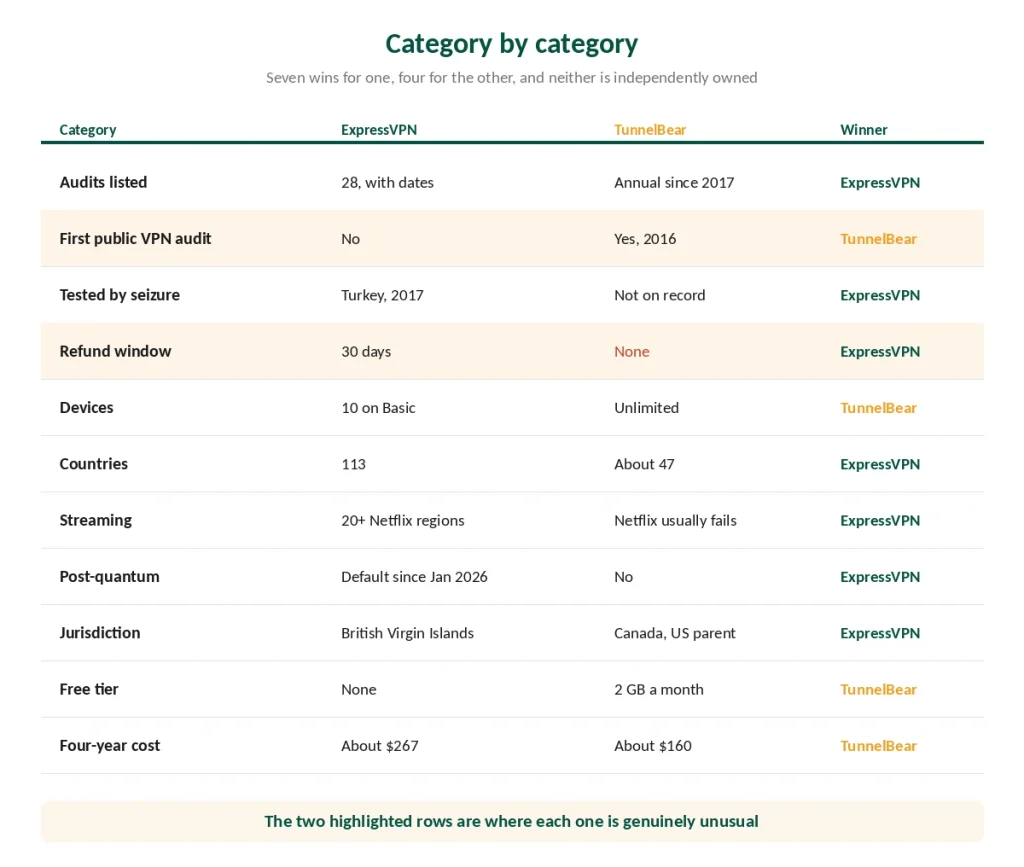
Two Audit Records, Counted Differently
Worth separating, because the numbers measure different things.
TunnelBear has the longer unbroken run and the earlier start. Cure53 did the work in 2016, the report appeared in 2017 with two critical issues and five high-severity findings published intact, and it has repeated annually since — the eighth by 2024. Cure53 raised 32 issues in 2022 and 13 in 2023, of which two were high-risk and none critical.
ExpressVPN has the deeper record. Its trust center lists 28 reports with dates and named auditors, running from a Cure53 browser-extension review in November 2018 through five separate Cure53 audits between March and May 2026. The most recent privacy assessment is the third KPMG engagement, published June 2025, examining TrustedServer as of 28 February 2025.
⚠️ Both publish, which is what matters most. Neither hides findings behind a login, unlike NordVPN’s six reports, which go to account holders.
The difference is scope. TunnelBear’s audits cover apps, servers and backend annually. ExpressVPN’s cover the protocol, servers, apps, extensions and specific systems, more often and by more firms.
Winner: ExpressVPN on depth, TunnelBear on having started it.
The Test Nobody Scheduled
Turkish investigators seized an ExpressVPN server in 2017 during the inquiry into the assassination of the Russian ambassador. They examined the hardware and recovered nothing usable, because TrustedServer runs from RAM and holds no persistent data.
That is stronger evidence than any audit, for the reason a scheduled inspection cannot match: a seizure does not give notice.
TunnelBear has no such episode, in either direction. No incident, and no test outside the annual cycle.
⚠️ Absence of an incident is worth something, and it is not the same as having been examined under adversarial conditions.
Winner: ExpressVPN.
The Refund Difference
This decides more than the audit comparison does.
ExpressVPN gives thirty days, granted on request. Buy, use the real product for a month, ask for the money back.
TunnelBear considers refunds case by case. No fixed window, no guarantee, which sets it apart from every other provider we cover.
So the free tier is the evaluation period, not a bonus. Two gigabytes a month with no payment card and full server access, which is roughly two hours of HD video. Enough to confirm the apps work on your devices; not enough to test streaming or sustained use.
⚠️ Practical order: run TunnelBear free for a week on the machines you actually use, then treat the subscription as non-refundable. Our free trial guide covers what each provider’s conditions mean.
Winner: ExpressVPN.
Coverage, Streaming and Protocols
One-sided, and worth being specific about.
ExpressVPN operates in 113 countries across roughly 170 locations. TunnelBear covers about 47. ⚠️ ExpressVPN does not publish a server count, which is unusual and which we note rather than filling with an unverifiable figure.
Streaming settles itself. ExpressVPN unblocks 20 or more Netflix regions and ships MediaStreamer for devices that cannot run an app. Published testing reports Netflix failing on most TunnelBear servers, which maintains no streaming-optimised servers and no Smart DNS — our streaming guide covers why access shifts monthly.
Protocols favour ExpressVPN. Lightway was rewritten in Rust in 2025, uses wolfSSL, is open source, and has carried ML-KEM post-quantum protection by default since January 2026. TunnelBear supports WireGuard, OpenVPN and IKEv2 with no post-quantum equivalent — our protocol guide explains why that matters.
Winner: ExpressVPN.
Devices, Ownership and Jurisdiction
TunnelBear allows unlimited simultaneous connections on every paid plan, changed from a previous cap of five that many reviews still quote. ExpressVPN’s Basic tier allows ten, with higher tiers raising it further.
⚠️ That is TunnelBear’s clearest practical advantage, and it comes at $107 less across four years.
Ownership differs in kind. ExpressVPN belongs to Kape Technologies, alongside CyberGhost and Private Internet Access — three brands we cover under one board. TunnelBear was acquired by McAfee in March 2018, a publicly traded US security company; the team stayed in Toronto and the audit programme survived intact.
Jurisdiction favours ExpressVPN. The British Virgin Islands sit outside every intelligence-sharing arrangement with no data-retention law. Canada is a Five Eyes member and TunnelBear’s parent is American.
Winner: TunnelBear on devices, ExpressVPN on jurisdiction, neither on independence.
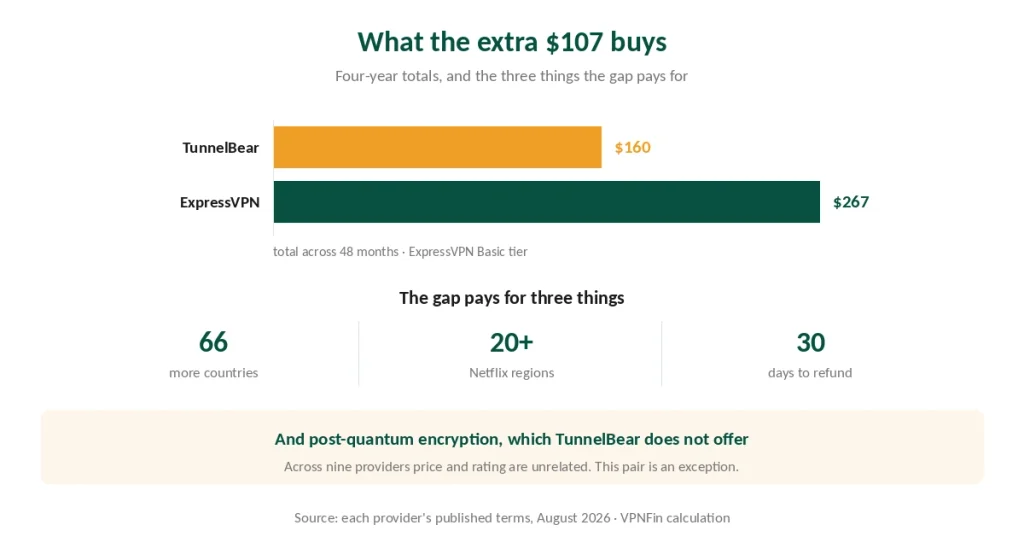
Price: $107 Apart
TunnelBear runs about $3.33 a month on the three-year plan, $4.00 annually and $9.99 month to month. Across four years, roughly $160.
ExpressVPN Basic runs about $3.59 a month on the 28-month plan, then renews at $99.95 a year. Across four years, roughly $267.
⚠️ Note the tier. ExpressVPN sells Basic, Advanced and Pro, and the higher ones renew at $119.95 and $199.95. Most comparisons quote one figure without saying which.
A gap of $107, or about $2.23 a month.
⚠️ What that buys is 66 more countries, working streaming, post-quantum encryption and a refund window. Across nine providers we found price and rating unrelated; this pair is one of the cases where the money does track something.
Winner: TunnelBear on the number, ExpressVPN on what it buys.
Winners by Category
| Category | Winner |
|---|---|
| Audit depth | ExpressVPN |
| Tested by seizure | ExpressVPN |
| Refund window | ExpressVPN |
| Country coverage | ExpressVPN |
| Streaming | ExpressVPN |
| Post-quantum encryption | ExpressVPN |
| Jurisdiction | ExpressVPN |
| First public VPN audit | TunnelBear |
| Audit cadence | TunnelBear |
| Devices | TunnelBear |
| Free tier | TunnelBear |
| Four-year cost | TunnelBear |
| Corporate independence | Neither |
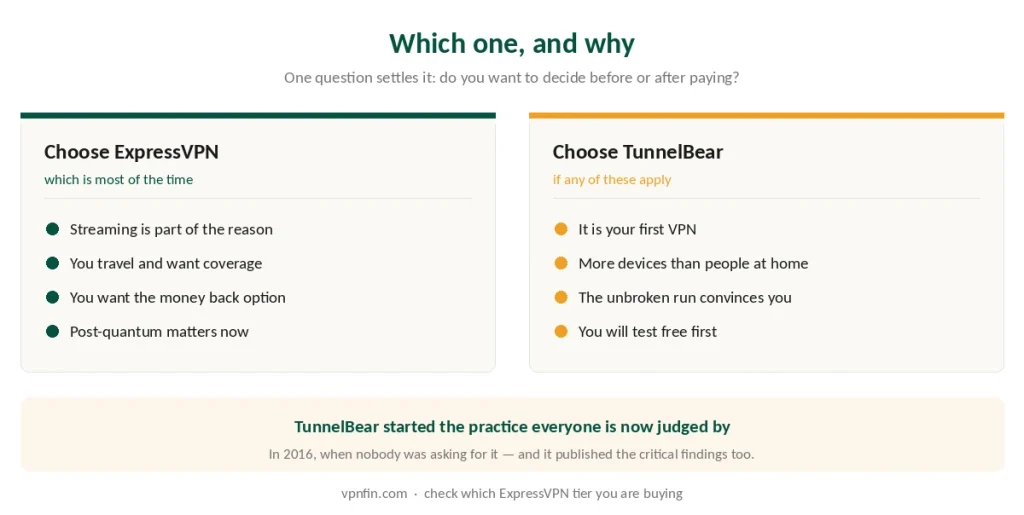
When to Choose TunnelBear Instead
It is your first VPN. The interface is the friendliest in the category by a distance, and for someone who has never used one that outweighs a feature list.
You have more devices than people. Unlimited connections at $107 less is real money for a household.
The unbroken run convinces you more than the count. It has published every year since 2017 without missing one, and it started the practice.
You will test on the free tier first. Two gigabytes with no card tells you whether the apps work before any money changes hands.
⚠️ Do not choose it for streaming, and do not choose it expecting to change your mind afterwards.
How We Research
This comparison draws on both providers’ full reviews on this site, where every figure was verified against named primary sources — ExpressVPN’s own trust center listing of 28 audit reports with dates and auditors, reporting on the 2017 Turkish server seizure, the published Cure53 reports TunnelBear commissions annually, and contemporaneous coverage of the March 2018 McAfee acquisition. We don’t run our own speed tests, and where a provider declines to publish a figure, as ExpressVPN does with its server count, we say so rather than substituting an unverifiable number. Our full approach lives on the About Us page.
ExpressVPN vs TunnelBear FAQ
ExpressVPN, whose trust center lists 28 reports with dates and named auditors — PwC Switzerland, KPMG, Cure53, F-Secure and Praetorian. TunnelBear has the longer unbroken run, publishing annually by Cure53 since 2017, and it commissioned the first public VPN audit anyone had done.
Not through a standard guarantee. TunnelBear considers requests case by case rather than offering a fixed window, which sets it apart from every other provider we cover. ExpressVPN gives thirty days on request, so evaluate TunnelBear on its free tier first.
TunnelBear allows unlimited simultaneous connections on every paid plan, changed from a previous cap of five that many reviews still quote. ExpressVPN’s Basic tier allows ten, with the Advanced and Pro tiers raising it further at higher renewal prices.
TunnelBear, by about $107. It comes to roughly $160 against ExpressVPN’s $267 on the Basic tier. What the gap buys is 66 more countries, working streaming, post-quantum encryption by default, and a refund window.
Usually not. Published testing reports Netflix failing on most TunnelBear servers, and the company maintains no streaming-optimised servers and no Smart DNS. ExpressVPN unblocks 20 or more regions and ships MediaStreamer for devices that cannot run an app.
The Verdict
ExpressVPN takes it, on coverage, streaming, encryption, jurisdiction and the ability to get your money back.
TunnelBear deserves the credit it rarely gets. The practice every provider is now judged by — hire an outside firm, publish what they find, repeat next year — started with a small Canadian company in 2016, when nobody was asking for it.
And its case here is genuine: unlimited devices at $107 less, with the friendliest apps anywhere.
But you have to be right the first time. With ExpressVPN you can decide after a month; with TunnelBear you decide on two gigabytes of evidence and then commit. Against NordVPN it faces the same objection.