
Disclosure: VPNFin is reader-supported. If you buy a VPN through links on this page, we may earn a commission at no extra cost to you. This never affects our ratings — here’s how we research.
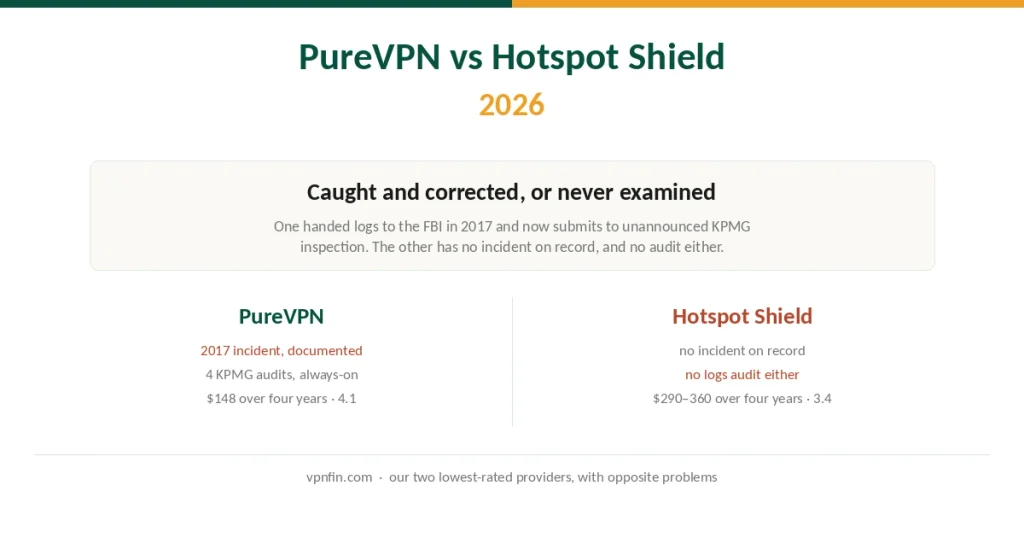
These are the two lowest-rated providers we cover, at 4.1 and 3.4, and their problems are opposite in a way that makes the comparison unusually clear.
PureVPN was caught. In 2017 it handed connection records to the FBI in a criminal case, despite advertising a no-logs policy. That is documented, and it is the worst thing on record about any provider in our rankings.
Hotspot Shield has never been caught, and has never been checked. No independent audit of its no-logs policy exists, and it has published no transparency report since 2019.
One of them responded to being caught by submitting to permanent third-party auditing. The other has not been asked.
The Short Answer
PureVPN wins, at 4.1 against 3.4, and costs roughly half as much across four years.
Its 2017 incident is real and should inform your decision. What followed is also real: an always-on KPMG audit arrangement with unannounced inspections, which is a rare arrangement in this category.
Hotspot Shield’s case is a free tier and 45 days, and it costs about twice as much.
Head to Head
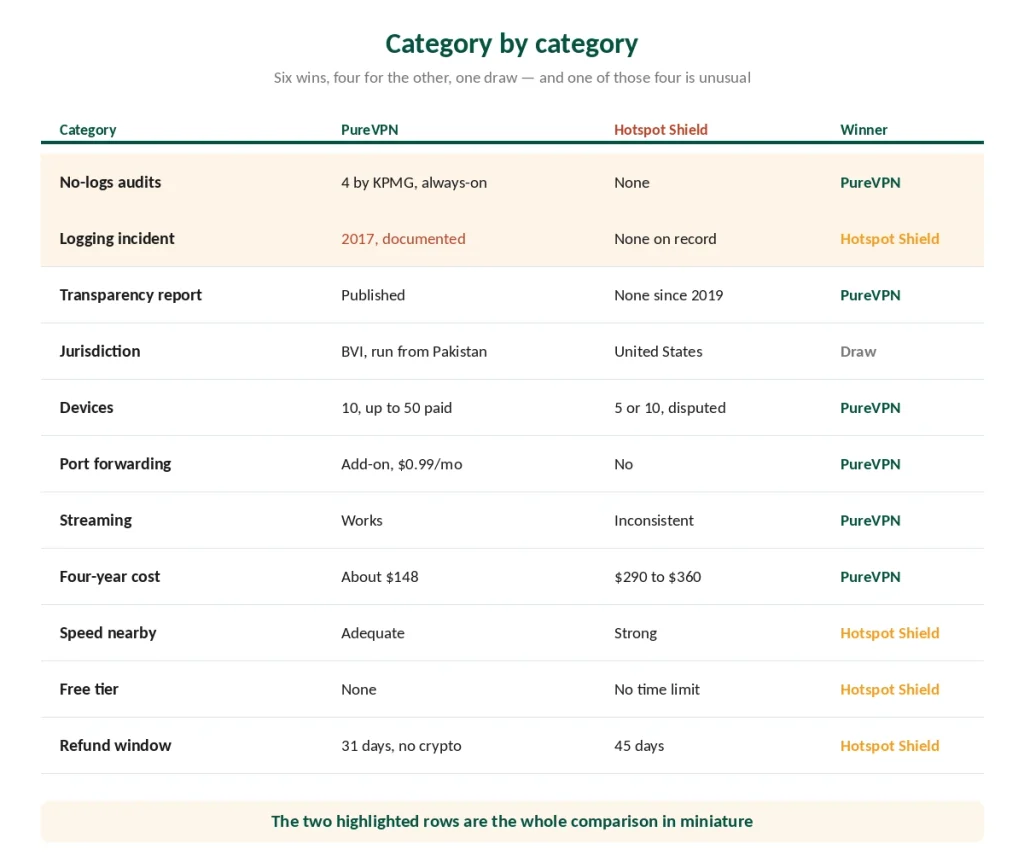
| PureVPN | Hotspot Shield | |
|---|---|---|
| No-logs audit | 4 by KPMG, always-on | None |
| Logging incident | 2017, documented | None on record |
| Transparency report | Published | None since 2019 |
| Devices | 10, expandable to 50 | 5 or 10, disputed |
| Jurisdiction | BVI registered, Pakistan operated | United States |
| Port forwarding | Add-on, $0.99/mo | No |
| Streaming | Works | Inconsistent |
| Free tier | None | Yes, no time limit |
| Refund window | 31 days | 45 days |
| Renewal | $47.95/yr | $95.99/yr |
| Four years | ~$148 | $290 – $360 |
| Our rating | 4.1 | 3.4 |
The 2017 Incident, and What Followed
We put this first because it is the reason people search for this comparison, and because burying it would be dishonest.
In 2017 PureVPN provided connection logs to the FBI in a cyberstalking prosecution, while its marketing claimed a no-logs policy. The company had records it said it did not keep, and it handed them over.
That is the strongest available evidence against a provider’s privacy claim — stronger than any audit, for the same reason a seizure is stronger than an inspection. It happened.
What happened afterwards is the part usually omitted. PureVPN moved to an always-on audit arrangement with KPMG, in place since 2023, under which the auditor can inspect systems without notice rather than on a scheduled date.
⚠️ That is a materially different arrangement from an annual audit, and it is rare in this category. Whether it compensates for 2017 is a judgment we are not making for you — but a provider that was caught and then submitted to unannounced inspection is in a different position from one that has never been examined.
Hotspot Shield has no comparable record in either direction. No incident, no audit, no transparency report since 2019.
⚠️ Absence of evidence is not evidence of good behaviour. It means there is no mechanism by which you could find out — which is the basis of our 3.4.
Winner: PureVPN, and the reasoning is uncomfortable but sound.
Price: Half, Against the Most Expensive Range We Track
PureVPN’s Standard plan renews at $47.95 a year — the gentlest renewal figure among the ten providers in our renewal price table. Across four years, roughly $148, which makes it the cheapest provider we cover.
⚠️ Note which tier. PureVPN sells Standard and Plus, and Plus renews at $69.95. Most reviews quote one figure without saying which, and the difference is $22 a year.
Hotspot Shield’s annual plan works out near $7.99 a month, with the regular rate reported at $95.99. Across four years, $290 to $360 — a range because published prices for the same plan differ across six sources.
So PureVPN costs less than half while rating 4.1 against 3.4.
⚠️ Both providers make the price hard to establish, in different ways. One splits tiers without labelling them clearly; the other has six published figures for one plan.
Winner: PureVPN, by a wide margin.
Devices, Features and Streaming
PureVPN allows ten simultaneous connections. Hotspot Shield’s limit is given as five by some published sources and ten by others.
Port forwarding is where PureVPN is unusual. It offers the feature as a paid add-on at $0.99 a month — not included, which many reviews get wrong, but available, which most providers cannot say at all. Our torrenting guide covers who needs it.
⚠️ Hotspot Shield does not offer it, and neither do most others.
Streaming works on PureVPN and is described as inconsistent on Hotspot Shield in published assessments — our streaming guide covers why snapshots go stale.
One gap worth naming on PureVPN’s side: no split tunnelling on macOS, and its obfuscation has been reported as unstable.
Winner: PureVPN.
Jurisdiction and Ownership
PureVPN is registered in the British Virgin Islands, outside every intelligence-sharing arrangement with no data-retention law, having relocated there from Hong Kong in 2021. ⚠️ Its parent company operates from Pakistan, where data protection law is weak — registration and operation are not the same thing, and most reviews mention only the first.
Hotspot Shield operates from the United States, inside the Five Eyes arrangement, and its servers write to disk rather than running from RAM.
Ownership differs in kind. PureVPN belongs to GZ Systems, a smaller operation without a portfolio of rival brands. Hotspot Shield belongs to Point Wild since December 2024, whose own press release lists Comparitech — a VPN review website — among its brands.
⚠️ We name these because the pattern repeats across the category, and because we have no such relationship ourselves.
Winner: PureVPN.
Winners by Category
| Category | Winner |
|---|---|
| No-logs verification | PureVPN |
| Transparency reporting | PureVPN |
| Jurisdiction | PureVPN |
| Devices | PureVPN |
| Port forwarding | PureVPN |
| Streaming | PureVPN |
| Four-year cost | PureVPN |
| Logging incident on record | Hotspot Shield |
| Free tier | Hotspot Shield |
| Refund window | Hotspot Shield |
| Speed nearby | Hotspot Shield |
⚠️ The eighth row is not a typo. Hotspot Shield has no logging incident on record, and that is a genuine point in its favour — it simply sits alongside having no audit either.
When to Choose Hotspot Shield Instead
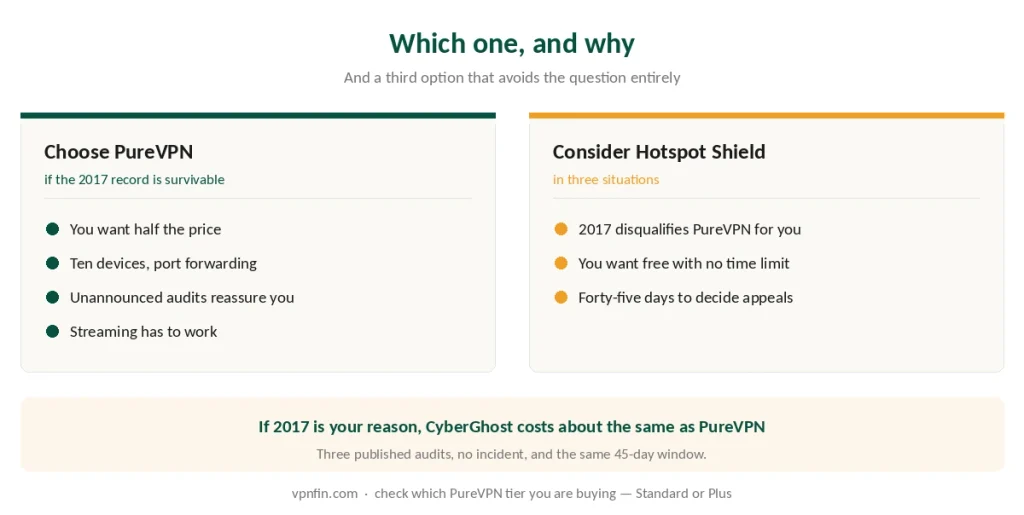
The 2017 incident disqualifies PureVPN for you. That is a legitimate position, and if you hold it, no amount of subsequent auditing changes it.
You want a free VPN with no time limit and accept that location data from free users funds it — our free VPN guide covers which free tiers avoid that.
Forty-five days matters, fourteen more than PureVPN offers.
⚠️ But if the 2017 incident is your reason, note what you are choosing instead: a provider with no independent verification of its own no-logs claim, at roughly twice the price. CyberGhost costs about the same as PureVPN with three published audits and no incident.
How We Research
This comparison draws on our full reviews of both providers, where every figure was verified against named primary sources at the time of writing — contemporaneous reporting on the 2017 FBI case, PureVPN’s published KPMG audit arrangement, Point Wild’s December 2024 merger announcement as carried by the wire services, and each provider’s own pricing terms. We don’t run our own speed tests. Where a provider’s published prices and device limits differ across sources, as Hotspot Shield’s do, we give the range and say plainly that we could not resolve it. Our full approach lives on the About Us page.
PureVPN vs Hotspot Shield FAQ
Yes, in 2017, in a cyberstalking prosecution, while its marketing claimed a no-logs policy. It is documented and it is the worst thing on record about any provider we cover. What followed is also documented: PureVPN moved to an always-on KPMG audit arrangement, in place since 2023, under which the auditor can inspect systems without notice.
No, and it has never been independently examined either. There is no audit of its no-logs policy and no transparency report since 2019. Absence of an incident is worth something, but it is not the same as verification.
PureVPN, by less than half. Its Standard plan renews at $47.95 a year, the gentlest figure among the ten providers we track, coming to roughly $148 across four years. Hotspot Shield lands between $290 and $360.
Yes, as a paid add-on at $0.99 a month rather than included — a distinction many reviews miss. Hotspot Shield does not offer it at all, and neither do most providers we cover.
Standard, which renews at $47.95 a year. The Plus tier renews at $69.95, and most published reviews quote one figure without saying which, so a $22 annual difference disappears into the comparison. Check the tier at checkout rather than trusting any review.
The Verdict
PureVPN takes it, at half the price, with more devices, a better jurisdiction and verification that Hotspot Shield does not have.
Its 2017 incident is the worst thing on record about any provider we cover, and you should weigh it. What followed — permanent KPMG auditing with unannounced inspections — is the strongest response any provider has made to being caught.
Hotspot Shield has no such incident, which is worth something, and no audit either, which is worth less than it sounds.
Choosing it over PureVPN on privacy grounds means preferring an unexamined record to a corrected one, at twice the cost. That is a defensible position and a strange one. Against CyberGhost the same money buys three audits and no incident at all.