
Disclosure: VPNFin is reader-supported. If you buy a VPN through links on this page, we may earn a commission at no extra cost to you. This never affects our ratings — here’s our full disclosure.
Is a VPN legal in Kazakhstan? Yes. Using one is not a crime, and Gizmodo notes that no arrests have been made for VPN use. But the authorities block most VPN and anonymising tools, Freedom House reports. They have confirmed they can block VPNs by court decision or ministry order. Kazakhstan is a clear example of a country where the tool is legal and hard to reach at the same time.
This page explains how blocking works, what research groups found in 2024, and where the legal limits actually sit.
Is a VPN Legal in Kazakhstan? The Short Answer
Using a VPN is legal. No law makes personal VPN use an offence, and we found no reported prosecutions for it.
Blocking is the obstacle. The authorities block most anonymising tools and VPN websites through court decisions and ministry orders, Freedom House notes.
Content rules still apply. Kazakhstan blocks some political and social content, Freedom House reports. A VPN hides your traffic, not what you publish, as our guide to what a VPN hides explains.
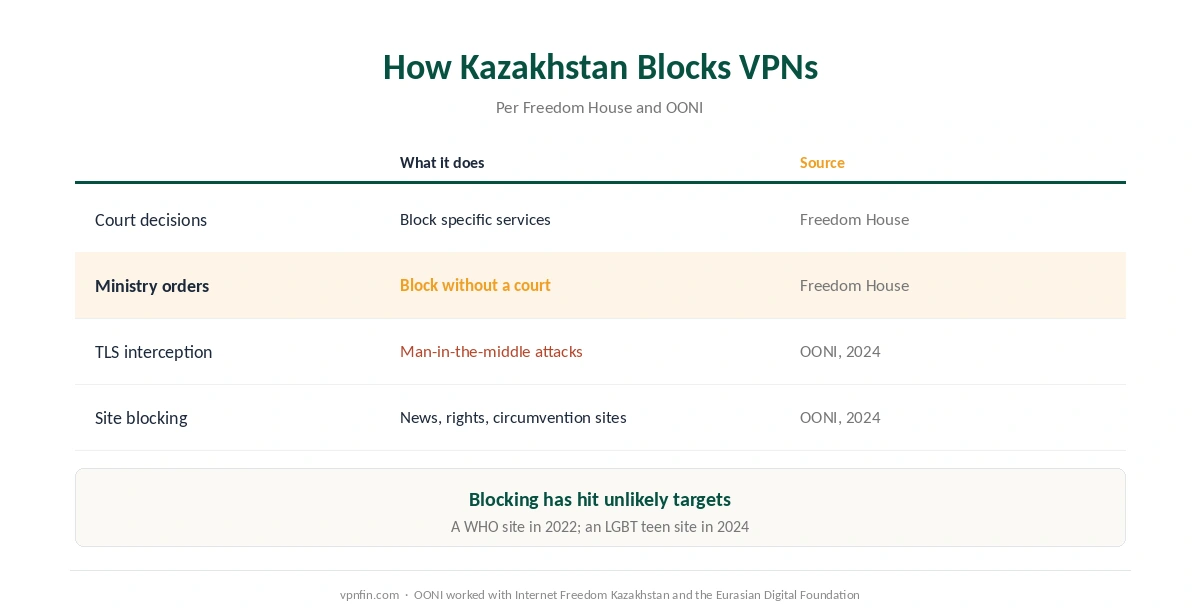
How Kazakhstan Blocks VPNs
| Method | What it does | Source |
|---|---|---|
| Court decisions | Order blocks on specific services | Freedom House |
| Ministry orders | Block sites and tools without a court | Freedom House |
| TLS interception | Man-in-the-middle attacks on encrypted connections | OONI, 2024 |
| Site blocking | News, human rights and circumvention tool sites | OONI, 2024 |
Research groups documented interception. A 2024 study by OONI, Internet Freedom Kazakhstan and the Eurasian Digital Foundation found TLS man-in-the-middle attacks and blocking of news, human rights and circumvention tool sites.
Blocking has hit unlikely targets. Authorities blocked a World Health Organization site in 2022 and a site for LGBT teenagers in February 2024, Freedom House records.
Is a VPN Legal in Kazakhstan if It Is Blocked?
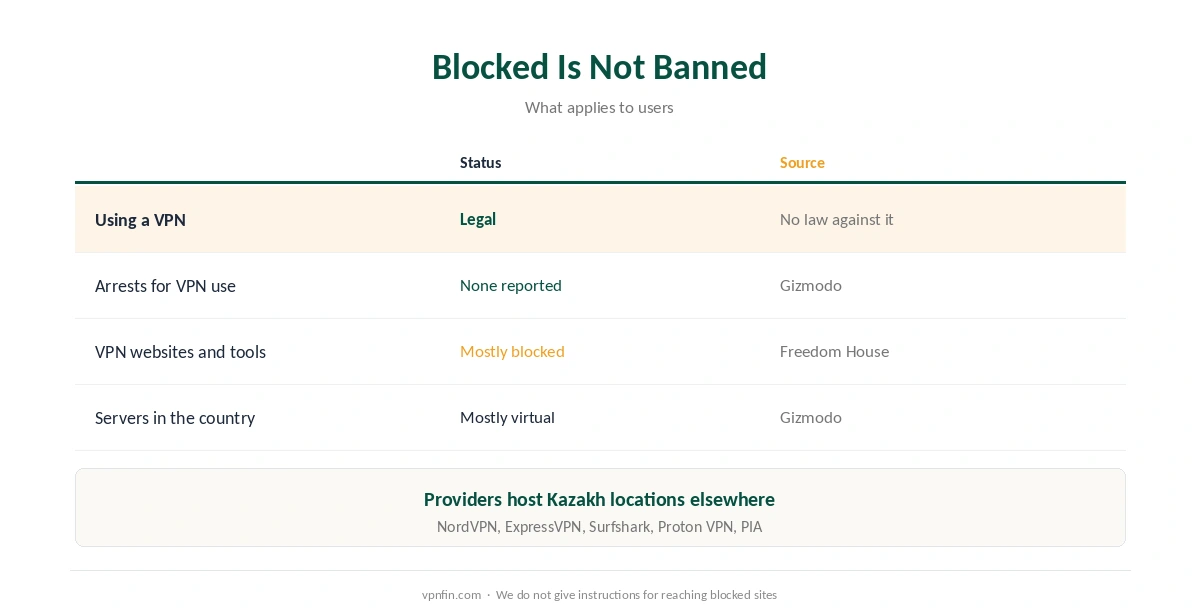
Yes. Blocking and banning are different things. A blocked service is not an illegal one for the user, and Gizmodo reports no arrests for VPN use.
Providers work around the rules on their side. Most VPNs have no physical servers in Kazakhstan; NordVPN, ExpressVPN, Surfshark, Proton VPN and PIA offer virtual Kazakh locations hosted elsewhere, Gizmodo reports. Our NordVPN review covers one of them. NordVPN and Surfshark share a parent, Nord Security.
Everyday uses raise no issue. Work, banking and public Wi-Fi are routine, and we do not give instructions for reaching blocked sites.
What Interception Means for Users
Is a VPN legal in Kazakhstan as a defence against interception? Yes, and encryption is only as good as the connection it runs over. A man-in-the-middle attack tries to insert itself between you and a site, which is why browsers warn about invalid certificates. Heed those warnings rather than clicking through, and run a quick connection check if something looks wrong.
A VPN encrypts the whole connection to its server, so your provider sees the tunnel rather than individual sites. Travellers passing through Central Asia will find our travel guide useful for the practical side.
How Kazakhstan Compares
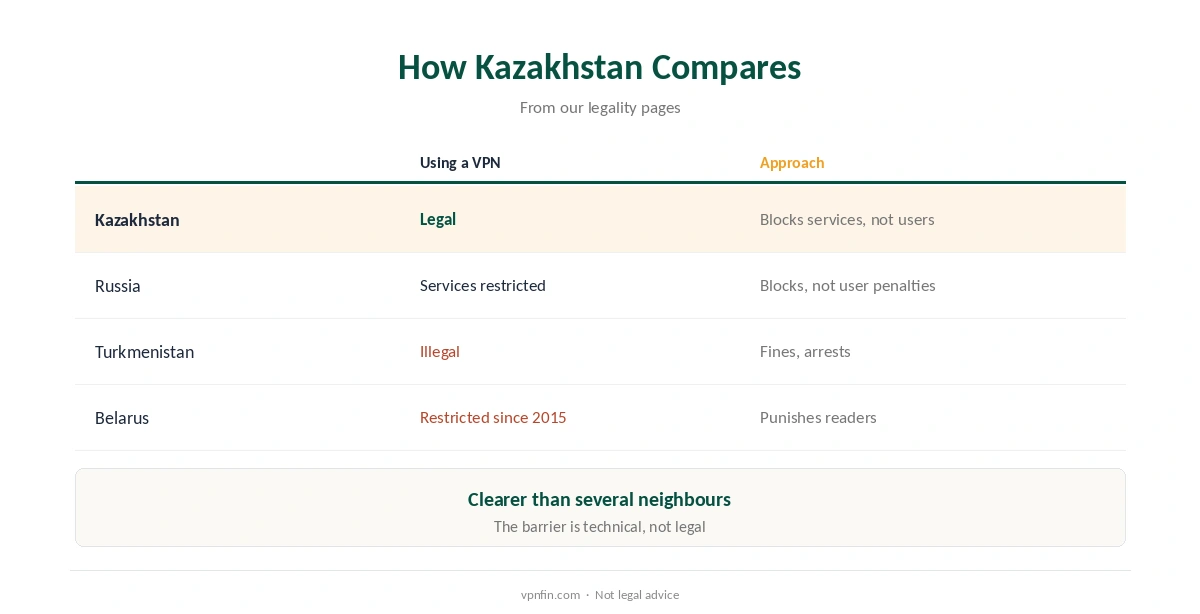
Russia follows a similar model, blocking services rather than punishing users, as our Russia page explains.
Its southern neighbour is far stricter. Turkmenistan fines and arrests VPN users, and Belarus has restricted anonymisers since 2015. So is a VPN legal in Kazakhstan by Central Asian standards? Yes, more clearly than in several neighbours.
For the full picture, our country-by-country guide compares every country, and our no-logs guide explains why a provider’s logging matters where researchers have documented interception.
For practical advice, our VPN for Kazakhstan guide covers what’s blocked and the picks.
How We Research
Blocking powers and examples come from Freedom House’s Freedom on the Net 2024, interception findings from OONI’s 2024 report with Internet Freedom Kazakhstan and the Eurasian Digital Foundation, and the absence of arrests and provider servers from Gizmodo’s 2026 guide. We are not lawyers, and this is not legal advice. We name each source where used; all were read on 27 September 2026. Our full approach lives on the About Us page.
Kazakhstan VPN Legality FAQ
Yes. Using a VPN is not a crime, and Gizmodo reports no arrests for VPN use. The authorities do block most VPN services.
Courts and the ministry responsible for information, which Freedom House says can order blocks without a court decision.
A 2024 OONI study found TLS man-in-the-middle attacks in Kazakhstan, alongside blocking of circumvention tool sites.
Most do not. Major providers offer virtual Kazakh locations hosted in other countries, Gizmodo reports.
Yes. The same rules apply: legal to use, though the authorities block many services.
The Verdict
A VPN is legal in Kazakhstan, and we found no prosecutions of users.
The practical barrier is blocking and documented interception, not the law. Content rules still apply to what you publish.