
Disclosure: VPNFin is reader-supported. If you buy a VPN through links on this page, we may earn a commission at no extra cost to you. This never affects our ratings — here’s our full disclosure.
For a year the coverage ran the same way: a law arrived, Britons downloaded VPNs by the hundred thousand, and something illicit was happening.
The Online Safety Act places duties on services. It does not place any on the person reading this. No provision criminalises installing a VPN, running one, or being in the United Kingdom while connected to a server abroad.
On 15 July 2026 the Technology Secretary said as much in Parliament, ruling out both banning VPNs and requiring age checks to buy one. What she said next is the part worth reading, and almost nobody quoted it.
Is a VPN Legal in the UK?
Yes, entirely. No British law restricts VPN use, and the Online Safety Act regulates the services you visit rather than how you connect to them. In July 2026 ministers confirmed the government would not ban or age-gate VPNs, citing their legitimate privacy uses. Platform terms of service are a separate matter from the law.
What the Act Actually Requires
The law is large and the part people meet is narrow.
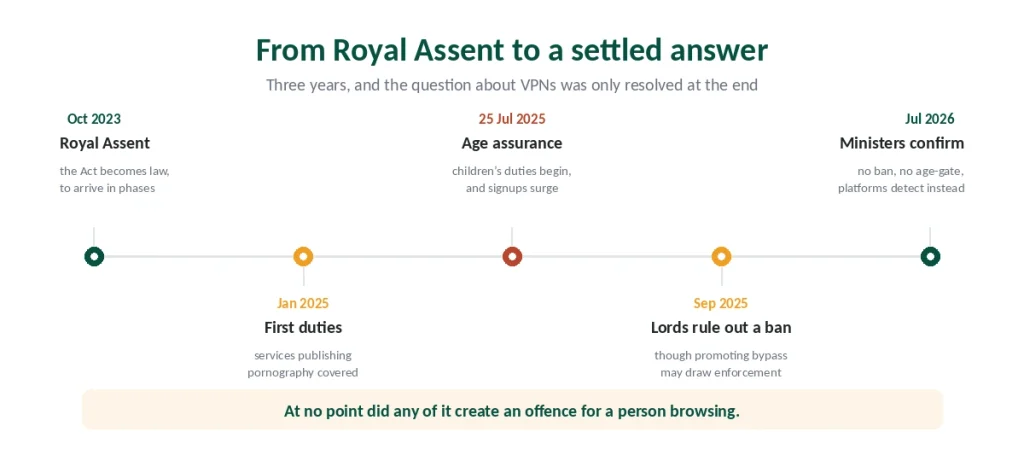
The Online Safety Act received Royal Assent in October 2023 and arrived in phases rather than at once.
Duties for services publishing pornography took effect in January 2025. Ofcom gained full enforcement powers over illegal content duties that March.
The date everyone remembers is 25 July 2025, when the children’s safety duties began. From then, services allowing pornographic content had to use what the regulator calls highly effective age assurance.
The scope reached well past adult sites. Reddit, Discord, X, Spotify and Bluesky all introduced checks for UK users, because the duties cover content categorised as harmful to children rather than one industry.
⚠️ Every one of those obligations lands on the service. Ofcom can fine a non-compliant company up to a tenth of its global revenue. Nothing in the framework creates an offence for a visitor, and the regulator has never suggested otherwise.
What Happened That Weekend
The reaction was immediate, measurable and self-reported by an interested party — which is worth saying plainly.
Proton VPN announced that UK signups rose more than 1,400% within hours of the duties taking effect, and described the surge as sustained rather than a spike.
VPN apps reached the top of the UK app charts over the following days.
⚠️ That figure comes from a VPN company’s own announcement, published on its own channels, about its own product. We report it because it is the only public measurement anyone has offered and because the direction is corroborated by app-chart positions. Treat the precision accordingly.
A petition to repeal the age-verification requirement passed the threshold for parliamentary debate within days, gathering well over the hundred thousand signatures needed.
Parliament Answered the Question Out Loud
Through early 2026 an obvious-sounding proposal circulated: if people are using VPNs to skip age checks, put age checks on VPNs.
The Lords signalled the direction first. In September 2025 a government spokesman told the chamber that services promoting VPNs as a way around age checks could face enforcement, while ruling out any ban on the apps themselves.
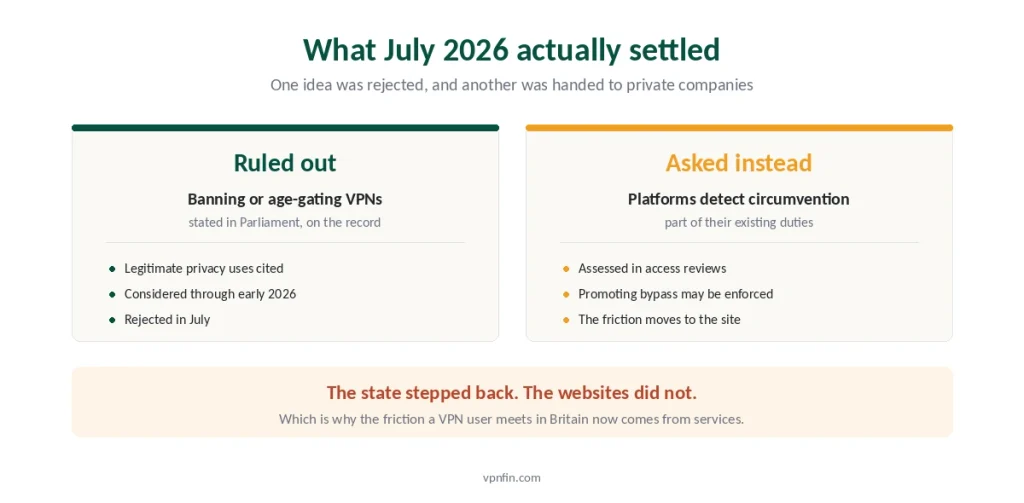
The Technology Secretary settled it on 15 July 2026, telling Parliament that VPNs have legitimate privacy and security uses and that the government would therefore not age-gate or ban them.
The reasoning is practical as much as principled. VPN traffic hides inside ordinary encrypted web traffic on the same port every website uses, protocols run on whatever port an operator chooses, and anyone with a few pounds a month can run a private server with a user base of one. There is no storefront to age-gate.
⚠️ So the legal position is settled and favourable. What is not settled is what platforms do about it, and that is where the pressure went instead.
What Replaced the Ban
This is the sentence that matters, and it arrived in the same statement.
Platforms are now expected to detect and prevent circumvention themselves. Providers already have to assess circumvention risk as part of their children’s access assessments.
Which relocates the whole question. The state is not going to stop you connecting through Amsterdam. The service you are visiting may decide that a connection from a known VPN address deserves different treatment.
That has consequences beyond adult content. Any platform building VPN detection to satisfy one duty ends up applying it to every user, including people using a VPN on a café network for reasons nobody has ever disputed — which is most of what a VPN is genuinely for.
⚠️ We are not going to write instructions for defeating age assurance, here or anywhere. The measures exist to keep children away from adult material, that is a reasonable aim, and platform terms may prohibit circumvention regardless of what the law says. This page explains a legal position; it does not offer a method.
The Numbers Contradict the Headline
Ofcom published its first statutory report on age assurance on 16 July 2026, and it complicates the story the coverage told.
More than 69 million age checks were completed in the second half of 2025 across a sample of thirty-two regulated pornography, dating and social media services. That is roughly twenty-three times the preceding six months.
An industry body reported an additional five million checks daily after the duties began.
Both things are true at once. A large number of people reached for a VPN, and a far larger number simply completed the check. The narrative of a nation routing around a law does not survive the arithmetic.
The Loop Nobody Closes
Worth stating, because it explains the surge better than defiance does.
Age assurance requires proof. In practice that means a government document, a card, or a facial estimate handed to a third-party verifier.
Those verifiers now hold new databases of exactly the material people are most careful with, and published analysis notes such records may be reachable under existing investigatory powers legislation.
So a measure aimed at protecting children created a fresh identity-data risk for adults, and a meaningful share of adults responded by trying to avoid creating the record at all.
⚠️ Which is why the privacy argument for a VPN in the UK has never been about adult content. What a VPN actually hides is narrow — your provider sees what your ISP used to — so the provider’s own record is the thing that matters. Proton VPN publishes five annual audits in full and NordVPN runs servers that retain nothing between reboots. Free services are the wrong answer to a privacy question by definition, and only three free tiers are worth trusting anywhere.
| Country | What the rule aims at | Reaches the user? |
|---|---|---|
| Turkey | The tunnel — ISPs must block | No |
| The UAE | Conduct behind an address | No |
| India | The provider's records | Not nationally |
| China | Provider, tunnel and user | Yes |
| Brazil | Nothing, until a court acts | For 39 days |
| Indonesia | Paperwork — registration | No |
| The UK | The destination you visit | No, and ministers said so |
| The US | The platform, state by state | No, in all twenty-seven |
| Russia | The search, not the tool | Only if you went looking |
| Australia | The platform, and the tunnel itself | No — platforms must detect it |
| France | The VPN provider itself | No, the orders bind five companies |
| Italy | The provider, by regulator order | No, but one VPN left the market |
| Spain | The provider, by injunction without a hearing | No, and only two firms were named |
| Germany | The provider's logfile, for three months | No, and the courts twice removed it |
How the UK Compares
Across the frameworks in this series, the British one is the first where a government answered the question directly.
Turkey regulates the tunnel. Internet providers must block VPN services, so reaching one is the obstacle.
The UAE regulates conduct. The statute never names VPNs; it reaches what you do behind a masked address.
India regulates records. Five years of subscriber data, which emptied the country of physical hardware.
China regulates all three, and names a figure for the individual.
Brazil regulates nothing until a court acts, and then fined users directly for thirty-nine days.
Indonesia regulates paperwork, withdrawing access from services that miss a filing.
The UK regulates the destination and says so. A minister stood up and ruled out restricting the tool, which no other government in this set has done. Britain also asked private companies to do the restricting instead, and Australia went further and named the countermeasure. Our wider legality guide covers why the legal-or-illegal framing answers this question badly nearly everywhere.
Britain settled the question out loud in July 2026. A minister told Parliament the government would not age-gate or ban VPNs, and put the duty to detect circumvention on the platforms instead — what that changed, and the surge that prompted it.
France went further still, where courts ordered five named VPN companies to block domains themselves. Our wider legality guide covers why the legal-or-illegal framing answers this question badly nearly everywhere.
Britain’s own restriction runs through a broadcaster rather than a court. BBC iPlayer blocks by address while the licence follows the person, so a licence-holder abroad is entitled to the programme and refused by the system at the same time.
And if you are wondering whether you need one at all, that is a fair question with an honest answer — we work through it without a sales pitch.
How We Research
This page draws on the published implementation timetable for the Online Safety Act, Ofcom’s first statutory report on age assurance dated 16 July 2026, the Technology Secretary’s statement to Parliament on 15 July 2026 and the earlier House of Lords exchange in September 2025, contemporaneous reporting on the July 2025 commencement, and Proton VPN’s own announcement of its UK signup figures. Where a measurement comes from a company with a commercial interest in the story, as the 1,400% figure does, we attribute it and say so rather than presenting it as independent. We are not lawyers and this is not legal advice. We do not publish methods for defeating age assurance. Our full approach lives on the About Us page.
UK VPN Legality FAQ
No. No British law restricts VPN use, and the Online Safety Act places its duties on services rather than on the people visiting them. In July 2026 the Technology Secretary told Parliament the government would not ban VPNs or require age checks to buy one, citing their legitimate privacy and security uses.
The government has ruled it out. Ministers considered the idea through early 2026 and rejected it in July, and the House of Lords had signalled the same position the previous September. Enforcement pressure moved to platforms instead, which are now expected to detect circumvention themselves.
Services allowing pornographic content must use highly effective age assurance, a duty that took effect on 25 July 2025. The scope extends to platforms hosting other content categorised as harmful to children. Ofcom enforces it and can fine companies up to ten percent of global revenue.
No, though a lot of people did. Proton VPN reported UK signups rising more than 1,400%, a figure from the company itself. Meanwhile Ofcom recorded more than 69 million age checks completed across thirty-two services in the second half of 2025, roughly twenty-three times the previous period.
Yes, and this is now the practical constraint rather than the law. Platforms are expected to assess and prevent circumvention as part of their duties, so services increasingly treat known VPN addresses differently. Their terms of service also bind you independently of what the legislation says.
The Verdict
Using a VPN in the UK is legal, and the position is now on the parliamentary record. In July 2026 the government ruled out banning VPNs or requiring age checks to buy one, citing their legitimate privacy and security uses.
The Online Safety Act never addressed users. Its duties fall on services, enforced by Ofcom with fines reaching a tenth of global revenue. Nothing in it creates an offence for a visitor.
What changed instead is who does the enforcing. Platforms are expected to detect and prevent circumvention themselves, which means the friction a VPN user meets in Britain will come from websites rather than from the state.
And the honest reading of the surge is not defiance. Sixty-nine million age checks were completed in six months. A significant minority preferred not to hand over identity documents, which is a privacy decision rather than a legal one — and it was always lawful to make it.