
Disclosure: VPNFin is reader-supported. If you buy a VPN through links on this page, we may earn a commission at no extra cost to you. This never affects our ratings — here’s how we research.
Most VPN comparisons end in a shrug because the products are similar. This one doesn’t. NordVPN loses 2.9% of your connection speed in independent testing; CyberGhost loses 31 to 38%. CyberGhost renews at $56.94 a year; NordVPN at $139.08. That is a tenfold difference in one direction and an $82 annual difference in the other, and this NordVPN vs CyberGhost comparison is about which trade-off suits you.
The Short Answer
NordVPN if speed matters. It is not slightly faster — it is an order of magnitude faster in like-for-like testing, and it has twice the no-logs audits.
CyberGhost if price matters. It costs $82 less every year, gives you 45 days to change your mind instead of 30, and runs more servers than NordVPN does.
On privacy, it’s closer than you’d expect. Panama and Romania both sit outside every intelligence-sharing arrangement.
Head to Head
| NordVPN | CyberGhost | |
|---|---|---|
| Speed loss | 2.9% | 31–38% |
| No-logs audits | 6 | 3 |
| Jurisdiction | Panama | Romania |
| Servers | ~9,500 | ~11,500 |
| Countries | ~150 | 100 |
| Devices | 10 | 7 (router = 1) |
| Renewal | $139.08/yr | $56.94/yr |
| Refund window | 30 days | 45 days |
| No-card trial | No | 24 hrs desktop |
| Our rating | 4.8 | 4.3 |
Speed: The Widest Gap We’ve Measured
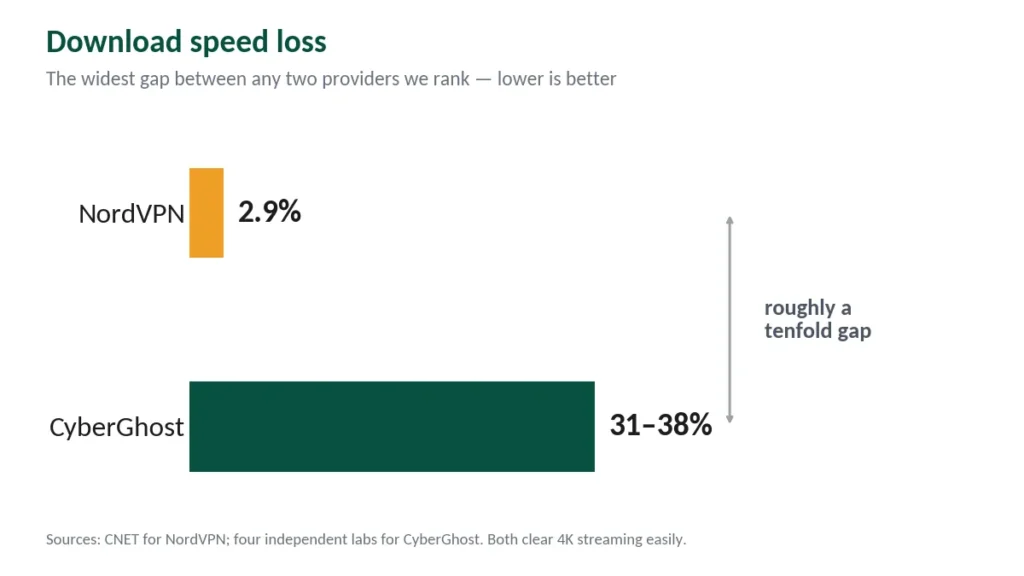
CNET recorded a 2.9% average download loss for NordVPN — the best result in their lineup. Independent testers put CyberGhost between 31% and 38%, with the gap widening on long-distance routes.
That is roughly a tenfold difference, and it is the largest we have found between any two providers we rank.
| Provider | Speed loss | Source |
|---|---|---|
| NordVPN | 2.9% | CNET |
| Surfshark | 21% | CNET |
| ExpressVPN | 18% | CNET |
| CyberGhost | 31–38% | independent labs |
| PureVPN | 12–67% | four labs, varies by server |
| Proton VPN | 16% | CNET |
What it means in practice depends entirely on what you do. Streaming 4K needs 15 to 25 Mbps depending on platform, and both clear that comfortably on any normal connection — a 34% loss on a 300 Mbps line still leaves around 200. You will not notice the difference watching anything.
Where you will notice it: large file transfers, competitive gaming, and torrenting, where a percentage becomes hours. If you pay for gigabit fibre specifically to use it, CyberGhost gives back a third of what you bought.
Winner: NordVPN, decisively.
Price: The Gap Runs the Other Way
Intro pricing looks similar — roughly $3.09–3.49 a month for NordVPN Basic against $2.19 for CyberGhost. Then the first term ends.
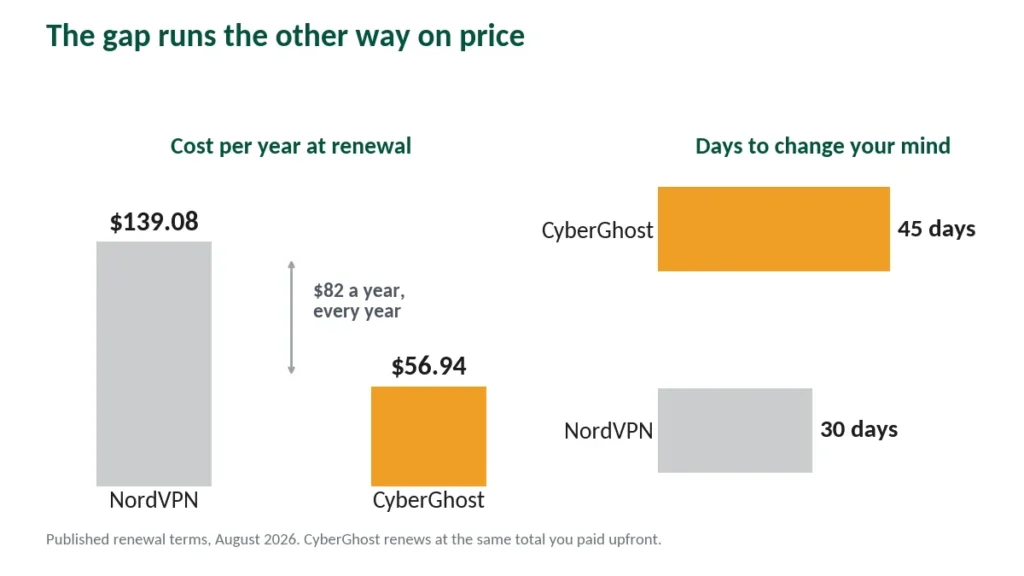
NordVPN renews at $139.08 a year, about $11.59 a month, per its own checkout small print.
CyberGhost renews at $56.94 a year — and unusually, that is the same total you paid upfront, simply charged annually instead of biennially. No other major provider does this.
That is $82 a year, every year. Over four years the difference compounds to roughly $176 — more than the entire four-year cost of CyberGhost, as our cheap VPN guide sets out in full.
CyberGhost also gives 45 days to request a refund against NordVPN’s 30, and a genuine 24-hour desktop trial with no payment card at all — the only one among the providers we rank.
Winner: CyberGhost, decisively.
Privacy: Closer Than the Ratings Suggest
This is where the comparison stops being one-sided.
NordVPN has six no-logs audits — two by PricewaterhouseCoopers in 2018 and 2020, four by Deloitte through the end of 2025. The most recent ran from 10 November to 12 December 2025 and covered standard, Double VPN, Onion Over VPN and obfuscated servers.
CyberGhost has three, all by Deloitte Audit Romania, in 2022, 2024 and 2025, the latest under the ISAE 3000 (Revised) standard.
Six against three favours NordVPN. But three is more than Surfshark’s two, and CyberGhost publishes quarterly transparency reports with actual numbers — 105,332 DMCA complaints and three police requests in the first quarter of 2025, none complied with.
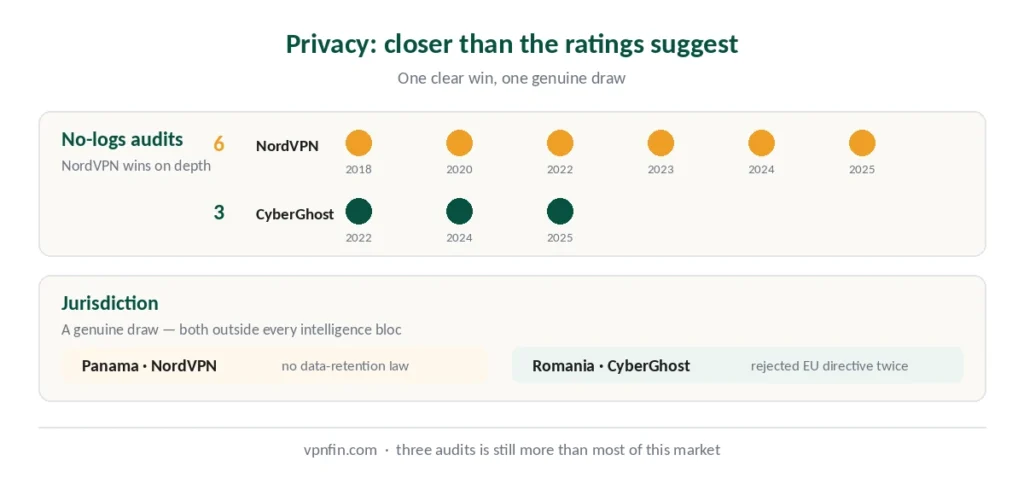
Jurisdiction is a genuine draw. NordVPN operates from Panama, CyberGhost from Romania. Both sit outside the 5, 9 and 14 Eyes arrangements, and Romania rejected the EU Data Retention Directive twice. Neither has a data-retention obligation.
Winner: NordVPN on audit depth, draw on jurisdiction.
Devices and Network
NordVPN allows 10 simultaneous connections, CyberGhost 7 — the lowest among major providers.
But there is a detail that changes the arithmetic: a CyberGhost router connection counts as one device, and everything behind that router is covered. With a VPN-capable router, one slot handles your entire home network, leaving six for phones and laptops that travel.
On network size the result is counterintuitive: CyberGhost runs more servers, roughly 11,500 against NordVPN’s approximately 9,500. NordVPN covers more countries — around 150 against 100 — so the two networks are built differently rather than one being simply larger.
Features Where They Diverge
NordVPN’s specialty servers have no CyberGhost equivalent: Double VPN routes traffic through two servers, Onion Over VPN combines with Tor, and Meshnet links up to 60 of your own devices privately. Threat Protection Pro blocks malware, though only from the Plus tier upward.
CyberGhost’s answer is simplicity. Servers are labelled by platform — you pick Netflix, Disney+ or BBC iPlayer from a menu rather than guessing which city works. NoSpy servers sit in its own Romanian data centre with staff-only physical access, unusual at this price.
What CyberGhost lacks: multi-hop routing, port forwarding, and a malware blocker in the standard plan. Neither provider offers port forwarding, which our torrenting guide covers as a deciding factor for seeders.
Which Should You Buy?
Buy NordVPN if you have fast internet and intend to use it, you transfer large files, you game competitively, or you want the deepest audit record available. Ten devices covers most households.
Buy CyberGhost if price is the deciding factor, you mainly stream and browse, you have a VPN-capable router, or you want the longest possible window to test before committing.
The honest framing: you are choosing between paying $82 a year for speed you may not need, or saving it and accepting a slower connection you probably won’t notice. Only you know which side of that you’re on.
How We Research
This comparison draws on our full reviews of both providers, published audit announcements from PwC and Deloitte, quarterly transparency reports, speed results from named independent labs including CNET, and renewal figures taken from each provider’s own checkout terms — cross-checked and verified at publication. Where sources conflicted, notably on CyberGhost’s server count, we say so rather than picking a convenient number. Our full approach lives on the About Us page.
NordVPN vs CyberGhost FAQ
NordVPN, by roughly ten times. CNET measured a 2.9% average download loss for NordVPN; independent testers put CyberGhost between 31% and 38%. That said, both clear what 4K streaming needs many times over — the difference shows on large transfers, gaming and torrenting rather than video.
CyberGhost, by $82 a year at renewal — $56.94 against NordVPN’s $139.08. CyberGhost is also unusual in renewing at the same total you paid upfront rather than increasing, which no other major provider does. Over four years the difference compounds to roughly $176.
Less than it appears, because a router connection counts as a single device and everything behind it is covered. With a VPN-capable router, one slot handles your whole home network. Without one, seven is tight — two people with a phone and laptop each, plus a tablet and a TV, uses all of them.
NordVPN on audit depth, with six no-logs audits against CyberGhost’s three. On jurisdiction it is a draw: Panama and Romania both sit outside the 5, 9 and 14 Eyes arrangements, and neither imposes data retention on VPN providers. CyberGhost additionally publishes quarterly transparency reports with actual request numbers.
CyberGhost, with roughly 11,500 against NordVPN’s approximately 9,500 — though NordVPN covers more countries, around 150 against 100. The networks are built differently: CyberGhost concentrates more servers in fewer places, NordVPN spreads them wider.
CyberGhost offers a genuine 24-hour desktop trial with no payment card required, the only one among the providers we rank. NordVPN does not, but both carry money-back guarantees — 30 days for NordVPN and 45 for CyberGhost’s six-month and two-year plans.
The Verdict
NordVPN takes it overall and ranks first in our top 5. A tenfold speed advantage and twice the audit record are not small margins, and nothing CyberGhost offers closes them.
But CyberGhost wins the argument that matters to more people than admit it. Most of us do not use the bandwidth we pay for. If your evenings are streaming and browsing, you are paying $82 a year for headroom you never touch — and getting 15 extra days to decide, plus a trial that needs no card.
Full detail in our NordVPN review and our CyberGhost review.