
Disclosure: VPNFin is reader-supported. If you buy a VPN through links on this page, we may earn a commission at no extra cost to you. This never affects our ratings — here’s how we research.
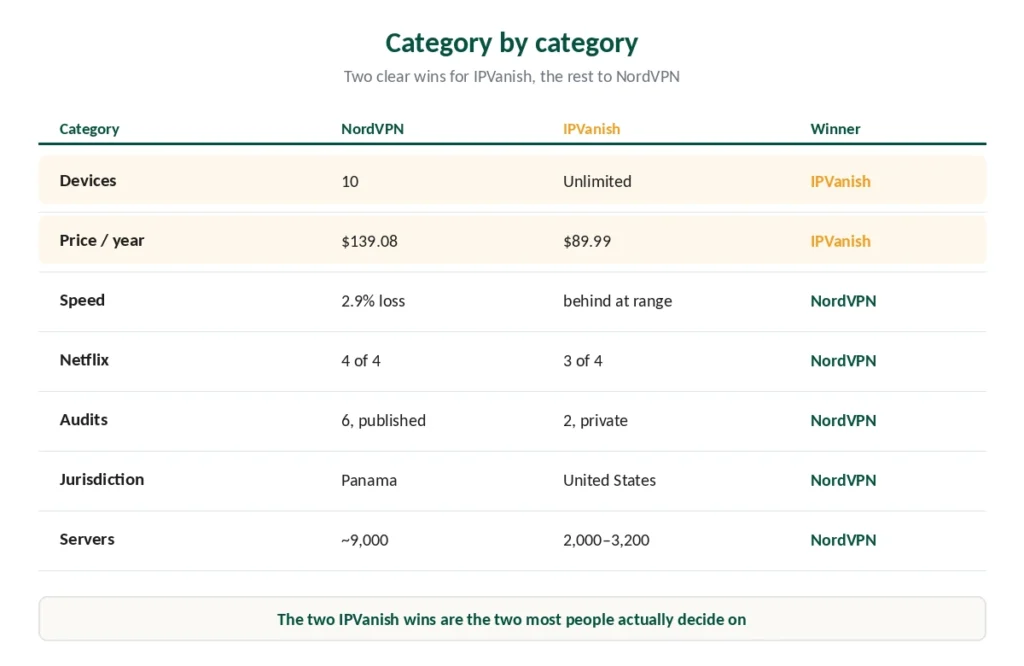
This comparison has an unusually clean shape. IPVanish wins two categories decisively — device count and price. NordVPN wins the rest.
Whether that makes IPVanish the wrong choice depends entirely on how many devices you own and how far your servers are from you.
We cover both in full separately: our NordVPN review and our IPVanish review. This page puts them against each other.
The Short Answer
Choose IPVanish if you’re covering more devices than any tiered plan allows, or if $16 a year on the first term — and $49 a year after — settles it.
Choose NordVPN if you connect to distant servers, care about Netflix libraries beyond your own country, or want audits you can actually read.
The one-line version: IPVanish is a defensible buy, NordVPN is the better product.
Devices: IPVanish, Without Argument
NordVPN allows 10 simultaneous connections. IPVanish allows unlimited, on every plan including the cheapest.
Count your household honestly. Two phones, two laptops, a tablet, a smart TV, a console and a streaming stick is seven before anyone visits. Add a partner’s devices and ten stops being generous.
The arithmetic that follows: IPVanish at $89.99 a year covering fifteen devices costs $6 per device. NordVPN at $139.08 covering ten costs $13.90.
⚠️ The counter-argument: a router counts as one connection with either provider, which collapses the difference entirely if you set one up.
Winner: IPVanish.
Speed: NordVPN, and the Gap Grows With Distance
Published testing from May 2026 measured both across three days on UK, US and Japanese servers using each provider’s fastest protocol.
IPVanish won one measurement — upload speed on the UK server.
NordVPN led everywhere else, and the margin widened with distance. On the Japanese server the gap reached 44 Mbps.
Separately, CNET’s testing placed NordVPN at 2.9% average download loss across its lineup, the best result recorded. IPVanish doesn’t appear in that round.
What this means practically. On a nearby server both are fast enough for anything. Connect to a server on another continent and NordVPN pulls clearly ahead — which is exactly when a VPN’s speed matters most, since you’re usually reaching across distance for a reason.
Winner: NordVPN, with the caveat that IPVanish stays quick enough for streaming and gaming close to home.
Streaming: A Concrete Difference
Most comparisons state that both work with Netflix. Published testing found otherwise.
NordVPN unblocked four Netflix libraries — US, UK, Germany and Japan — for a 100% success rate across the platforms tested.
IPVanish managed three, failing on Netflix US. It also failed to unblock Prime Video, giving a 75% overall rate in the same round.
⚠️ Netflix US is the library people actually want. It’s the largest, and it’s the one most reviews assume works.
Beyond Netflix, published sources credit NordVPN with reliable access to roughly twenty regional libraries against a narrower set for IPVanish. Neither provider labels servers by platform the way CyberGhost does.
Winner: NordVPN, and this is the gap most likely to affect you day to day.
Privacy: Six Public Audits Against Two Private Ones
Both have audited no-logs policies. The difference is in what you can verify.
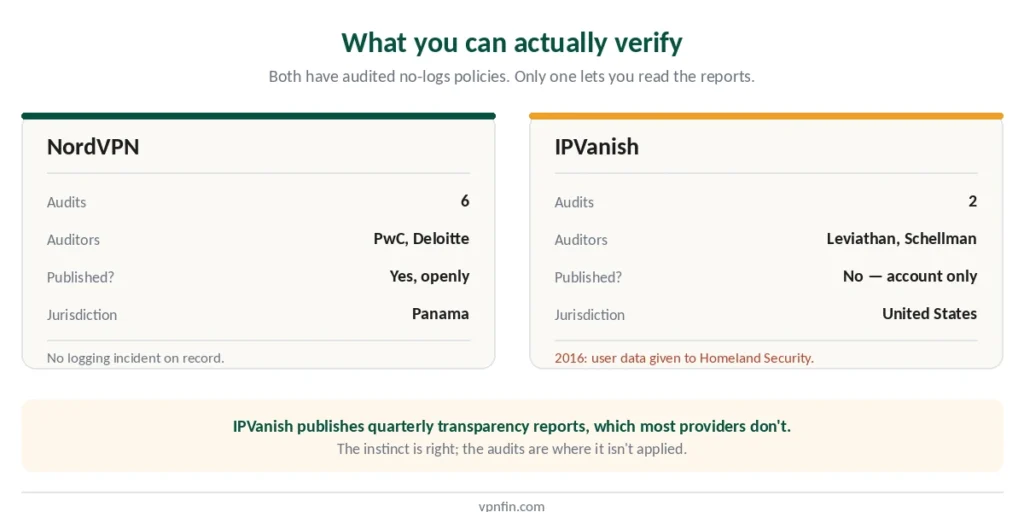
NordVPN: six independent no-logs audits by PwC and Deloitte, with summaries published openly. Panama jurisdiction, outside every intelligence-sharing arrangement, with no mandatory data retention.
IPVanish: two audits — Leviathan Security Group in 2022 and Schellman Compliance in February 2025 — both examining infrastructure rather than interviewing staff. Neither report is published. Access requires a paid account or an email request.
And the history differs. IPVanish handed the Department of Homeland Security a user’s real identity and connection timestamps in 2016, under previous ownership, while advertising a no-logs policy. NordVPN has no comparable incident.
⚠️ IPVanish does publish quarterly transparency reports, which most providers don’t. That’s the right instinct applied unevenly.
Winner: NordVPN, on jurisdiction, audit count and transparency alike.
Features: Closer Than Expected
NordVPN carries more: Threat Protection Pro for blocking ads and malicious domains, specialty servers for P2P and obfuscation, Meshnet for device-to-device links, Dark Web Monitoring, and post-quantum encryption on its newer builds.
IPVanish carries fewer, but one is better. Published comparison found IPVanish’s Double Hop implementation more configurable than NordVPN’s Double VPN — you get more control over the route rather than a preset pair of countries. Our double VPN guide explains what that routing actually does.
Both include: WireGuard, OpenVPN, IKEv2, kill switch, split tunnelling. IPVanish adds a SOCKS5 proxy.
On network size, IPVanish’s own figures are hard to pin down — published sources cite anywhere from 2,000 to 3,200 servers across 75 to 113 countries. NordVPN’s roughly 9,000 servers across nearly 150 countries is both larger and more consistently reported.
Winner: NordVPN on breadth, IPVanish on one specific tool.
Price: IPVanish, on Both Terms
First term: IPVanish runs about $3.33 a month on the annual plan against NordVPN’s $4.49 — roughly $43.54 versus $59.88 for the year.
Renewal: IPVanish renews at $89.99 a year. NordVPN renews at $139.08.
Across four years: the gap compounds to roughly $150 in IPVanish’s favour — our cheap VPN guide sets out how renewal pricing changes every ranking in this category.
⚠️ Refund terms differ in a detail worth knowing. Both offer 30 days, but IPVanish excludes monthly plans from that entirely. NordVPN’s applies regardless of term.
Winner: IPVanish, clearly and on every measure.
Which Should You Buy?
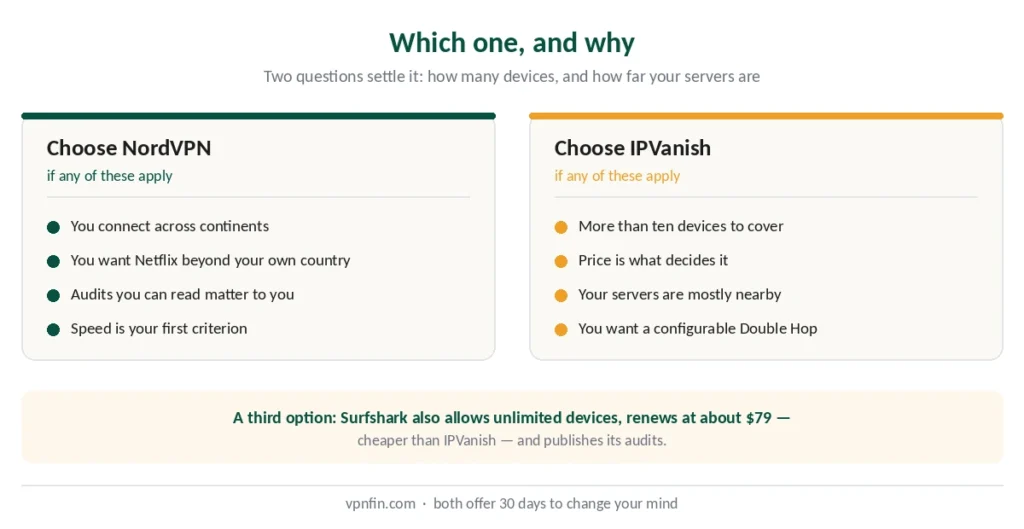
IPVanish makes sense if your device count exceeds ten, price is the deciding factor, and you connect mostly to nearby servers.
NordVPN makes sense if you stream from libraries outside your own country, connect across continents, or want a provider whose verification you can read without buying a subscription first.
And there’s a third option worth naming. Surfshark also allows unlimited devices, renews at roughly $79 — cheaper than IPVanish — and publishes its audits. If the device count is what brought you here, it deserves a look before you decide. We compare it against NordVPN directly. We put those two against each other here.
How We Research
This comparison draws on published testing from named sources including Gizmodo, TheBestVPN, CyberInsider, VPNpro and CNET, alongside our own full reviews of both providers — cross-checked and verified at publication. We don’t run our own speed tests. Where sources disagreed — notably on IPVanish’s server count, where figures range from 2,000 to 3,200 — we’ve given the range rather than picking one. Our full approach lives on the About Us page.
NordVPN vs IPVanish FAQ
On most measures, yes. NordVPN leads on speed over distance, Netflix library access, audit transparency and jurisdiction. IPVanish wins on device count — unlimited against NordVPN’s 10 — and on price, at $89.99 a year against $139.08. Which matters more depends on your household size and how far your servers are.
NordVPN, and the gap widens with distance. Published testing in May 2026 found IPVanish ahead on one measurement — upload speed on a UK server — while NordVPN led everywhere else, reaching a 44 Mbps advantage on a Japanese server. Both are fast enough for streaming on nearby servers.
Partially. Published testing unblocked three of four Netflix libraries with IPVanish, failing specifically on Netflix US — the largest catalogue and the one most people want. NordVPN unblocked all four tested. IPVanish also failed on Prime Video in the same round.
IPVanish allows unlimited simultaneous connections on every plan. NordVPN caps at 10. If you’re covering a large household, that’s IPVanish’s strongest argument. Note that configuring either provider on a router counts as a single connection, which removes the difference entirely.
NordVPN. Six independent no-logs audits with published summaries, Panama jurisdiction outside every intelligence-sharing arrangement, and no logging incidents on record. IPVanish has two audits that examined infrastructure properly, but doesn’t publish either report, operates from the United States, and handed user data to Homeland Security in 2016 under previous ownership.
Yes, on both the first term and renewal. The annual plan runs about $43.54 for the first year against NordVPN’s $59.88, and renews at $89.99 against $139.08. Across four years the difference compounds to roughly $150. Surfshark renews cheaper still at around $79, also with unlimited devices.
The Short Version
IPVanish wins devices and price, and neither win is marginal. Unlimited connections at $89.99 a year is the best device-per-dollar figure in this category.
NordVPN wins speed, streaming, privacy and breadth. The speed gap grows with distance, and the Netflix gap is concrete — four libraries against three, with the American one the failure.
The deciding question: do you connect near or far, and how many devices are you covering? Those two answers settle it.